09-10-2026
The United Nations said it was monitoring France’s nationwide high school student protests with concern as demonstrations entered their fifth consecutive day. UN human rights agency spokesperson Shabia Mantoo said some incidents involving protests and school blockades had turned violent. France’s Education Ministry reported that 141 of the country’s 3,700 high schools were closed on Friday. Since mid-September, nearly 7,000 people—86% of them minors—have been taken into police custody, according to the Justice Ministry.
Students, mostly aged 15 to 18, are protesting teacher shortages, crowded timetables, deteriorating facilities and school buildings that are poorly equipped to cope with rising temperatures. Although most demonstrations have been peaceful, some protesters have started fires and vandalised bus shelters. Police have used tear gas, batons and blast balls, leading human rights groups and students to accuse officers of excessive force. Authorities have opened 18 internal investigations into alleged police misconduct.
The government has announced measures in response to the students’ demands. Education Minister Edouard Geffray said about 3,000 substitute teachers would be deployed in the coming days to address shortages at the 114 high schools most affected by protests. Prime Minister Sebastien Lecornu pledged to present a plan addressing the crisis by the end of October. Economy Minister Roland Lescure said additional school funding could be accommodated despite constraints on the 2027 budget. The draft budget proposes a 1.4% increase in education spending, to €90.9 billion—the second-largest funding increase after defence.
Student union representative Marius Mesnil dismissed the government’s offers as “a few crumbs” and called for another wave of demonstrations on Tuesday.
Entities: United Nations (UN), France, Shabia Mantoo, French high school student protests, French Education Ministry • Tone: analytical • Sentiment: negative • Intent: inform
09-10-2026
Fox News Digital frames France’s student protests as more than a dispute over overcrowded, understaffed, and poorly equipped schools. The article alleges that far-left and communist organizations, labor unions, political parties, and international media are using the demonstrations to advance wider ideological goals and amplify unrest internationally. It highlights BreakThrough News, describing it as a pro-communist outlet based in New York and saying it is funded by Shanghai-based tech entrepreneur Neville Roy Singham, whom it links to a broader network of left-wing organizations in the United States.
The article says Fox’s review of news coverage, social-media posts, and public statements identified 50 organizations involved in or supporting the protest movement. Of these, it counts 15 student or youth groups and 35 adult organizations, including labor unions, communist or socialist groups, civil-rights organizations, political parties, and Palestinian advocacy. It argues that the range of participants turns a domestic education dispute into a platform for broader arguments about capitalism, austerity, policing, military spending, and Israel.
The article quotes Heritage Foundation fellow Mike Gonzalez, who compares the network to left-wing coalitions he says have disrupted infrastructure and institutions in the United States. Its framing is strongly critical of the protest movement’s adult organizers and international supporters, emphasizing their political affiliations and organizational connections. The supplied article text ends during Gonzalez’s quotation, so it does not include the remainder of his comments or the full investigation.
Entities: BreakThrough News, Neville Roy Singham, Mike Gonzalez, Fox News Digital, France • Tone: analytical • Sentiment: negative • Intent: critique
09-10-2026
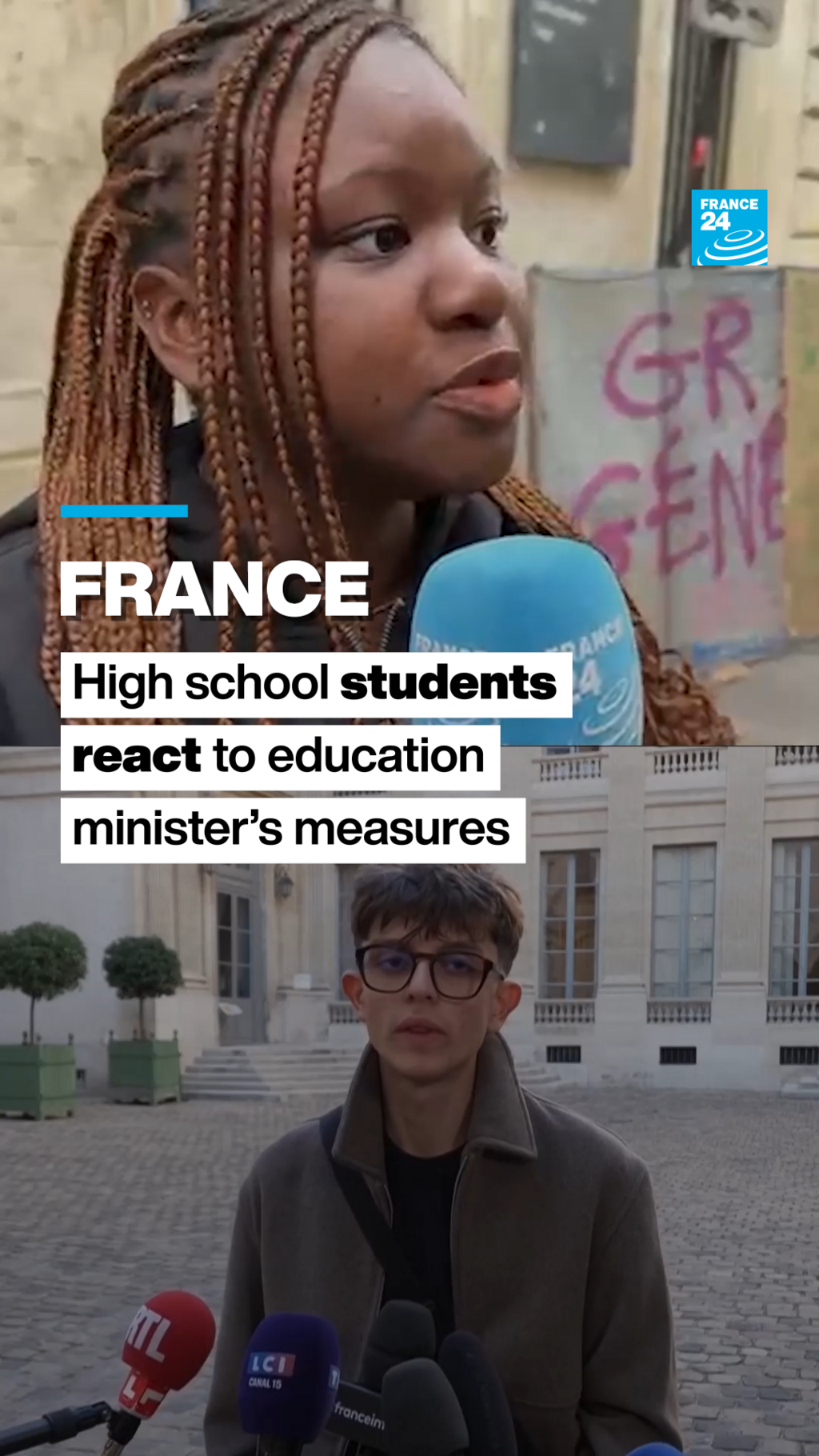
France 24 reports that high school students in France were interviewed about emergency measures announced by Education Minister Édouard Geffray on Thursday, October 8, 2026. The announcement came in response to what the article describes as massive high school student protests. The video, which runs for 1 minute and 39 seconds, presents some students’ reactions to the measures. However, the supplied article text does not include the students’ comments or explain the measures themselves, so their views and the substance of the minister’s response cannot be determined from this page text alone.
The report is dated October 9, 2026, and credits video journalist Ava Luquet. Its keywords are France, education, and protest. Headlines displayed alongside the article point to wider developments around the demonstrations, including a government promise of 3,000 additional teachers, demands for better learning conditions, arrests, and the suspension of stun grenade use at school protests. These are related headlines, not details established in the article’s brief description.
Overall, the item is a short news-video introduction focused on student reactions to a government response amid protests. It signals the connection between the minister’s emergency measures and the demonstrations, but provides no information in the supplied text about whether students welcomed, rejected, or otherwise assessed those measures. The page also contains website and video-player notices, which are not part of the report’s substantive content.
Entities: Édouard Geffray, Ava Luquet, France, France 24, French high school students • Tone: neutral • Sentiment: neutral • Intent: inform
09-10-2026
French high school students say they will continue protesting over poor school conditions, despite a government assessment that demonstrations have slowed. The protests began in late September, with students—mostly aged 15 to 18—blocking school entrances and demanding action on absent teachers, overloaded timetables, dilapidated classrooms and buildings unable to cope with rising temperatures. Tens of thousands have demonstrated across the country. Although many students were back in class on Friday, organizers called for another large-scale protest on Tuesday.
The United Nations human rights agency said it was following events with concern and urged all sides to de-escalate and remain peaceful. Clashes have sometimes become violent: protesters have started fires and damaged bus shelters, while police have used tear gas, batons and blast balls. Rights groups and students have accused police of using disproportionate force, and police have opened 18 internal investigations into alleged misconduct. After a 15-year-old lost a hand when a stun grenade was fired on Monday, the government suspended use of the weapon.
The justice ministry reported that more than 6,800 people had been detained since demonstrations began, 86 percent of them minors. A government source estimated protest-related damage at at least €30 million and said the movement had slowed. The source also said most injured students had hurt themselves accidentally, rather than through police action. Students interviewed by AFP rejected the idea that they were giving up. One student in Toulouse said protesters were conserving their energy for the following week, while another in Marseille said the education minister’s announcements were insufficient.
Education Minister Édouard Geffray announced that about 3,000 substitute teachers would be sent to the 114 most affected high schools. Prime Minister Sébastien Lecornu promised a crisis-response plan by the end of October. Economy Minister Roland Lescure said demands for additional school resources could be addressed within the constrained 2027 budget, which allocates education €90.9 billion, a 1.4 percent increase. The previous Friday, about 800 schools had closed because of the protests.
Entities: French high school student protests, France, United Nations human rights agency, Shabia Mantoo, Édouard Geffray • Tone: analytical • Sentiment: neutral • Intent: inform
09-10-2026
FRANCE 24’s Truth or Fake report examines misleading claims circulating online during student protests in France. The demonstrations, which include school blockades and marches, are protesting underfunding, poor school conditions and teacher shortages. Some have turned violent, with students, law-enforcement officers and teachers injured, while rights groups have accused riot police of excessive force against children. This charged atmosphere has helped misleading posts gain attention.
A TikTok video viewed more than two million times showed an armoured vehicle passing students near Bernard Palissy High School in Gien. Its caption, “They brought back the tank,” led viewers to believe the French army was being deployed against protesters. FRANCE 24’s Observers geolocated the footage and found that the vehicle was near the barracks of the 12th Equipment Support Base, about 500 metres away. The unit maintains armoured vehicles, and the vehicle was returning to the barracks. The French Ministry of the Armed Forces described the trip as routine and unrelated to events at the school; the report found no evidence of a deployment against students.
The article also identifies other examples of protest-related misinformation. A video presented as showing protesters taking over the Paris Stock Exchange was actually filmed in 2023, during demonstrations against raising the retirement age. It showed people entering Euronext offices, not an event connected to the current student protests. Separately, a Facebook post claimed an image showed a policewoman being chased and beaten during a school blockade. Its digital watermark indicated that the image had been generated using OpenAI tools. The report’s central point is that old footage, misleading context and AI-generated imagery are being recirculated as evidence of current events.
Entities: France, French student protests, FRANCE 24 Observers, Vedika Bahl, Bernard Palissy High School • Tone: analytical • Sentiment: neutral • Intent: analyze
09-10-2026
Protests over poor conditions in French schools have spread across the country, with schoolchildren and university students demanding better facilities, more substitute teachers and greater investment. Videos and reports from schools describe vermin, leaking roofs, broken heating, classrooms that overheat, overcrowding and cancelled lessons. The article argues that France’s substantial education spending—6.7% of GDP—has not reliably produced good learning environments, partly because responsibility for school buildings is divided among municipalities, departments and regions, while the central government handles teacher pay and national curricula. Local authorities have unequal resources, slow renovation processes and budgets heavily committed to staffing and pensions.
Aging infrastructure remains widespread: more than 80% of elementary school buildings are over 50 years old, and an estimated 10–20% of all school buildings urgently need renovation. The Paris region has committed €6.6 billion to a decade-long program, but improvements have not necessarily addressed heat protection, and some repaired or newly built schools have since been damaged during protests. The article also identifies unequal spending between school levels, staffing shortages, low teacher salaries and problems caused by reforms to upper secondary education. OECD assessment results indicate that more than a third of French 15-year-olds fail to reach basic mathematics competence. Many lessons are cancelled, and few are covered by substitute teachers.
The deficiencies challenge France’s ideal of equal educational opportunity: pupils from poorer families are more likely to experience cancelled lessons, and academic outcomes are strongly linked to socioeconomic background. The government has announced more than 3,000 substitute teachers and a software system to identify schools in difficulty, while its proposed 2027 budget adds education funding but also plans teaching-post cuts. Protests have also become politically charged, with some demonstrations featuring broader political slogans and clashes with police. The article presents the unrest as both a response to persistent educational problems and a symptom of wider political tensions ahead of the presidential election.
Entities: French education system, Student protests over school conditions, Emmanuel Macron, Edouard Geffray, Bally Bagayoko • Tone: analytical • Sentiment: negative • Intent: analyze
09-10-2026
The French government has offered 3,000 additional supply teachers in response to weeks of high-school student protests over inadequate resources and lessons lost when absent teachers are not replaced. Education Minister Edouard Geffray announced that new ministry software would help assign the teachers to about 500 lycées judged to have the greatest need, many likely in high-immigration suburbs. He also promised additional funding for teachers willing to work overtime and said students’ concerns would be considered in discussions on the education portion of the 2027 state budget. The measures are the government’s first concrete concession, but they do not include major new investment on the scale protesters demand.
Thursday’s demonstrations, described by unions as the fourth major action in a three-week movement, brought about 71,000 people into the streets nationwide, including 24,000 at Paris’s Bastille. Police used tear gas after some protesters attacked officers with paving stones and homemade fireworks. Authorities say 6,877 people have been arrested since protests began, 86% of them under 18. Other incidents included a ransacked high school in Bordeaux and the beating of a deputy-head in Marseille. By Friday, 140 of France’s 3,500 lycées were fully or partly closed, fewer than on previous days, but another protest day was planned for Tuesday.
Student leaders reacted cautiously, saying they wanted to see the promised resources delivered. One union representative said action would continue until €10bn was committed. Political responses were divided: Jean-Luc Mélenchon praised the demonstrations, while the National Rally criticized concessions, arguing they rewarded violence. The unrest comes amid broader tensions over fuel prices and difficulties in the farming sector, with a revived Yellow Vest movement planning demonstrations and presidential elections approaching. The government hopes school holidays and colder, wetter weather will reduce protest momentum.
Entities: Edouard Geffray, Nathanaël Combary, Sabrine Kharbach, Jean-Luc Mélenchon, Laurent Jacobelli • Tone: analytical • Sentiment: negative • Intent: inform