09-10-2026
Hurricane Isaias has strengthened to Category 2 over the Gulf of Mexico and is forecast to reach the northern Gulf Coast, potentially making landfall in Florida, Alabama, or Mississippi on Friday night or early Saturday. The US National Hurricane Center (NHC) warned that the storm could bring dangerous storm surge, damaging winds, and flooding rain. Authorities issued mandatory evacuation orders for coastal areas in four northeastern Florida counties, while states of emergency were declared in parts of Alabama and Georgia. The NHC urged residents to finish preparations to protect lives and property, and US Department of Homeland Security Secretary Markwayne Mullin said federal agencies would coordinate with state and local governments.
Isaias is the first Atlantic hurricane of the season, which began June 1. At the time of the report, it was about 230 miles south of the Mississippi River delta, with maximum sustained winds of 105 mph. The article says a strong El Niño has contributed to an unusually quiet Atlantic season by increasing vertical wind shear, which inhibits storm formation and strengthening.
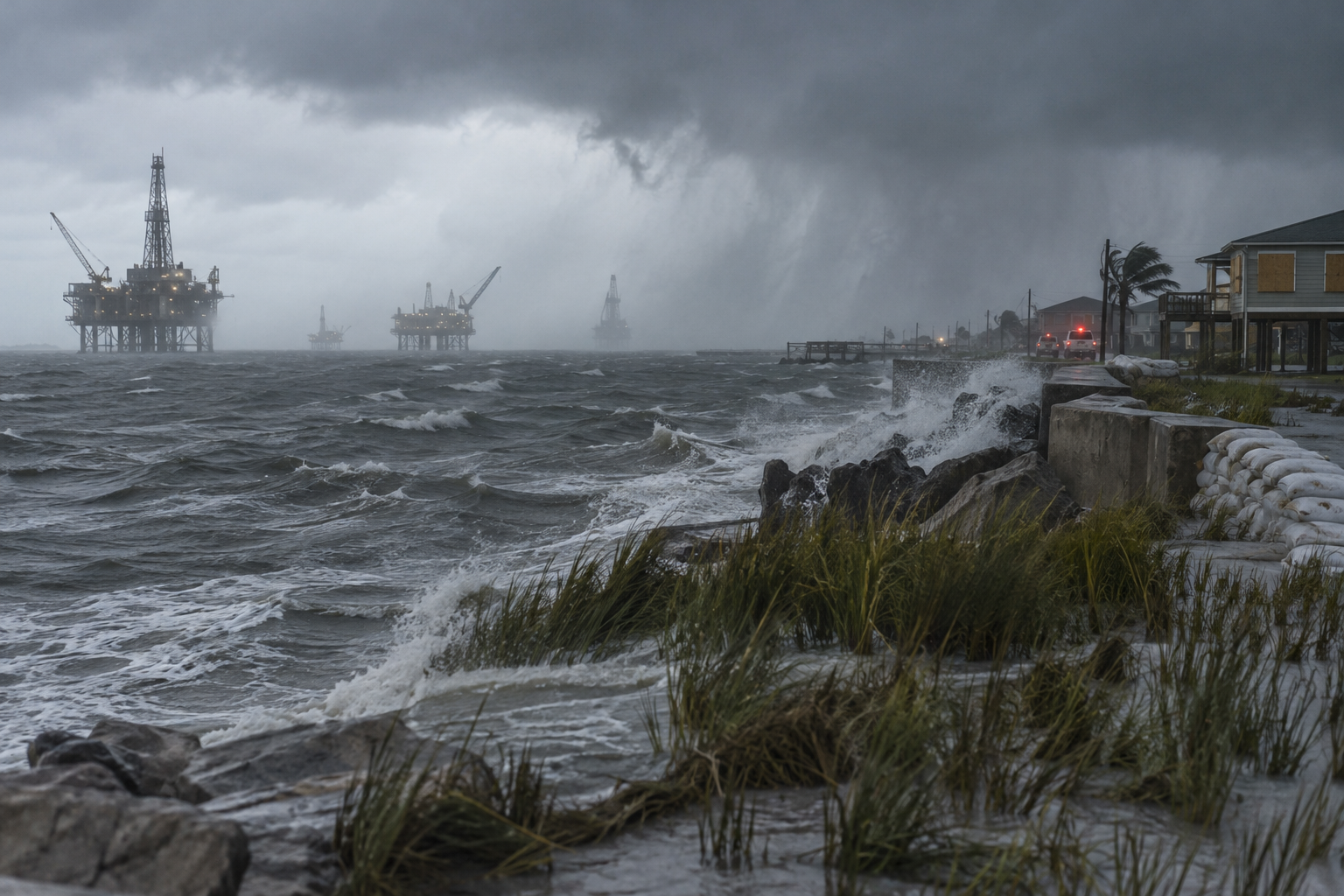
The storm has also disrupted energy production in the Gulf of Mexico. Offshore platforms and rigs have been evacuated, and the Marine Minerals Administration reported that 63% of regional oil production and 57% of gas production had been temporarily suspended. The oil shutdown represents nearly 1.3 million barrels per day, while Gulf offshore production accounts for almost 15% of US annual crude output.
The article contrasts Atlantic conditions with those in the Pacific, where El Niño has left less wind shear and more favorable conditions for hurricanes to intensify. Hurricane Simon, a Category 1 storm with 90 mph winds, was moving toward Mexico’s Pacific coast and was forecast to approach Jalisco, including the area near Puerto Vallarta, on Friday night or early Saturday. The NHC warned that Simon could rapidly intensify into a very dangerous major hurricane.
Entities: Hurricane Isaias, Hurricane Simon, US Gulf Coast, Florida, Alabama • Tone: analytical • Sentiment: negative • Intent: inform
09-10-2026
Hurricane Isaias strengthened on Thursday as it moved toward the US Gulf Coast, leading officials to order evacuations and declare emergencies across parts of Florida, Alabama and Mississippi. The first Atlantic hurricane of the 2026 season had sustained winds of 85 mph and was forecast to approach Category 3 strength, with winds up to 110 mph, before reaching the northern Gulf Coast late Friday or early Saturday. The National Hurricane Center warned that Isaias could bring life-threatening storm surges, flooding and tornadoes, and its director urged residents to prepare immediately. Although increasing wind shear was expected to weaken the hurricane somewhat near landfall, forecasters said it would remain dangerous. Storm-surge warnings covered coastal areas, where water could rise 5 to 7 feet above sea level. Rainfall of 3 to 7 inches was expected, with isolated totals reaching 15 inches.
The storm had also disrupted Gulf of Mexico energy production. Operators evacuated personnel from 121 production platforms and five rigs, while shutting in about 63% of regional oil production—1.3 million barrels per day—and 57% of natural gas output. A forecast estimated that roughly 9 million barrels of oil production could be lost during the storm, more than the amount affected by Tropical Storm Bertha in July. BP, Chevron, ENI, Murphy Oil and Shell were among the companies identified as having significant exposure.
In Florida, mandatory evacuations were ordered for coastal areas of Okaloosa County, and three airports were set to close. Governor Ron DeSantis had declared an emergency in 25 counties. Alabama Governor Kay Ivey declared an emergency covering 40 counties; Dauphin Island issued an evacuation notice, and Baldwin County encouraged voluntary evacuations in low-lying areas while preparing shelters. Jackson County and Gautier in Mississippi declared local emergencies as coastal communities braced for flooding and power outages. The article also notes that El Niño had suppressed Atlantic hurricane development this year, making Isaias’s late arrival near the record for the latest first Atlantic hurricane.
Entities: Hurricane Isaias, US Gulf Coast, National Hurricane Center, Michael Brennan, Florida • Tone: urgent • Sentiment: negative • Intent: warn
09-10-2026
Hurricane Isaias has become the first Atlantic hurricane of the 2026 season, with sustained winds of 80mph and a minimum pressure of 975mb. The National Oceanic and Atmospheric Administration (NOAA) expects it to strengthen to Category 2 before reaching the northern Gulf coast of the United States on Friday evening. The season has been unusually quiet, which the article attributes to a strong El Niño. Isaias’s late formation is notable: the first Atlantic hurricane had not formed this late in the season since 8 October 1905, before satellites made it possible to detect more hurricanes that never make landfall.
The storm is forecast to bring 75–150mm of rain across the Gulf coast, with as much as 250mm in some areas. Officials warn of possible flash floods and isolated river flooding, as well as a growing likelihood of life-threatening storm surge along parts of the northern Gulf coast. Damaging hurricane-force winds are also possible in parts of the Florida panhandle, southern Alabama and Mississippi. A hurricane warning has been issued, and residents have been urged to prepare for extended power outages and follow any evacuation orders. The article’s photographs show residents boarding up a home in Dauphin Island, Alabama, and collecting sandbags in Mobile.
The report also describes severe weather impacts elsewhere. In Zimbabwe’s south-east Masvingo province, a state of disaster was declared after a severe hailstorm damaged homes and critical infrastructure. Preliminary assessments found that roofs were torn from 8,500 homes, while 15,300 people reported shattered windows. Damage to power infrastructure disrupted drainage and sewerage systems, raising public-health concerns as the rainy season begins. In Australia, a rare tornado struck Ulladulla, about 140 miles south of Sydney, on 3 October, damaging properties and felling trees. The article notes that Australia experiences about 50 tornadoes a year.
Entities: Hurricane Isaias, 2026 Atlantic hurricane season, National Oceanic and Atmospheric Administration (NOAA), El Niño, Northern Gulf coast • Tone: analytical • Sentiment: negative • Intent: inform
09-10-2026
Hurricane Isaias is disrupting oil production in the Gulf of Mexico and threatens to further constrain fuel supplies as global markets face tight conditions. By Thursday, producers had shut in about 1.3 million barrels per day—approximately 63% of U.S. Gulf oil production—according to the Bureau of Safety and Environmental Enforcement. The Category 3 storm, with sustained winds of up to 120 miles per hour, was moving toward Mississippi, Alabama and the Florida panhandle, with landfall expected Friday night or early Saturday.
Although Isaias appeared to be moving away from the major refinery corridor in southern Louisiana, hurricane warnings covered areas around Chevron’s Pascagoula, Mississippi, refinery and Vertex Energy’s Saraland, Alabama, refinery. Together, the facilities can process 466,000 barrels per day, or 2.4% of U.S. refining capacity. Chevron said its refinery remained operational; Vertex had not provided comment. Analyst Andy Lipow identified power loss and flooding as the main risks, and said restarting the refineries could take one to two weeks if they shut down without sustaining damage.
The potential disruption comes when Gulf Coast refineries are operating at 95% of capacity, leaving little room to replace lost output. Diesel inventories are unusually low for this time of year, while conflicts in Eastern Europe and the Middle East have disrupted refining capacity. Russia banned diesel exports after Ukrainian strikes on its refineries, and attacks by Iran and Houthi allies have also affected Middle Eastern facilities. U.S. refiners have been exporting diesel, particularly to Europe, to capitalize on high margins.
Analyst Kevin Book said past Gulf refinery outages have sometimes pushed fuel prices up even as crude prices fell, because refineries both reduce crude demand and produce less fuel. Lipow also warned that the storm could delay tanker deliveries of crude to refineries and shipments of gasoline, jet fuel and diesel from them, with Florida likely to experience delays in receiving those fuels.
Entities: Hurricane Isaias, Gulf of Mexico, National Hurricane Center, Bureau of Safety and Environmental Enforcement, Chevron • Tone: analytical • Sentiment: negative • Intent: inform