08-10-2026
The article reports that French Prime Minister Sebastien Lecornu has promised to address students’ concerns as school protests continue to grow. The demonstrations have led to hundreds of schools closing. Students are demanding improved conditions at school and more teachers. The article also notes rising criticism of the police response to the demonstrations. It does not provide further details about the government’s proposed changes, the scale or locations of the protests, or the specific concerns about police conduct.
Entities: Sebastien Lecornu, France, French prime minister, students, school protests • Tone: neutral • Sentiment: neutral • Intent: inform
08-10-2026
France is experiencing large student-led protests over education, with government sources estimating 266,000 participants. Student organisers and unions describe the movement as exceptional and compare its scale with the unrest of May 1968, when protests over university conditions grew into nationwide strikes. The current demonstrations began on September 21 at a high school in a Paris suburb and focus on funding, teacher shortages, overcrowded classrooms and poor facilities. Interviewees argue that these are immediate triggers for a broader “crisis of hope” among young people, amid unemployment, political extremism, war-related fears, climate change and concern that artificial intelligence could threaten future careers.
The article also points to frustration with what students see as a lack of meaningful dialogue between the government and student representatives. Researcher Robi Morder contrasts the current government’s approach with earlier administrations that negotiated with student movements, while organisers say officials have not taken their longstanding demands seriously. Extreme heat and classrooms with more than 40 pupils are cited as factors that helped intensify the protests.
Organisers and unions allege police brutality, while the government has made limited conciliatory gestures: Prime Minister Sebastien Lecornu said students must be heard, and Interior Minister Laurent Nunez ordered police to stop using stun grenades against protesting high school students. Student leaders say demonstrations will continue, including around planned mobilisation dates on October 17 and November 20. The October 17 nationwide strikes are also expected to address energy and food prices, proposed budget cuts and public-sector pay freezes, with support from the left-wing France Unbowed party and the CGT union. Organisers deny acting on behalf of political parties or promoting violence. Student unions have set out 10 demands, estimated to cost one billion euros, including increased education investment, more staff and space, better financial and housing support, affordable university meals, equal fees for international students and an end to repression associated with the movement.
Entities: France, May 1968 protests, Alice Cohen-Morzadec, Andrew Smith, Robi Morder • Tone: analytical • Sentiment: neutral • Intent: inform
08-10-2026
French high-school students have staged widespread protests since late September over education funding, teacher shortages, deteriorating school buildings and other frustrations, including long school days, phone restrictions and the Parcoursup university admissions system. The demonstrations have sometimes turned violent, with injuries among students, teachers and police and hundreds of arrests. The article argues that these grievances are genuine but do not fully explain the scale or tactics of the protests. France spends more per upper-secondary student than the EU average, and its teacher shortages are not worse than those in other countries, though French teachers are relatively poorly paid. Long school days and competition for university places are also not unique to France. The article instead places the movement in a longstanding French tradition of street protest, in which demonstrations and blockades have sometimes forced governments to change policy or spend more. It recalls student protests in 1990, 1998, 1986, 1994 and 2006, as well as the yellow-vest movement of 2018–19. While protests have not always prevailed—the 1968 uprising ended after an election—the current students draw on a political culture where demonstrators challenge elected officials’ claim to represent the public. Polling indicates substantial public support, and protesters have backing from teachers, unions and left-wing politicians. The government is in a weak position: President Emmanuel Macron is unpopular and cannot seek another term, while a fragmented parliament makes passing a budget difficult. Prime Minister Sébastien Lecornu faces both political and financial constraints, including high borrowing costs, a deficit of 5.4% of GDP and elevated public debt. The article concludes that this weakness may limit the government’s ability to respond with concessions, despite the protesters’ momentum.
Entities: Henri Astier, Madalena, Emmanuel Macron, Sébastien Lecornu, Laurent Nuñez • Tone: analytical • Sentiment: negative • Intent: analyze
08-10-2026
The France 24 report examines the French government’s response to protests by high school students and asks whether proposed measures will be sufficient to ease the unrest. In a televised address on Wednesday evening, Prime Minister Sébastien Lecornu acknowledged the concerns of protesting students, saying the country could not be “indifferent” to them and that young people’s anger “does not come from nowhere.” His remarks recognize the protests as a response to underlying grievances rather than dismissing them outright.
Lecornu also rejected the claim that security forces had been instructed to confront young people. He said the government would present a plan to respond to the crisis at the end of October. The report, presented by France 24’s Rochelle Ferguson Bouyahi, considers what measures the government might introduce and whether they could calm the protests.
The supplied page text does not include the video’s full discussion or specify any particular policy measures. It therefore establishes the government’s public commitments and the central question facing its response, but does not provide enough information to assess the proposed plan in detail. The article also points to continuing demonstrations: a related headline notes that French teenagers were keeping up school blockades despite the prime minister’s pledge to act. Overall, the report focuses on the gap between acknowledging student anger and delivering a response capable of addressing protesters’ concerns and reducing disruption.
Entities: Sébastien Lecornu, Rochelle Ferguson Bouyahi, France, France 24, French government • Tone: analytical • Sentiment: neutral • Intent: analyze
08-10-2026
French teenagers continued protesting on Thursday, blockading some high schools and marching through cities, despite the government’s promise to address their concerns. The grievances described in the report are teacher shortages and the poor, deteriorating condition of school buildings. The demonstrations therefore continued after the government pledged to act, rather than ending in response to that assurance.
Reporting from Paris for France 24, journalist Jamie Smith-Maillet says the protesters he spoke with regard the government’s proposed measures as lacking detail. They are seeking concrete action, and have vowed to continue demonstrating until they see it. The report frames the dispute as one between a government pledge and protesters’ doubts that the response is sufficiently specific or actionable. It does not provide details about the measures promised, the number of schools or cities involved, the scale of participation, or the government’s response beyond its pledge. Overall, the available article text describes ongoing student demonstrations and their stated demands, without presenting further context or outcomes.
Entities: French teenagers, Jamie Smith-Maillet, France 24, Paris, French government • Tone: analytical • Sentiment: neutral • Intent: inform
08-10-2026
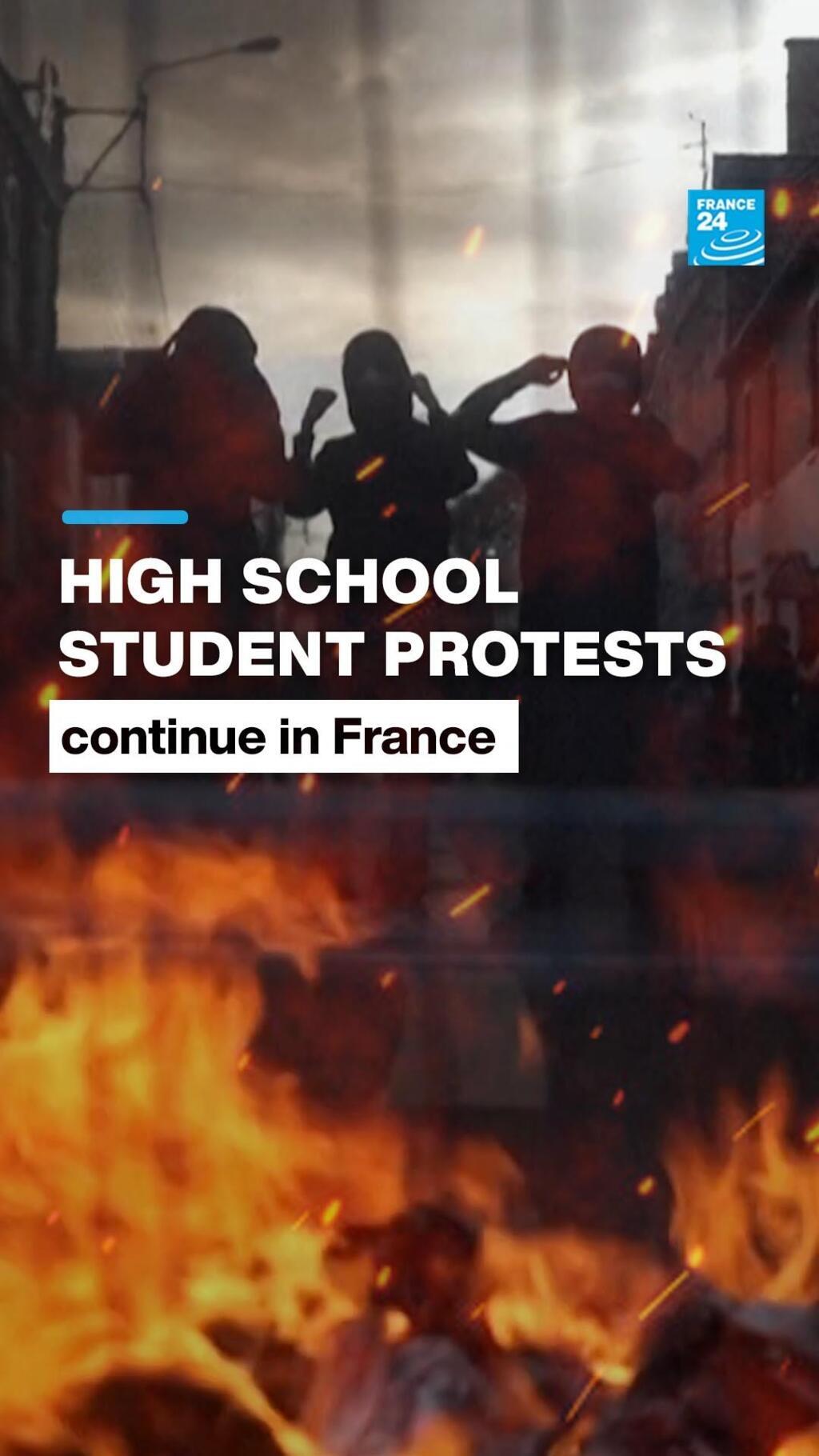
A France 24 video report, issued on October 8, 2026, covers continuing high school student protests in France. According to the accompanying description, students were protesting on Thursday because they believed the government had failed to respond to their demands. The report follows the fourth day of protests. The page also links to related coverage, including an article about French teenagers maintaining school blockades despite a pledge by the prime minister to act, and an explainer on government measures. However, the supplied page does not include a transcript or further details about the students’ specific demands, the government’s response, the scale of the demonstrations, or events shown in the 52-second video. The summary is therefore limited to the information in the video page’s headline and description.
Entities: France, FRANCE 24, French high school students, French government, student protests • Tone: neutral • Sentiment: neutral • Intent: inform
08-10-2026
The France 24 liveblog preview reports that French high school and university students were being urged to hold another round of demonstrations on Thursday, October 8, 2026. The calls came two days after a large turnout at protests demanding increased funding for education. The article says the government had made a series of conciliatory gestures in an effort to end the crisis, though the supplied text does not specify what those measures were or whether they changed the protesters’ demands.
The preview also recaps three developments from the previous day. First, the Marseille public prosecutor’s office told AFP that an investigation had been opened after a 17-year-old boy sustained a head injury outside a secondary school on Wednesday. The excerpt gives no further details about how the injury occurred or the investigation’s findings. Second, student leaders called for fresh demonstrations on Thursday, while several teacher unions also called for new nationwide strikes. Third, Prime Minister Sébastien Lecornu defended the police response to protests across France in a televised address. He denied that law enforcement had been instructed to crack down on teenage protesters.
The supplied page text ends with a notice that the requested content is unavailable. Consequently, it contains only the liveblog introduction and a short recap, not the promised continuing coverage. Details beyond those statements—including the government’s specific gestures, the scale of Thursday’s protests, and any later developments—cannot be established from the provided material.
Entities: French student protests, Education funding, High school students, University students, Teacher unions • Tone: neutral • Sentiment: neutral • Intent: inform
08-10-2026
France 24’s “French Connections” segment examines why student protests recur in France and how protest has become a recognizable part of young people’s political experience. The introduction describes France as being in the international spotlight while large student demonstrations continue, but it provides no details about the specific protests, their demands, locations, or organizers. Instead, it frames the subject through broader questions about protest culture and its history.
The segment presents demonstrating as something of a rite of passage: a moment when teenagers encounter politics and experience the power of acting collectively. It asks how this culture has appeared in recent French history and why some student mobilizations succeed in producing change while others do not. The program promises to look more closely at those questions, but the supplied page text contains only the segment description, not the video’s full discussion or conclusions. Consequently, it does not identify particular past protests or explain which factors make demonstrations effective. The segment is credited to Florence Villeminot and was issued on 8 October 2026. Its stated focus is the relationship between French youth, political participation, collective action, and the varying influence of student protests.
Entities: France, French students, young people, teenagers, France 24 • Tone: analytical • Sentiment: neutral • Intent: analyze
08-10-2026
French high-school protests continued into their third week on Thursday, with teenagers blockading some schools and marching in cities. The demonstrations concern teacher shortages and deteriorating school buildings. They followed a government pledge to address students’ grievances, but officials offered no specific details about what action would be taken. The unrest reflects a wider conflict between demands for investment in struggling public services and a government facing pressure from bond markets to reduce France’s debt and deficit.
The protests have also brought arrests, injuries and controversy over police tactics. Hundreds of people have been arrested and dozens injured, prompting debate about the use of force against teenage demonstrators. On Wednesday, the government suspended the use of stun grenades in policing the protests.
The education ministry reported that 224 high schools were closed on Thursday morning, while 151 schools were partially reopening after earlier closures. It said closures had fallen by 30 per cent compared with Wednesday morning and that 94 per cent of high schools were fully or partially open. The figures suggest disruption was easing, even as blockades and marches continued. The article presents the movement as both a dispute over school conditions and an example of broader tensions around public spending, fiscal constraints and the policing of protests in France.
Entities: French teenagers, France, French high schools, Government, Education ministry • Tone: analytical • Sentiment: negative • Intent: inform
08-10-2026
Student protests that began in the Paris region in mid-September have spread to other European countries, with young people raising similar concerns about education despite the absence of a single coordinated movement. Demonstrators point to overcrowded classrooms, teacher shortages, deteriorating school buildings, rising costs and reduced public spending. France became the focal point after high-school students and teachers protested resource and staffing shortages, with university students, parents and trade unions later joining in. Demonstrations have disrupted hundreds of schools and led to more than 6,500 arrests, most involving minors, as well as clashes with police and serious injuries. After a 15-year-old boy lost his hand during a confrontation in Lens, the French government suspended stun-grenade use at student protests and opened investigations into police conduct. The protests are unfolding while the government faces pressure to reduce its deficit, and protesters say official promises are not enough without concrete changes.
Similar actions have appeared elsewhere. In Belgium, students in Liège protested education costs, overcrowding and limited study materials, linking their actions to events in France and earlier disputes over proposed reforms and tuition fees. Students in Turin and Rome have occupied schools under the slogan “Let’s do as in France,” citing inadequate funding, poor buildings and the cost of living. Greek students have called nationwide assemblies, walkouts, demonstrations and possible occupations. In Ireland, university students have protested tuition fees, higher-education funding and accommodation costs; in Germany, students, teachers, parents and unions have sought more investment, more teachers and a fairer system. Austrian student groups are preparing demonstrations amid warnings of possible university budget cuts of about €1 billion.
The article frames the unrest as a shared European tension between governments seeking to restrain deficits and borrowing costs and education communities demanding greater investment. It stresses that national circumstances differ and that the protests are not one unified uprising, while noting that France has become a visible example for young people elsewhere.
Entities: France, Paris, Lens, Belgium, Liège • Tone: analytical • Sentiment: neutral • Intent: analyze
08-10-2026
France will release 10 million barrels of diesel from its strategic reserves to ease pressure on consumers, Prime Minister Sébastien Lecornu announced. The fuel, purchased before the U.S.-Iran war drove up global energy prices, is expected to reduce pump prices by 12 to 18 euro cents per litre. The move comes as student protests over years of underfunding in schools have spread across the country, with hundreds of schools expected to close during a week of blockades. Demonstrations intensified after a 15-year-old boy lost a hand in a clash involving police; the government has suspended the use of stun grenades. Lecornu acknowledged protesters’ anger and public fatigue with recurring crises.
The article describes a government under pressure from both public discontent and bond investors. Complaints extend beyond education to living standards, wages, strained public services, political dysfunction, immigration and security. These conditions have contributed to greater support for the far-right National Rally and the left-wing New Popular Front alliance. At the same time, Lecornu is seeking parliamentary approval for a budget that would cut about 43 billion euros in public spending, despite lacking a majority. He has urged compromise and said France must reduce its deficit to 5% of GDP by 2027; the deficit is projected to be 5.4% this year. The government’s spending restraint is intended to reassure bond markets, but it risks provoking further public anger.
France’s borrowing costs have risen sharply: its benchmark cost is up about 1.26 percentage points this year, while the yield on 10-year French government bonds was around 4.9%. The country’s risk premium over Germany has nearly doubled. Marine Le Pen, a leading contender in the 2027 presidential race, has promised to bring the deficit below 3% within 18 months. However, analyst Davide Oneglia said markets remained unconvinced by her fiscal pledges. The article also situates France’s diesel release within a broader Group of Seven agreement to release 100 million barrels of reserves amid disruptions in the Middle East and attacks on Russian refineries.
Entities: France, Sébastien Lecornu, Marine Le Pen, Davide Oneglia, Group of Seven (G7) • Tone: analytical • Sentiment: negative • Intent: inform