08-10-2026
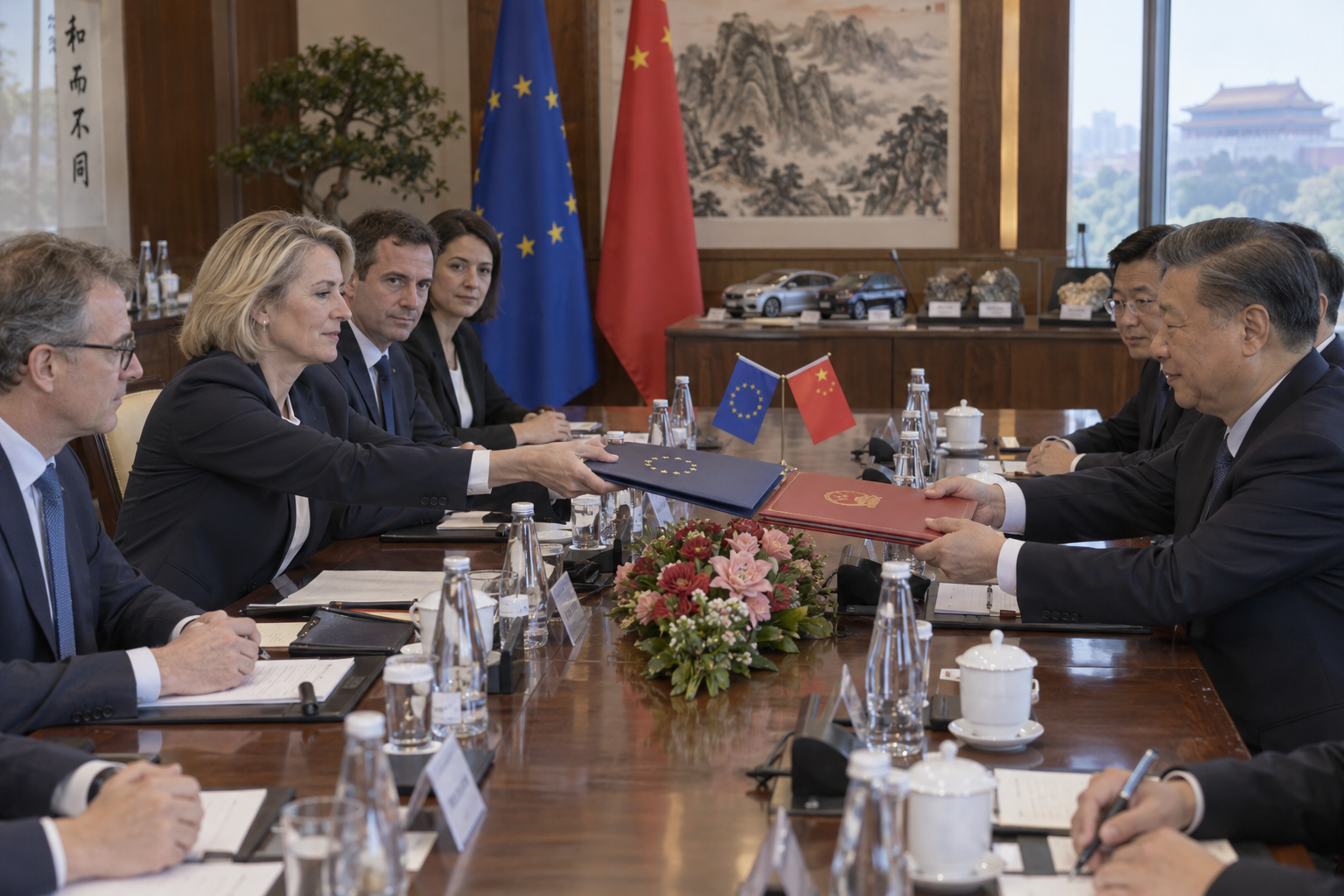
European Trade Commissioner Maros Sefcovic has arrived in Beijing for two days of talks with Chinese Commerce Minister Wang Wentao, focused on the EU’s growing trade deficit with China and restrictions on Chinese exports of rare earths and other critical minerals. The EU’s deficit exceeds €1bn ($1.12bn) a day. The discussions also take place amid rising competition between Chinese companies and Europe’s leading carmakers. China has rejected a request for voluntary limits on its hybrid-car exports, while the European Commission is reportedly considering a unilateral cap on hybrid imports instead.
Pressure for a tougher European approach is growing. A majority of EU lawmakers backed a non-binding resolution calling for a more assertive trade policy towards Beijing. China has warned that it would respond resolutely to restrictions on Chinese companies or products. Separately, French President Emmanuel Macron and German Chancellor Friedrich Merz have urged the EU to prepare a credible instrument that could be activated quickly against countries that harm the bloc economically. The proposed measure, which is not aimed at a specific country, would give the European Commission the ability to respond to trade aggression within days. EU leaders are expected to discuss it at a summit next week. Beijing has urged France and Germany to avoid protectionist measures.
Trade imbalances are also on the agenda of international finance leaders. In September, G20 finance leaders other than China’s agreed to act against non-market distortions that worsen imbalances. Beijing argues that focusing on imbalances and overcapacity is itself a protectionist effort to pressure and constrain China.
EU-China discussions on trade imbalances have been under way since June. Sefcovic has called for tangible results by October and a commitment that can be presented to EU leaders in Brussels. The dispute is a major issue for next week’s summit, amid concerns over the EU’s next seven-year budget and protests in France. European Commission President Ursula von der Leyen has said the imbalance has reached a tipping point and that Europe will use every available tool to rebalance the relationship.
Entities: Maros Sefcovic, Wang Wentao, Emmanuel Macron, Friedrich Merz, Ursula von der Leyen • Tone: analytical • Sentiment: neutral • Intent: inform
08-10-2026
The France 24 Business report focuses on European Union trade commissioner Maros Sefcovic’s arrival in Beijing for two days of talks with Chinese commerce minister Wang Wentao. Sefcovic said he wants to address what he described as an “unsustainable trade deficit” between the EU and China, framing the discussions around the need to rebalance trade. The report identifies the automotive industry as a particular concern for Europe: Chinese hybrid vehicles have expanded their share of the European market to 25 percent. The article does not provide further figures on the overall deficit, specify policy proposals, or describe Wang’s response, so the details and outcomes of the talks remain unknown in the supplied text. It presents the visit as an effort to discuss trade imbalances and the competitive position of European industries. The edition also briefly mentions a separate business story: Microsoft has unveiled new AI-powered personal computers in an effort to compete with Apple. The provided material gives no additional details about the products or their features. Overall, the report is a concise update on the EU-China trade agenda, highlighting the commissioner’s stated objective and the growth of Chinese hybrid vehicles in Europe, alongside a short technology-industry headline. It does not state whether the talks produced agreements or describe any decisions by either side.
Entities: Maros Sefcovic, Wang Wentao, Beijing, European Union (EU), China • Tone: analytical • Sentiment: neutral • Intent: inform
08-10-2026
The article reports that China and the European Union have begun a new round of trade talks in Beijing, but expectations for a major breakthrough are low. Observers on both sides anticipate continued turbulence in the relationship and see preventing a full-scale trade conflict as a more realistic goal than resolving all disputes at once.
Chinese companies operating in Europe are hoping the discussions will produce limited progress that can help stabilise trade ties. European analysts, by contrast, are described as cautious about what the talks may deliver. A Chinese source familiar with the negotiations nevertheless expects some results, arguing that EU Trade Commissioner Maros Sefcovic is unlikely to leave without an outcome of some kind.
The China Chamber of Commerce to the EU urged both sides to use the Trade and Investment Consultations (TIC) mechanism to manage differences, pursue solutions and provide businesses with clearer signals. The article thus presents the talks as a practical channel for containing tensions and reducing uncertainty, rather than as a forum likely to produce a sweeping agreement.
The report offers only a brief account of the opening of the talks and does not specify the issues under discussion or describe any agreements reached. Its central message is that optimism is scarce, even as participants hope for incremental progress and a deterioration into an outright trade conflict can still be avoided.
Entities: China, European Union (EU), Beijing, Brussels, Xiaofei Xu • Tone: analytical • Sentiment: neutral • Intent: inform