08-10-2026
The article reports that US Secretary of State Marco Rubio called on Western nations to prioritize their own national interests “unapologetically,” linking that position to the “America First” approach associated with President Donald Trump. Rubio made the remarks in a speech in Athens, where he praised ancient Greece and expressed concern about what he described as “Western decline.” He also defended Trump’s foreign-policy approach. The article’s framing presents nationalism and the prioritization of national interests as central themes in Rubio’s message, and connects those themes to both classical Greek history and contemporary US politics. The provided text does not include further details about the speech, the specific policies Rubio advocated, the audience’s response, or reactions from other governments or political figures. It also does not explain how Rubio’s references to ancient Greece supported his argument beyond noting that he praised it. Accordingly, the report establishes the main claims and setting but offers little elaboration or analysis of their implications. Its primary function is to inform readers of Rubio’s remarks and the broad ideas he associated with them: national prioritization, concern about the West’s direction, and support for an America First foreign policy.
Entities: Marco Rubio, United States Secretary of State, Athens, Western nations, ancient Greece • Tone: neutral • Sentiment: neutral • Intent: inform
08-10-2026
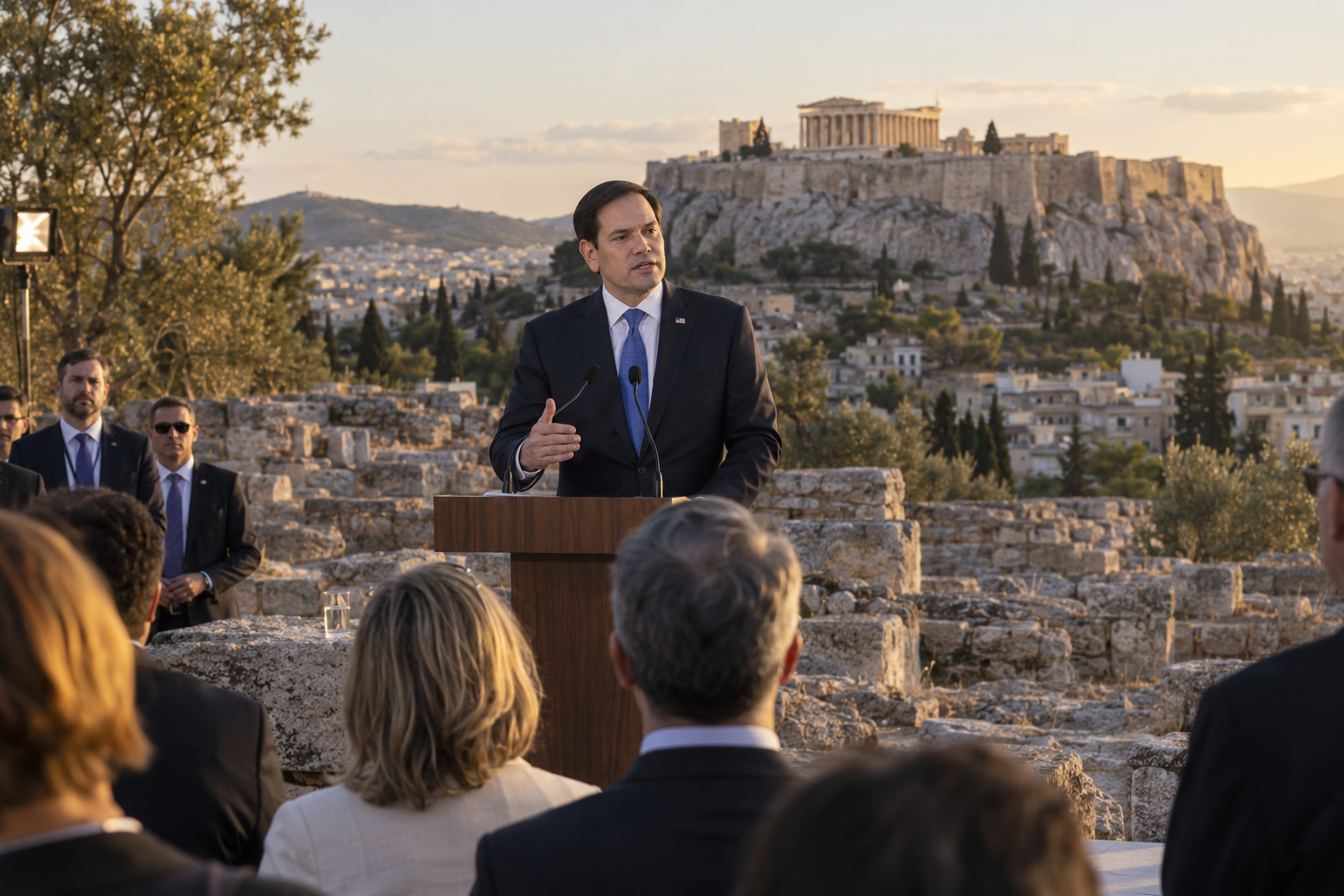
Secretary of State Marco Rubio delivered a speech at Athens’ Pnyx, overlooking the Acropolis, arguing that Western societies should recover qualities he associated with ancient Greece: ambition, risk-taking, competition and the pursuit of achievement. He presented a historical lineage from Greece through Rome and European Christianity to the United States, and warned that the West faces a choice between renewed power and decline. Under President Trump, he said, the United States has chosen to pursue national power by reclaiming critical supply chains, reindustrializing, rebuilding defense and competing for future technologies.
The article notes that Rubio’s account emphasized competition and national loyalty more than democracy and political equality, despite the speech’s setting at a site associated with democratic assembly. The address developed themes he had raised at the Munich Security Conference, including the need for a shared Western identity, and was delivered as the U.S. wages war with Iran while Europe contends with Russia’s war in Ukraine.
Rubio’s Greece visit also included discussions with Greek officials on defense, energy and regional security. Foreign Minister George Gerapetritis said Greece could provide maritime assistance in the Strait of Hormuz if a viable peace process is established. The trip’s wider agenda included NATO cooperation, Arctic security and efforts to reduce Europe’s reliance on Russian energy. Rubio declined to detail what level of Iranian uranium enrichment the United States might accept, reiterating that Iran cannot have a nuclear weapon. He also declined to address questions about whether Ambassador Kimberly Guilfoyle complied with ethics rules amid congressional scrutiny; she has denied wrongdoing.
The article places the speech against the costs of the Iran war, including higher oil and gasoline prices, and notes attention to Rubio’s possible political future. Rubio did not discuss his ambitions, but cited a recent Greenland deal as an example of his administration’s vision. Greece was the second stop on his three-country European tour, which began in Iceland and was to conclude in Portugal.
Entities: Marco Rubio, Donald Trump, JD Vance, George Gerapetritis, Kimberly Guilfoyle • Tone: analytical • Sentiment: neutral • Intent: inform
08-10-2026
The article reports on a speech by US Secretary of State Marco Rubio in Athens, where he urged Europe to emerge from what he called its “long slumber” and presented the United States as a powerful partner. Speaking at Pnyx hill beneath the Acropolis, before senior Greek officials, Rubio invoked ancient Greece as the birthplace of Western democracy and described Western civilisation as being at a crossroads between “national power” and decline. He said he believed Europe could awaken and rekindle the civilisational spirit associated with ancient Greece. Rubio also pointed to developments he framed as signs of a broad generational shift across Europe: sharply increased defence spending, new partnerships and programmes, and expanded manufacturing and production. He linked those developments to defence commitments made the previous year at the NATO summit in The Hague. The report characterizes the speech as rousing and emphasizes Rubio’s appeal for Europe to take a more active role in its security and future. It does not provide further details about the specific defence commitments, partnerships, or programmes, nor does it include responses from European officials or other reactions to Rubio’s remarks. The article is a brief news account focused on the location, historical symbolism, and central message of the secretary of state’s address.
Entities: Marco Rubio, United States, Europe, Athens, Acropolis • Tone: analytical • Sentiment: neutral • Intent: inform