09-10-2026
The India-based Cockroach Janta Party says its members have been detained in what it describes as mass arrests across the country. The reported detentions took place ahead of a protest scheduled for Saturday in New Delhi. The party says the demonstrators are calling for the resignation of the chief of the election panel. Their demand is linked to alleged irregularities in revisions to voter lists. Critics say those revisions benefited Prime Minister Narendra Modi’s Bharatiya Janata Party (BJP). The report presents these claims as allegations and attributes them to the party and its critics; it does not provide independent confirmation of the arrests, explain how many people were detained, or include a response from the election panel or the BJP. The central issues are the reported pre-protest detentions and the dispute over voter-list revisions and their alleged political effects. The item is a brief news report, published on 9 October 2026, and supplies no further details about the protest or the alleged irregularities.
Entities: Cockroach Janta Party, India, New Delhi, Bharatiya Janata Party (BJP), Narendra Modi • Tone: neutral • Sentiment: negative • Intent: inform
09-10-2026
The article examines how Indian artists and online creators are using satire to protest disputed voter-roll revisions and alleged censorship, amid growing demonstrations against Chief Election Commissioner Gyanesh Kumar. Stand-up comic Brijesh Jha says Instagram removed a parody video after it attracted 1.7 million views. The video protested the removal of Jha’s and two family members’ names from West Bengal’s voter list and accused the election chief of disenfranchising voters at the BJP’s behest. Meta cited local laws but offered no further explanation. Jha says the removal left him feeling helpless and connects it to a wider government crackdown on dissent.
The article describes the Special Intensive Revision (SIR), a voter-roll exercise launched in June the previous year to remove deceased, duplicate or questionable registrations. It reports that more than 130 million voters have been deleted, and that an Indian Express investigation found two of the three election commissioners had objected repeatedly to decisions made by Kumar. Opposition figures accuse the Modi-appointed chief of acting for the BJP and are demanding an independent inquiry. The revelations have prompted protests, including the brief detention of Congress leader Rahul Gandhi during a march to the Election Commission. The BJP, in turn, accuses opposition parties of attacking democratic institutions.
Satirical groups, students and artists have also taken to the streets and social media. The article cites nearly 195,000 content-blocking orders issued to major platforms between March and July, while the government disputes the significance of that figure. New rules require platforms to remove content deemed unlawful within three hours, rather than 36. Political cartoonist Satish Acharya says some of his work was removed and his account blocked in India. Both Acharya and Jha describe humour and art as forms of dissent, while Jha refuses to reapply for voter registration and urges Modi to restore his right to vote and stop the online crackdown.
Entities: Brijesh Jha, Narendra Modi, Gyanesh Kumar, Rahul Gandhi, Satish Acharya • Tone: analytical • Sentiment: negative • Intent: inform
09-10-2026
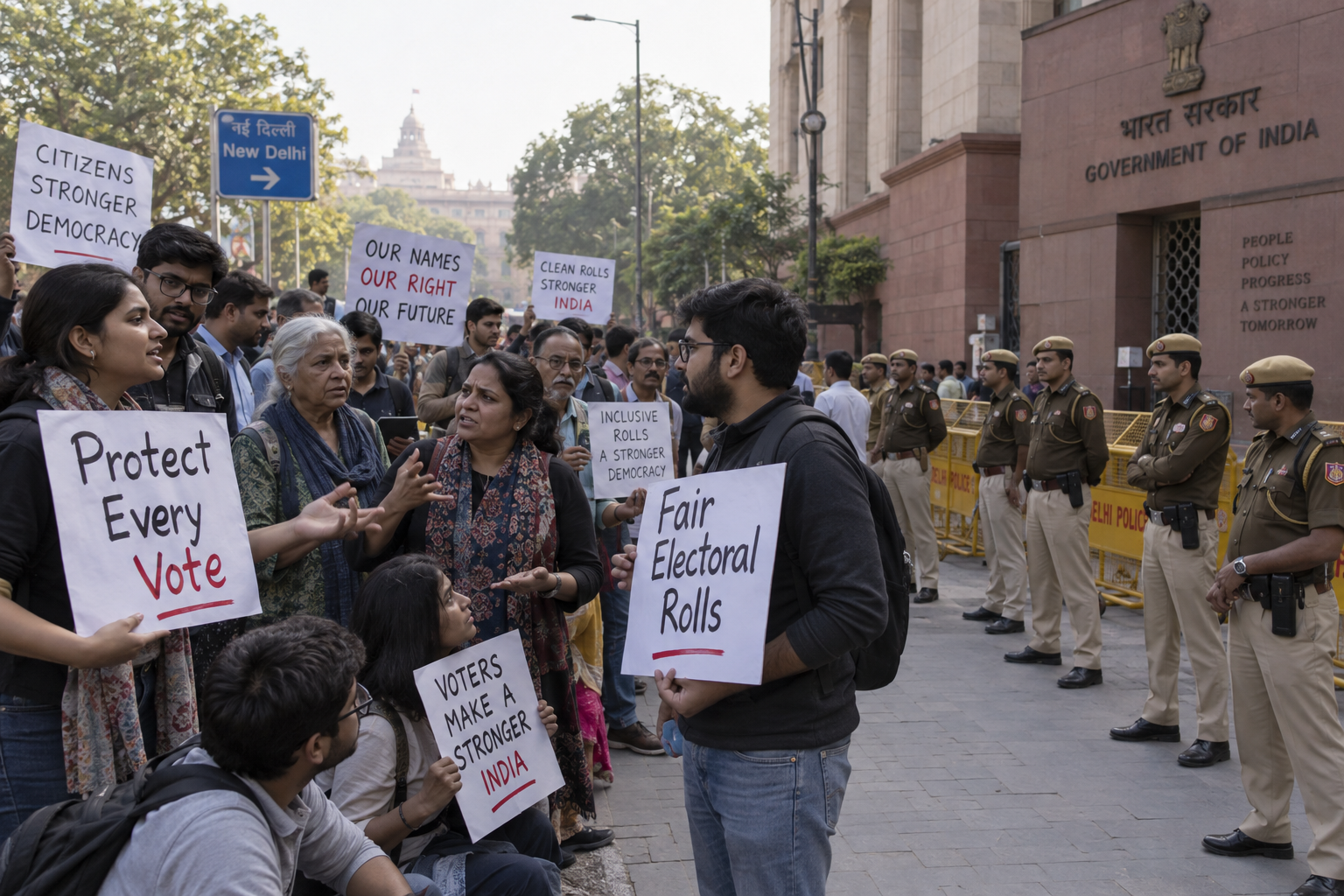
India’s Cockroach Janta Party (CJP), a youth-led protest movement, has called for a nationwide march in New Delhi on October 10 after the Election Commission of India (ECI) ignored its demand that Chief Election Commissioner Gyanesh Kumar resign. Authorities have barricaded parts of the capital and detained protesters, including students, opposition leaders Rahul Gandhi and Priyanka Gandhi Vadra, and CJP spokesperson Deepak Baliyan. Police say the march has not been authorized and is illegal; organizers and supporters argue that the protest is necessary to demand accountability.
The dispute centers on an Indian Express investigation reporting that election commissioners Sukhbir Singh Sandhu and Vivek Joshi raised at least 14 formal objections over ten months to decisions involving voter registration, deletions, restorations, and electoral-roll data. The commissioners are overseeing a Special Intensive Revision (SIR) that requires voters to re-verify their eligibility. The ECI says the exercise is intended to remove errors, including duplicate and outdated entries, and prevent the inclusion of illegal immigrants. Critics say it has exceeded that purpose; the report says more than 130 million names were removed from rolls that previously listed about 970 million eligible voters.
The CJP emerged after India’s chief justice referred to unemployed young people as “cockroaches.” The movement adopted the label and channeled frustration over youth unemployment, education, and competitive-exam leaks. It claims nearly 25 million Instagram followers and previously helped pressure the education minister to resign. Its current demands include Kumar’s resignation and criminal proceedings, a halt to upcoming elections and the SIR, and repeal of the 2023 law governing election-commissioner appointments.
The protests have attracted student groups, civil-society figures, opposition leaders, and farmers’ rights activist Rakesh Tikait. The ECI denies internal divisions and says its decisions were unanimous. With nearly 43,000 security personnel reportedly deployed and past protests marked by force, the planned march raises questions about electoral credibility, protest rights, and the authorities’ response.
Entities: Cockroach Janta Party (CJP), Gyanesh Kumar, Sukhbir Singh Sandhu, Vivek Joshi, Narendra Modi • Tone: analytical • Sentiment: negative • Intent: analyze
09-10-2026
The France 24 programme Access Asia examines protests in India following an investigation by The Indian Express that raised concerns about the integrity of the country’s Election Commission. The programme’s description frames the protests as part of a broader dispute over trust in the institution responsible for elections, and asks why demonstrations have broken out after the investigation. Journalist Faye D'Souza joins the programme to discuss the issue and the pressure facing Narendra Modi’s government. According to the description, that pressure is coming from both the political opposition and the Gen Z-led Cockroach Janta Party. The discussion also considers a wider sense of discontent in India, suggesting that the protests form part of a broader political mood rather than an isolated response alone. The supplied article is a short programme listing, not a full transcript: it does not provide the investigation’s detailed findings, explain the specific allegations, describe the scale or locations of the protests, or include D'Souza’s full analysis. Its stated focus is therefore the reported concerns about election integrity, growing public demonstrations, opposition pressure on the government, and broader dissatisfaction. The item was published as a 13-minute edition of Access Asia on 9 October 2026, with Joanna Cockerell, Delano D'Souza and Stéphanie Cheval credited. Overall, it presents a developing political controversy for examination and discussion, without offering enough detail in the supplied text to establish the truth of the concerns or assess the government’s response.
Entities: India, Election Commission of India, The Indian Express, Faye D'Souza, Narendra Modi • Tone: analytical • Sentiment: negative • Intent: inform