09-10-2026
Malaysia closed schools across Kuala Lumpur, Putrajaya and five states as smoke from Indonesian forest fires pushed air pollution to unhealthy levels. The closures affected roughly two million students. Kuala Lumpur recorded an Air Pollutant Index (API) reading of about 170, while Singapore’s air quality fell into the “very unhealthy” range, according to IQAir.
Malaysian Prime Minister Anwar Ibrahim called the haze situation worrying and said he had spoken with Indonesian President Prabowo Subianto, who agreed to take necessary steps, though Anwar gave no details. Malaysia also sought an urgent meeting of ASEAN environment ministers and stepped up cloud seeding to encourage rainfall. King Sultan Ibrahim called for measures to protect children, older people and patients with respiratory illnesses, and said schools should close when API readings reach 150. National guidelines classify readings above 100 as unhealthy, above 200 as very unhealthy and above 300 as hazardous; readings above 500 are the threshold for a local emergency. Education Minister Fadhlina Sidek promised parents more advance notice of future closures.
The article links the fires to El Niño conditions that Indonesia had warned could increase fire risk during the dry season. A month later, smoke spread across the region during Indonesia’s worst fire season in more than a decade. Fires across six provinces had burned at least 200,000 hectares. Indonesia’s Ministry of Health recorded more than 170,000 respiratory infections, though the actual total was likely higher because the figure included only people who sought healthcare. The haze also raised concerns around Singapore’s Formula One weekend. Organisers said the races would proceed, with masks and additional medical staff available, and described the haze as “not a threat.”
Entities: Malaysia, Indonesia, Kuala Lumpur, Putrajaya, Singapore • Tone: analytical • Sentiment: negative • Intent: inform
09-10-2026
Malaysia closed schools in Kuala Lumpur and other parts of the country on Friday as haze from forest fires in nearby Indonesia worsened air quality. Education Minister Fadhlina Sidek said she had directed state education departments and district education offices to keep monitoring conditions and respond when necessary. She identified schools that would close completely and those that would operate partially across five states and two federal territories. Sidek also said future closure decisions would be announced in advance to give parents time to prepare.
Air quality in Kuala Lumpur remained at unhealthy levels. Swiss monitoring organization IQAir ranked the Malaysian capital among the world’s most polluted cities, placing it second behind neighboring Singapore. The city recorded an Air Pollutant Index (API) reading of 170 on Friday. Malaysia’s King Sultan Ibrahim had said schools should close whenever readings reach 150 or above. API levels over 200 are considered very unhealthy, readings above 300 hazardous, and levels exceeding 500 the threshold for declaring a local emergency.
Kuala Lumpur is about 1,200 kilometers (745 miles) from Indonesia, where a wave of forest fires has affected millions of people since August. Malaysian Prime Minister Anwar Ibrahim said Indonesian President Prabowo Subianto had agreed to take measures to address the haze, but offered no further details. The article describes the cross-border effects of Indonesia’s fires and the Malaysian authorities’ response, particularly the decision to close schools as pollution readings rose.
Entities: Malaysia, Kuala Lumpur, Indonesia, Fadhlina Sidek, Sultan Ibrahim • Tone: analytical • Sentiment: negative • Intent: inform
09-10-2026
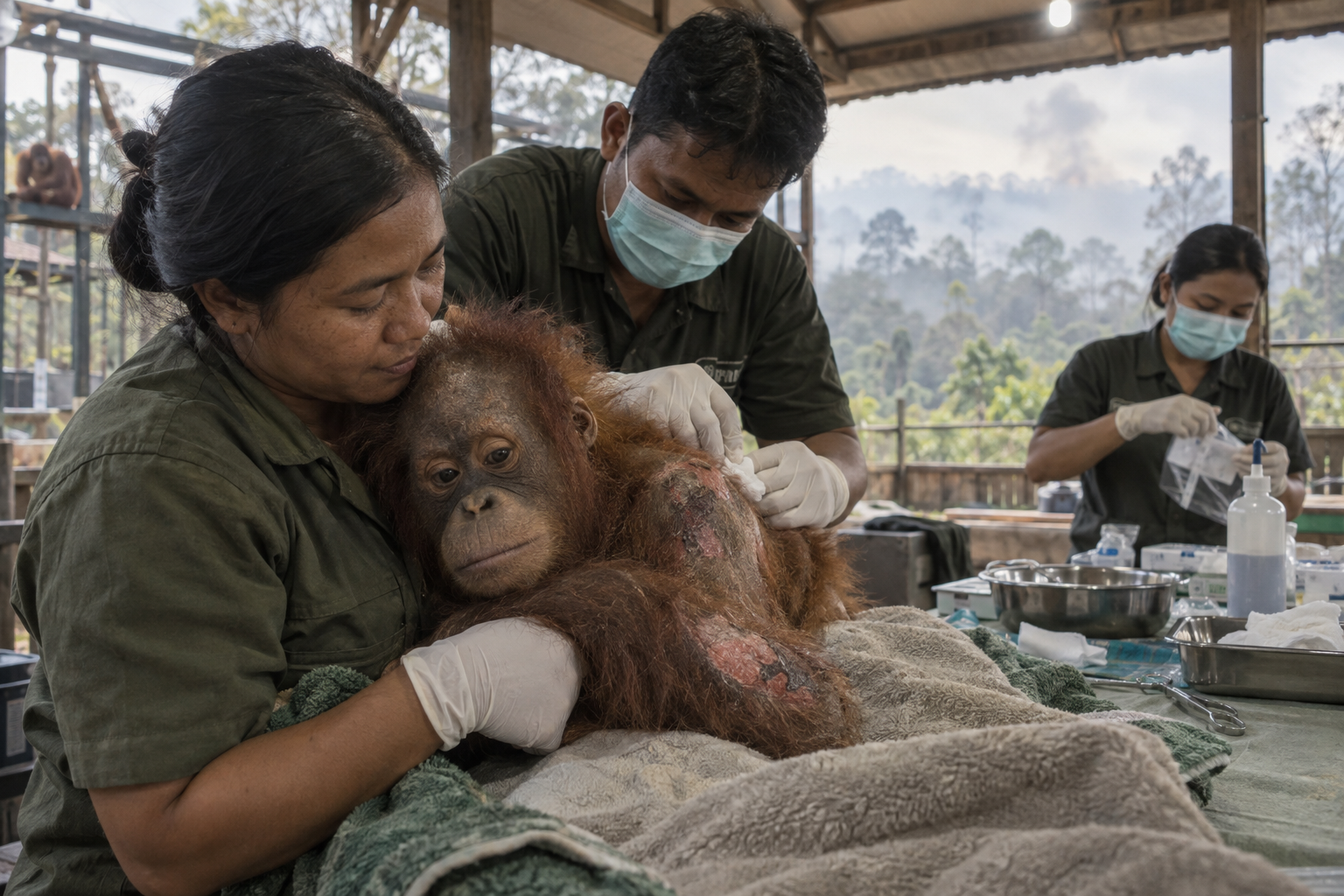
A three- to four-year-old female orangutan named Novita was rescued from wildfires in Central Kalimantan, on the Indonesian part of Borneo. She was found clinging to a tree on 26 September with burns on her hands and feet, apparently sustained while crossing the flames. Rescuers from the Borneo Orangutan Survival Foundation tranquilised her, provided oxygen and intravenous fluids, and transported her to the Nyaru Menteng rehabilitation centre in Palangkaraya. Officials later said her burns were improving, although they cautioned that she might not make a full recovery.
Novita is one of dozens of orangutans rescued from fires in Sumatra and Borneo in recent months. The article links the fires’ intensification to Indonesia’s dry season and drought associated with El Niño. Estimates of the affected area vary considerably: government figures report that more than 202,000 hectares burned between January and July, while satellite monitoring by Nusantara Atlas estimated that nearly 896,000 hectares had burned by the end of August.
Beyond the immediate danger to wildlife, the fires are destroying orangutan habitat and worsening regional haze. Smoke has also caused respiratory symptoms among orangutans being cared for at the Borneo Orangutan Survival Foundation’s facility in Central Kalimantan. The report presents Novita’s rescue as an example of the growing threat wildfires pose to orangutans, while noting uncertainty about her long-term recovery and the broader impact of the fires.
Entities: Novita, Borneo, Central Kalimantan, Sumatra, Palangkaraya • Tone: urgent • Sentiment: negative • Intent: inform
09-10-2026
The article reports that Novita, a baby orangutan injured in wildfires on Borneo, was rescued and taken for treatment by the Borneo Orangutan Survival Foundation. Rescuers tranquilised her, provided oxygen and intravenous fluids, and transported her to the Nyaru Menteng rehabilitation centre in Palangkaraya. Officials said her burns were improving, though they cautioned that she might not make a full recovery. Novita is one of dozens of orangutans rescued from fires on Sumatra and Borneo in recent months, underscoring the threat the blazes pose to wildlife as well as forests.
The fires have intensified during Indonesia’s dry season, amid drought linked to El Niño. The article gives two estimates of the area burned: government figures indicate that more than 202,000 hectares burned between January and July, while satellite monitoring by Nusantara Atlas estimated that nearly 896,000 hectares had burned by the end of August. The figures cover different periods and come from different sources.
Beyond destroying orangutan habitat, the fires are worsening regional haze. Smoke has also caused respiratory symptoms among orangutans at the BOS Foundation’s care facility in Central Kalimantan, meaning the effects are reaching animals already under human care. The report presents Novita’s rescue and treatment alongside the wider, escalating impact of fires on orangutans and their habitat. It offers no further details about the cause of individual fires or additional measures being taken to prevent habitat destruction.
Entities: Novita, Borneo, Sumatra, Indonesia, Borneo Orangutan Survival Foundation (BOS Foundation) • Tone: analytical • Sentiment: negative • Intent: inform