08-10-2026
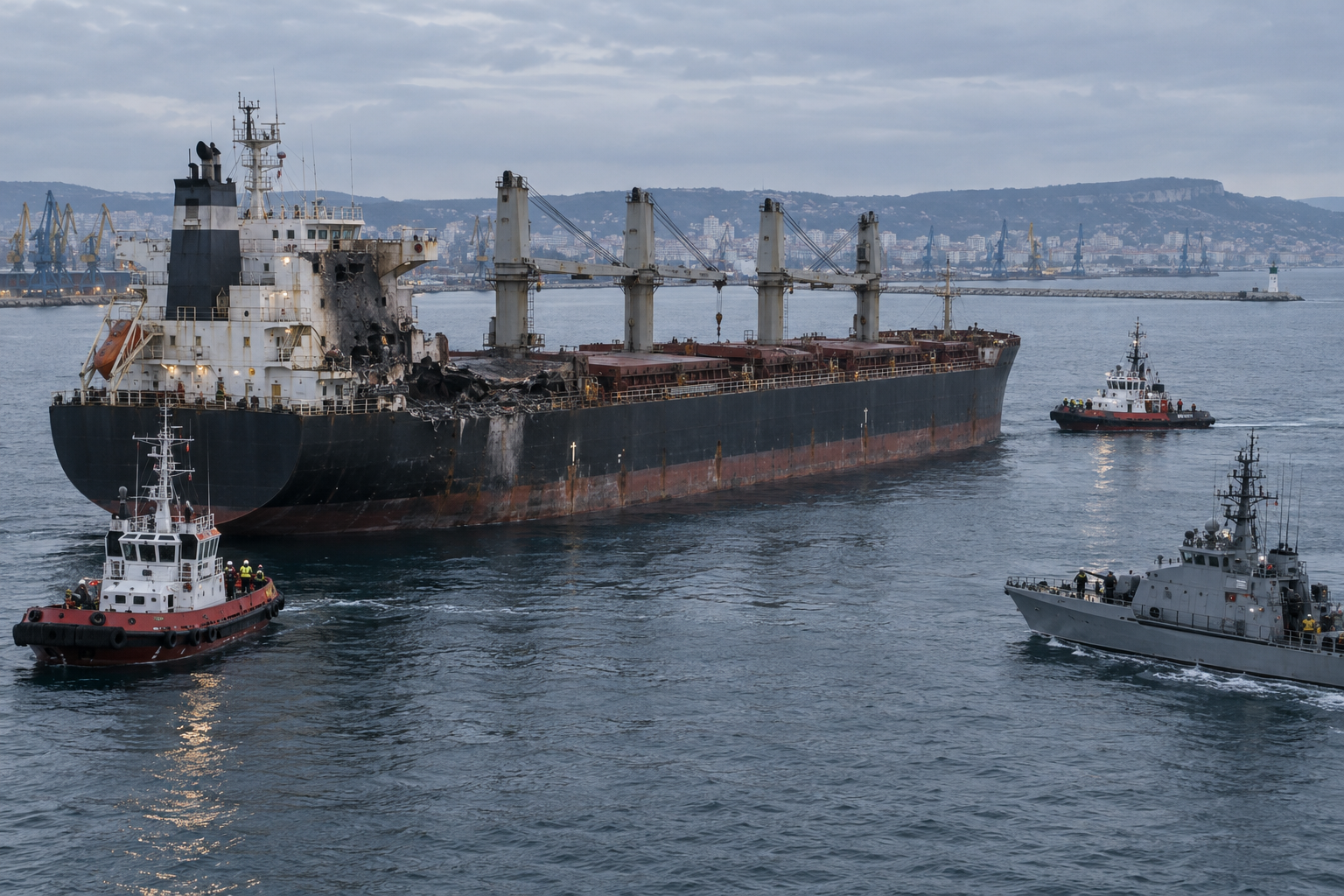
Recent drone attacks on cargo ships in the western Black Sea have raised doubts about the region’s safety and exposed concerns about Bulgaria’s ability and willingness to respond to security threats. On October 6, drones struck the Alfa Watan and Able in Bulgaria’s exclusive economic zone (EEZ): the Alfa Watan sank and its crew was missing when the search was called off, while the Able was damaged and its crew rescued. A day earlier, the Royad Mammadov sank off Romania, killing two crew members. The incidents follow other attacks on ships carrying Ukrainian grain.
Experts say the attacks show that the Black Sea front is expanding, but responsibility for the latest strikes has not been conclusively established. A surviving Able crew member suspected a Russian attack because the ship carried Ukrainian grain. Security expert Ruslan Trad described Russian responsibility as probable but unproven, noting both Russia’s threats to navigation to Ukrainian ports and Bulgaria’s limited experience attributing maritime drone attacks.
Bulgaria’s government condemned the attacks as violations of international law but did not identify Russia as responsible. Prime Minister Rumen Radev stressed the lack of concrete evidence and disputed Ukrainian President Volodymyr Zelenskyy’s account of discussions between the countries. Analyst Rumena Filipova argues that Bulgaria’s tendency to downplay incidents and its weak institutional response make it vulnerable to Russian and Chinese influence and raise questions about its geopolitical stance.
The attacks do not amount to a direct attack on Bulgaria or Romania because they occurred in their EEZs, outside sovereign territory, and experts do not expect a military response or NATO Article 5 to be invoked. However, analysts anticipate tighter maritime monitoring, greater allied intelligence-sharing, stricter shipping routes, higher insurance costs and economic effects on local businesses. Filipova says Bulgaria needs to modernize its navy and coordinate more closely with Romania. Turkey also has a stake: the ships belonged to Turkish firms, and President Recep Tayyip Erdogan discussed Black Sea navigation security with Vladimir Putin.
Entities: Bulgaria, Black Sea, Alfa Watan, Able, Royad Mammadov • Tone: analytical • Sentiment: negative • Intent: analyze
08-10-2026
The France 24 discussion examines the risk that Russia’s war against Ukraine could spill over into European waters and broader European security. Its central incident is the reported attack on three Turkish-owned cargo ships traveling from Ukraine in European Union waters, allegedly by Russian drones. One vessel, the Togo-flagged Alfa Watan, sank off Bulgaria on Tuesday; ten Egyptian and Syrian crew members were reported missing. The article also notes that Ukraine has been striking Russian tankers in the Black Sea, while there is no sign of a return to a UN-brokered arrangement permitting oil, grain and fertilizer shipments to pass safely.
The discussion places these developments in a wider political context. The United States is described as being in “drawdown mode,” while reports that the US president’s entourage is interested in commercial deals with Moscow raise questions about the reliability of American support. Europe, meanwhile, is still debating whether closing several Russian consulates is an adequate response to an August drone attack on a Ukrainian cargo plane in Leipzig, Germany.
The program asks how far Russia might go in pressuring Europe and whether European countries are prepared for hybrid warfare and relatively inexpensive forms of conflict. Ukraine’s experience is presented as evidence that mass-produced drones can strike cities and undermine public morale. The discussion also considers whether the perceived threat is real or exaggerated, especially for voters who will participate in upcoming elections in Spain, France and Italy. The supplied page contains the program description rather than a full transcript, so it does not provide the panelists’ answers or further details of the debate.
Entities: Russia, Ukraine, European Union waters, Black Sea, Alfa Watan • Tone: analytical • Sentiment: negative • Intent: analyze
08-10-2026
Nine Syrian sailors and one Egyptian sailor are missing after the Turkish-owned cargo ship Alfa Watan sank following a drone strike off Bulgaria’s Black Sea coast on Tuesday. Bulgarian authorities found a boat, three life rafts and pieces of the vessel, but reported no traces of the 10 crew members and called off the search on Wednesday. A second ship was damaged in an attack the same day, but its crew were rescued.
Syria called on Bulgaria and the International Maritime Organisation to investigate both the attack and the decision to end the search before the crew’s fate was known. Mazen Aloush, a director at Syria’s General Authority for Ports and Customs, urged authorities to use all available technical means to reach the wreck and said the case should not be closed until every possibility had been exhausted.
Responsibility for the attack has not been established. Bulgarian Prime Minister Rumen Radev said the ships’ cargo and direction of travel could point to Russia, but cautioned that there was not enough evidence to make that claim definitively. Russia’s embassy in Sofia denied Russian involvement. Ukrainian President Volodymyr Zelenskyy blamed Russia, while also saying Ukrainian forces were not operating in the area.
The incident has added to concerns about the effects of the Russia-Ukraine war on Black Sea shipping and the security of nearby countries. Bulgarian President Iliana Iotova said Bulgaria would invite Turkey and Romania to discuss protecting maritime traffic and might ask Nato allies for additional air and maritime surveillance and counter-drone systems. The attack followed a reported ship fire in Romanian waters that killed two people, as well as drone incidents in Poland and Romania, prompting fears that Russia may be testing Nato’s defences.
Entities: Alfa Watan, Black Sea, Bulgaria, Syria, Egypt • Tone: analytical • Sentiment: negative • Intent: inform
08-10-2026
The article examines whether Bulgaria can serve as a secure and effective gateway into the European Union for goods traveling along the Middle Corridor, a trade route linking China and Europe through Kazakhstan, Azerbaijan, Georgia and Turkey. The question has gained urgency after drones struck two commercial ships off Bulgaria’s Black Sea coast on October 6, sinking one and highlighting security risks along the route. The EU is promoting the corridor as a way to diversify trade and reduce dependence on routes disrupted by Russia’s war in Ukraine and instability in the Middle East. EU Commissioner Marta Kos has said the corridor could reduce transport times from Asia to Europe from about 45 days to 15, and described Bulgaria as “Europe’s Connectivity Gateway.” Bulgaria has strategic assets, including the busy Kapitan Andreevo crossing with Turkey, the Black Sea ports of Varna and Burgas, and a railway link near Istanbul due to open. But the corridor faces substantial obstacles. Security conditions in Central Asia remain uncertain; weak institutions and bureaucratic barriers complicate planning; and Russian influence could affect infrastructure projects. The drone attacks underscore the risks, while falling Caspian Sea water levels—partly driven by climate change—could threaten shipping. Existing ports and railways also lack the capacity to handle major growth in trade. Even so, the EU wants to invest in connectivity and raise €12 billion in public and private funding. Bulgaria could benefit from upgrades to its long-underfunded railways, ports and road links, especially connections across the north and east-west. The article concludes that the route offers potential benefits but is not a ready replacement for established trade routes; its success will depend on security, infrastructure investment and conditions across the countries it crosses.
Entities: Bulgaria, Middle Corridor (Trans-Caspian Transport Corridor), European Union, Marta Kos, Vessela Tcherneva • Tone: analytical • Sentiment: neutral • Intent: analyze