31-08-2026
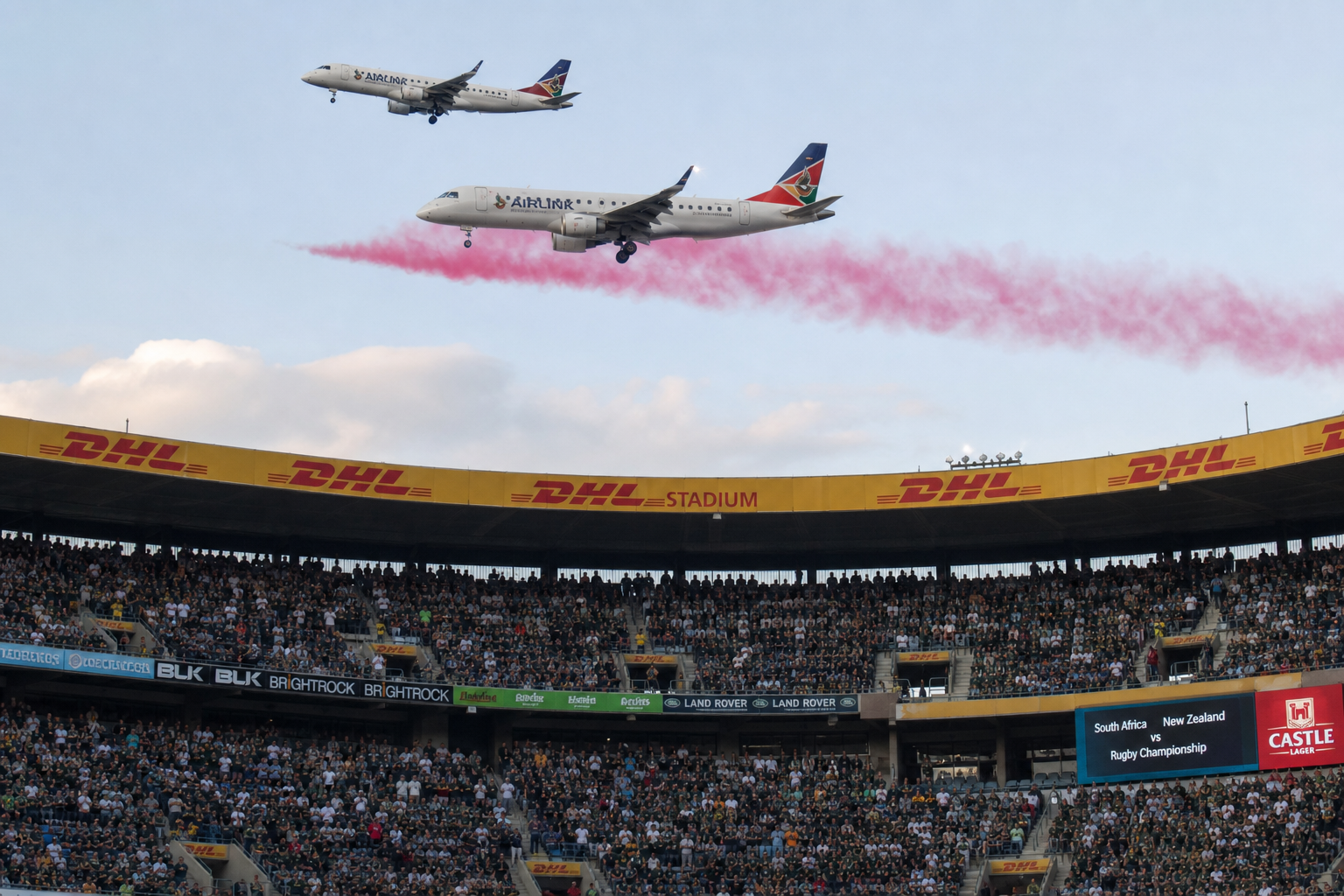
Airlink, a South African airline, has defended a highly publicised flypast involving two of its aircraft over Cape Town’s DHL Stadium. The planes flew in close formation at an altitude reportedly less than 50 feet above the stadium, which was packed with more than 50,000 spectators preparing to watch a rugby match between South Africa and New Zealand. Smoke flares were released as the aircraft passed overhead.
The stunt prompted mixed reactions. Some observers described it as reckless because of the potential consequences of an accident involving two aircraft above a crowded venue. Others praised the pilots’ skill and the precision needed to execute the manoeuvre. Airlink said the flypast was carefully planned in cooperation with aviation authorities. The airline stated that the aircraft were operated by highly experienced crews, with three senior captains on each plane serving as commander, co-pilot, and safety or technical officer. It also said the flight followed approved and rehearsed altitude and speed limits.
Flight-tracking service Flightradar24 analysed the flight and reported that the lead aircraft passed less than 50 feet above the stadium roof. Despite safety concerns, the stunt also generated considerable national pride in South Africa. Sports Minister Gayton McKenzie praised the country’s pilots and called the display spectacular.
Low-altitude aircraft flypasts have become part of the build-up to major sporting events in South Africa. The article recalls a particularly symbolic 1995 flypast, when a South African Airways aircraft passed over Johannesburg’s Ellis Park stadium before the Rugby World Cup final between South Africa and New Zealand. That match, later depicted in the film “Invictus,” was associated with Nelson Mandela’s efforts to use sport to promote national unity after apartheid.
Entities: Airlink, Cape Town, DHL Stadium, South Africa national rugby team, New Zealand All Blacks • Tone: analytical • Sentiment: neutral • Intent: inform
31-08-2026
Two passenger jets performed an unusually low flyover above the packed DHL Stadium in Cape Town, South Africa, during the second Test match of the Castle Double Malt Rugby’s Greatest Rivalry between South Africa and New Zealand. The aircraft passed one after the other over more than 56,000 spectators, prompting both amazement and questions about aviation safety.
Marcel Opperman, a spectator who recorded the flyover, said he felt no danger but described the experience as extraordinary, calling it “probably one of my top-five moments” in his life. Preliminary flight data estimated that the planes passed approximately 50 feet above the stadium. Airline captain Laura Einsetler characterized that clearance as exceptionally low for full-size passenger aircraft, noting that airliners differ significantly from the fighter jets typically used in ceremonial flyovers. She said the altitude, speed and flight angles were too low for that type of aircraft in that setting.
The flyover also reflected a South African rugby tradition dating back more than 30 years. In 1995, shortly after the country’s first democratic elections, a South African Airways Boeing 747 flew low over a Johannesburg stadium during a Rugby World Cup final as South Africa emerged from apartheid.
Airlink, the airline involved in the latest flyover, defended the operation as safe. The company said the flight required extensive planning and rehearsal, and that the South African Civil Aviation Authority and Air Traffic Navigation Services provided guidance, approval and support. Airlink also said the pilots were senior and experienced and complied with altitude and speed limits established by South African aviation authorities. The report therefore presents the event as both a thrilling spectacle for spectators and a technically demanding maneuver that raised legitimate safety concerns.
Entities: Marcel Opperman, Laura Einsetler, Airlink, CBS News, DHL Stadium • Tone: analytical • Sentiment: neutral • Intent: inform
31-08-2026
South African airline Airlink has defended a low-level formation flyover involving two of its jets over Cape Town’s DHL Stadium before a rugby test match between South Africa and New Zealand. The aircraft flew above a reported crowd of more than 50,000 spectators, prompting cheers from the stadium and widespread circulation of dramatic footage online. However, the manoeuvre also generated concern among aviation professionals and members of the public who questioned whether the aircraft had flown too close to the stadium roof.
Flight-tracking company Flightradar24 estimated that the lead aircraft passed approximately 41 to 46 feet above the roof. Airlink said the flyby required extensive planning and rehearsal because it involved low-altitude flight at about 150 knots. The airline stated that the South African Civil Aviation Authority and Air Traffic Navigation Services had provided guidance, approval and support to help ensure the operation was conducted safely. Airlink also promoted the flyover on X with the slogan “Planning. Precision. Performance.”
South Africa’s Minister for Sports, Arts and Culture, Gayton McKenzie, praised the display as “spectacular” and jokingly suggested that the pilots might land on the field during a future event. Scottish pilot Scott Bateman took a sharply different view, saying he was “aghast” at the reported clearance. He argued that the concerns raised by professional aviators deserved a substantive response rather than dismissal. Bateman emphasized that aviation safety depends on investigating situations that nearly go wrong, not simply defending operations that appear to have succeeded. The article therefore presents the flyover as both a crowd-pleasing spectacle and a subject of continuing debate over aviation risk, regulatory oversight and acceptable safety margins.
Entities: Airlink, Cape Town, DHL Stadium, South Africa, New Zealand • Tone: analytical • Sentiment: neutral • Intent: inform
31-08-2026
A dramatic pre-match flyby by two Airlink Embraer passenger jets over Cape Town Stadium before the second rugby union Test between South Africa and New Zealand has prompted debate about aviation safety. The aircraft, which were not carrying passengers, passed at an altitude estimated by Flightradar24 to be just 41–46 feet above the stadium roof. The second jet flew through a cloud of pink dust released from the roof as part of the pre-game spectacle, drawing enthusiastic cheers from an estimated 56,000 spectators and widespread attention online.
Airlink, a sponsor of the South African rugby team, defended the stunt, saying it was carefully planned, rehearsed and conducted within civil aviation regulations. The airline said the jets flew at approximately 150 knots and that each aircraft carried three senior captains serving as commander, co-pilot and safety officer. Airlink also credited the South African Civil Aviation Authority and Air Traffic Navigation Services with providing guidance, approval and support.
The flyby forms part of South African rugby’s long-standing tradition of aircraft displays at major matches, dating back to a Boeing 747 flyover before the 1995 World Cup final between South Africa and New Zealand. However, aviation experts said this latest maneuver was unusually low and left little room for error. Chris Martinus of the Aircraft Owners and Pilots Association South Africa questioned the aircraft’s ability to respond to an emergency at that altitude. Australian aviation consultant and former pilot Keith Tonkin warned that the event could establish a dangerous precedent, noting that turbulence or a bird strike might leave pilots with insufficient space to maneuver. Airlink maintained that recorded flight data confirmed the jets stayed within permitted speed and altitude limits.
Entities: Airlink, South African Civil Aviation Authority, Air Traffic Navigation Services, South Africa rugby union team, New Zealand rugby union team • Tone: analytical • Sentiment: neutral • Intent: analyze