31-08-2026
A Nepali head teacher evacuated about 1,600 students just minutes before devastating floods destroyed their school in Nuwakot district. Rajendra Dawadi, head teacher of Tribhuvan Trishuli Secondary School, said he acted after receiving warnings about an approaching flood and hearing from a parent who had come to collect a child. He estimated that delaying the evacuation by 10 minutes could have cost the lives of the students and staff. A local resident said the three-storey school building was completely swept away.
Students at another school, Shree Bagheswori Madhyamik School in Galchhi, Dhading district, survived after teachers ordered them to leave their classrooms. Some children were away at lunch when the floodwaters arrived, while others escaped after being told to abandon their schoolbags and lunch boxes. Families later returned to the mud-filled school to search for belongings. Flood sediment covered benches, walls, notebooks and the courtyard, with waterlines showing how rapidly the water had risen.
The disaster has severely disrupted education across Nepal. Save the Children reported that at least 69 schools in flood-affected districts had been destroyed or damaged, putting the education of nearly 19,000 children at risk. The government closed schools and universities for three days and paused university examinations, but continuing flood warnings have made the timing of reopening uncertain.
Nepal Police reported at least 794 deaths and more than 2,500 people missing. In Tibet's Gyirong County, Chinese authorities reported 16 deaths and 546 missing people. The article highlights both the devastating scale of the floods and the lifesaving impact of rapid evacuation decisions by teachers and communities.
Entities: Rajendra Dawadi, Surinder, Lakshmi Shrestha, Kopila Mizar, Tribhuvan Trishuli Secondary School • Tone: urgent • Sentiment: negative • Intent: inform
31-08-2026
Al Jazeera reports on an interview with Nepal’s Foreign Minister, Shisir Khanal, concerning devastating floods near Nepal’s border with China. The floods have caused more than 900 deaths, making the disaster one of the most serious emergencies described in the brief report. Khanal says Nepal and China are working together to establish a data-sharing mechanism designed to identify potential flood risks. The proposed cooperation suggests an effort to improve cross-border monitoring, early warning systems, and disaster preparedness in areas where flooding may affect communities on both sides of the border.
The report is presented as a direct conversation between the Nepalese foreign minister and Al Jazeera, rather than as a detailed account of the flooding itself. The available text does not provide information about the precise locations affected, the extent of infrastructure damage, the number of people displaced, or the causes and timing of the floods. It also does not describe specific relief operations or identify additional governments and aid organizations involved in the response.
Published on 31 August 2026, the report focuses on two central facts: the severe human cost of the floods and Nepal’s planned cooperation with China to reduce future risks. Khanal’s comments frame information sharing as an important part of managing hazards in a region where flood threats can cross national boundaries. The article therefore serves both as a brief update on the disaster and as an indication of a developing Nepal-China coordination effort focused on risk identification and preparedness.
Entities: Shisir Khanal, Nepal, China, Al Jazeera, Nepal-China border • Tone: urgent • Sentiment: negative • Intent: inform
31-08-2026
An Al Jazeera Newsfeed report describes survivors returning to their homes in Nepal’s Nuwakot district after devastating flash floods. Residents are searching through mud and debris for belongings that were left behind when floodwaters and sediment swept through the area. The destruction followed a glacier collapse that sent large quantities of mud and debris through mountain valleys, causing extensive damage and a major loss of life.
According to the report, at least 781 people have been killed and more than 2,500 remain missing. The figures indicate the scale of the disaster and the continuing uncertainty facing families whose relatives have not been located. The survivors shown returning home are engaged in an immediate recovery effort, attempting to retrieve personal possessions from damaged or buried homes.
The report focuses on the aftermath rather than detailing the broader emergency response or the causes of the glacier collapse. Its imagery and description emphasize the physical devastation in Nuwakot and the personal consequences for affected communities. The article was published on 31 August 2026 and presents the situation as an ongoing humanitarian disaster, with residents still searching for belongings while many people remain unaccounted for. The concise news report informs viewers about the continuing recovery and the severe human toll of the floods.
Entities: Nepal, Nuwakot district, Al Jazeera, Flash floods, Glacier collapse • Tone: neutral • Sentiment: negative • Intent: inform
31-08-2026
Devastating floods and mudslides near Nepal’s border with China have killed at least 939 people in Nepal, according to the country’s disaster authority. Chinese state media has reported 16 additional deaths in Tibet, bringing the known regional death toll to 955. Rescue operations are entering their sixth day, while 4,471 people remain missing on both sides of the border.
Nepal’s latest figures list 3,925 people missing nationwide, including 592 foreigners. Many of those unaccounted for were working on hydropower projects that were struck by the floods. The number of missing hydropower workers has fallen from 933 to 639, although officials continue to revise the figures. Nuwakot is among the worst-affected districts, with 1,158 people missing, followed by neighboring Rasuwa, where 865 remain unaccounted for. Missing personnel also include soldiers, police officers, and customs and immigration officials.
Authorities in India’s Uttar Pradesh state have recovered 17 bodies from rivers flowing from Nepal. These victims are believed to have been killed in the floods but have not yet been added to the official death toll.
The accompanying photographs document the disaster’s human impact. They show relatives conducting cremations, soldiers and paramilitary personnel recovering and carrying bodies, residents searching for missing family members, and people salvaging belongings from devastated communities. Families have posted photographs of missing people at a hospital in Kathmandu while seeking information. With mortuaries overwhelmed, Nepal has begun taking DNA samples before burying some recovered bodies so relatives may later identify and reclaim them. Kathmandu has appealed for international assistance, including more than 1,000 freezer units to store the dead.
Entities: Nepal–China border floods, Nepal, Tibet, Nuwakot district, Rasuwa district • Tone: urgent • Sentiment: negative • Intent: inform
31-08-2026
The article reports the account of Rajendra Dawadi, a school principal in Nepal who evacuated more than 900 students to safety during devastating floods. Dawadi recalls carrying out the evacuation before seeing the school itself disappear beneath the rising floodwaters. His experience illustrates both the immediate danger faced by students and the scale of the destruction caused by the disaster. The report places the principal’s actions within a wider national tragedy, stating that the floods have killed more than 900 people and that nearly 5,000 others remain missing. The article is presented as a video news report published by Al Jazeera on 31 August 2026. Its focus is on personal testimony and emergency response rather than a detailed explanation of the flooding’s causes, the affected regions, or the broader government response. By highlighting Dawadi’s efforts, the report emphasizes the urgency of protecting vulnerable people during a rapidly unfolding natural disaster. The destruction of the school after the evacuation underscores the severity of the flooding and the narrow window available to get the students to safety. The casualty and missing-person figures convey that the principal’s experience was part of a much larger humanitarian emergency affecting Nepal. Overall, the report informs audiences about the disaster through a first-person recollection of rescue and loss, while underscoring the continuing scale and human cost of the floods.
Entities: Rajendra Dawadi, Nepal, Al Jazeera, Nepalese school students, More than 900 students • Tone: urgent • Sentiment: negative • Intent: inform
31-08-2026
The supplied text does not include the body of the AP News article. Instead, it consists almost entirely of AP’s site-wide navigation, section labels, newsletter promotions, and unrelated headlines. The available article headline reports that hundreds of people are feared to be trapped inside hydropower tunnels following severe flooding in Nepal. A related headline expands the reported scope of the disaster, stating that flood deaths in Nepal and Tibet have surpassed 950. Another AP listing refers to the “odds of survival” for people trapped after the Nepal flood, reinforcing the seriousness and urgency of the situation.
Based on the supplied material, the flooding appears to be a major regional disaster affecting Nepal and Tibet, with potentially catastrophic consequences for people inside underground hydropower infrastructure. However, the extract provides no details about the affected hydropower project, the identities or occupations of those feared trapped, the specific locations, the timing of the floods, rescue operations, official casualty figures, or whether the reported deaths have been confirmed by authorities. It also does not provide statements from government agencies, emergency responders, hydropower operators, survivors, or relatives.
Consequently, the headline-level information supports only a limited summary: widespread flooding has caused a very high death toll across Nepal and Tibet, while hundreds may remain trapped in hydropower tunnels in Nepal. The event is presented as an unfolding emergency, and the word “feared” indicates that the number of trapped people may not yet be confirmed. A full and reliable account would require the missing article body and subsequent official updates.
Entities: Nepal, Tibet, AP News, Hydropower tunnels, Severe flooding • Tone: urgent • Sentiment: negative • Intent: inform
31-08-2026
The supplied content is primarily an AP News webpage navigation and topic index rather than the article itself. It includes the headline “Hundreds of workers feared stuck in hydropower tunnels after catastrophic flooding in Nepal” and a related top-story listing stating that Nepal’s flood deaths had crossed 900. Based on those elements, the report concerns a major flooding disaster in Nepal, with hundreds of workers potentially trapped inside tunnels connected to a hydropower project. The wording indicates an unfolding emergency involving possible entrapment, rescue efforts, and a large-scale loss of life.
The material provided does not include the article’s body, so it does not provide reliable details about the affected hydropower facility, the exact number of missing or trapped workers, the location of the tunnels, the flood’s cause, the government or rescue agencies involved, or the status of rescue operations. It also does not explain whether the reported death toll includes casualties in neighboring areas such as Tibet or China, although those places appear in the page’s broader navigation and related coverage. Consequently, a full account of the disaster cannot be reconstructed without the missing article text. The available headline and listing nevertheless convey the severity and urgency of the situation: widespread flooding has reportedly caused more than 900 deaths in Nepal, while hundreds of workers may remain isolated underground. The article’s apparent primary purpose is to inform readers about the developing disaster and alert them to the danger facing the workers and surrounding communities.
Entities: Nepal, Hydropower tunnels, Hydropower workers, Catastrophic flooding, Flash floods • Tone: urgent • Sentiment: negative • Intent: inform
31-08-2026
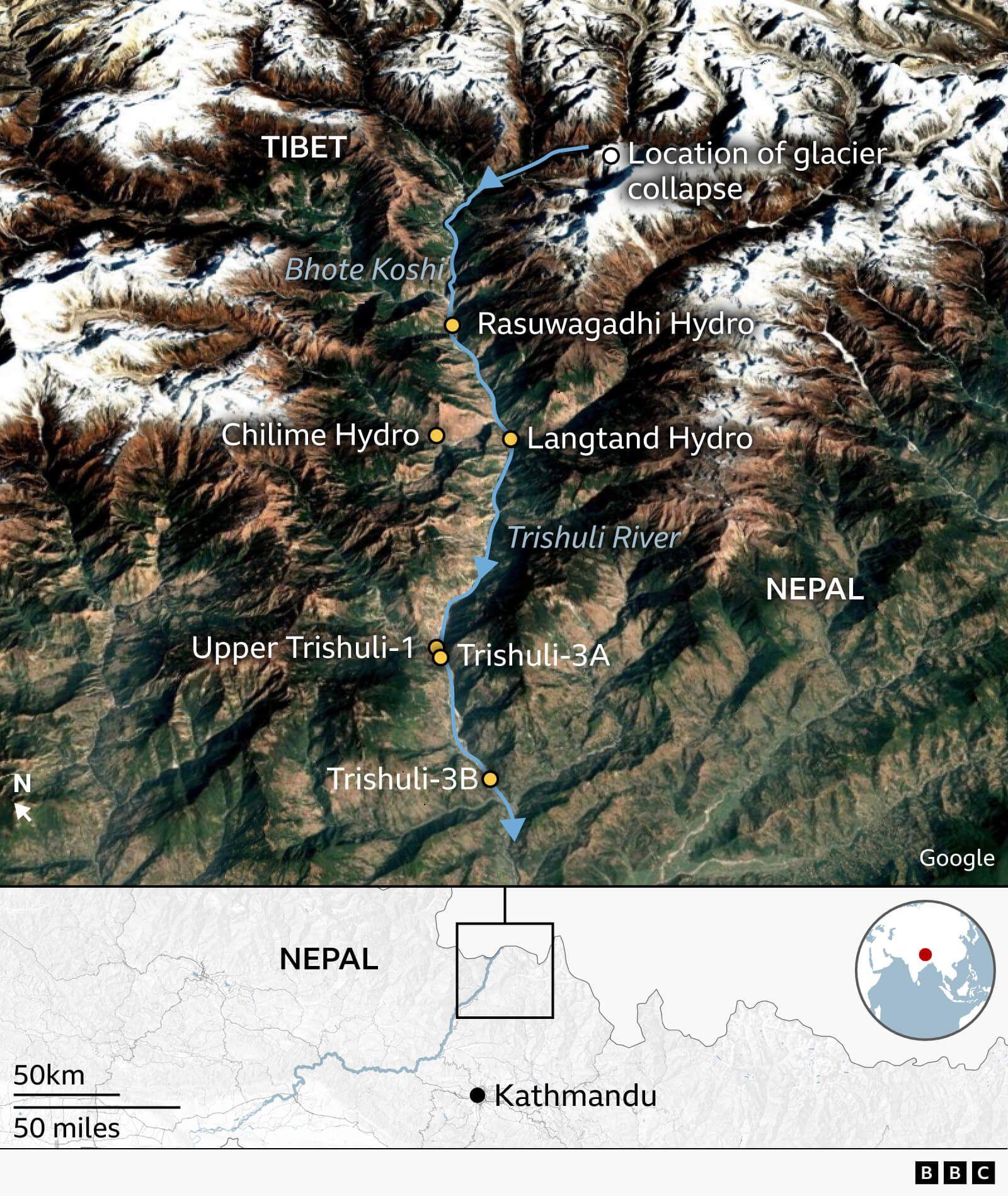
More than 600 workers are feared trapped in mud-filled tunnels at hydropower projects along Nepal’s Trishuli River after devastating floods on the Nepal-Tibet border. Rescuers are using explosives to blast through hillsides and pumping air into the Trishuli-3A site, but families fear the opportunity to save survivors is rapidly disappearing. A team that entered one tunnel on Monday found nobody and withdrew, while rescuers continue to struggle to locate several buried or destroyed access routes.
Nepal’s disaster management authority has reported 939 deaths and 3,925 missing people, including 592 foreign nationals. Prime Minister Balendra Shah said 279 people had been rescued from the hydropower sites and that 11,379 people had been rescued overall. The operation involves Chinese and Nepalese military personnel, with experts from India, South Korea and Australia also contributing. Families have criticized the pace of the response, saying air should have been pumped into the tunnels sooner, but some continue to hope that oxygen systems and the underground environment may have protected workers.
At least 11 hydropower projects were damaged. Australian tunnelling expert Arnold Dix described the area as a “lunar landscape”, with boulders larger than houses and the original tunnel locations difficult to identify.
Downstream in Chitwan, nearly 300 bodies carried by the rivers have reached the riverbanks. Because authorities lack sufficient freezer space, unidentified remains are being temporarily buried while medical teams collect DNA samples for identification. In Tibet, Chinese state media reports 16 deaths and 546 missing people, while flood footage and online discussion of higher casualty figures have reportedly been censored. Nepalese authorities have also ordered the removal of content they consider misinformation.
Entities: Nepal, Trishuli River, Trishuli-3A hydropower site, Nepal-Tibet border floods, Nepal Army • Tone: urgent • Sentiment: negative • Intent: inform
31-08-2026
Rescuers in Nepal are racing to reach hundreds of hydropower workers believed to be trapped in tunnels after catastrophic flash floods and mudslides along the Nepal-China border. The combined death toll in Nepal and China has surpassed 950, while more than 4,400 people remain missing. Nepal’s Independent Power Producers’ Association says at least 900 workers are unaccounted for at 12 damaged hydropower projects, with approximately 500 thought to be inside tunnels buried by mud and debris.
Four bodies have been recovered from three tunnels, but the prospects of finding survivors are declining six days after the disaster. Some workers reportedly contacted relatives or authorities when the flooding began, while others who escaped said colleagues remained underground. Experts believe some trapped workers may still have oxygen, but they urgently need food, water and a way out. Australian tunnel-rescue specialist Arnold Dix has joined the effort, although rescuers face a severe shortage of heavy equipment and limited experience with disasters of this scale.
Operations are focused on projects in Nepal’s Rasuwa and Nuwakot districts, including Upper Trishuli-1, where about 300 workers may be trapped, and Trishuli-3, where crews are digging roughly 15 metres into a tunnel. The flooding also damaged infrastructure serving thousands of people in the region.
On the Chinese side, authorities are rebuilding a road to the Gyirong Port border crossing, which is submerged under several metres of water. Chinese officials reported 16 deaths and 546 missing people, while Nepal reported 939 deaths and 3,925 missing, including foreigners. About 30 Canadians are still unaccounted for. Families remain frustrated by limited information but continue to hope their relatives are alive, including the family of Gireesh Raina, who disappeared during a pilgrimage to Mount Kailash.
Entities: Nepal, China, Arnold Dix, Mohan Kumar Dangi, Uttam Bhlon Lama • Tone: urgent • Sentiment: negative • Intent: inform
31-08-2026
Five days after a mountainside and glacier collapsed near Nepal’s border with Tibet, unleashing catastrophic flash floods, mud and debris, rescue teams continued searching for survivors while the disaster’s death toll and missing-person count rose. Nepal’s national disaster agency reported at least 903 deaths and approximately 4,200 people still missing. The collapse destroyed infrastructure and swept through Himalayan valleys, with floodwaters and debris traveling as far as 150 miles into neighboring India.
Hope remained after rescuers pulled a 6-year-old girl alive from mud-covered rubble over the weekend. However, heavy monsoon rains caused the Trishuli River to surge again Monday, adding to the danger and forcing search teams to accelerate their efforts. The continuing flooding has complicated recovery operations and raised fears that the death toll will increase.
The disaster has left families in Nepal, the United States and elsewhere waiting for information about missing relatives. Samarth Srivastav told CBS News that his father, Vivek, was near the Nepal-Tibet border when the floods struck and has not been heard from since. Samarth described mounting anxiety and the painful uncertainty of not knowing whether his father is alive.
At Kathmandu’s Tribhuvan University Teaching Hospital, walls were covered with photographs of recovered bodies so relatives could search for missing loved ones. The images were disturbing, but families had few alternatives for identifying the dead.
American families also said they wanted more assistance from U.S., Chinese and Nepalese authorities. Conflicting reports about possible survivors have produced a rollercoaster of emotions, while Chinese officials have not confirmed whether foreign tourists in Tibet survived. Despite the worsening conditions and limited official information, families continued to hope that their loved ones might still be found alive.
Entities: Nepal, Tibet, Trishuli River, Kathmandu, Rasuwa district • Tone: urgent • Sentiment: negative • Intent: inform
31-08-2026
Nepal remains on high alert for additional flooding after water levels rose in the Bhotekoshi River, prompting authorities to warn residents in already devastated districts to move to safer ground if necessary. Nepal’s disaster agency reported 903 deaths and 4,247 people missing, while Chinese authorities reported 16 deaths and 546 missing on the Chinese side of the border. The warnings have intensified the fear and exhaustion of survivors, many of whom have repeatedly fled their homes amid alarms, rain and the continuing threat of flash floods.
In Dhading, one of Nepal’s hardest-hit regions, residents have begun returning to homes damaged or destroyed by the floods to search for belongings, clear mud and rubble, and recover livestock. A major power plant serving more than 20,000 people in four districts was also badly damaged and inspected for the first time after the disaster. Rescue workers faced additional challenges as they worked to clear a major highway linking Kathmandu with affected areas.
The disaster has also affected foreign nationals. The U.S. State Department said 85 Americans remained unaccounted for, while nine had been evacuated and no American deaths were known. The United States activated $3.6 million in emergency humanitarian aid. Chinese state media reported that 261 foreigners were missing in Tibet, including more than 100 Nepalis.
The flash floods began after a glacial collapse in the Himalayas caused a massive rockfall and sent melted water and debris into rivers flowing through Tibet and Nepal. Scientists said it was too early to directly attribute the event to climate change, but warned that rising global temperatures are increasing the likelihood of such disasters, particularly in the rapidly warming Himalayas. Nepal’s foreign minister called for a global response, and Malaysia pledged search-and-rescue assistance and $1 million in aid.
Entities: Nepal, Kathmandu, Dhading district, Bhotekoshi River, Trishuli River • Tone: urgent • Sentiment: negative • Intent: inform
31-08-2026
The article examines how Chinese authorities managed public information after a catastrophic flash flood and mudslide struck the China-Nepal border on August 26. While Nepal faced widespread destruction, hundreds of deaths and thousands of missing people, the disaster’s impact in Tibet was accompanied by what the article describes as a rapid digital suppression campaign. Eyewitness footage showing a torrent destroying the national border gate at Gyirong Port reportedly disappeared from WeChat, including private messages. China Digital Times said the imagery was targeted not because it showed violence or political dissent, but because the destroyed border gate symbolized state vulnerability.
The article argues that Chinese censorship has evolved beyond simple keyword blocking. Authorities and platforms now use video fingerprinting, image hashing and machine-learning systems to identify and block specific visual material. At the same time, platforms such as Xiaohongshu and Weibo allegedly flood users with official reports, maps, scientific explanations and polished rescue footage. This “saturated information” strategy fills online spaces with state-approved material, limiting the visibility of eyewitness accounts while presenting the government as competent and responsive.
The official narrative emphasized President Xi Jinping’s coordination of relief efforts and Premier Li Qiang’s arrival at Gyirong. However, a hashtag noting that the port had reopened only six months earlier briefly gained significant attention before being deleted, raising questions about infrastructure failures and possible negligence.
The article also describes the continuing humanitarian crisis. In Nepal and Tibet, rescue teams searched through mud, debris and blocked tunnels for missing people. More than 900 people were reported dead and nearly 5,000 missing in the broader disaster, including workers at hydroelectric projects. Difficult terrain, bad weather and collapsed infrastructure complicated the rescue effort.
Entities: China, Tibet, Nepal, Gyirong Port, WeChat • Tone: analytical • Sentiment: negative • Intent: analyze
31-08-2026
Nepal’s devastating flash floods are putting Prime Minister Balendra Shah, popularly known as “Balen,” and his young, largely inexperienced government under its first major national test. The floods swept through areas near the Chinese border, carrying mud, rocks, ice and debris that destroyed towns, roads and bridges and damaged hydropower facilities. Authorities said more than 900 people had been confirmed dead and nearly 4,800 remained missing as rescue operations entered their sixth day. Hundreds of workers may be trapped in tunnels at hydropower construction sites, while families across affected districts continue searching for missing relatives.
The government has acknowledged that it was initially confused and unprepared for a disaster of this magnitude, the deadliest in Nepal since the 2015 earthquake. Security agencies have received praise for using helicopters to reach inaccessible areas, but the response has also exposed weaknesses in coordination between the federal government and provincial and local authorities. Critics say the administration adopted an overly centralized approach and failed to involve local governments, communities and volunteers sufficiently.
The government initially resisted outside assistance, believing Nepal’s rescue teams could manage the operation. It later sought specialized help from China and India for tunnel rescues, DNA testing and forensic work. Former officials criticized the delay, arguing that three crucial days were lost before international experts were allowed to deploy.
Despite the criticism, the government’s disaster relief fund had collected more than 5 billion Nepali rupees, which some observers viewed as evidence of public trust in Shah’s administration. Officials maintain that all available resources are being mobilized and that the immediate priority is saving lives. The floods therefore represent both a humanitarian catastrophe and a crucial test of whether Shah’s administration can make fast decisions, coordinate across levels of government and manage a national emergency effectively.
Entities: Nepal, Balendra Shah (Balen), Rastriya Swatantra Party, China, India • Tone: analytical • Sentiment: negative • Intent: analyze
31-08-2026
This France 24 video report examines the aftermath of deadly flooding in Nepal, focusing on survivors in Sinchaur, a village in the Nuwako district that was hit on August 26, 2026. While rescue teams continue searching areas that may contain survivors, people who escaped the floods face a second crisis: securing shelter, food, and the basic resources needed to survive. The report presents recovery as an ongoing ordeal rather than a completed rescue operation. Survivors are attempting to rebuild their lives amid extensive destruction and loss, while remaining concerned that further flooding could worsen the situation. The video’s on-the-ground perspective highlights the human consequences of the disaster and the uncertainty faced by affected communities. It also places the experiences of villagers alongside continuing emergency operations, including searches for possible survivors. The report was produced by France 24 special correspondents Ondine de Gaulle and Shahzaib WAHLAH. Overall, the piece provides a concise field report on the immediate humanitarian challenges following Nepal’s floods, emphasizing survival, displacement, recovery, and the continuing threat posed by additional flooding. It does not provide detailed casualty figures or extensive information about the causes of the disaster, instead concentrating on the experiences of survivors and the practical difficulties of beginning to rebuild after the catastrophe.
Entities: Nepal, Sinchaur, Nuwako district, France 24, Ondine de Gaulle • Tone: urgent • Sentiment: negative • Intent: inform
31-08-2026
The France 24 report examines Nepal’s devastating floods through the analysis of Dr. Basanta Raj Adhikari, director of the Center for Disaster Studies at Tribhuvan University’s Institute of Engineering. Adhikari describes the disaster as evidence that conventional approaches to disaster prevention are reaching their limits in the Himalayas, where the terrain is exceptionally steep, complex and difficult to monitor comprehensively.
The hazards facing Nepal extend beyond conventional flooding. Flood velocities in the affected events were estimated at between 170 and 180 kilometres per hour, while the country is also exposed to ice and snow avalanches and glacial lake outburst floods. Because these hazards can develop across remote and highly varied mountain terrain, Adhikari argues that it is effectively impossible to predict or monitor every extreme event using existing methods.
However, his assessment is not fatalistic. Rather than focusing exclusively on predicting each disaster, he recommends a shift toward risk-informed adaptation. Nepal should use satellite observation to identify high-risk areas and “hotspots,” then reinforce that information through ground-based monitoring and early-warning systems. The resulting data should be incorporated into risk-sensitive land-use and urban planning so that settlements and infrastructure are better positioned to withstand unavoidable hazards.
The report therefore presents Nepal’s floods not only as an immediate humanitarian and environmental disaster, but also as a warning about the need to rethink prevention and development in mountain regions. Its central argument is that reducing future losses will require combining modern monitoring technologies with locally informed planning and engineering approaches suited to the Himalayas’ extreme conditions.
Entities: Nepal, Dr. Basanta Raj Adhikari, Center for Disaster Studies, Tribhuvan University, Institute of Engineering • Tone: analytical • Sentiment: negative • Intent: analyze
31-08-2026
Four days after catastrophic flooding struck villages along Nepal’s border with China, more than 2,400 people remain missing and families are desperate for information. Nepal’s Foreign Secretary Amrit Bahadur Rai said 734 bodies had been recovered after nearly 30-foot waves of water swept through mountain valleys. The Red Cross estimates that more than 90,000 people have been affected, while rescue teams continue searching and have found some survivors.
At least 85 Americans remain unaccounted for, according to U.S. State Department spokesperson Tommy Pigott. Nine Americans have been evacuated safely, and the State Department says it is not aware of any American deaths. Many of the missing Americans were tourists, hikers or pilgrims traveling to Mount Kailash, a sacred site in China’s Tibet Autonomous Region.
The article focuses on two families searching for relatives. Ragu Rajan and Archana Suresh of Murphy, Texas, were traveling to Mount Kailash when flooding destroyed the Gyirong Port border crossing and the Friendship Bridge between Nepal and China. Deepak and Madhu Ahuja, U.S. citizens from Dallas, had completed a pilgrimage and were returning to the border when they lost contact with their daughter.
The United States has increased support for its embassies in Kathmandu and Beijing and activated $3.6 million in emergency assistance. Catholic Relief Services is helping distribute food and other supplies, but blocked roads and mudslides are making deliveries difficult. Initial aid shipments to Rasuwa and Nuwakot included blankets, mosquito nets, shelter materials and food.
Authorities warn that further monsoon rains through Sept. 1 could trigger additional flash floods, debris flows, landslides and travel disruptions, complicating rescue and relief efforts.
Entities: Nepal floods, Nepal-China border, Kathmandu, Nepal, Amrit Bahadur Rai, Tommy Pigott • Tone: urgent • Sentiment: negative • Intent: inform
31-08-2026
The article examines growing criticism of Nepal’s initial reluctance to accept foreign assistance after catastrophic floods and mudslides in the country’s Himalayan border region. The disaster, triggered by an ice-and-rock avalanche, has killed 903 people and left 4,247 missing, according to Nepal’s disaster management department. Debris has also blocked nine hydropower tunnels in the Rasuwa and Nuwakot districts, trapping 933 workers from Nepal, South Korea and China.
Bhim Gautam, head of Nepal’s Independent Power Producers Association, says the country lacked the equipment, technology and expertise needed to locate and rescue workers from the damaged tunnels. He claims industry leaders pressured the government to permit foreign rescue teams and argues that approval for teams from China, India and Australia came too late. Nepal’s finance minister, Swarnim Wagle, rejected claims that the government had refused outside help, saying assistance was accepted according to conditions on the ground. Prime Minister Balen Shah later said Nepali security forces and experts from India, China and South Korea were conducting rescue operations.
Political analyst Chandradev Bhatta attributes the hesitation partly to geopolitical concerns. Nepal’s leaders remain sensitive to foreign influence after the 2015 earthquake, when China, India and Western countries competed for influence during reconstruction. Bhatta also says the government may have underestimated the scale of the disaster. Public criticism intensified online, with activists accusing officials of prioritizing nationalism over saving lives.
The article also reports that China denied concealing early warnings or casualty information about flooding and mudslides near its border with Nepal. China’s last reported figures—16 confirmed dead and 546 missing—had not been updated for more than 48 hours, raising further questions about the disaster’s toll and official transparency.
Entities: Nepal, Nepal-Tibet border region, Rasuwa and Nuwakot districts, Trishuli River flooding, Ice-and-rock avalanche • Tone: analytical • Sentiment: negative • Intent: analyze
31-08-2026
China and Nepal are conducting urgent rescue operations after catastrophic flooding struck the Nepal-Tibet border the previous Wednesday. More than 4,700 people remain missing, including dozens of Americans, while the reported death toll has risen above 900. Rescue teams are searching for survivors and attempting to clear routes into the hardest-hit area around the Gyirong-Rasuwa border checkpoint. Access has been extremely difficult: some teams have had to hike for days, crawl through deep mud, and work through continuing rain. Floodwaters reportedly rose nearly 200 feet along parts of the Himalayan valley.
On the Nepalese side, many of the missing are local residents, while authorities are also searching for more than 900 workers stranded at hydropower plant sites. On the Tibet side, victims and missing people include tourists, adventure travelers heading to Mount Kailash, and Hindu and Buddhist pilgrims. Nepal has regularly released names and nationalities, but Chinese authorities initially provided only figures and waited five days before disclosing the nationalities of missing foreign nationals. NPR correspondent Jennifer Pak says reporting from Tibet has been limited because the region is politically sensitive and foreign journalists face restrictions, leaving international coverage dependent largely on Chinese state media.
Chinese researchers say the disaster unfolded within minutes after a large section of a glacier in Nepal broke off and plunged roughly 4,000 feet down a Himalayan valley, carrying water, ice and mud into Tibet and Nepal. They attributed the glacier’s instability to global warming. The Isha Foundation, which had 80 pilgrims in the area, has called for stronger coordination between the two governments, including a possible common consultative process for the Himalayan region.
Entities: China, Nepal, Tibet, Gyirong-Rasuwa border checkpoint, Jennifer Pak • Tone: urgent • Sentiment: negative • Intent: inform
31-08-2026
A catastrophic flood in Nepal’s Himalayan region has killed more than 900 people, while over 4,700 remain missing, according to Nepal’s disaster agency. Rescue teams are working continuously near the Nepali-Tibetan border, searching muddy terrain and damaged infrastructure for survivors. Officials said 592 of those missing are foreigners.
Among the missing are 85 Americans, many of whom were visiting the region as part of a religious pilgrimage to Mount Kailash, a sacred site for Hindus, Buddhists and other faiths. The article identifies Long Island residents Amita Amin and Jitendra Manubhai Patel, as well as New Jersey resident Tejal Vyomesh Patel, as three of the missing Americans. Nine Americans have been evacuated safely, according to the U.S. State Department, which is coordinating with American embassies in Nepal and China.
The remote and mountainous disaster zone is complicating rescue operations. Teams are searching tunnels and hydropower facilities where workers may be trapped, while roads and villages have been destroyed by flash floods and mudslides. State Department spokesman Tommy Pigott said U.S. officials were communicating with local authorities around the clock and seeking reliable information about the missing Americans. The department has also activated $3.6 million in emergency humanitarian assistance, intended to support 10,000 affected households and help rebuild destroyed roads.
The disaster occurred near the Rasuwagadhi border post after a glacier collapse and landslide triggered a massive surge of water. The flooding swept away entire villages and was described by local officials as a “tsunami from the sky.” Nepal has begun burying hundreds of bodies recovered from the Himalayan region as rescue and recovery efforts continue.
Entities: Nepal, Tibet and the Nepali-Tibetan border, Rasuwa district, Rasuwagadhi border post, Mount Kailash pilgrimage • Tone: urgent • Sentiment: negative • Intent: inform
31-08-2026
Rajendra Dawadi, principal of Tribhuvan Trishuli Secondary School in Nepal’s Trishuli Valley, evacuated hundreds of students just before catastrophic flash floods swept through the area. Dawadi was in his classroom when colleagues and a parent warned that floodwaters were racing through the valley after a glacial collapse in the Himalayas. Although the danger had not been fully confirmed, he rang the school bell, ordered students and staff toward higher ground, and instructed bus drivers not to bring additional students to campus. At least 900 students were at the school that morning. One bus had already arrived, but Dawadi told its driver to turn around; shortly afterward, a nearby older bridge collapsed.
As Dawadi and the students reached safety, the school building was destroyed by water, mud, boulders and debris. Two staff members remain missing. The disaster reportedly killed more than 900 people across Nepal and China, while over 4,700 remain missing. Dawadi’s school had been both his workplace and the institution where he was educated, making its destruction especially painful. Parents later embraced and thanked him, while 14-year-old student Suvina Tamang said she would thank him for saving her life.
Dawadi rejects the label of hero, saying that evacuating the children was his responsibility. He is now focused on the students’ recovery, including psychological counseling and the resumption of classes, even if the school must temporarily relocate. The floods have severely damaged education infrastructure across northern Nepal. Save the Children reported that at least 69 schools were completely destroyed, putting nearly 19,000 students’ education at risk. Dawadi is appealing to the Nepalese government to rebuild the schools and help children return to class.
Entities: Rajendra Dawadi, Tribhuvan Trishuli Secondary School, Trishuli Valley, Nuwakot district, Nepal • Tone: emotional • Sentiment: negative • Intent: inform
31-08-2026
The article reports allegations from the International Campaign for Tibet that China is understating the scale of flooding and mudslides on the Tibetan side of the Nepal-Tibet border. The group says approximately 300 homes in four villages—Sale, Serchung, Labi and Rizi—were destroyed and that the number of missing people may be substantially higher than the official figures.
The floods began on 26 August after a glacier collapsed, devastating communities on both sides of the border. Nepal has reported more than 900 deaths and over 4,000 missing people, while Chinese authorities say 16 people have died and 546 are missing, including 261 foreign nationals. Independent verification in Tibet is difficult because foreign journalists face restrictions and Tibetans may be detained for sharing information with outside groups.
The article describes efforts by Chinese authorities to control public discussion, including penalties against people accused of spreading false information or disrupting online order. Reports also claim survivors were moved to Gyirong and placed under strict management. Chinese social media discussion has largely echoed official accounts, although some users have challenged the reported death toll and questioned why most updates have come from Nepal.
Tibetan campaigners and Human Rights Watch argue that Beijing prioritizes control of the disaster narrative and raise questions about development and hydropower construction in an environmentally and geologically fragile region. China’s foreign ministry rejects the allegations, saying information has been released transparently and on time and accusing critics of malicious speculation and smear campaigns.
Entities: China, Tibet, Nepal, Nepal-Tibet border, Gyirong • Tone: analytical • Sentiment: negative • Intent: inform
31-08-2026
Rescue teams in Nepal are racing to reach more than 900 hydropower workers missing after catastrophic flash floods struck the Himalayan region. Hundreds are believed to be trapped in tunnels and underground facilities at hydropower projects in the Rasuwa and Nuwakot districts. Approximately 500 workers may be trapped in water-control tunnels, where falling oxygen levels are reducing the likelihood of survival as rescue operations are delayed by debris, unstable terrain, high water and bad weather.
The floods, described by Nepal’s prime minister as unprecedented, swept away roads and more than 40 bridges, forced rescuers to rely on helicopters and disrupted approximately 700 megawatts of hydropower capacity. India and China are supplying bridge-building materials and specialized tunnel-rescue assistance. At the Upper Trishuli project, about 250 people were rescued, while army engineers used explosives to try to reach another 42 missing workers. Indian and Nepali teams are also using pumps, excavators and improvised equipment at the Chilime plant.
The disaster’s wider toll remains severe, although official figures cited in the report vary. Nepalese authorities reported more than 900 deaths and thousands missing, while China reported additional fatalities and missing people in Tibet. More than 93,000 people have been affected, and entire communities have been destroyed. Bodies have been buried in shallow graves after DNA testing.
Nearly 21,000 security personnel are involved in rescue efforts, supported by civilians and volunteers. Operations have repeatedly been suspended because of storms and concerns that an overflowing disaster-created lake could cause further flooding. Despite the devastation, rescuers have recovered survivors, including a six-year-old girl found alive in mud. The United Kingdom has sent a rapid-deployment team and pledged financial support, while China has mobilized rescue workers, equipment and relief funds.
Entities: Nepal, Tibet, Rasuwa district, Nuwakot district, Nepali Army • Tone: urgent • Sentiment: negative • Intent: inform
31-08-2026
Rescue teams in Nepal are concentrating on reaching hundreds of hydropower workers believed to be trapped in tunnels after a catastrophic flood struck the Nepal-Tibet border region. Officials estimate that 933 workers are trapped across 11 hydropower projects, particularly in the badly affected districts of Rasuwa and Nuwakot. Mud, rocks and other debris have blocked tunnel entrances, forcing rescuers to use heavy earth-moving equipment to clear pathways.
The disaster, attributed to a glacier collapse, has killed at least 903 people in Nepal, while nearly 5,000 remain missing. At least 590 of those missing are foreign nationals from 39 countries. On the Chinese side of the border, authorities reported 16 deaths and 546 missing people in Gyirong County.
Nepalese Army spokesman Raja Ram Basnet said the main challenge was the large quantity of debris deposited inside and around the tunnels. Prime Minister Balendra Shah called the flooding an “unprecedented and devastating natural disaster” and said authorities were still struggling to assess the full extent of the damage.
Nepal has requested specialized tunnel-rescue expertise from India and China but says it does not need broader foreign assistance for general search-and-rescue operations. Rescue efforts have been repeatedly halted by poor weather and concerns about a lake formed near the Nepal-China border. The lake has begun overflowing into Nepal’s rivers, raising fears of additional flooding.
The emergency has struck as Nepal expands its hydropower industry to address domestic electricity shortages and export power to India. Because these projects depend on tunnels to carry water through the country’s mountainous terrain, the same infrastructure is now central to the rescue operation.
Entities: Nepal, Rasuwa, Nuwakot, Nepalese Army, Raja Ram Basnet • Tone: urgent • Sentiment: negative • Intent: inform
31-08-2026
The article reports on the devastating floods and flash flooding in Nepal and the profound impact on Nepali residents living in the UAE. A massive rock-and-ice avalanche triggered floods in the Rasuwa and Dhading districts, destroying homes, bridges, roads and other infrastructure. The disaster has reportedly killed more than 900 people, while more than 4,200 remain missing, including over 500 foreign nationals.
Manoj Marahatta, a Nepali entrepreneur in Dubai, describes the disappearance of 32 people from his hometown of Gurkha after a bus carrying pilgrims was caught in the flooding. He says five passengers escaped, but there has been no contact with the others. Marahatta also recounts reports from rescue workers who have found victims buried in mud or trapped in destroyed buildings, with only body parts recovered in some cases. His relatives shared photographs showing the dramatic transformation of parts of Dhading from populated areas into mud-covered debris.
The Nepali community in the UAE has responded through fundraising and volunteer coordination. A cricket tournament in Dubai went ahead despite concerns that it should be cancelled, with proceeds and prize money donated to Nepal’s Prime Minister’s Disaster Relief Fund. Nepali residents are also working with volunteers in Nepal to identify urgent needs, including food, clothing, torches and medicines, and to distribute supplies through official channels.
The UAE has provided Nepal with a $10 million humanitarian aid package and sent an aircraft carrying 83 tonnes of food and shelter supplies. The Nepali embassy in Abu Dhabi said the government’s priorities were to save lives, locate missing people, assist survivors and support long-term recovery. Community leaders said the scale of the catastrophe had affected nearly every Nepali family overseas and urged further donations.
Entities: Nepal, United Arab Emirates (UAE), Manoj Marahatta, Santosh Khanal, Prime Minister Balendra Shah • Tone: emotional • Sentiment: negative • Intent: inform
31-08-2026
A glacier-collapse disaster on August 26 along the Nepal-China border has exposed serious weaknesses in Himalayan disaster-data sharing. Nepalese authorities reported 903 deaths and 4,247 people missing, including 933 workers trapped or unaccounted for in hydropower-project tunnels. Chinese authorities in Gyirong County reported 16 deaths and 546 missing, while India’s Ministry of External Affairs said 158 Indians had been rescued.
The article argues that the disaster revealed a major imbalance between the two countries. China has significantly greater capacity to monitor the Tibetan Plateau and respond to mountain hazards, while Nepal remains highly vulnerable to floods, glacier collapses and other climate-related disasters. Kathmandu says it did not receive the kind of real-time information it needs, including warnings about glacier movements, rainfall and river levels. Nepalese officials say a lack of high-altitude weather stations and cross-border data-sharing mechanisms contributed to the absence of meaningful advance warning.
China rejects the suggestion that it failed to cooperate, saying it maintains sound cooperation with Nepal and shared important information within the limits of existing technology. However, the article highlights a broader transparency problem. Tibet’s political isolation makes it difficult for outsiders to independently verify casualty figures, damage assessments and the effectiveness of rescue operations. Reports from The New York Times, BBC and The Guardian said that footage and eyewitness accounts from Tibet were limited or censored, and that foreign journalists face restrictions there.
The issue extends beyond Nepal and China because rivers originating on the Tibetan Plateau affect hundreds of millions of people across South Asia. Nepal plans to seek a formal data-sharing agreement with Beijing, modeled partly on its arrangement with India. The article concludes that the key test will be whether China shares more timely and comprehensive information before the next Himalayan disaster.
Entities: Nepal, China, Tibet / Tibetan Plateau, Gyirong County, India’s Ministry of External Affairs • Tone: analytical • Sentiment: negative • Intent: analyze
31-08-2026
Days after devastating flash floods swept through Nepal, survivors are returning to villages buried under mud and debris to recover documents, photographs, valuables and fragments of their former lives. For many, however, the journeys are not only practical. They are attempts to reconnect with homes and memories that disappeared within minutes.
Shanti Lamichhane waits near what remains of Dhunge, a village that once housed about 150 families. She says she wants to retrieve a few belongings, but also feels that her memories remain at the site. Dhunge has been reduced to a swamp-like expanse with a strong rotting smell and is one of many settlements destroyed by the floods. Residents had been forced to flee without time to collect anything.
In Devighat, Hari Prasad Rimal returned hoping to find treasured possessions. The only item he recovered was a photograph of his daughter, which had been attached to a chest found floating in the floodwater. His warehouse business several kilometres upstream was still inaccessible, and drone images indicated that only mud and debris remained.
Navraj Upretti, who ran a restaurant in Dhunge, waded through knee-high sludge with the help of rescuers while searching for important documents. He said he had less than a minute to escape when the flooding began and managed to reach only about 100 metres away before his house was inundated. His home and business were completely destroyed.
The survivors’ return illustrates the human cost of the disaster: beyond the physical destruction, people are trying to recover personal records, photographs and emotional connections to places that no longer exist.
Entities: Nepal, Shanti Lamichhane, Hari Prasad Rimal, Navraj Upretti, Dhunge village • Tone: emotional • Sentiment: negative • Intent: inform
31-08-2026
At least 43 Australians remain unaccounted for after catastrophic flooding struck the Nepal-Tibet border region, where more than 2,400 people are still missing and search efforts continue. The disaster affected people travelling through the Gyirong Port, including pilgrims returning from or travelling toward Mount Kailash, a sacred site for several religions.
Among the Australians missing is Renee Spry, a Townsville disability support worker and mother of two. She had completed a pilgrimage to Mount Kailash and was at the border crossing shortly before flash flooding began. Her sister, Clair Spry, said the family continued to pray for Renee and for others affected by the disaster. Renee's husband is attempting to travel to Nepal to help with the search.
Several other Australians have also been identified as missing, including Melbourne couple Sidharthi Kumari Sahu and Sandeep Mohapatra, who were travelling with a Kailash Journeys pilgrimage group. Sydney IT worker and father of two Gopi Krishna Naidu Agastya was reportedly at an immigration building at the Gyirong crossing when the flood struck. His family and friends are appealing for information.
The tragedy has deeply affected Nepali communities in Australia. In Alice Springs, more than 250 people attended a vigil, while community members discussed fundraising and providing practical support. Madhu Banthee, a resident of Santa Teresa, said he had not heard from his best friend in Brisbane, who was in Nepal when the flood occurred, but continued to hope for survivors.
The Australian government has increased humanitarian assistance for Nepal to $8 million. Assistant Foreign Minister Matt Thistlewaite said the funding would support hygiene kits and solar lights, while the Australian Defence Force would help transport supplies. Much of the region's power and telecommunications infrastructure has been destroyed, complicating rescue and communication efforts.
Entities: Renee Spry, Gopi Krishna Naidu Agastya, Sidharthi Kumari Sahu, Sandeep Mohapatra, Clair Spry • Tone: urgent • Sentiment: negative • Intent: inform
31-08-2026
NPR interviews Lila Pieters Yahia, the United Nations resident coordinator in Nepal, about the search-and-rescue response following a devastating flash flood in the Himalayas. The disaster occurred during the monsoon season and destroyed or damaged extensive road infrastructure, including more than 40 square kilometers of roads and over 35 bridges, making it extremely difficult for responders to reach affected communities. Heavy rain, landslides and the threat of additional flash floods continue to complicate operations.
The Nepalese government has mobilized security personnel and helicopters, while satellite imagery and warning systems are being used to monitor conditions. Pieters Yahia says residents received warnings through their mobile phones and that internet service is functioning, but access remains the central challenge. Authorities have been working to reopen roads for small vehicles and motorcycles to reach communities near the disaster’s epicenter.
Asked whether enough aid is arriving, Pieters Yahia says most basic relief supplies, including nonfood items, are available. The more urgent need is funding and cash transfers that allow affected residents to buy goods locally. She emphasizes that local shops in Nuwakot remain open and stocked, and that supporting storekeepers and suppliers will help prevent further damage to the local economy.
Specific equipment is also needed, including heavy machinery, freezers for preserving bodies and DNA freezers. Pieters Yahia cautions against sending large quantities of supplies by air to Kathmandu because damaged roads would make distribution difficult. Instead, she calls for cash, transportation capacity and support for local markets and suppliers.
Entities: Nepal, Lila Pieters Yahia, A Martínez, United Nations, Himalayas • Tone: urgent • Sentiment: negative • Intent: inform
31-08-2026
The supplied material contains only the headline, byline, and opening sentence of a Washington Post article; the full article text is not included. The story is identified as an account of families seeking answers after a devastating flood in Nepal, apparently involving people who remain missing. The opening focuses on Venus Rajnikant Patel, a 45-year-old software engineer from Cincinnati who was traveling in Nepal. According to the excerpt, Patel awoke on Aug. 26 after a restful night and intended to share photographs or observations of the surrounding scenery with relatives in a family group chat. The contrast between his ordinary, hopeful morning and the disaster described in the headline establishes a personal entry point into the broader crisis. It suggests that the article may examine the experiences of families waiting for information, the uncertainty surrounding missing people, and the consequences of the flood, but those details are not present in the supplied text and cannot be reliably summarized without inventing information. The byline credits Amy B. Wang, Liam Bowman, and Violet Jira. The available excerpt conveys a serious and emotionally somber subject while remaining primarily introductory and factual. Because the body of the article is missing, this analysis cannot assess the full scope of the flooding, the number of missing people, official rescue or recovery efforts, affected locations within Nepal, or statements from relatives and authorities. The clean text below preserves all substantive content available in the prompt while removing the publication slogan and sign-up prompt.
Entities: Venus Rajnikant Patel, Amy B. Wang, Liam Bowman, Violet Jira, The Washington Post • Tone: emotional • Sentiment: negative • Intent: inform