31-08-2026
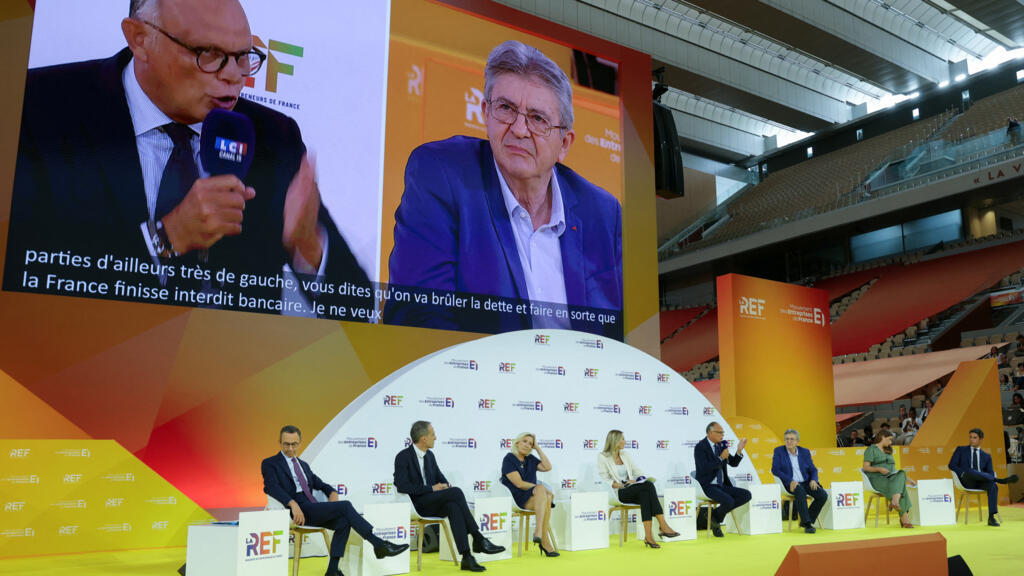
France 24 reports that France is entering a politically significant election year ahead of a crucial presidential vote. As politicians return from the summer break during the country’s back-to-school period, parties on both the left and right are preparing for an increasingly competitive contest. Their central challenge is to identify candidates capable of opposing Marine Le Pen, the far-right leader who is currently leading opinion polls.
The report emphasizes that France’s political landscape remains fragmented, particularly on the left. Rather than presenting a unified bloc or a clearly established candidate, the left is portrayed as divided among competing political forces. This fragmentation could make it difficult for the left to consolidate support before the presidential election and could affect the wider balance of the race. The right wing is also seeking a candidate with sufficient support to compete effectively against Le Pen.
The article is framed as a short France 24 video explainer by journalist Clovis Casali. It asks who is currently running in the election and promises an overview of the emerging field, although the provided text names only Marine Le Pen and does not list other declared or potential candidates. The report’s main focus is therefore the early strategic positioning of France’s political camps rather than a detailed account of campaign platforms or polling figures.
Overall, the article presents the coming election as one shaped by uncertainty, division and the strength of the far right. It highlights the importance of candidate selection and political coordination, especially among left-wing parties, as France moves toward the presidential contest.
Entities: France, France 24, Clovis Casali, Marine Le Pen, 2026 French presidential election • Tone: analytical • Sentiment: neutral • Intent: inform
31-08-2026
France 24 reports that French politicians are intensifying preparations for the 2027 presidential election, which is approximately eight months away according to the article, while the eventual field of candidates remains unsettled. The campaign is already taking shape through interviews, political meetings and public statements, but parties have yet to resolve who will represent them.
On the centre-left, the Socialist and Place Publique parties plan to hold a primary in October. Their stated aim is to choose a single candidate and prevent the vote from being divided among multiple contenders. The article presents this effort as part of a wider struggle to organize the non-extreme-right vote ahead of the election.
Centrist and centre-right politicians face a similar strategic choice. They must decide whether to compete against one another or cooperate in the hope of building a stronger challenge. The central dilemma, as framed by the report, is how France’s mainstream political forces can respond to the growing strength of both the far right and the far left.
The short video report does not identify the specific candidates who will run or provide polling figures, but it emphasizes the uncertainty surrounding the presidential race and the pressure on established parties to coordinate. It portrays the coming months as a period of campaign-building, internal negotiations and efforts to prevent political fragmentation. Overall, the article offers a concise overview of the strategic calculations facing France’s centre-left, centrist and centre-right camps before the 2027 election, with particular attention to the challenge posed by the far right.
Entities: France, 2027 French presidential election, French political campaign, Socialist parties, Place Publique • Tone: analytical • Sentiment: neutral • Intent: analyze
31-08-2026
The article reports that France’s far-right National Rally party intends to introduce a fine for wearing the Islamic veil if it wins power. The proposal was announced by National Rally MP Jean-Philippe Tanguy, described as Marine Le Pen’s lieutenant in the presidential election. Tanguy said the party would “penalize the wearing of the veil” as part of a broader effort to combat what it calls Islamist ideology.
He also framed the proposal as an expression of solidarity with women internationally who are compelled to wear the veil and, according to his remarks, risk dying while defending the freedom not to wear it. The report does not specify the proposed amount of the fine, how the measure would be enforced, or whether it would apply to all forms of Islamic veiling or particular contexts. It also does not include responses from Muslim organizations, civil-rights groups, other political parties, or legal experts.
The announcement comes amid a French presidential campaign in which the National Rally and other parties on the far right are prominent in polling. The proposal places religious clothing, secularism, immigration-related political debates, women’s rights, and opposition to Islamist movements at the center of the party’s platform. It also reflects the continuing political controversy in France over the relationship between individual religious expression and the country’s model of secularism, known as laïcité.
France 24 presents the announcement as a campaign policy position rather than an enacted law. The report is accompanied by a video from journalist Monte Francis and identifies Marine Le Pen, the National Rally, religion, Islam, women’s rights, France, and Europe as key topics.
Entities: Marine Le Pen, Jean-Philippe Tanguy, National Rally, France, Paris • Tone: analytical • Sentiment: neutral • Intent: inform
31-08-2026
France 24 examines the emerging race to succeed Emmanuel Macron in the next French presidential election. With eight months remaining before the vote, political figures are increasing their campaign activity through interviews, meetings and public statements. The report says that the absence of an obvious leading contender has encouraged a large number of politicians to consider entering the race, creating a crowded and unsettled field. As the election approaches, more candidates are competing for a place on the starting line, and the political environment remains fluid.
According to the report, far-right candidate Marine Le Pen is currently leading the polls. However, the main unanswered question is who would face her in the second round of the election. The article does not identify a clear challenger or describe a settled contest between specific candidates. Instead, it emphasizes the uncertainty surrounding the field and the belief among politicians that they may still have a realistic opportunity to advance.
The report is presented as part of France 24’s “Welcome to France” coverage and is narrated by journalist Marc Perelman. It focuses on the early positioning of French politicians rather than on a specific policy dispute or campaign event. The central themes are the growing intensity of campaigning, the lack of a clearly established successor to Macron, Marine Le Pen’s position at the top of current polling, and the uncertainty over the second-round matchup. The available article text is a brief introduction to a 4:14 video report and does not provide polling figures, a full list of candidates, or detailed reactions from the politicians involved.
Entities: France, France 24, French presidential election, Emmanuel Macron, Marine Le Pen • Tone: analytical • Sentiment: neutral • Intent: inform
31-08-2026
French presidential hopeful Edouard Philippe has called for the creation of a new political party, alliance or confederation to unite centrist and right-wing voters ahead of France’s 2027 presidential and subsequent parliamentary elections. Speaking in Tourcoing, the former prime minister and leader of the Horizons party said the alliance should field a single candidate in each constituency under a common banner, with the goal of securing a parliamentary majority and preventing the far right from taking power.
Marine Le Pen, leader of the far-right National Rally, is currently the leading candidate in opinion polls. Philippe argued that moderates who support the rule of law, European integration and a market economy must cooperate to stop France from moving towards either Le Pen’s nationalist, identity-based populism or the hard-left programme of Jean-Luc Mélenchon’s France Unbowed (LFI). He intensified his call for a broader “political realignment” but provided few details about the proposed organisation or its programme.
Philippe faces a challenge from Gabriel Attal, the 37-year-old leader of the centrist Renaissance party and a former prime minister. Attal said there was no obvious favourite in the presidential contest and claimed that he was polling at roughly the same level as Philippe. He also criticised Philippe for campaigning with ideas from “20 years ago” and argued that forming parliamentary coalitions before winning the presidency was premature.
Justice Minister Gérald Darmanin, who has ruled out standing for president and endorsed Philippe, defended him as the only candidate capable of winning the presidency and obtaining a parliamentary majority. The competing candidacies risk dividing the moderate vote in the first round, potentially making it harder for Philippe to reach the runoff against Le Pen or another leading contender.
Entities: Edouard Philippe, Marine Le Pen, Gabriel Attal, Jean-Luc Mélenchon, Gérald Darmanin • Tone: analytical • Sentiment: neutral • Intent: inform