31-08-2026
Spanish Prime Minister Pedro Sanchez has rejected claims that Morocco deliberately helped trigger the arrival of more than 70,000 migrants in Spain’s North African enclave of Ceuta on July 30 and 31. Speaking to Cadena Ser, Sanchez said Spanish intelligence and police had briefed the government before the incident, but none of the reports indicated that an event of such scale was imminent. He added that neither Spanish agencies nor intelligence services cooperating with Madrid had found evidence of Moroccan involvement, while emphasizing that the circumstances remain under investigation.
Most of the migrants crossed from Morocco by swimming or on foot and returned within hours, but thousands are believed to remain in Ceuta. Estimates vary significantly: the Spanish central government puts the number at 3,500 to 7,000, while local authorities estimate that at least 10,000 remain. Many lack adequate shelter. The influx has generated speculation that Morocco used migration as political leverage, particularly amid tensions surrounding Western Sahara, a territory largely controlled by Morocco but claimed by the Algeria-backed Polisario Front.
Sanchez urged cooperation with Morocco rather than distrust and accused far-right groups and human-trafficking networks of spreading misinformation. He said false online claims suggested migrants who entered by sea could not be returned. He also referred to alleged rumors circulated through social-media networks linked to Russia and Israel, and to an international far-right movement exploiting migration to intensify divisions.
The crisis has become a major domestic political issue. Conservative and far-right parties are demanding the return of all arrivals, including minors, while Ceuta residents have protested over security and hygiene concerns. The government plans to provide 6,000 reception places, assess migrants’ legal status, and determine whether some can be returned to Morocco. It also announced €168 million in assistance for Ceuta, placing further pressure on Spain’s migration policy and its relationship with Morocco.
Entities: Pedro Sanchez, Spain, Morocco, Ceuta, Cadena Ser • Tone: analytical • Sentiment: negative • Intent: inform
31-08-2026
Italy will extend its suspension of the Schengen free-movement arrangement with Spain for at least another 15 days, according to Italian media. Rome initially suspended the agreement for one month beginning July 31 after a major influx of migrants crossed into Ceuta, the Spanish territory on Morocco’s northern coast. The border incident, which reportedly resulted in dozens of deaths, created a wider European Union migration crisis and drew criticism of Spain’s left-wing government, including from Italy.
Italy’s Interior Ministry said the extension was necessary because the conditions that prompted the original suspension continued, although it did not specify which factors remained unresolved. The ministry acknowledged steps taken by Spain and the EU to stabilize the situation. The decision came even though nearly all of the approximately 70,000 people who crossed the barrier had returned to Morocco shortly afterward. Spain responded to Italy’s initial measure by introducing controls on passengers arriving from Italy and reportedly planned to extend those controls for another 15 days.
Spanish Prime Minister Pedro Sanchez attributed the Ceuta crisis partly to an online disinformation campaign. He said an international far-right movement with alleged links to Russia and Israel had distorted a July 8 Supreme Court ruling and spread false information through social media, alongside efforts by criminal migrant-trafficking organizations. Sanchez said the campaign aimed to divide Spain and Europe, while emphasizing that there was no evidence Moroccan authorities had caused the crisis.
Around 5,000 migrants remained in Ceuta, including at least 1,200 minors. Spain requested assistance from Frontex to process them as local opposition to their presence grew. Ceuta’s position—bordered by Morocco and the sea, with no direct land connection to the EU mainland—makes it particularly difficult for asylum seekers to enter and move through the bloc.
Entities: Italy, Spain, Giorgia Meloni, Pedro Sanchez, Ceuta • Tone: analytical • Sentiment: negative • Intent: inform
31-08-2026
The article reports that Spanish Prime Minister Pedro Sánchez accused Israel and Russia of helping spread disinformation about Spain’s migration policy during a major migration crisis in Ceuta, the Spanish enclave on Morocco’s northern coast. According to Sánchez, the misinformation may have contributed to a sudden influx of migrants into the territory between July 30 and 31. More than 72,000 people reportedly crossed irregularly from Morocco during the unprecedented surge, although the article does not provide details about how many ultimately entered Ceuta or were expelled.
Sánchez said there were indications of involvement by both Russia and Israel, but he acknowledged that Spain had no evidence linking Morocco to the alleged disinformation campaign. The accusations remain contested: Israel and Russia have both denied participating in the dissemination of misleading information. The report does not identify the specific online content or communication channels allegedly used, nor does it describe the evidence cited by the Spanish government.
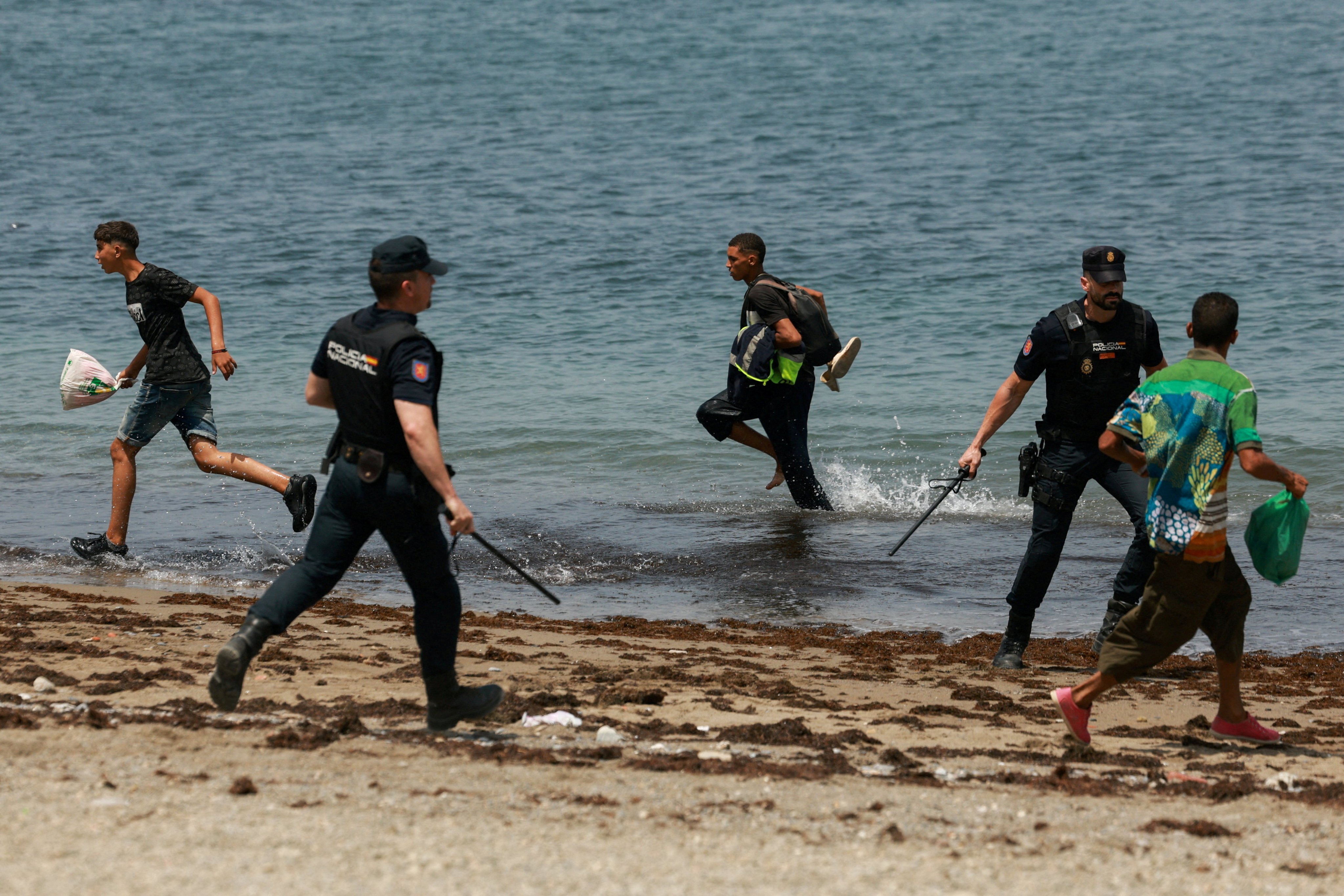
The crisis involved migrants crossing into Ceuta, with Spanish police escorting some people back to a beach after they were expelled from the area. The article presents the episode as a combination of migration pressure, information warfare, and diplomatic tension involving Spain, Morocco, Israel, and Russia. France 24 correspondent Sarah Morris provides additional reporting in an accompanying video. Overall, the piece focuses on Sánchez’s claims, the denials from the countries accused, and the scale of the migration movement rather than reaching an independent conclusion about responsibility.
Entities: Spain, Ceuta, Pedro Sánchez, Israel, Russia • Tone: analytical • Sentiment: negative • Intent: inform
31-08-2026
Spanish Prime Minister Pedro Sánchez has blamed Russian and Israeli networks, working alongside far-right groups, for spreading disinformation that contributed to a sudden influx of migrants into Ceuta, Spain’s North African enclave. He said the European Union’s diplomatic service, the EEAS, had identified indications that these networks promoted misleading claims about Spain’s migration policy.
More than 72,000 migrants reportedly crossed from Morocco into Ceuta between July 30 and 31, creating an unprecedented crisis at one of the European Union’s two land borders with Africa. At least 100 people died during the attempted crossing, according to Ceuta’s local authorities. Spanish officials said misleading videos posted on Instagram, TikTok and other social-media platforms falsely suggested that migrants who reached Ceuta by sea would be permitted to remain in Spain. Authorities said those claims encouraged thousands of people to make the journey.
The episode has triggered alarm across the European Union and sparked political controversy in Spain. Opposition parties and several human-rights organizations accused Morocco of deliberately allowing the mass crossing as a means of pressuring Spain. Morocco has denied the allegation.
Sánchez rejected speculation that Moroccan authorities were involved, saying he categorically denied their participation. His comments therefore place the main responsibility for the crisis’s information component on foreign disinformation networks rather than on Rabat. The article presents the government’s explanation while noting the competing accusations and the lack of evidence implicating Moroccan officials.
Entities: Pedro Sanchez, Spain, Ceuta, Morocco, Russia • Tone: analytical • Sentiment: negative • Intent: inform
31-08-2026
Spain’s prime minister, Pedro Sánchez, has rejected suggestions that Morocco orchestrated the mass border crossing into Ceuta at the end of July and beginning of August. As many as 70,000 people reportedly attempted to enter the Spanish enclave from Morocco, and up to 141 are thought to have died. The movement triggered a political crisis, a humanitarian emergency and renewed disputes within the European Union over migration policy.
Some commentators had speculated that Morocco facilitated the crossings to protest Spain’s improving relations with Algeria. Sánchez said, however, that no intelligence agency had found evidence implicating Moroccan authorities. He argued that continued cooperation between Spain and Morocco was essential to resolving the crisis.
The prime minister also accused social-media accounts linked to Russia, Israel and the international far right of spreading false claims about migration. He said criminal gangs had promoted a fabricated interpretation of a Spanish supreme court ruling, suggesting that people who reached Ceuta by swimming could not be deported. Israel’s foreign minister, Gideon Sa’ar, called Sánchez’s allegation a “brazen lie,” while the Kremlin denied any Russian connection to the crisis.
Although most migrants returned to Morocco within weeks, at least 5,000 people, including 1,200 minors, remained in Ceuta. Their presence contributed to clashes involving residents, police and migrants. Some migrants sleeping on beaches reportedly had their belongings burned, and four Moroccans were arrested after allegedly throwing stones at Spanish soldiers. Sánchez said accommodation capacity would soon be sufficient.
Spain’s conservative People’s party accused the government of failing to protect Ceuta and restore public order. Vox leader Santiago Abascal described the episode as an “invasion” and an act of war promoted by Morocco. The article presents the crisis as a dispute involving migration, disinformation, Spain-Morocco relations and sharply polarized domestic politics.
Entities: Pedro Sánchez, Ceuta, Morocco, Spain, Gideon Sa’ar • Tone: analytical • Sentiment: negative • Intent: inform