30-08-2026
A flash flood and landslide disaster near Nepal’s border with Tibet has destroyed villages, killed many people and left almost 3,000 missing. The disaster was triggered when part of a Himalayan glacier broke off and crashed into a river, sending a wall of water and mud through the region. Survivors from Timure and other areas were airlifted to Kathmandu, but many arrived without clothing, money, accommodation or basic supplies.
Gosok Phuntsok Choeling monastery, normally home to monks, has become a makeshift evacuation centre for nearly 200 displaced people. Volunteers, many of them young people from affected communities, are registering arrivals, distributing donations and caring for survivors. Everyone at the centre has lost someone, including people who were partially buried or whose family members remain missing.
Bhujung Tamang said he escaped with his wife and two daughters after hearing a huge boom and seeing his home swept away. Alina Lama, a trekking guide whose relatives are missing, criticised the government for leaving some evacuees to find their own way after being airlifted from the disaster zone. She said authorities must plan not only for immediate rescues but also for the long-term education, housing and care of orphaned children.
Nineteen-year-old Aananda Thapa Magar lost numerous relatives, including his father, grandfather, siblings and young niece. Despite his grief, he is helping other survivors and focusing on rebuilding the future. He hopes families can recover the bodies of loved ones for proper burial and rituals. Nepal’s Finance Minister estimates reconstruction will cost between US$4 billion and US$5 billion, highlighting the enormous scale of the recovery ahead.
Entities: Nepal, Tibet, Kathmandu, Timure village, Rasuwa district • Tone: emotional • Sentiment: negative • Intent: inform
30-08-2026
The Al Jazeera Newsfeed video reports on severe flooding at the Nepal-Tibet border, where raging floodwaters have isolated a house and left people trapped on rooftops and balconies. The title describes the property as a “miracle home” amid widespread devastation, suggesting that the structure has remained standing or accessible despite the surrounding destruction. The footage focuses on the immediate physical danger created by the floodwaters and the isolation of those affected.
Authorities cited in the report say that at least 675 people have been killed and nearly 2,500 remain missing. These figures indicate a disaster of substantial scale, although the excerpt does not identify the specific flooding event, explain when the deaths occurred, or provide a breakdown of casualties by location. It also does not include details about rescue operations, the condition of the trapped people, damage to infrastructure, the causes of the flooding, or assistance being provided by government agencies.
Published on August 30, 2026, the short video item appears intended to convey the severity of the disaster through dramatic footage and a concise casualty update. Its focus is visual rather than analytical: viewers are shown floodwaters surrounding the home and people seeking safety above ground level, while the authorities’ figures communicate the broader human toll. The report presents the situation as an ongoing emergency, particularly because thousands of people are still unaccounted for. Beyond the location, the footage, and the reported death and missing-person figures, the supplied text provides no additional context about the affected communities or the wider response.
Entities: Nepal, Tibet, Nepal-Tibet border, Al Jazeera, raging floodwaters • Tone: urgent • Sentiment: negative • Intent: inform
30-08-2026
Authorities in Nepal warned of possible renewed flooding on Sunday after water levels rose in the Bhotekoshi River, urging people in already devastated districts to remain on high alert. The warning followed information from Chinese officials about increased upstream water flow. Nepal sent alerts to residents’ phones while rescue teams worked to reopen the Prithivi Highway, a vital route connecting Kathmandu with some of the worst-affected areas.
The warnings came after catastrophic floods on Wednesday killed at least 788 people in Nepal and left 2,502 missing, according to Nepal’s disaster agency. Chinese authorities reported 16 deaths and 546 people missing on the Chinese side of the border. The missing include hundreds of foreign nationals who were working, visiting or making pilgrimages in the region. Chinese state media said 261 foreigners were missing in Tibet, including more than 100 Nepalis. A flood-created mountain lake had largely drained, but officials continued to monitor a nearby crater containing an estimated 1.4 million cubic metres of water.
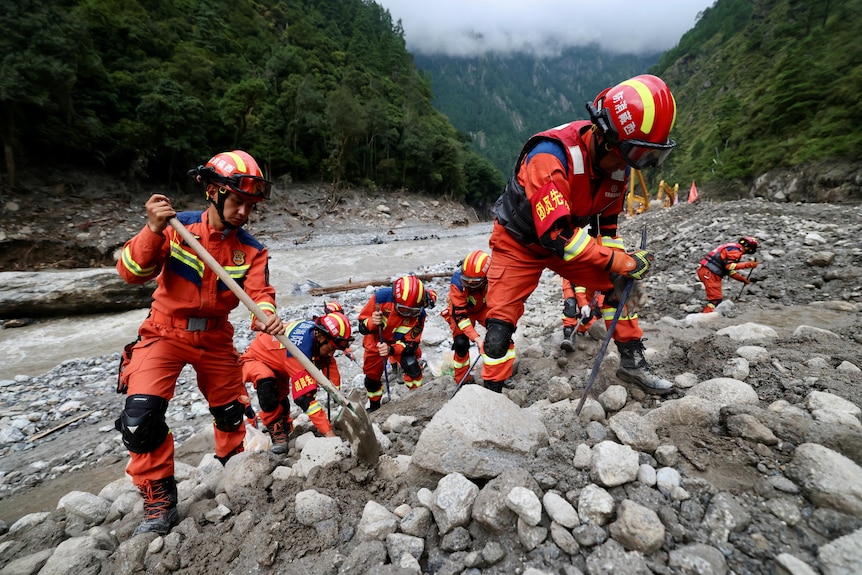
Rescue operations continued at five hydroelectric sites, including the Upper Trishuli complex, where about 350 people may be trapped in a tunnel. Approximately 10,000 Nepali troops, assisted by specialists from China and India, were deployed for tunnel rescues. Canadian Foreign Affairs Minister Anita Anand said one previously missing Canadian had been found safe, but 31 Canadians remained unaccounted for. Families in Canada criticized the government for what they described as inadequate communication and asked Ottawa to provide search equipment and designated contacts.
In Dhading and other severely damaged areas, residents returned to ruined homes to salvage belongings, while workers assessed damage to a power plant serving more than 20,000 people. Villages remained buried in mud and debris, with damaged electricity infrastructure and disrupted roads complicating relief efforts. Residents near the Trishuli River continued watching for further surges as authorities maintained emergency warnings.
Entities: Nepal, Tibet, Bhotekoshi River, Trishuli River, Dhading • Tone: urgent • Sentiment: negative • Intent: inform
30-08-2026
The death toll from devastating flash floods in Nepal and Tibet, an autonomous region of China, has risen to 691, while more than 3,000 people remain missing. Nepal reported 675 deaths and 2,498 missing people, while Chinese authorities reported 16 deaths and 546 missing. Poor weather, difficult Himalayan terrain, mud and debris have slowed aerial rescue operations, although helicopters have resumed flights in badly affected districts such as Nuwakot. More than 3,700 people have been rescued in Nepal, with aircraft delivering food, clothing and other supplies while evacuating survivors. Hundreds of missing people are believed to be foreign workers, trekkers or pilgrims.
Authorities have also warned of further flooding after the Bhotekoshi River rose in Rasuwa and a new lake formed high in the Himalayas. The United States has pledged more than $3.6 million in humanitarian assistance, including emergency food aid for as many as 10,000 households. India, China, Japan, Australia and other countries have also supplied relief materials.
Rescue teams are concentrating on hydropower tunnels where more than 100 workers may still be trapped, particularly at the Trishuli 3A and 3B projects. Rescuers have faced four to five feet of mud and limited landing areas. At Trishuli 3A, teams broke through enough mud to send air into the tunnel and began excavation and camera operations. Specialized rescue teams from India and China, along with Nepalese mountain-rescue experts, are assisting.
Families across Nepal are searching hospitals, relief centers and lists of missing people for information. A Kathmandu hospital has registered around 1,600 missing-person reports, while the Red Cross estimates that about 90,000 people have been affected. Officials say locating missing people is the national priority, and Nepal has requested additional expertise in tunnel rescue, survivor detection, forensic identification, DNA analysis and morgue capacity.
Entities: Nepal, Tibet and China, Nuwakot district, Rasuwa district, Bhotekoshi River • Tone: urgent • Sentiment: negative • Intent: inform
30-08-2026
The death toll from devastating flash floods in Nepal and along the China border has risen to roughly 800, while about 3,000 people remain missing. Nepal’s disaster agency reported 788 deaths and 2,502 missing people, while Chinese authorities reported 16 deaths and 546 missing on the Chinese side. Poor weather, severe mud and debris, difficult Himalayan terrain, and limited landing areas have slowed helicopter rescues, although aircraft have resumed carrying aid into affected districts and survivors out. More than 3,700 people have been rescued in Nepal, but hundreds of missing people are foreigners who had traveled to the region for work, trekking, or pilgrimage.
Nepal has warned of additional flooding after water levels rose in the Bhotekoshi River. The United States has pledged more than $3.6 million in humanitarian aid, including emergency food assistance for up to 10,000 households. The Red Cross estimates that approximately 90,000 people have been affected, while Nepal has received relief supplies from India and other countries.
Rescue teams are also searching for more than 100 workers believed to be trapped in tunnels at hydropower projects, especially the Trishuli 3A and 3B sites. Rescuers have faced four to five feet of mud and a lack of suitable landing sites. Teams have begun excavating, sending air into at least one tunnel, and deploying cameras. Specialized tunnel-rescue teams from India and China, along with Nepalese mountain rescuers, are assisting.
Families across Nepal are searching hospitals, relief centers, and lists of missing and unidentified people for information. Officials have registered around 1,600 missing persons at one Kathmandu hospital. Authorities remain on alert after a glacier collapse created a high-altitude lake that experts warned could overflow and cause further flooding.
Entities: Nepal, China’s Tibet Autonomous Region, Nuwakot, Rasuwa, Bhotekoshi River • Tone: urgent • Sentiment: negative • Intent: inform
30-08-2026
Nepal remained on high alert Sunday after rising water levels in the Bhotekoshi River raised fears of renewed flooding in districts already devastated by catastrophic flash floods. Authorities sent emergency warnings to residents’ phones after Chinese officials reported increased upstream water flow. Nepal’s disaster agency said 788 people had died and 2,502 were missing, while Chinese authorities reported 16 deaths and 546 missing on the Chinese side of the border.
Rescuers were working to clear a major highway linking Kathmandu with badly affected areas. Survivors in villages such as Dhading described repeated alarms, nighttime evacuations, heavy rain and the exhausting task of moving elderly relatives to safety. Residents returning to damaged homes found buildings destroyed, thick mud and rubble covering their belongings, and entire communities without shelter. Some searched for anything salvageable, while others recovered livestock, including chickens that had survived the floods.
Workers also began assessing severe damage to a power plant serving more than 20,000 people across four districts. The missing include hundreds of foreign nationals who had traveled to the region for work, mountain tourism or religious pilgrimage. Chinese state media reported that 261 foreigners were missing in Tibet, including more than 100 Nepalis.
Scientists said the floods began after a glacial collapse in the Himalayas. A massive rockfall, measured at magnitude 5.2, reportedly carried part of a glacier with it, sending rocks and meltwater into rivers and producing a torrent that destroyed buildings, bridges and sections of land in Tibet and Nepal. Although researchers said it was too early to directly attribute the disaster to climate change, they noted that warming temperatures increase the likelihood of such events, particularly in the rapidly warming Himalayas. Nepal’s foreign minister called for stronger global action on climate change, while Malaysia announced a search-and-rescue deployment and $1 million in aid.
Entities: Nepal, Kathmandu, Bhotekoshi River, Dhading district, National Disaster Risk Reduction and Management Authority • Tone: urgent • Sentiment: negative • Intent: inform
30-08-2026
The combined death toll from devastating floods in Nepal and Tibet has risen to 750, while more than 3,000 people remain missing, according to authorities. Nepal has reported 734 deaths and Chinese state media has confirmed 16 deaths in Tibet, including more than 100 Nepalis and nationals of over a dozen countries among those killed. The number of missing people remains uncertain as rescue teams continue identifying victims and assessing damage.
Nepal issued a fresh flood warning after water levels rose in the Bhotekoshi River. Residents were told to remain on high alert and move to higher ground. On the Tibetan side, a new barrier lake formed after a landslide blocked a river near the Gyirong border port, prompting authorities to relocate rescue teams because of the risk that the barrier could burst and cause another flood.
Scientists believe a glacier collapse in the Himalayas may have triggered the disaster, sending enormous volumes of water through river valleys. The flood swept through villages and infrastructure along nearly 170 kilometers of river systems. More than 100 hydropower workers are believed to remain trapped in tunnels, while over 900 workers reportedly went missing during the disaster. Rescuers are using drills, oxygen pumps, cameras, helicopters, drones, thermal imaging and manual excavation to search for survivors.
Teams from India and China have joined Nepalese rescuers, including mountain rescue specialists. Authorities have evacuated survivors by air, rescued around 1,500 injured or stranded people and sheltered hundreds at military bases. International assistance is also increasing, with the United States pledging $3.6 million, Caritas International providing emergency funds, and the WHO, World Food Program and UNICEF sending supplies. More rain is forecast, complicating operations, but 116 people rescued from Timure offer a measure of hope amid widespread devastation.
Entities: Nepal, Tibet, Himalayas, Bhotekoshi River, Trishuli River • Tone: urgent • Sentiment: negative • Intent: inform
30-08-2026
France 24 reports that hopes are fading for thousands of people who remain missing four days after catastrophic floods in Nepal and the surrounding region. The disaster has killed more than 750 people, while over 3,000 others are still unaccounted for. Search and rescue efforts are therefore taking place under increasingly difficult and discouraging circumstances, with the likelihood of locating survivors diminishing as time passes.
The situation remains dangerous because additional heavy rain and flooding are expected across the region. This threatens to worsen the humanitarian crisis, complicate rescue operations, and potentially place more communities at risk. The brief report provides an update from France 24 correspondent Shahzaib Wahlah and frames the disaster within broader concerns involving Nepal, Tibet, China, climate, climate change, flooding, and natural disasters.
The article is primarily an urgent news update rather than a detailed investigation. It emphasizes the scale of the death toll, the large number of missing people, and the deteriorating prospects for survivors. It also warns that the emergency is not necessarily over, since further rainfall and flooding are forecast. While the supplied text does not include detailed information about the causes of the flooding, the response agencies involved, or conditions in individual affected communities, it communicates the severity of the crisis and the immediate risks facing the region.
Entities: Nepal, Tibet, China, France 24, Shahzaib Wahlah • Tone: urgent • Sentiment: negative • Intent: inform
30-08-2026
Authorities in Nepal warned residents in flood-affected districts to remain on high alert Sunday after water levels rose in the Bhotekoshi River, raising fears of additional flooding. The warnings followed catastrophic flash floods on Wednesday that killed at least 788 people in Nepal and 16 in Tibet, bringing the combined reported death toll to more than 800. More than 3,000 people remained missing, including hundreds of foreign nationals who were working, visiting the mountains or travelling on pilgrimage.
Nepal’s National Disaster Risk Reduction and Management Authority said Chinese officials had reported increased water flow upstream. China’s state news agency Xinhua reported that a lake formed by the earlier floods had mostly drained, but warned that a nearby crater containing an estimated 1.4 million cubic metres of water still posed a risk and needed close monitoring.
Rescue crews were also working to clear a major highway linking Kathmandu with one of the worst-hit areas. In Dhading, residents returned to homes that had been heavily damaged or destroyed, digging through thick mud and rubble for salvageable belongings. Some people were also trying to recover livestock, while workers inspected a severely damaged power plant that supplies more than 20,000 people across four districts.
The flooding destroyed homes, vehicles, farm equipment and sections of rice terraces. Landslides sent large rocks and sediment into rivers and buried parts of villages. Electricity remained unavailable in some areas because power poles and wires had been swept into the mud. Residents said repeated flood alarms, nighttime evacuations and continuing rain were causing exhaustion and confusion, particularly for families caring for elderly relatives.
Entities: Nepal, Tibet, Bhotekoshi River, Dhading, Galchhi • Tone: urgent • Sentiment: negative • Intent: inform
30-08-2026
Devastating floods and landslides in Nepal and Tibet have left thousands of people missing, including dozens of Americans, while rescue and relief efforts are complicated by the region’s remoteness and damaged infrastructure. State Department spokesman Tommy Pigott said approximately 85 Americans remain unaccounted for, while nine have been safely evacuated. No American deaths had been reported at the time of the interview.
The United States has pledged more than $3.5 million in humanitarian aid for Nepal and Tibet. Catholic Relief Services is distributing the first $500,000 of that assistance. Senthil Kumar Gurunathan, the organization’s South Asia representative, told NPR that many survivors fled their homes with nothing and are now sheltering in schools, private homes and other available safe spaces. Immediate needs include ready-to-eat food, cooking supplies, clean drinking water, emergency shelter, clothing, blankets, mats, mosquito nets and dignity kits supporting menstrual hygiene and sanitation.
Relief delivery is difficult because roughly 40 kilometers of roadway linking the affected areas to Kathmandu have been washed away. Aid groups are seeking alternative routes to reach isolated communities, but many needs remain unmet. With winter approaching, organizations are also beginning “winterization” efforts to keep displaced people warm.
The longer-term response will involve rebuilding homes, villages and livelihoods after the destruction of settlements, shops and household assets. Catholic Relief Services also expects mental-health support to be a major priority, particularly for children and others affected differently by the trauma. Meanwhile, Nepal’s government is continuing efforts to locate those still missing, including foreign nationals. The article emphasizes that the initial rescue phase is only the beginning of a prolonged recovery requiring shelter, essential supplies, infrastructure access, economic assistance and psychological care.
Entities: Nepal, Tibet, Kathmandu, United States, Catholic Relief Services • Tone: urgent • Sentiment: negative • Intent: inform
30-08-2026
Authorities in Nepal warned residents to prepare for possible additional flooding after water levels rose in the Bhotekoshi River. Flood alerts were sent to mobile phones as rescue crews worked to reopen the Prithivi Highway, a vital route linking Kathmandu with some of the districts most severely damaged by Wednesday’s floods. The disaster followed a glacial collapse in the Himalayas. Scientists said a bedrock failure beneath a glacier caused a massive rockfall, estimated to have registered as magnitude 5.2, sending rocks and meltwater into downstream valleys in Nepal and Tibet.
The floods destroyed homes, bridges, roads, power infrastructure, rice terraces and vehicles, while leaving many villages covered in thick mud and debris. In Dhading, residents returned to damaged homes to search for belongings and salvage what they could. Some communities remain cut off because both concrete and suspension bridges were destroyed, and many intact homes and businesses still lack electricity.
Nepal’s disaster agency reported 752 deaths and 2,502 missing people, while Chinese authorities reported 16 deaths and 546 missing on the Chinese side of the border. The missing include foreign workers, visitors, pilgrims and hundreds of Nepalis. Chinese state media said 261 foreigners were missing in Tibet.
Residents said repeated warnings, nighttime evacuations and continuing rain were creating exhaustion and confusion, particularly for families caring for elderly relatives. Officials said the latest alert followed information from China about increased upstream water flow. International assistance was also beginning: Malaysian Prime Minister Anwar Ibrahim announced that Malaysia would send a specialized search-and-rescue team, help evacuate affected Malaysians and provide $1 million in financial aid. The article presents a disaster zone still facing immediate flood danger while beginning a difficult recovery.
Entities: Nepal, Tibet, Bhotekoshi River, Trishuli River, Dhading • Tone: urgent • Sentiment: negative • Intent: inform
30-08-2026
The article reports that nine Americans have been evacuated from Nepal after catastrophic flooding near the Nepal-Tibet border, while approximately 85 Americans remain unaccounted for. The disaster has killed at least 750 people overall, and rescue teams are searching for more than 3,000 missing individuals in areas covered by mud and debris.
State Department spokesman Tommy Pigott said officials are not currently aware of any American deaths. The department is coordinating with the US embassies in Kathmandu and Beijing, as well as local authorities, but the remote location and severe damage are complicating rescue and information-gathering efforts. The flooding occurred near the Rasuwagadhi border post after a landslide sent water and mud through nearby villages.
Some of the missing Americans had traveled to Nepal to participate in a Hindu and Buddhist pilgrimage to Mount Kailash. The article identifies New Yorkers Amita Amin and Jitendra Manubhai Patel, along with Tejal Vyomesh Patel of New Jersey, as participants who disappeared during the disaster.
The State Department has committed $3.6 million in emergency humanitarian assistance. The funds are intended to support approximately 10,000 affected households and help rebuild roads destroyed by the flooding. Rescue workers continue searching the disaster zone while US officials work to verify the status of missing citizens and coordinate with Nepali and Chinese authorities.
Entities: Nepal, Nepal-Tibet border, US State Department, Tommy Pigott, ABC News • Tone: urgent • Sentiment: negative • Intent: inform
30-08-2026
The risk of a glacial lake bursting near the China-Nepal border has declined after the lake began shrinking and draining naturally, Chinese authorities reported on Saturday. The lake formed when glacier debris blocked or altered water flow near the site of a devastating flood earlier in the week. It lies at the confluence of two rivers and straddles China’s Tibet region and Nepal. Satellite imagery collected from Thursday through Saturday morning showed that water was gradually flowing out of the reservoir. By Saturday afternoon, sections of the lake bed were visible. The Chinese water resources ministry said the lake on the Purepu Tsangpo river covered approximately 99,000 square metres early Saturday—about the size of 14 soccer pitches—which was 21,000 square metres smaller than on Thursday. Authorities and experts had warned that the lake posed an extremely high risk of secondary disasters in the valley, potentially endangering downstream rescue operations. However, ministry experts said search-and-rescue work could safely continue if the lake’s outflow remained low or manageable and the water receded completely within two to three days. Rescue workers would also be alerted and evacuated if unusual changes were detected. According to CCTV, warnings could be issued more than 30 minutes in advance. The report presents the lake’s natural drainage as a significant reduction in the immediate threat, while emphasizing that monitoring remains necessary because abnormal outflows could still create danger for teams working downstream.
Entities: China-Nepal border, Tibet, Nepal, Purepu Tsangpo river, Chinese water resources ministry • Tone: analytical • Sentiment: neutral • Intent: inform
30-08-2026
A flash flood near Uttargaya Public School in Betrawati, Nuwakot, Nepal, was approaching so quickly that there was no time for an official warning system to respond. Instead, an unidentified man ran past the school shouting, “The big flood is coming, run,” alerting more than 370 students and teachers. The warning allowed the school community to flee toward a forested hill behind the campus as floodwaters cut across roads and usual escape routes.
The incident occurred shortly after the school day began on Wednesday. Hostel students were having breakfast, while other pupils were arriving for classes and tuition. Older students ran independently, while teachers helped younger children through mud and carried some who could not keep up. Several students initially underestimated the danger, but escaped after seeing the scale of the flood. Grade 10 student Sujal Lama said he spent the night in the forest before returning, while Grade 8 student Rashmi Tamang described the difficult climb uphill.
The disaster also caused at least one family tragedy. Nawaraj Tamang was swept away while trying to reach the school and rescue his Grade 10 son, Ayush. Ayush survived by escaping into the forest.
Afterward, students and teachers were scattered across higher ground, communications were disrupted, and school records could not be accessed. Vice-principal Pawan Sharma said staff had returned only about 25% to 30% of the children directly to their parents and were still communicating with other families. The school was continuing to trace students, and no confirmed figure for deaths among Uttargaya students had been released. The account highlights both the life-saving importance of immediate warnings and the risks created by inadequate emergency communication during a sudden flood.
Entities: Nuwakot, Nepal, Uttargaya Public School, Betrawati, Trishuli Bazaar, Trishuli River • Tone: urgent • Sentiment: negative • Intent: inform
30-08-2026
The Straits Times roundup highlights five international stories reported around Aug 29-30, 2026. In Nepal, electrical technician Bikash Tharu and his co-workers narrowly survived the Aug 26 flash flood along the Bhote Koshi River because they overslept after a demanding workday. The delay allowed them to see the flood approaching and flee to higher ground before it destroyed an under-construction hydropower dam. Tharu later recounted the experience from a Nepali army relief camp in Nuwakot district.
In the United States, British far-right commentator Milo Yiannopoulos was deported to the United Kingdom after being arrested at New Orleans airport. US authorities said he had overstayed his welcome after entering the country legally in 2019. The article also reports on Norway’s new monarch, King Haakon VIII, who paid an emotional tribute to his late father, King Harald, in his first televised address to the nation. Harald died at 89 after more than three decades on the throne and was remembered as both a reformer and a devoted family man.
The roundup further describes a worsening power-supply situation at Ukraine’s Zaporizhzhia nuclear power plant. The facility has been without off-site electricity for more than a week and is relying on emergency diesel generators to keep its six shut-down reactors cool. The International Atomic Energy Agency said the plant had only about 10 days of diesel available and had not received a delivery to an off-site storage facility in roughly six months.
Finally, Tottenham Hotspur suffered a 2-0 defeat to Newcastle United after a promising first hour deteriorated into another second-half collapse. The result undermined coach Roberto De Zerbi’s efforts to rebuild the team’s relationship with its supporters.
Entities: Nepal flash flood of Aug 26, 2026, Bikash Tharu, Bhote Koshi River, Under-construction hydropower dam, Nepali army relief operation • Tone: neutral • Sentiment: neutral • Intent: inform