30-08-2026
Several senior U.S. military leaders have warned Defense Secretary Pete Hegseth that extending large-scale operations against Iran is unsustainable and is degrading the military’s ability to respond to threats elsewhere, including potential attacks on the U.S. homeland. The concerns were reportedly documented in the Aug. 14 Secretary of Defense Orders Book, a classified document that tracks the global availability of U.S. forces and equipment and informs Pentagon decisions.
The United States has kept more than 50,000 troops on alert in the Middle East as President Donald Trump pressures Iran to reopen the Strait of Hormuz and accept U.S. conditions for ending the conflict. Some deployments are scheduled to continue through September or into 2027. Commanders of European, Pacific and Southern Commands, as well as the Navy’s top admiral, reportedly filed “non-concurs,” indicating disagreement with the extensions while acknowledging they would carry them out. Army and Air Force leaders agreed with the current deployment strategy but warned of significant risks.
The Navy has been especially strained. Its ships and aircraft have been used in combat, defense against Iranian attacks and enforcement of a blockade of Iranian ports. Prolonged deployments have reduced maintenance capacity, and only about one-fourth of the destroyer fleet is reportedly ready to deploy. Navy leaders warned that continuing at the current pace could jeopardize readiness for future conflicts.
The commanders of European and Southern Commands said the diversion of ships and surveillance aircraft has impaired their ability to fulfill homeland-defense missions. Pacific Command chief Adm. Samuel Paparo reportedly objected to the continuing provision of an aircraft carrier strike group and destroyers. Army units, including the 82nd Airborne Division and Patriot air-defense crews, are also facing extended deployments. The disclosures illustrate the administration’s dilemma: Trump wants to secure favorable terms for ending the war, while Iran has refused to capitulate and the U.S. military’s capacity is being increasingly strained.
Entities: Pete Hegseth, Donald Trump, Iran war and prolonged military operations, Secretary of Defense Orders Book, U.S. Department of Defense / Pentagon • Tone: analytical • Sentiment: negative • Intent: analyze
30-08-2026
The USS Abraham Lincoln sailed past Singapore early Sunday while heading home after a demanding nine-month deployment in the Middle East. The aircraft carrier is expected to make a port visit in Thailand, where its approximately 5,000 crew members can rest and recover before returning to the ship’s U.S. base.
The Lincoln was observed from Indonesia’s Batam Island as it traveled through waters near Singapore shortly after 1 a.m. local time. The Japan-based USS George Washington arrived in the Middle East earlier this month to replace it. During its deployment, the Lincoln supported U.S. military operations against Iran and launched thousands of aircraft flights. The ship also spent more than 250 consecutive days at sea, a record-setting period that extended the crew’s mission and intensified its workload.
The lengthy deployment has prompted growing concern among family members and others about conditions aboard the carrier. Reports have cited deteriorating mental health, alleged shortages of food and hygiene products, and worsening sanitary conditions. U.S. Central Command denied reports of increased suicidal ideation among the crew and said there had been no deaths aboard the ship. The Navy is still investigating an Aug. 3 incident in which a sailor fell overboard and was later recovered.
Defense Secretary Pete Hegseth said reports about problems on the carrier had been misrepresented. However, Jefferson Kelley, whose son Jackson is serving on the Lincoln during his first deployment, criticized the mission’s length and the demands placed on the crew. The carrier left San Diego on Nov. 21, and the war with Iran, which began in February, prolonged its deployment. The ship’s return follows months of operational pressure and public concern over the well-being of its sailors.
Entities: USS Abraham Lincoln, Singapore, Thailand, Middle East, USS George Washington • Tone: analytical • Sentiment: negative • Intent: inform
30-08-2026
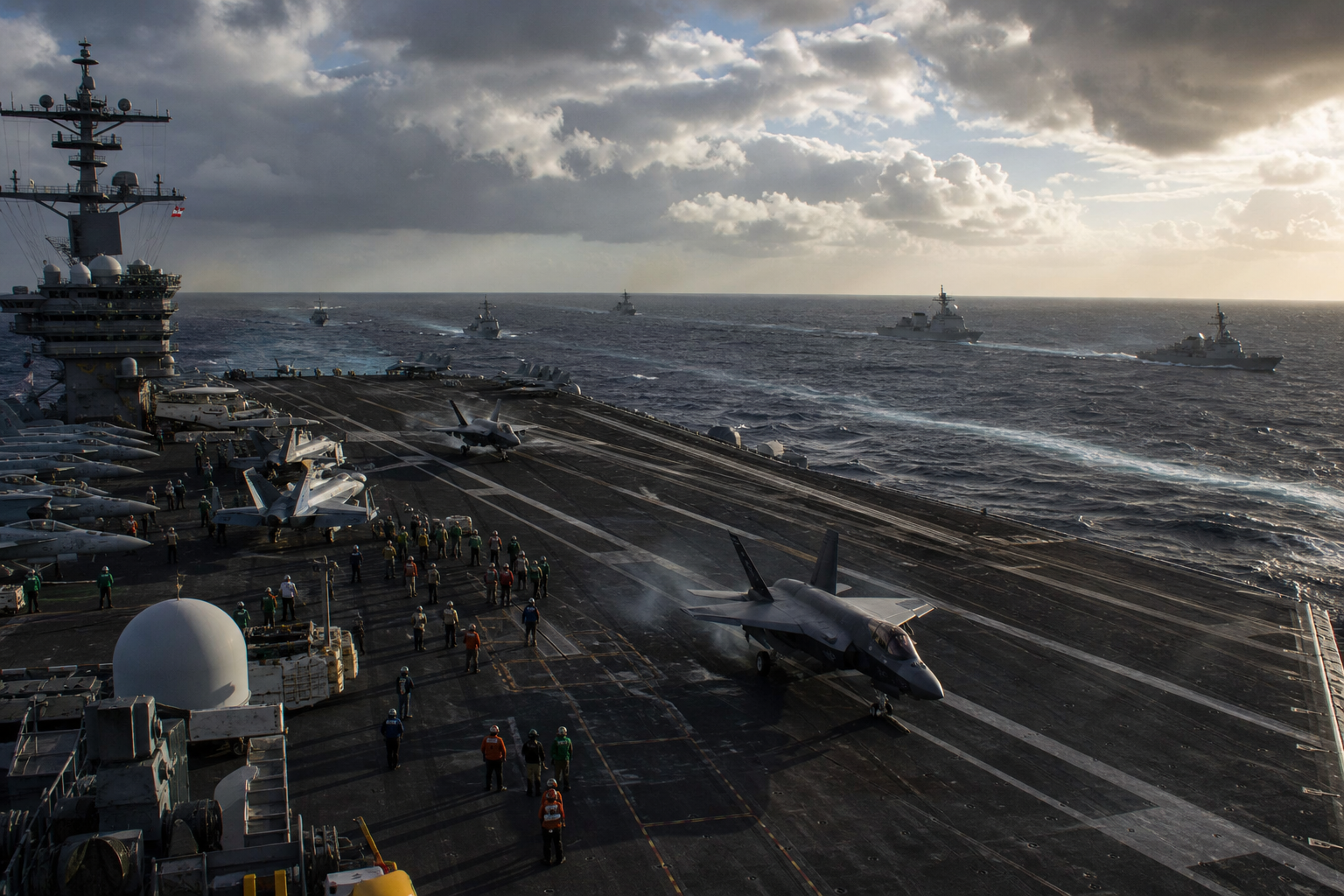
The USS George Washington aircraft carrier has arrived in the Arabian Sea near the Strait of Hormuz and Iran, replacing the USS Abraham Lincoln as the U.S. Navy’s principal carrier presence in the region. The Nimitz-class carrier, designated CVN 73, carries approximately 5,000 sailors and supports about nine operational squadrons, including strike fighters, electronic warfare aircraft, and helicopters.
Capt. Nicholas DeLeo, the carrier’s commanding officer, told Fox News Digital that morale among the crew remains high. He attributed that morale to sailors’ pride in their work, strong teamwork, and their commitment to maintaining the ship, conducting flight operations, and supporting one another. Rear Adm. Jeff Heames, commander of Carrier Strike Group Five, similarly said the carrier group was prepared and properly resourced for sustained operations.
The George Washington serves as the flagship of Carrier Strike Group Five and is reportedly accompanied by the guided-missile cruiser USS Robert Smalls and the guided-missile destroyer USS Shoup. Its deployment places the group under U.S. Central Command and contributes to the broader U.S. effort to maintain maritime security, stability, and a credible military capability in the Middle East. Retired Gen. Joseph Votel said the region would require continued force deployments and a high level of readiness.
The carrier is conducting flight operations during both day and night. Its aircraft reportedly include F/A-18E/F Super Hornets, F-35C Lightning II stealth fighters, EA-18G Growlers, E-2D Advanced Hawkeyes, and MH-60 Seahawk helicopters. The article also highlights a milestone landing: Lt. Steven Frazier completed the ship’s 200,000th arrested landing in an F-35C. The carrier can recover roughly one aircraft per minute and typically lands about 70 aircraft daily.
Entities: USS George Washington (CVN 73), Arabian Sea, Strait of Hormuz, Iran, USS Abraham Lincoln • Tone: analytical • Sentiment: positive • Intent: inform