30-08-2026
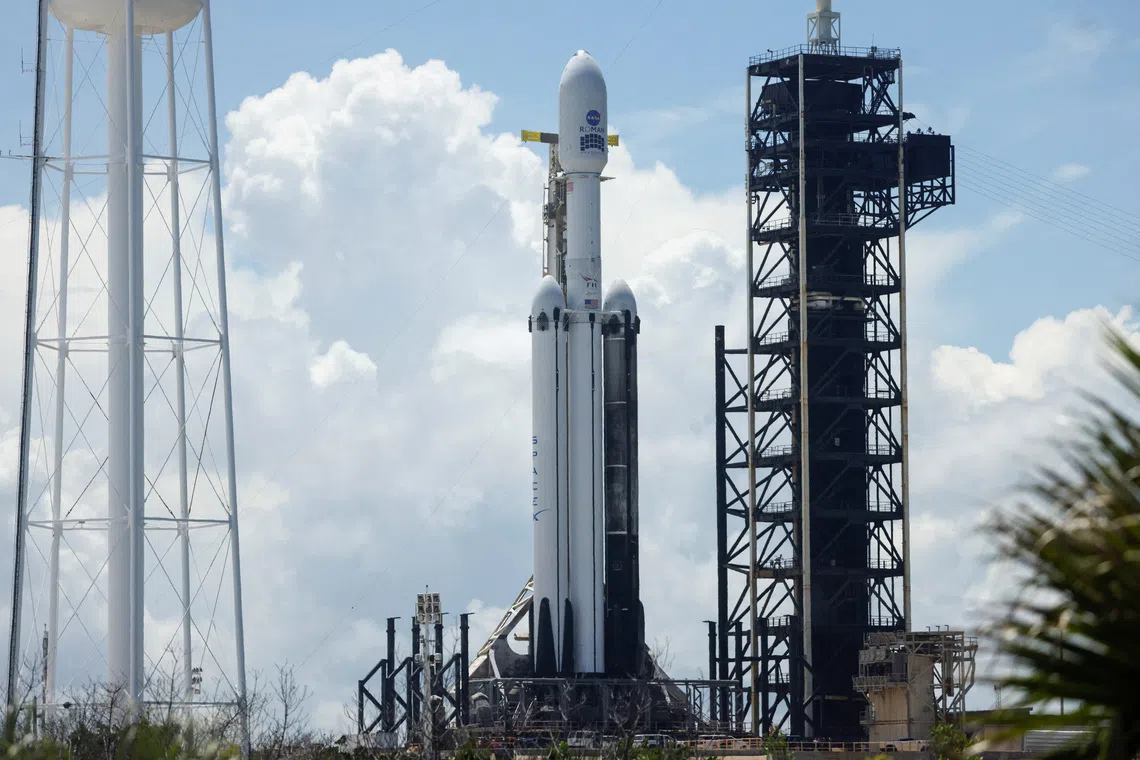
NASA has successfully launched the Nancy Grace Roman Space Telescope aboard a SpaceX Falcon Heavy rocket from the Kennedy Space Center in Florida. The telescope, named after NASA’s first chief astronomer Nancy Grace Roman, is designed to survey enormous areas of the Universe and investigate some of astronomy’s biggest unanswered questions, including the nature of dark energy and dark matter, the formation and distribution of galaxies, black holes, and whether life may exist beyond Earth.
Roman will spend about 100 days travelling to an orbit roughly one million miles from Earth. From there, it will conduct panoramic surveys with a field of view about 100 times larger than those of the Hubble and James Webb space telescopes. NASA expects the mission to discover tens of thousands, and possibly up to 100,000, exoplanets. Scientists also hope its infrared instruments will help characterise the atmospheres of distant worlds and assess whether some could be habitable.
Astronomer Jenifer Millard explained that Roman’s position, around four times farther from Earth than the Moon, will reduce interference from infrared light emitted by Earth and the Moon. Unlike Hubble, which orbits close to Earth, Roman will orbit the Sun in a location similar to that used by the James Webb telescope, but with a much broader field of vision.
The mission is expected to operate for at least five years, with a goal of lasting 10 years. NASA says its surveys will map billions of galaxies and help scientists trace how cosmic structures have changed over time. Because dark matter and dark energy are believed to account for about 95% of the Universe but remain poorly understood, researchers describe Roman as a major advance in understanding the cosmos.
Entities: Nancy Grace Roman Space Telescope, NASA, SpaceX Falcon Heavy, Kennedy Space Center, Florida • Tone: analytical • Sentiment: positive • Intent: inform
30-08-2026
NASA has launched the Nancy Grace Roman Space Telescope, a roughly US$4 billion observatory designed to investigate major questions in astrophysics and cosmology. The telescope lifted off from Kennedy Space Center in Florida aboard a SpaceX Falcon Heavy rocket and will travel to an orbit near Lagrange Point 2, approximately 1.6 million kilometres from Earth. Its primary mission is planned to last five years, although NASA says it carries enough fuel to operate for another five years.
Roman was originally built for a National Reconnaissance Office spy-satellite program that was cancelled after going over budget. The NRO donated the hardware to NASA in 2012, allowing the agency to repurpose it for astronomical research. Named after NASA’s first chief astronomer, Nancy Grace Roman, the observatory is expected to begin science operations after about 90 days of commissioning, with its first high-resolution images anticipated before the winter holidays.
The telescope will complement the Hubble and James Webb space telescopes. While Webb provides highly detailed views of distant objects and the early universe, Roman will survey enormous areas of space rapidly. Scientists say it could map the entire Milky Way in roughly a month, a task that would take Hubble about a century.
Roman’s central objectives are to study dark energy and dark matter. It will create the most comprehensive three-dimensional map of the universe yet, surveying more than two billion galaxies to examine the force accelerating cosmic expansion and the gravitational effects of dark matter. The observatory will also conduct a major search for exoplanets, potentially discovering thousands and producing the first statistical census of planetary systems resembling our own. NASA scientists describe the launch as the conclusion of years of engineering work and the beginning of a new phase of exploration.
Entities: Nancy Grace Roman Space Telescope, NASA, SpaceX Falcon Heavy, Kennedy Space Center, Cape Canaveral, Florida • Tone: analytical • Sentiment: positive • Intent: inform
30-08-2026
NASA has launched the Nancy Grace Roman Space Telescope, a powerful observatory designed to survey the universe and investigate phenomena including exoplanets, black holes, exploding stars and distant galaxies. The telescope lifted off from Cape Canaveral, Florida, aboard a Falcon Heavy rocket operated by Elon Musk’s SpaceX. It is expected to travel approximately 1.6 million kilometers from Earth, reaching its destination in about a month. The mission has a budget exceeding $4 billion, and NASA expects the first images to arrive in early 2027.
Roman is designed to operate in a way similar to the Hubble Space Telescope, but its much wider field of view will allow it to survey the sky substantially faster. NASA officials say it could complete in one month observations that would have taken Hubble a century. The telescope is expected to discover thousands of supernovae, tens of thousands of planets, billions of galaxies and tens of billions of stars. It could also identify rare and unusual cosmic objects that are difficult to find using narrower surveys.
Roman is expected to produce more than 500 terabytes of data annually, exceeding the roughly 400 terabytes gathered by Hubble during more than three decades in space. It will complement both Hubble and the James Webb Space Telescope, which observes the universe at different wavelengths.
The mission is named after Nancy Grace Roman, NASA’s first chief of astronomy and one of the agency’s earliest female senior leaders. Roman played an important role in advancing NASA’s space astronomy program during the 1960s and 1970s. The telescope is NASA’s first space observatory named after a woman. NASA scientists described the recognition as appropriate and long overdue. The mission reportedly launched nearly a year ahead of schedule and within budget.
Entities: NASA, Nancy Grace Roman Space Telescope, Nancy Grace Roman, SpaceX, Falcon Heavy rocket • Tone: analytical • Sentiment: positive • Intent: inform
30-08-2026
France 24 reports that NASA has successfully launched a new space telescope from Florida’s Kennedy Space Center. According to the brief video report, the telescope reached orbit approximately 10 minutes after liftoff and has begun its planned scientific mission. Its objective is to investigate some of the universe’s biggest unresolved mysteries, although the report does not specify the telescope’s instruments, launch vehicle, or individual research targets. The telescope is named after Nancy Grace Roman, a pioneering astronomer and NASA executive often associated with the development of the agency’s space astronomy program. Scientists have described the telescope as a “discovery machine,” reflecting expectations that it could produce important observations and expand knowledge of the cosmos. The report identifies the United States, Florida, and NASA as central locations and organizations involved in the launch. The accompanying video is credited to Camille Knight and has a runtime of one minute and 50 seconds. The article is a concise launch update rather than a detailed scientific or technical examination. It focuses on the successful deployment, the telescope’s rapid arrival in orbit, its broad mission to explore unresolved questions about the universe, and the significance of its namesake. No information is provided about the telescope’s expected operating life, funding, launch date beyond the publication date, or the specific discoveries scientists hope it will make.
Entities: NASA, Nancy Grace Roman, Kennedy Space Center, Florida, United States • Tone: neutral • Sentiment: positive • Intent: inform
30-08-2026
NASA is preparing to launch the Roman Space Telescope on Aug 30 aboard a SpaceX Falcon Heavy rocket from Florida. The mission will create a wide-ranging map of the cosmos and investigate major unanswered questions about the universe, particularly the nature of dark matter and dark energy. The telescope, which stands more than 12m tall and cost over US$4 billion to develop, is named after astronomer Nancy Grace Roman, known as the “Mother of Hubble.”
Roman will operate from a vantage point 1.5 million kilometers from Earth, a journey expected to take about 100 days. Its field of view will be more than 100 times wider than Hubble’s and broader than that of the James Webb Space Telescope, allowing it to survey enormous sections of the sky. NASA expects the observatory to identify thousands of exoplanets and tens of thousands of supernovae, producing what officials describe as the largest catalogue of astronomical objects ever assembled.
The telescope will use infrared observations to study light from billions of years ago, offering insights into the early universe. Scientists hope this will clarify the roles of dark matter, which is thought to provide gravitational structure, and dark energy, which is associated with the accelerated expansion of the universe. Roman’s findings will complement observations from the Rubin Observatory in Chile and the European Space Agency’s Euclid mission.
Researchers say the mission could challenge current cosmological theories. Recent observations have raised questions about whether the standard model of the universe is correct, and Roman is expected to provide sufficiently precise data to test competing explanations. All of the telescope’s data will be publicly available, although it will generate about 1.3 terabytes daily. Scientists anticipate that its most important discoveries may be unexpected ones that lead to new questions and future missions.
Entities: NASA, Roman Space Telescope, SpaceX Falcon Heavy, Donald Trump, Nancy Grace Roman • Tone: analytical • Sentiment: positive • Intent: inform