22-09-2026
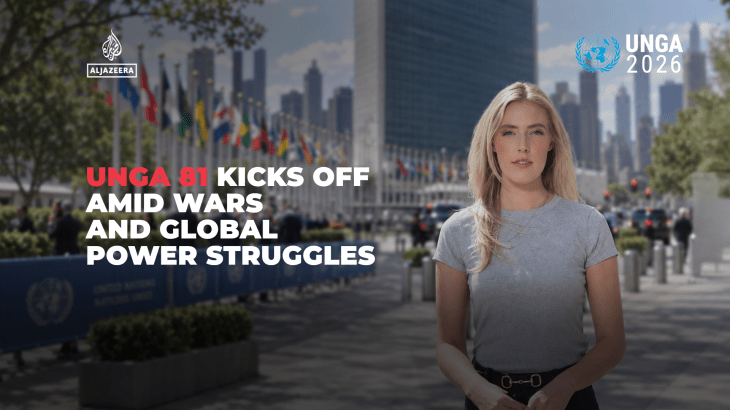
The article is a brief Al Jazeera video explainer previewing the major issue expected to shape the 81st United Nations General Assembly (UNGA) in New York. It notes that world leaders are gathering at a time when armed conflicts are increasing and confidence in international institutions is weakening. Against this backdrop, the report focuses less on the formal agenda of the gathering and more on the credibility and practical relevance of the international system.
According to Al Jazeera’s Emma Withrow, the central question is whether global rules continue to matter when powerful countries can disregard them without facing meaningful consequences. This framing points to concerns about the erosion of international norms, the unequal application of those norms, and the difficulty of preserving cooperation when influential states act outside established rules.
The preview presents UNGA 81 as an important test of the United Nations’ authority and of the broader rules-based international order. While the short article does not identify specific conflicts, countries, or diplomatic initiatives, it establishes a wider context of multiplying wars and declining trust. The report therefore directs attention to the gap between the principles expressed at the United Nations and the actions of states with the greatest political or military influence.
Published on 22 September 2026, the item is designed as an analytical video introduction to the themes viewers should follow during the UNGA. Its emphasis is ultimately on accountability, international legitimacy, and whether global institutions can still constrain powerful actors.
Entities: United Nations General Assembly (UNGA), UNGA 81, New York, Al Jazeera, Emma Withrow • Tone: analytical • Sentiment: negative • Intent: analyze
22-09-2026
In his final address to the United Nations General Assembly, Secretary-General Antonio Guterres urged world leaders to respond collectively to several major global challenges. His speech focused on the need to regulate artificial intelligence, end ongoing wars, intensify action on climate change and reform United Nations institutions that he said are struggling to deal effectively with mounting international pressures.
The address was delivered on Tuesday, September 22, 2026, and was presented as Guterres’s final speech to the General Assembly. The central message was that existing international systems are not adequately equipped to manage the scale and complexity of today’s crises. Guterres therefore called for stronger global governance and institutional changes, alongside action on urgent security, technological and environmental issues.
Artificial intelligence was identified as an area requiring international regulation, reflecting concerns about the technology’s rapid development and its potential consequences when left without common rules. Guterres also emphasized the need to end wars, placing conflict prevention and peace efforts among the priorities for world leaders. Climate change was another key issue on the agenda, with the secretary-general urging governments to maintain focus on a challenge affecting countries worldwide.
The report provides a full replay of the address rather than a detailed account of the speech’s individual proposals or the reactions of member states. Its framing presents Guterres’s remarks as a broad appeal for international cooperation and a warning that the United Nations and other global institutions face serious difficulties in confronting current crises. The video is accompanied by a brief description and was issued by France 24 on September 22, 2026.
Entities: Antonio Guterres, United Nations, United Nations General Assembly, France 24, Artificial intelligence regulation • Tone: urgent • Sentiment: negative • Intent: inform
22-09-2026
France 24’s short video report previews the main issues expected to dominate this year’s United Nations General Assembly: armed conflicts, artificial intelligence and climate change. The report frames the gathering against what it describes as an “unrelenting succession of global crises,” suggesting that international cooperation is being tested by several overlapping emergencies.
The General Assembly’s stated theme is “Restoring trust, managing transformation: A United Nations that delivers for all”. This theme emphasizes the need to rebuild confidence in multilateral institutions while managing major technological, environmental and geopolitical changes. The reference to restoring trust indicates concerns about the UN’s ability to respond effectively and maintain credibility among member states and the wider public.
The report specifically identifies AI as an agenda item, reflecting the growing importance of the technology in global policy discussions. It also highlights climate change as a continuing international challenge and places ongoing wars within the broader discussion of global instability. However, the available text does not identify particular conflicts, climate initiatives, AI regulations or statements by individual leaders.
The article is primarily an introductory overview rather than a detailed analysis. It alerts viewers to the major subjects under discussion as world leaders gather at the UN and presents the Assembly as an opportunity to address interconnected crises. Its focus is on the scope of the agenda and the institution’s stated goal of delivering for all, rather than on specific decisions or outcomes.
Entities: France 24, United Nations, United Nations General Assembly, World leaders, Global crises • Tone: analytical • Sentiment: negative • Intent: inform