22-09-2026
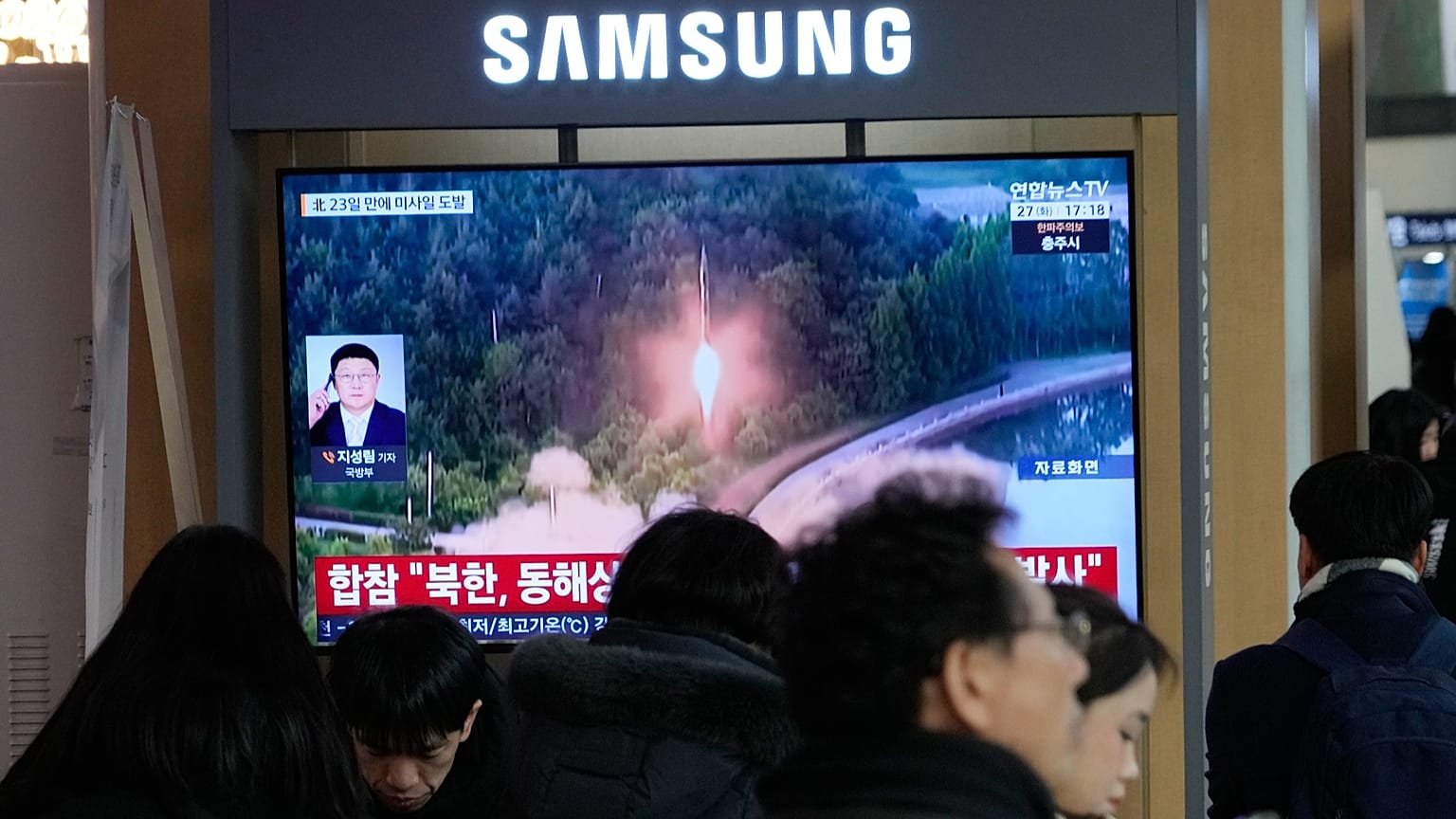
North Korea launched two short-range ballistic missiles toward the sea on Sunday, South Korea’s military reported, in the latest weapons demonstration by Pyongyang amid rising tensions with the United States and its allies. The missiles were fired about three hours apart from the Wonsan area on North Korea’s eastern coast. One traveled approximately 280 miles and the other more than 370 miles before landing in waters off the country’s east coast. South Korean and U.S. authorities said they were analyzing the second missile’s precise specifications.
U.S. Pacific Command said it was consulting with regional allies and assessed that the launches did not pose an immediate threat to U.S. personnel, American territory, or allied countries. South Korea’s presidential office condemned the launches and urged North Korea to stop ballistic-missile testing, which is prohibited under United Nations Security Council resolutions. South Korea’s military said it remained prepared to respond to any provocation, while Japan reported detecting a suspected missile that did not enter its territorial waters.
The launches followed North Korea’s renewed assertion that it is a nuclear-armed state and its rejection of a U.N. resolution calling for an end to its nuclear activities. They also came after President Donald Trump reduced the scale of a joint U.S.-South Korean military exercise, reportedly in an effort to encourage diplomacy with North Korean leader Kim Jong Un. Kim’s sister, senior official Kim Yo Jong, dismissed the reduction as insufficient and characterized the exercise as provocative.
The article places the launches within a broader pattern of military activity. North Korea has criticized the Pacific Vanguard maritime exercise involving the United States, South Korea, Japan, Australia, New Zealand, and Canada, and recently conducted a live-fire drill involving missiles, artillery, and drones. Pyongyang says such exercises threaten its sovereignty, while claiming its own weapons development is intended to strengthen nuclear deterrence and overcome regional air defenses.
Entities: North Korea, United States, South Korea, Kim Jong Un, Kim Yo Jong • Tone: analytical • Sentiment: neutral • Intent: inform
22-09-2026
North Korean leader Kim Jong Un observed what state media described as a test of a new hypersonic weapon, accompanied by his teenage daughter Kim Ju Ae, who is widely viewed as a possible successor. The Korean Central News Agency said Kim praised the weapon as an “irresistible force” and an “incurable headache” for the country’s adversaries. Although North Korea did not identify the weapon, images showed a display labeled “Hwasongpho-11Ma-1 flight trajectory.” Analysts believe the test may have involved an upgraded short-range ballistic missile fitted with a hypersonic glide vehicle.
Hypersonic weapons are designed to travel at lower altitudes and higher speeds than conventional missiles, potentially making them more difficult to detect and intercept. North Korea has tested several such systems since 2021 and considers them part of its effort to expand and modernize its nuclear and conventional military capabilities.
The test could complicate South Korean President Lee Jae Myung’s expected effort to propose improved relations with Pyongyang at the United Nations General Assembly. Lee has suggested replacing Seoul’s longstanding demand for complete North Korean denuclearization before talks with an initial agreement to freeze further nuclear testing or development. The two Koreas remain technically at war because the 1953 Korean War ended with an armistice rather than a peace treaty.
U.S. President Donald Trump has also expressed interest in meeting Kim, potentially around the APEC summit in Shenzhen, China. Trump met Kim three times during his first term, but negotiations failed to produce progress on denuclearization. North Korea is believed to possess dozens of nuclear warheads, though estimates vary. Despite Trump’s decision to reduce annual U.S.-South Korean military drills, Pyongyang has shown no clear interest in resuming talks with either Washington or Seoul.
Entities: Kim Jong Un, Kim Ju Ae, North Korea, South Korea, Korean Central News Agency (KCNA) • Tone: analytical • Sentiment: negative • Intent: inform
22-09-2026
North Korean leader Kim Jong-un oversaw the test of what state media described as a “new-type weapon” on Sunday, presenting it as evidence of the country’s growing military and defence capabilities. The Korean Central News Agency (KCNA) did not identify the weapon system, but reported that Kim called the test a demonstration of “ultra-modern defence technology.” He said the development would create “an incurable headache” for adversaries and deliver a “cruel and unavoidable blow.”
The announcement followed reports from South Korea and Japan that North Korea had launched two short-range ballistic missiles into waters off its east coast. Both governments condemned the launches as threats to regional peace and security. Seoul said the activity violated United Nations Security Council resolutions, while Tokyo lodged a “stern protest” with Pyongyang.
The latest test was also linked to a broader North Korean military exercise conducted eight days earlier, involving multiple short-range ballistic missiles and long-range artillery fired toward the East Sea, also known as the Sea of Japan. North Korean state media said the weapons struck their targets with complete accuracy. Kim described the new weapon technology as important to the country’s wartime readiness and the future development of its armed forces.
The report comes amid North Korea’s continued insistence that its nuclear status is permanent and irreversible. Pyongyang recently rejected an International Atomic Energy Agency resolution calling for an end to its nuclear activities, arguing that domestic laws had permanently established its status as a nuclear weapons state. Kim’s sister, Kim Yo-jong, likewise called the country’s nuclear-armed status “absolute” and dismissed hopes of denuclearisation. Together, the missile tests and official statements underscore persistent tensions surrounding North Korea’s weapons programs and its relations with neighbouring countries and international institutions.
Entities: Kim Jong-un, Kim Yo-jong, North Korea (DPRK), South Korea, Japan • Tone: analytical • Sentiment: negative • Intent: inform
22-09-2026
North Korea announced that its latest missile tests involved a new weapons system of “great significance,” although leader Kim Jong Un did not identify the weapon. Kim said the system would improve the country’s war readiness and give its enemies an “incurable headache.” Images released by North Korean state media appeared to show two missiles equipped with conical, finned vehicles. A monitoring screen identified the system as the Hwasong-11Ma, which North Korea has previously described as hypersonic.
South Korea detected two short-range missile launches from the Wonsan area on Sunday. The missiles traveled approximately 280 and 370 miles toward the sea, according to South Korea’s Joint Chiefs of Staff. Japan said they landed outside its exclusive economic zone. Kim observed the tests with his teenage daughter, Kim Ju Ae, who is widely regarded as a possible successor.
The launches are part of a broader series of North Korean military demonstrations, including live-fire exercises and the commissioning of a new warship. North Korea has continued expanding its nuclear-capable missile arsenal despite US efforts to restart diplomacy. Its weapons include long-range missiles potentially capable of reaching the US mainland and shorter-range systems intended to challenge defenses in South Korea and Japan.
North Korea has tested several systems it claims use hypersonic technology. Such weapons are designed to travel at more than five times the speed of sound and maneuver in ways that could help evade missile defenses, though experts question whether North Korean tests have consistently achieved the claimed speeds.
The tests occurred after President Donald Trump reduced a joint US-South Korean military exercise in an apparent diplomatic gesture. Kim’s sister, Kim Yo Jong, rejected the move as insufficient. Experts believe North Korea’s stronger nuclear capabilities and closer relationships with Russia and China may give Kim greater leverage in future negotiations. Pyongyang says talks would require Washington to end its “hostile policy,” including sanctions and joint military drills, and abandon denuclearization demands as a precondition.
Entities: North Korea, Kim Jong Un, Kim Ju Ae, Kim Yo Jong, Korean Central News Agency (KCNA) • Tone: analytical • Sentiment: neutral • Intent: inform