22-09-2026
CNBC’s Daily Open examines the market rally ahead of a planned meeting between U.S. President Donald Trump and Chinese President Xi Jinping in Washington. U.S. stocks rose sharply on Monday as oil prices and Treasury yields declined while AI-related chipmakers surged. The S&P 500 gained 1.5%, the Nasdaq Composite rose 2.3% to a record close, and the Dow added 0.7%. Lower crude prices eased inflation concerns, while falling Treasury yields reduced expectations for additional Federal Reserve tightening.
Bitcoin also rallied above $86,000, reaching its highest level since late January, although it remained well below its October 2025 peak. Analysts identified $90,000 as a potential next test if Bitcoin’s $75,000 support level holds, while lawmakers remain stalled over legislation that would establish a U.S. cryptocurrency regulatory framework.
The article outlines several issues surrounding the Trump-Xi summit. The leaders are expected to extend a trade truce reached in Busan and potentially create a “Board of Trade” for non-sensitive goods, though progress on investment remains limited. China’s advances in artificial intelligence have increased pressure on Washington to maintain its lead in the technology race. U.S. CEOs are expected at the state dinner, while no visa applications from Chinese business attendees had been received at the time of reporting. Taiwan may receive less attention than Iran, particularly as Trump has indicated openness to meeting Iranian President Masoud Pezeshkian.
The article also covers U.S. AI policy, noting that Treasury Secretary Scott Bessent said developers would not receive a federal liability shield. OpenAI, by contrast, has advocated international safety coordination for increasingly autonomous AI systems. In business news, Eli Lilly reported strong early Medicare demand for GLP-1 obesity treatments, while Nissan is considering expanded production at two U.S. plants. The article concludes by assessing how the shutdown of Saudi Arabia’s East-West pipeline could affect Asian oil importers, with South Korea appearing most exposed.
Entities: Donald Trump, Xi Jinping, United States-China trade truce, Wall Street and AI-linked chip stocks, Bitcoin and U.S. cryptocurrency regulation • Tone: analytical • Sentiment: neutral • Intent: analyze
22-09-2026
CNBC’s China Connection examines what businesses and policymakers are watching ahead of a planned summit in Washington between U.S. President Donald Trump and Chinese President Xi Jinping. Xi’s visit, his first U.S. state visit since the Obama administration, comes as Chinese observers express greater optimism about bilateral relations than their U.S. counterparts. Analysts describe the leaders’ May meeting as a potential turning point that recognized China as a peer power, although major disagreements remain.
The first priority is extending the current trade truce, which is due to expire in November. Both countries have suspended some tariff and rare-earth restrictions, while China has increased purchases of U.S. soybeans. However, expectations for a large Boeing order are limited, and analysts say China retains leverage because of its dominance in rare-earth materials and permanent magnets. The likely outcome may be preservation of the status quo rather than a major trade breakthrough.
Artificial intelligence is another key issue. Chinese AI companies have narrowed the gap with U.S. rivals, prompting discussions about a formal U.S.-China AI Dialogue and a possible system for reporting AI-related incidents. Washington is particularly concerned about China’s potential assistance to malicious actors, while Nvidia chip purchases appear to be a less significant focus.
The summit will also feature U.S. business leaders, although there is little information about Chinese business participation or the proposed bilateral investment board. The war involving Iran may overshadow Taiwan, with Washington seeking China’s help in avoiding military assistance to Tehran and encouraging a negotiated settlement. Taiwan is still expected to be discussed, but less prominently.
Finally, the article considers the summit’s global implications. Additional Trump-Xi meetings may occur, but analysts do not expect immediate changes to China’s export-driven economic model. Weak Chinese domestic demand, global dependence on Chinese manufacturing, and rising concern about the impact of Chinese exports on other economies will continue to test the relationship.
Entities: Donald Trump, Xi Jinping, China-U.S. relations, Washington, D.C., Beijing • Tone: analytical • Sentiment: neutral • Intent: inform
22-09-2026
Chinese President Xi Jinping is expected to visit the United States from Wednesday through Friday, with a dinner in Washington, D.C., anticipated as part of his summit with President Donald Trump. Although U.S. officials have disclosed a number of American business leaders expected to attend, Beijing has not publicly identified which Chinese executives will accompany Xi.
Microsoft CEO Satya Nadella is reportedly expected to attend the dinner, according to a source familiar with the plans. Other U.S. executives named by senior officials include Nvidia CEO Jensen Huang, OpenAI CEO Sam Altman, Google CEO Sundar Pichai, Tesla and SpaceX CEO Elon Musk, Citigroup CEO Jane Fraser, Amazon founder Jeff Bezos, Apple CEO Tim Cook, Dell Technologies CEO Michael Dell and Boeing CEO Kelly Orthberg.
The attendance list reflects the summit’s emphasis on technology, manufacturing, finance, aerospace and other major commercial sectors. The dinner follows a May 14 meeting in Beijing between Chinese Premier Li Qiang and U.S. business representatives, where several of the same executives were involved in discussions.
Reuters previously reported that Chinese business representatives under consideration could include executives from electric vehicle maker BYD, smartphone manufacturer Xiaomi, battery producers CATL and Gotion, consumer electronics company Hisense, automotive-parts manufacturer Wanxiang, state-owned Bank of China and agricultural conglomerate COFCO Group. However, China’s Ministry of Foreign Affairs had not confirmed the names, and most of the companies did not respond to CNBC’s requests for comment. BYD declined to comment.
The uncertainty comes as U.S.-China relations remain strained. Both governments have increasingly placed companies from the other country on blacklists that limit business activity, making the presence of corporate leaders at the dinner a potentially important signal of ongoing commercial engagement.
Entities: Donald Trump, Xi Jinping, Satya Nadella, Jensen Huang, Sam Altman • Tone: analytical • Sentiment: neutral • Intent: inform
22-09-2026
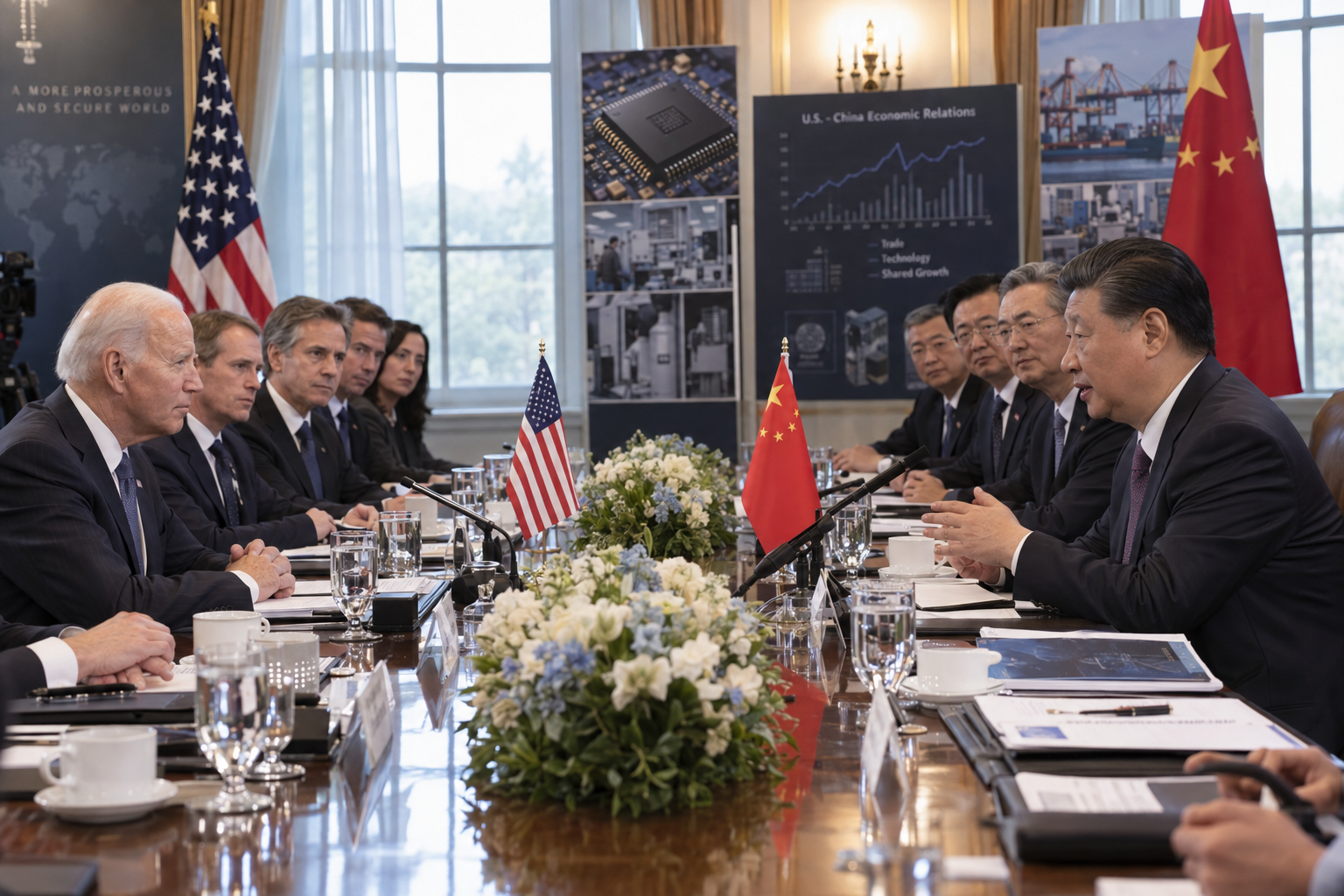
President Donald Trump and Chinese President Xi Jinping are expected to meet in Washington for their second face-to-face summit of the year, seeking to reinforce a fragile U.S.-China trade truce. Although both governments have signaled goodwill, they continue to exchange accusations and impose retaliatory measures. Their discussions are expected to cover tariffs, export controls, rare earths, artificial intelligence, sanctions related to the Iran war and broader economic vulnerabilities.
The current truce grew out of agreements reached after last year’s severe trade war, when U.S. tariffs on Chinese imports reached 145% and China’s retaliatory tariffs reached 125%. A temporary agreement reduced those rates, while a later deal in Busan included China suspending rare-earth export controls and purchasing U.S. agricultural products. The agreement expires Nov. 10 unless extended. Analysts broadly expect the leaders to preserve the current arrangement, possibly for another year, while making only limited progress on more contentious issues such as advanced semiconductor access and export controls.
Trade remains heavily restricted. Estimates of the average U.S. tariff on Chinese goods range from 22.8% to 36.5%, while China’s average tariff on U.S. products is estimated at 31%. Bilateral goods trade fell nearly 30% in 2025 and continued declining during the first seven months of 2026. Nevertheless, China remains one of the United States’ largest trading partners, and the U.S. trade deficit with China is still about $91.2 billion.
Treasury Secretary Scott Bessent suggested that negotiations may include a reciprocal $30 billion tariff reduction involving U.S. agriculture, energy and medical devices, alongside increased Chinese purchases of everyday goods. Analysts say both leaders are primarily managing for small gains and avoiding escalation. Trump also faces domestic political pressure to demonstrate economic progress before the U.S. election, while AI is expected to become a major area of competition because both countries view technological leadership as central to economic power.
Entities: Donald Trump, Xi Jinping, United States-China trade relationship, Washington, D.C., China • Tone: analytical • Sentiment: negative • Intent: analyze
22-09-2026
The article examines how the US-China technology rivalry has changed since Chinese President Xi Jinping’s May visit to Beijing by identifying the economic and technological leverage available to both sides ahead of an upcoming summit in Washington. The meeting is expected to test whether the two countries can advance their stated goal of “constructive strategic stability” despite their prolonged strategic competition.
Huawei Technologies remains a central symbol and battleground of the conflict. Although Washington has tightened restrictions on the company and on China’s access to advanced semiconductor technology, Huawei continues to develop alternative routes forward. The company’s ambitions have expanded to the point that “becoming Nvidia” is described as an internal goal, reflecting its effort to become a major provider of high-performance computing and artificial intelligence infrastructure.
Shortly before Xi’s planned meeting with US President Donald Trump, Huawei announced a system it said could allow up to 1 million processors to operate as a single unified computer. The announcement followed other claimed advances in semiconductor design, including the Tau Scaling Law and LogicFolding architecture. These approaches are intended to produce high-performance chips without depending on the most advanced lithography equipment, whose export to China remains restricted by the United States and its allies.
The article places these developments within a broader contest involving artificial intelligence, chips, rare earths and technology supply chains. It suggests that both countries have developed new sources of leverage since the previous Xi-Trump summit. However, the supplied excerpt focuses primarily on Huawei and China’s efforts to overcome semiconductor restrictions, and does not yet provide a definitive assessment of which side has the overall advantage.
Entities: United States, China, Donald Trump, Xi Jinping, Huawei Technologies • Tone: analytical • Sentiment: neutral • Intent: analyze
22-09-2026
The article argues that the September 2026 meeting between US President Donald Trump and Chinese President Xi Jinping will be a highly choreographed display of goodwill, but is unlikely to produce major agreements or resolve the central disputes in US-China relations. Trump plans an unusually personal welcome for Xi at Joint Base Andrews, followed by a White House summit, gala dinner, tea, and a visit to the National Archives. These gestures are intended to project respect, prestige, and improving personal relations, while offering opportunities for both leaders to shape domestic and international perceptions.
Trump wants political gains before the November midterm elections, particularly benefits for US farmers and evidence that he remains an effective dealmaker. Xi, meanwhile, will use the visit to appear as an equal to Trump ahead of important Communist Party meetings and preparations for a further term in office. The summit’s carefully staged symbolism may therefore matter more than its policy outcomes.
Several issues could create tension, including China’s alleged provision of satellite imagery to Iran and Trump’s accusations that Beijing interfered in the 2020 US presidential election. However, analysts believe neither issue is likely to derail the meeting. China is also not expected to make significant concessions. The Trump administration contains officials with sharply different views of Beijing, while Chinese strategists reportedly see the United States as divided, weakened, and in long-term decline.
Experts cited in the article say Beijing is seeking to preserve an uneasy calm while strengthening its position for extended competition with Washington. Trump’s limited emphasis on human rights and democratic governance, along with his reluctance to organize allies against China, may make him a comparatively manageable counterpart for Beijing. Overall, the summit is presented as an exercise in relationship management and political theater rather than a breakthrough in trade, security, or strategic competition.
Entities: Donald Trump, Xi Jinping, United States-China relations, Joint Base Andrews, White House • Tone: analytical • Sentiment: neutral • Intent: analyze