22-09-2026
The live updates report escalating tensions in the nearly seven-month U.S.-Iran war and a widening regional conflict. An Islamic Revolutionary Guard Corps spokesman warned that Iran would respond to any new U.S. assault with unspecified weapons and by expanding the “geography” of the war. President Donald Trump said he was considering several options, including destroying Iran, imposing further economic pressure, or seeking a new agreement. He also said he would probably be willing to meet Iran’s leader during the United Nations General Assembly in New York.
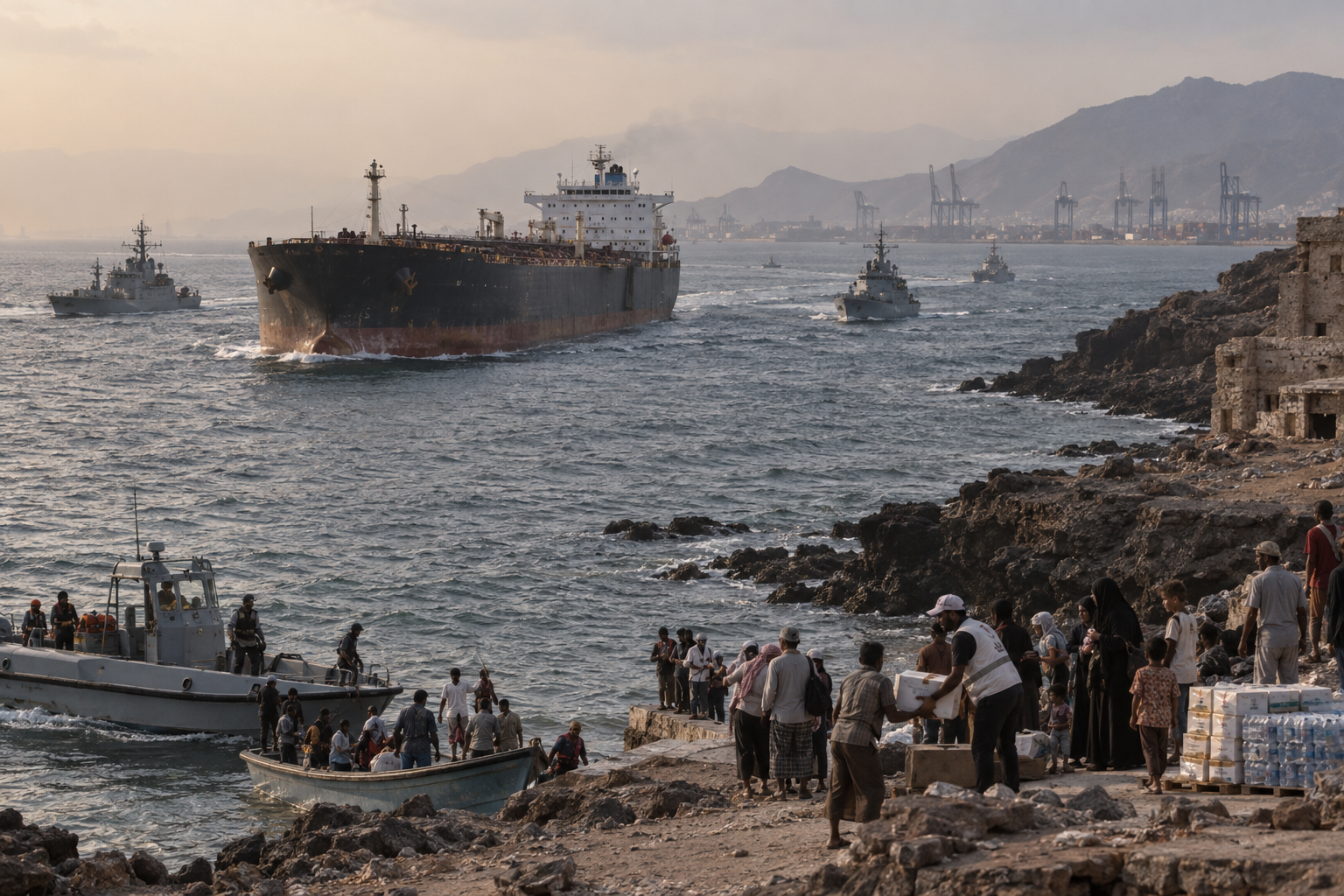
The conflict has increasingly affected U.S. allies and commercial shipping. U.S. embassies across the Middle East issued security alerts as Iran-backed Houthi rebels intensified attacks against Saudi Arabia and announced a blockade targeting Saudi-linked shipping in the Bab el-Mandeb Strait and Red Sea. The Houthis reportedly seized the Yemeni port city of Mokha and nearby islands, improving their ability to monitor one of the world’s most important shipping routes. In response, British Prime Minister Andy Burnham said the United Kingdom would provide limited military assistance to Saudi Arabia, including Royal Air Force air-to-air refueling for Saudi aircraft. The United States considered strikes against the Houthis but ultimately did not authorize them.
Other updates described the conflict’s effects on military families, aviation and maritime trade. Iran’s opening attacks targeted the U.S. Navy’s Middle East headquarters in Bahrain, leaving some military families stranded for more than a week. Iraq said it would suspend flights by Iranian airlines in response to threatened U.S. sanctions. Separately, two tankers were reportedly hit by a projectile or debris in the Strait of Hormuz, injuring two crew members and underscoring the risks to energy shipments. Overall, the article portrays a rapidly expanding conflict involving military retaliation, economic sanctions, regional proxy forces and disruption to global trade.
Entities: Iran–U.S. war, Islamic Revolutionary Guard Corps (IRGC), President Donald Trump, Andy Burnham, United Kingdom and Royal Air Force • Tone: urgent • Sentiment: negative • Intent: inform
22-09-2026
Saudi-led airstrikes on Yemen’s Red Sea port city of Mokha reportedly killed at least six civilians and wounded eight others, according to Saba, a news agency affiliated with Yemen’s Iran-backed Houthi movement. The reported fatalities included two children and a woman, while the wounded included a child and a woman. Mokha has become strategically important as the Houthis have launched an offensive aimed at taking control of Yemen’s entire Red Sea coastline, intensifying pressure on the Saudi-backed, internationally recognised Yemeni government.
The article says Yemen’s governing body head, Rashad al-Alimi, asked US President Donald Trump for American support during a Sept 20 call. According to a source in al-Alimi’s office, Trump did not promise military assistance, and the call was intended partly to demonstrate solidarity with Yemen’s embattled government. US media also reported that Saudi Crown Prince Mohammed bin Salman had urged Trump to strike the Houthis. Media reports said British Prime Minister Andy Burnham had agreed to provide military support to Saudi Arabia.
The latest fighting is presented as part of a broader regional conflict involving Iran, the United States, Israel and Iran-backed armed groups. The article says Houthi gains have strengthened Iran and its allies’ influence over key waterways, including the Strait of Hormuz, which is vital to Gulf states and Saudi Arabia for oil exports.
Yemen’s civil war began in 2014 when the Houthis captured the capital, Sanaa. Saudi Arabia began leading a coalition in support of the internationally recognised government in 2015. Although the conflict had largely been frozen since 2022, the article reports that fighting resumed in July. The Saudi intervention helped escalate the war, which has contributed to one of the world’s worst humanitarian crises.
Entities: Houthis, Mokha, Yemen, Saudi Arabia, Yemen’s Red Sea coast, Saba news agency • Tone: urgent • Sentiment: negative • Intent: inform
22-09-2026
Oil prices rose on Sept 22 after declining for four consecutive sessions, as investors awaited possible talks between the United States and Iran during the United Nations General Assembly in New York. Brent crude futures for November increased US$1.14, or 1.1 per cent, to US$101.48 a barrel. West Texas Intermediate (WTI) crude for October, which expires on Sept 22, gained 87 cents, or 0.9 per cent, to US$96.65, while the more actively traded November WTI contract rose 85 cents to US$93.22.
The market’s gains appeared to reflect short-covering rather than a fundamental shift in supply and demand. Analysts said prices would probably remain volatile and range-bound until there was clearer evidence of progress or failure in US-Iran diplomatic efforts. Washington and Tehran exchanged threats on Sept 20, although US President Donald Trump said he was open to meeting Iranian President Masoud Pezeshkian. Iran reportedly conveyed conditions for resuming negotiations through mediators.
Supply concerns eased after Saudi Aramco increased crude exports through the Strait of Hormuz. Around 14 million barrels were loaded onto seven supertankers inside the Gulf on Sept 20, following attacks on the East-West Pipeline that had disrupted some shipments through Yanbu. Crude implied volatility declined, although it remained historically high.
Regional risks persisted. Yemen’s Iran-backed Houthis claimed attacks on Riyadh and a Saudi Aramco facility in Yanbu, while China privately urged Tehran to help restrain the group after Saudi Arabia sought Beijing’s assistance. In Libya, an armed group closed a valve on the pipeline linking the Sharara oilfield to the Zawiya port. Production at the field fell by approximately 200,000 barrels per day to between 100,000 and 105,000 barrels per day. These competing developments—easing Gulf supply concerns and continued geopolitical and operational disruptions—left oil markets highly sensitive to diplomatic and security headlines.
Entities: Brent crude futures, West Texas Intermediate (WTI) crude, United States-Iran diplomatic talks, United Nations General Assembly, Donald Trump • Tone: analytical • Sentiment: neutral • Intent: inform
22-09-2026
The supplied material is not the full Al Jazeera live-blog article. It consists primarily of website clutter—repeated “Advertisement” labels and a prompt asking readers to enable instant alerts—along with the indicator “24 Updates.” The headline states that Iran’s Islamic Revolutionary Guard Corps (IRGC) says the United States and Israel must accept withdrawal from the region, placing the article within the context of the US-Israel war on Iran. However, none of the 24 reported updates, quotations, official statements, timelines, locations, casualty figures, military developments, or reactions are included in the provided content. As a result, it is not possible to produce a substantive account of the events, verify the IRGC’s statement, or determine how the situation developed during the live coverage. The headline suggests a confrontational regional military and political dispute, with Iran demanding that the United States and Israel leave the region. The wording also conveys an ultimatum and indicates that the IRGC is presenting withdrawal as an obligation rather than a negotiated possibility. The available text supports only a limited analysis: the article’s apparent purpose is to provide breaking-news coverage of the conflict, while its framing is urgent and conflict-focused. Any further claims about military operations, diplomatic responses, civilian impact, or the positions of other governments would require the missing article updates. The advertisements, notification prompt, and navigation-like elements have therefore been excluded from the cleaned version.
Entities: Iran, Islamic Revolutionary Guard Corps (IRGC), United States, Israel, Middle East region • Tone: urgent • Sentiment: negative • Intent: inform