22-09-2026
Lebanese President Joseph Aoun’s appeal to US President Donald Trump for help securing a complete Israeli withdrawal from Lebanon reflects Beirut’s dependence on Washington as the only power with meaningful leverage over Israel. However, the article argues that Aoun has overestimated both Trump’s willingness and ability to act. A US-mediated Lebanon-Israel framework agreement reportedly placed implementation obligations on Beirut while requiring no Israeli withdrawal, leaving Israel able to invoke the agreement whenever Washington seeks concessions.
The author contends that Lebanon is now trapped in a prolonged stalemate. Trump is constrained by the war with Iran, domestic political pressures ahead of the US midterm elections, and donors who support Israel. The administration’s desire to see Hezbollah disarmed and its areas transferred to the Lebanese army is presented as a preference rather than a coherent policy, because Washington has offered no realistic mechanism for achieving it while avoiding civil conflict. US envoys Michel Issa and Tom Barrack have argued that any settlement must involve Iran and broader regional negotiations, but their views have little influence when they conflict with Israeli preferences.
With negotiations stalled, Aoun has sought international support for Lebanon’s army and security forces. Yet his government faces severe limits: Israel continues attacking southern Lebanon and refuses further withdrawals unless Hezbollah is disarmed, while the Lebanese army rejects using force against Hezbollah because it fears civil war and institutional fragmentation. The article concludes that Lebanon’s predicament exposes broader diplomatic incoherence in Washington. The Trump administration lacks clear objectives, consistency, and an effective strategy for Lebanon, leaving Aoun politically stranded and Lebanon falling through the gaps of US regional policy.
Entities: Joseph Aoun, Donald Trump, Lebanon, Israel, United States/Washington • Tone: analytical • Sentiment: negative • Intent: analyze
22-09-2026
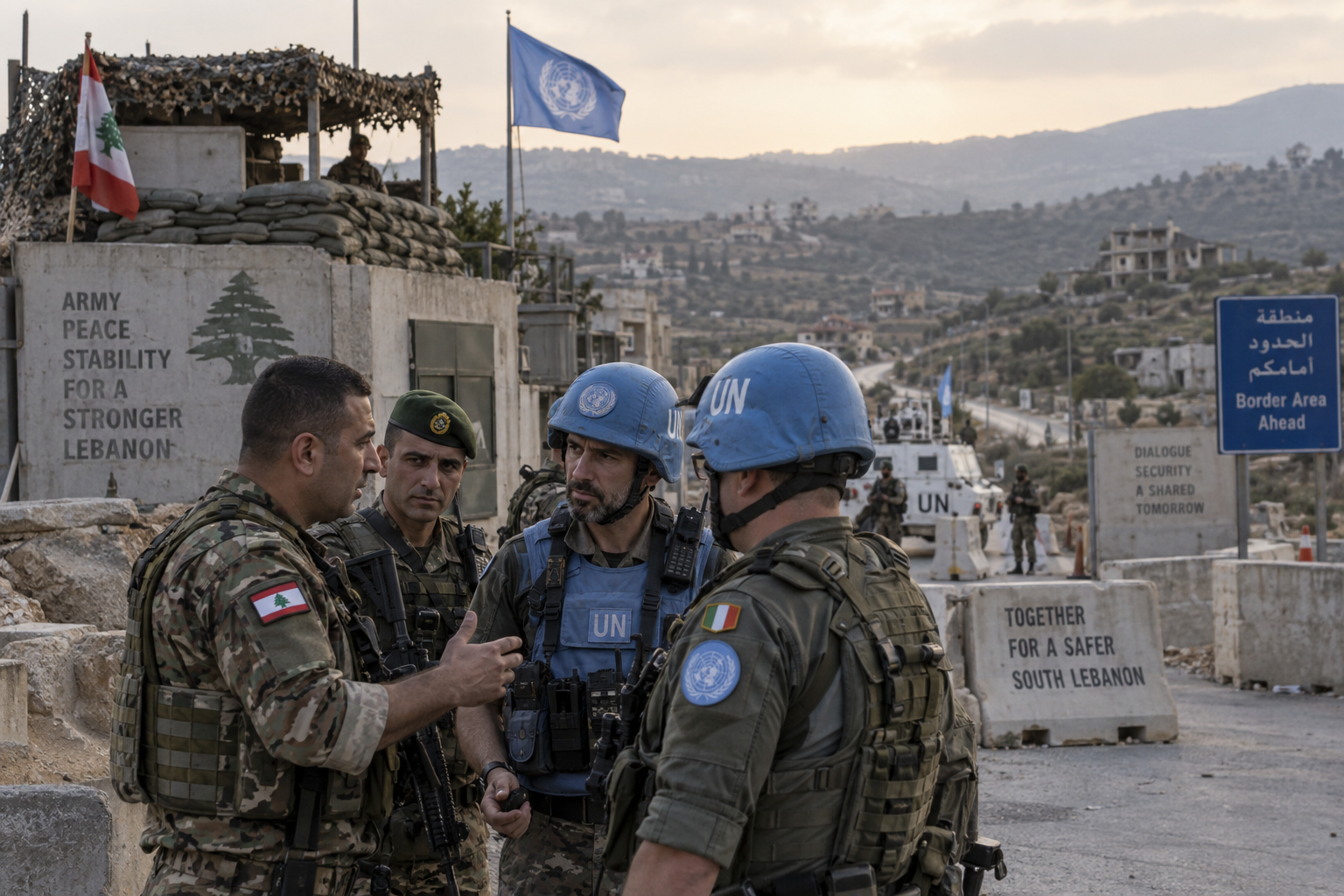
South Lebanon may face a security vacuum when the United Nations Interim Force in Lebanon (Unifil) withdraws on December 31, 2026, because no successor arrangement has been agreed. Diplomatic discussions have focused on three linked options: expanding the UN political mission in Beirut, creating a European Union mission to train and advise the Lebanese armed forces, and pursuing the disarmament of Hezbollah. Progress has been limited, and diplomats have not agreed on the mandates, sequencing, or division of responsibilities among these mechanisms.
France and Italy are leading efforts to build international support for the Lebanese army and prevent further deterioration along the Israel-Lebanon border. However, they are waiting for Beirut to present a clear action plan that could form the basis of a framework acceptable to Washington. The United States is reportedly open to individual countries helping after Unifil’s departure but does not want a replacement force operating under a UN mandate.
Israel’s October 27 elections have made its government less willing to accept an international military presence in southern Lebanon or make concessions to the Lebanese army, which Israel accuses of failing to disarm Hezbollah. Hezbollah, meanwhile, continues to reject disarmament and maintains significant military capabilities despite Israeli attacks that have weakened its leadership. European diplomats fear that forcing disarmament could trigger civil war, while insufficient pressure could allow Hezbollah to retain its position.
The situation has been worsened by Israel’s military operations, which have killed more than 4,300 Lebanese people, destroyed border towns, and created a buffer zone extending 6km to 10km inside Lebanon. Lebanese observers fear that Israel could maintain a long-term presence similar to its occupation before 2000. Experts say a workable arrangement would require Hezbollah’s disarmament, the strengthening of the Lebanese army, and a corresponding Israeli withdrawal, but Lebanon has yet to articulate a clear request for the post-Unifil mechanism.
Entities: South Lebanon, United Nations Interim Force in Lebanon (Unifil), United Nations Special Coordinator for Lebanon (Unscol), Hezbollah, Israel • Tone: analytical • Sentiment: negative • Intent: analyze
22-09-2026
The article reports that Israeli forces now maintain nearly 30 military positions across southern Lebanon, including eight fortified bases, according to the UN peacekeeping force in Lebanon (UNIFIL). Five fortified positions existed before the latest escalation, while three newer bases were established in Khiam, Maroun El Ras and Maiss El Jabal after fighting resumed in March. UNIFIL says the bases include earthworks, observation posts and restricted road access, while roughly 20 additional temporary positions are used by troops moving through homes and other existing structures.
The growing military presence is occurring alongside negotiations, backed by the United States, that seek an Israeli withdrawal from Lebanese territory, Hezbollah’s disarmament and the transfer of security control to the Lebanese army. The article says Israel has nevertheless expanded its self-declared security zone through depopulation, demolitions and the cutting of roads, causing the zone’s boundaries to shift unpredictably.
Tensions have increased between Israeli forces and the Lebanese Armed Forces. Lebanese troops recently withdrew from a checkpoint near Deir Mimas after Israeli forces used stun grenades. Lebanese officials said the checkpoint had been coordinated through the US-endorsed mechanism linking Israel and Lebanon, but acknowledged uncertainty over the exact location of the so-called yellow line. Israeli forces subsequently raided homes, questioned residents and confiscated hunting rifles, according to villagers.
The article also describes the detention and interrogation of Kfarshouba mayor Qassem Al Qadiri. He said Israeli forces attempted to assert authority over access to basic services and encouraged local officials to deal directly with them. Al Qadiri rejected that proposal, insisting that the village was part of the Lebanese state. His statement that residents no longer know where the boundary lies captures the uncertainty and growing sense of coercion among communities inside the occupation zone.
Entities: UNIFIL (UN peacekeeping force in Lebanon), Israeli military, Hezbollah, Lebanese Armed Forces (LAF), Kandice Ardiel • Tone: analytical • Sentiment: negative • Intent: inform