22-09-2026
The Al Jazeera NewsFeed segment examines where real power lies within the United Nations, challenging the assumption that equal voting rights mean equal influence. Although every UN member country has a vote, the article highlights the special authority held by five countries that possess veto power in the UN Security Council. A veto allows any one of those countries to block a substantive Security Council decision, giving them substantially greater influence over matters involving international peace and security than the other 188 countries referenced in the segment.
The explainer also frames UN power as broader than formal voting procedures. It asks how money, vetoes and political influence shape what the organisation can and cannot do. This suggests that the segment considers both the UN’s institutional rules and the practical realities affecting its decision-making capacity. Financial resources can influence the organisation’s operations and priorities, while diplomatic relationships and broader geopolitical influence can affect negotiations and outcomes even when they are not expressed through a formal veto.
Presented by Al Jazeera’s Noor Wazwaz, the piece is a concise introduction to the distribution of authority within the UN. The available text does not identify the five veto-holding countries individually or provide examples of specific resolutions, disputes or funding arrangements. Instead, it establishes the central issue: the UN formally includes all member states, but its most consequential decisions are shaped disproportionately by the permanent members of the Security Council and by the money and influence surrounding the organisation. The segment therefore serves as a short, analytical explainer of the gap between equal membership and unequal power at the United Nations.
Entities: United Nations, UN Security Council, Al Jazeera, Noor Wazwaz, veto power • Tone: analytical • Sentiment: neutral • Intent: analyze
22-09-2026
Russia has called for reform of the United Nations Security Council but said its current system of permanent members and veto power should be preserved. Kremlin spokesman Dmitry Peskov made the comments in Moscow on September 22 while responding to Turkish President Recep Tayyip Erdogan’s renewed criticism of the council.
Erdogan has argued that the five permanent members—Britain, China, France, Russia and the United States—do not adequately represent the international community and prevent the United Nations from taking swift decisions. He has urged the abolition of both permanent membership and the veto, which allow the five countries to block substantive Security Council resolutions.
Peskov said Moscow supports expanding the council’s permanent membership beyond the existing five countries. However, he rejected the idea of removing the veto, describing both permanent membership and veto rights as important components of the UN’s institutional structure. His remarks therefore position Russia in favor of broadening representation while retaining the privileges that give the current permanent members substantial influence over international security decisions.
The comments highlight a central disagreement in longstanding debates over Security Council reform. Countries seeking greater representation generally argue that the council’s structure reflects the balance of power at the end of World War II rather than the modern international system. Russia, while supporting an expansion of permanent membership, maintains that the veto remains essential to the council’s design. The report does not specify which additional countries Moscow would support for permanent seats or describe any immediate reform proposal. It presents the Kremlin’s position as a response to Erdogan’s call for a more fundamental restructuring of the council.
Entities: United Nations Security Council, Russia, Kremlin, Dmitry Peskov, Recep Tayyip Erdogan • Tone: analytical • Sentiment: neutral • Intent: inform
22-09-2026
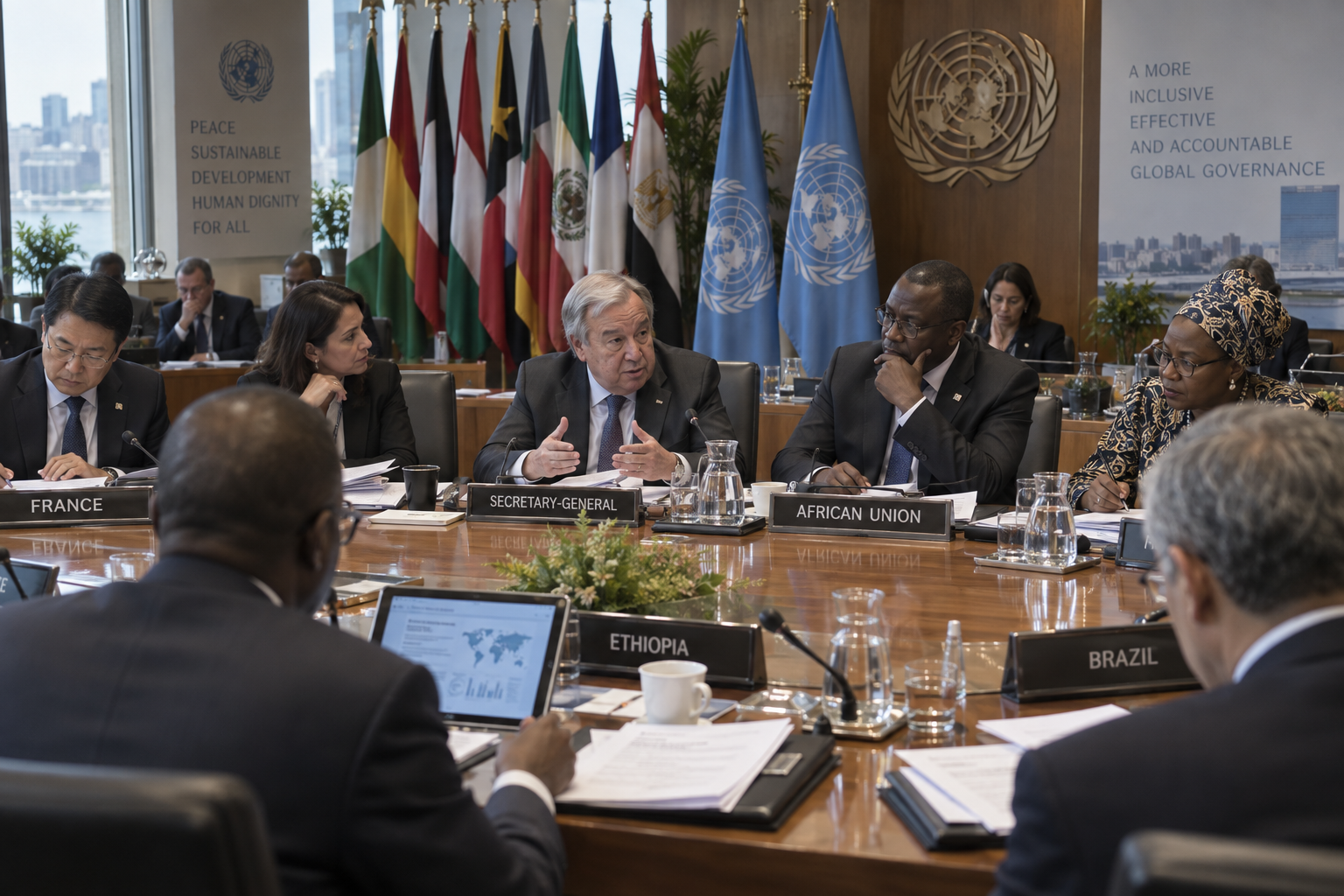
The African Union is expected to use the United Nations General Assembly’s annual high-level meeting to seek a stronger role in global decision-making. A central objective is securing permanent African representation on the UN Security Council, reflecting long-standing concerns that the continent is underrepresented in the body responsible for addressing international peace and security.
The gathering begins amid heightened security at UN headquarters in New York, where flags were raised and police officers, canine teams, and law-enforcement drones were deployed ahead of the arrival of world leaders. The security measures are presented as preparations for the high-level event rather than as a response to a specific incident.
On Monday, the leaders of the African Union and the United Nations met to discuss issues affecting Africa’s position in the international system. Their agenda included reforms to international financial institutions, debt sustainability, and ways to ensure that African countries gain greater economic value from their mineral resources. These priorities link political representation with broader demands for fairer financial arrangements and more beneficial resource management.
Kenyan President William Ruto is also expected to promote several issues during his visit, including climate finance, reform of global governance, peace and security, and digital cooperation. In addition, the UN Development Programme will present an Africa-focused package addressing artificial intelligence, natural resources, data, talent, and access to capital.
Overall, the article highlights a coordinated African effort to influence debates at the UN, expand the continent’s formal representation, and secure stronger economic, technological, and financial support. It also places those diplomatic priorities within the context of the security preparations surrounding the General Assembly.
Entities: African Union (AU), United Nations (UN), UN General Assembly, UN Security Council, New York • Tone: analytical • Sentiment: neutral • Intent: inform