09-11-2026
Iranian citizens quoted in the article expect Israel’s policy toward Iran to remain unchanged even if opposition candidate Gadi Eisenkot succeeds in forming a new government. Tehran resident Ali Soroush said Israel’s “enmity” toward Iran would continue, while Arash Kamali expressed the view that replacing Benjamin Netanyahu with another leader would be unlikely to change Israel’s approach. Their comments reflect a broader perception among people interviewed in the Iranian capital that a change in Israel’s governing coalition would not alter its policy toward the Islamic Republic.
The article places those views in the context of a recent Israeli election and the war between Israel, the United States and Iran. It reports that Israel and the United States struck Iran in February, starting the war against Tehran. Netanyahu and his government have said they must prevent Iran from seeking nuclear weapons, which they describe as a threat to their countries.
After the October 27 election, Netanyahu’s allies lost their parliamentary majority, but the bloc led by Eisenkot did not win one either. Arab-led parties made historic gains and could potentially help Eisenkot form a coalition, although such an arrangement would be politically difficult. An Arab party has joined an Israeli governing coalition only once before, and an alliance could be particularly divisive after more than three years of war in Gaza.
President Isaac Herzog said he would give Eisenkot the first opportunity to form a government. Eisenkot, a former military chief and Netanyahu’s main challenger, was due to receive the mandate at a Sunday ceremony. He would have up to 28 days to assemble a coalition, with a possible two-week extension. If he failed, Netanyahu could be asked to try. If neither candidate could form a government, Israel would return to elections early the following spring.
Entities: Ali Soroush, Arash Kamali, Isaac Herzog, Gadi Eisenkot, Benjamin Netanyahu • Tone: analytical • Sentiment: neutral • Intent: inform
09-11-2026
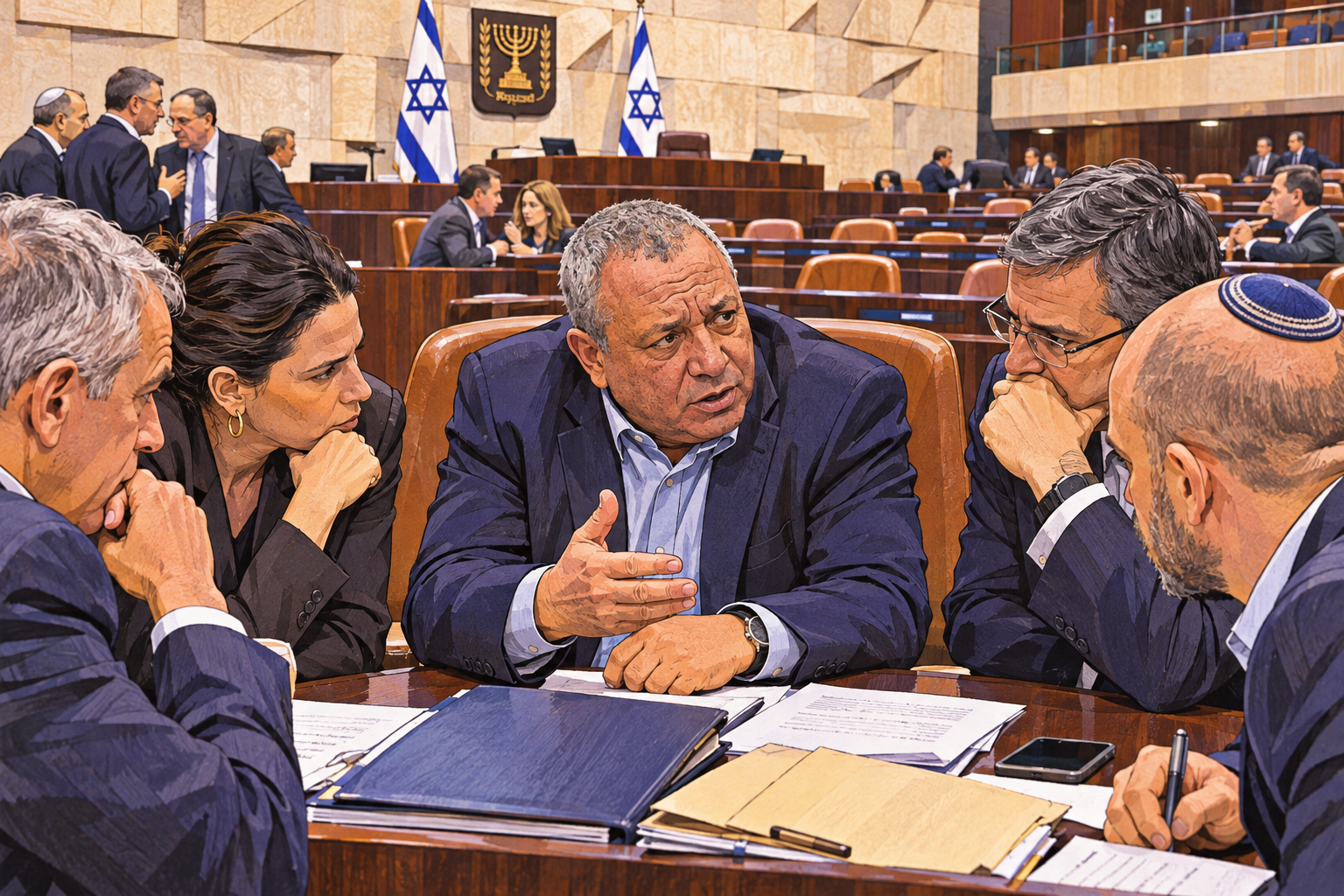
Gadi Eisenkot has 28 days, with a possible 14-day extension, to assemble support from at least 61 members of Israel’s 120-seat Parliament after President Isaac Herzog tasked him with forming a government. Eisenkot’s opposition bloc holds 48 seats, while Benjamin Netanyahu’s bloc has 53, leaving Eisenkot without a clear path to a majority. The article outlines three difficult possibilities.
First, Eisenkot could form a minority government dependent on Arab Israeli lawmakers. Arab-majority parties won a record 19 seats, and Eisenkot might rely mainly on the more moderate Raam party, which has eight seats, while the Joint List abstains from no-confidence votes. However, disagreements over the war in Gaza could destabilize such an arrangement. Netanyahu has attacked the idea, and right-wing opposition leader Avigdor Liberman has ruled out joining a government that relies on Arab Israeli parties.
A second possibility is an alliance with ultra-Orthodox parties Shas and United Torah Judaism. Their combined 13 seats could help Eisenkot reach a majority, but they would likely seek to preserve the exemption from mandatory military service for ultra-Orthodox Jews. Ending that exemption was a prominent opposition promise, amid resentment over reservists’ repeated deployments. Liberman has nonetheless indicated openness to working with the ultra-Orthodox to avoid relying on Arab Israeli lawmakers. Yair Golan criticized the inconsistency of opposing both that alliance and cooperation with Arab parties while also opposing changes to Netanyahu’s judicial reforms.
The third option is a national-unity government with Netanyahu, though each man insists on leading. Eisenkot has described Netanyahu as dangerous and unfit, citing the failure to prevent the Oct. 7, 2023, Hamas attack, political divisiveness and corruption charges. Netanyahu has little incentive to serve under Eisenkot, since losing the premiership would cost him immunity. A unity arrangement could avert another election, which some observers believe might favor Netanyahu as opposition enthusiasm fades. Herzog supports unity as a way to reduce polarization, but Israel’s past experience—including the rapid collapse of a 2020 unity government with Benny Gantz—underscores the risks.
Entities: Gadi Eisenkot, Isaac Herzog, Benjamin Netanyahu, Avigdor Liberman, Yair Golan • Tone: analytical • Sentiment: neutral • Intent: inform
09-11-2026
The supplied article excerpt reports that former Israeli military chief Gadi Eisenkot called for Prime Minister Benjamin Netanyahu and his government to be replaced swiftly. Eisenkot argued that Israel was suffering a “devastating” loss of confidence among its closest friends and strategic allies. His comments frame the government’s situation as not only a domestic political matter but also a concern for Israel’s international relationships. The headline says Eisenkot accepted a mandate to form a government, although the short excerpt provided does not explain who issued the mandate, how the process would work, or what political support he has. It also provides no further details about Netanyahu’s response, the government’s standing, or the reactions of Israel’s allies. The article is attributed to Sammy Westfall and Suheir Hashimeh and dated November 8, 2026, according to the URL and headline information supplied. The excerpt includes a publication slogan and interface prompts, which are not part of the reported article and have been excluded from the clean text. Because the provided content consists of only a headline and one sentence of article text, this summary is limited to those details and cannot describe the article’s wider context or arguments.
Entities: Gadi Eisenkot, Benjamin Netanyahu, Israel, Israeli military, Israeli government • Tone: urgent • Sentiment: negative • Intent: inform
09-11-2026
The supplied article excerpt reports that Gadi Eisenkot, a former Israeli military chief, is considering a potentially controversial political alliance as he explores how to form a government capable of removing Prime Minister Benjamin Netanyahu from office. The possible partners are ultra-Orthodox Jewish parties, whose participation could help resolve the difficult coalition arithmetic involved in assembling a governing majority. The excerpt frames the effort as both a political calculation and a contentious choice: Eisenkot is seeking a viable path to a new government, but an alliance with these parties may provoke controversy.
The material provided is only the article’s opening sentence, followed by a website sign-up prompt. It does not explain why the proposed alliance is controversial, describe the parties’ positions, provide reactions from politicians, or give details about the broader political negotiations. It also does not establish whether any agreement has been reached. Accordingly, this summary is limited to the information in the excerpt and should not be read as a complete account of the article. The excerpt’s central focus is the prospect of opposition coalition-building around Eisenkot, with the aim of ousting Netanyahu, and the potential role of ultra-Orthodox parties in that effort.
Entities: Gadi Eisenkot, Benjamin Netanyahu, Jerusalem, Israel, Israeli opposition • Tone: analytical • Sentiment: neutral • Intent: inform