09-11-2026
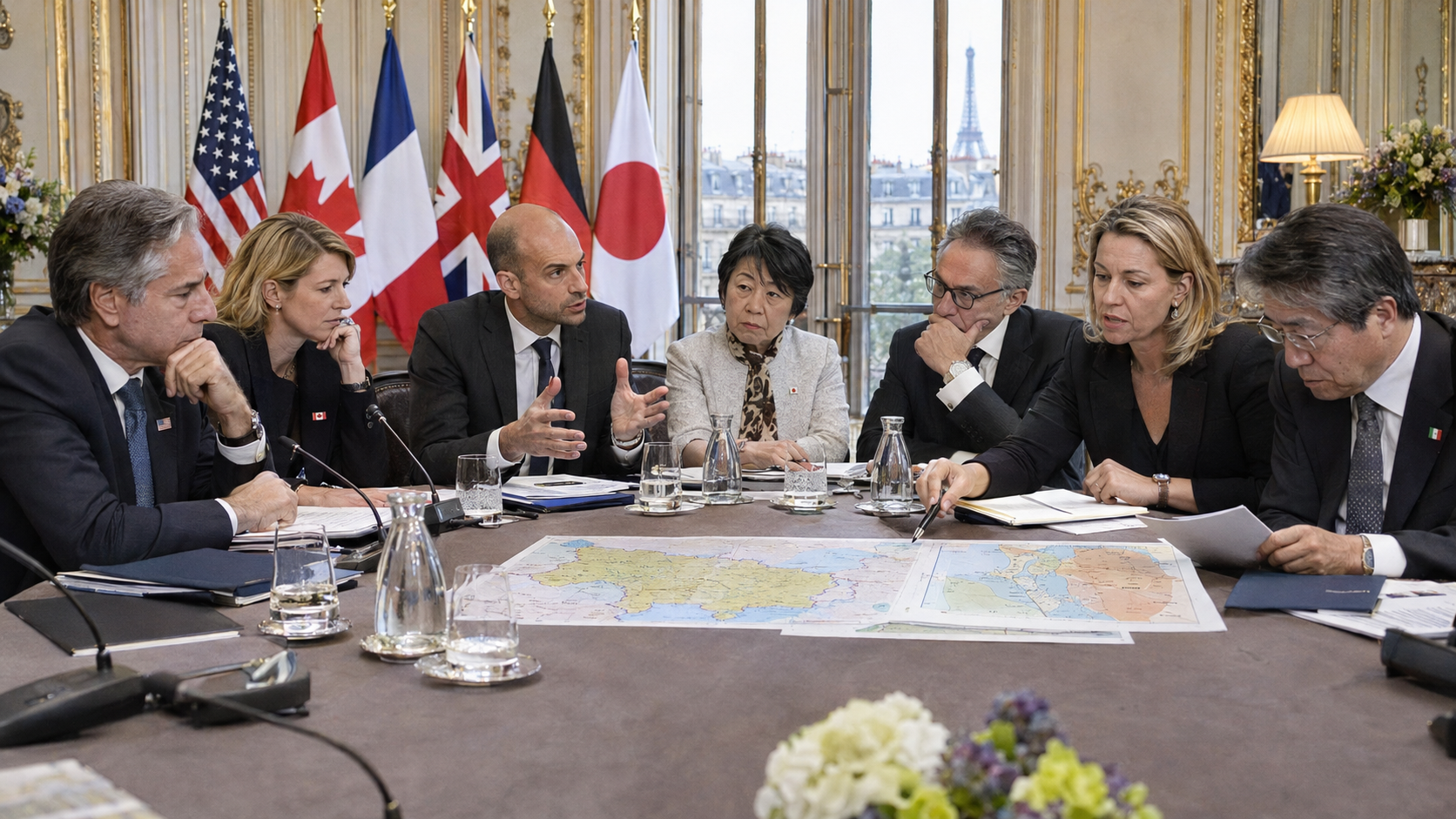
Foreign ministers from the Group of Seven began a two-day meeting in Paris on Nov. 9, with European officials expected to press US Secretary of State Marco Rubio for a fair settlement of Russia’s war against Ukraine and to discourage renewed military escalation with Iran. Their discussions coincided with US-mediated negotiations involving Moscow and Kyiv, scheduled to take place in Abu Dhabi on Nov. 10 and 11. European governments are concerned Ukraine could be pushed into accepting unfavorable terms and that Washington might make security arrangements with Russia without Europe’s involvement. German Foreign Minister Johann Wadephul said Europe must have a place at the table, while French Foreign Minister Jean-Noel Barrot said Europeans, including France, would be represented at the Abu Dhabi talks. Ukrainian Foreign Minister Andriy Sybiga was also due to attend a session in Paris, and President Volodymyr Zelensky coordinated positions with European Commission President Ursula von der Leyen. Canada announced new sanctions targeting 38 entities and 24 individuals, citing efforts to reduce Russia’s military capabilities.
The ministers also addressed concerns about Iran. President Donald Trump has not ruled out further strikes, including against a site known as Pickaxe Mountain, though he told CNN renewed fighting was highly unlikely. European officials said they wanted a resolution and the restoration of normal shipping through the Strait of Hormuz. Wadephul warned that military escalation could not be afforded, while Rubio said negotiations with Tehran had made no progress and criticized Iran’s demands as unrealistic. The meeting, one of the final events of France’s G-7 presidency, was moved from Marseille to Paris for scheduling reasons. Rubio’s visit was his first overseas trip since the US midterm elections; the United States is due to assume the G-7 presidency from France in 2027.
Entities: Group of Seven (G-7), Marco Rubio, Donald Trump, Ukraine war, Russia • Tone: analytical • Sentiment: neutral • Intent: inform
09-11-2026
G7 foreign ministers began a two-day meeting in Paris on Monday, with the conflicts in Ukraine and Iran expected to feature prominently in discussions. The article focuses on the attention directed toward US Secretary of State Marco Rubio, who is likely to be asked whether the Trump administration will reconsider or change its positions on either conflict. That question has taken on added significance following what the article describes as a sweeping Democratic victory in the US midterm elections. The report presents the meeting as taking place amid multiple unresolved global crises, but the supplied text does not provide details about the ministers’ agenda, the specific policy positions under review, or Rubio’s response. France 24 correspondent Clovis Casali is credited with additional reporting. The provided page text is a short introduction to a video report rather than a full transcript; it offers no further statements from officials or other participants. Its central point is therefore the political scrutiny Rubio may face in Paris and the possibility that the US approach to Ukraine and Iran could become a focus of the G7 foreign ministers’ talks.
Entities: Marco Rubio, Clovis Casali, G7 foreign ministers, G7 meeting, Paris • Tone: analytical • Sentiment: neutral • Intent: inform
09-11-2026
G7 foreign ministers are meeting in Paris for two days of talks, where European governments are expected to urge the United States to support a fair settlement to Russia’s war against Ukraine and avoid further military action against Iran. The meeting brings together ministers from Britain, Canada, France, Germany, Italy, Japan and the United States. Russia’s invasion of Ukraine is approaching its fifth anniversary, while Washington has not ruled out additional strikes on Iran. US Secretary of State Marco Rubio is expected to attend both days, unlike at the ministers’ previous meeting in March; the trip is his first abroad since Republicans lost the US midterm elections.
The meeting coincides with US-mediated talks between Moscow and Kyiv in Abu Dhabi. European officials are concerned that Ukraine could be pressured into accepting unfavorable terms. France’s foreign minister, Jean-Noel Barrot, said Europeans would be represented at the talks. The article also notes concerns over President Donald Trump’s suggestion of a broad deal with Russia and envoy Jared Kushner’s proposal for a wider European security architecture, which has previously met European skepticism.
On Iran, European governments want a resolution and the restoration of normal shipping through the Strait of Hormuz. Trump has left open the possibility of new strikes, including at a suspected nuclear site that Tehran says is not a nuclear facility.
Other events around the ministerial include a French-hosted donor conference to raise money to repair the protective dome over the Chernobyl reactor, damaged in a Russian strike. About 500 million euros is needed, and slightly more than half has been raised. Marseille, the meeting’s originally planned location, will host the launch of a 14-port network focused on combating drug trafficking. Rubio declined to comment directly on the Republican midterm defeat and said he was not concerned about protests in France.
Entities: G7 foreign ministers, France, Paris, United States, Marco Rubio • Tone: analytical • Sentiment: neutral • Intent: inform