24-09-2026
Poland’s deputy prime minister says a fire at a state-owned Starlink satellite station in the central province of Masovia was deliberate sabotage intended to disrupt internet access, including for Ukrainian institutions and the army. The station remains operational, and an investigation is under way. Krzysztof Gawkowski said the incident may fit a new Russian pattern of attacks, although the Kremlin has not commented. Prime Minister Donald Tusk cautioned against definitively calling it sabotage before the investigation is complete.
Separately, Denmark’s intelligence service warned that Russia is expected to intensify hybrid warfare in the coming months. It described a direct military attack on Nato as highly unlikely, but said the risk of a limited attack is low and growing. The report places the Polish fire amid broader European concerns: Germany has blamed Russia for an attempted drone attack on Leipzig/Halle Airport, and France is planning measures to protect critical infrastructure. Recent airspace incidents involving Moldova, Romania and Poland are also cited. Russia denies preparing to attack Nato countries and has not acknowledged responsibility for the alleged acts of sabotage.
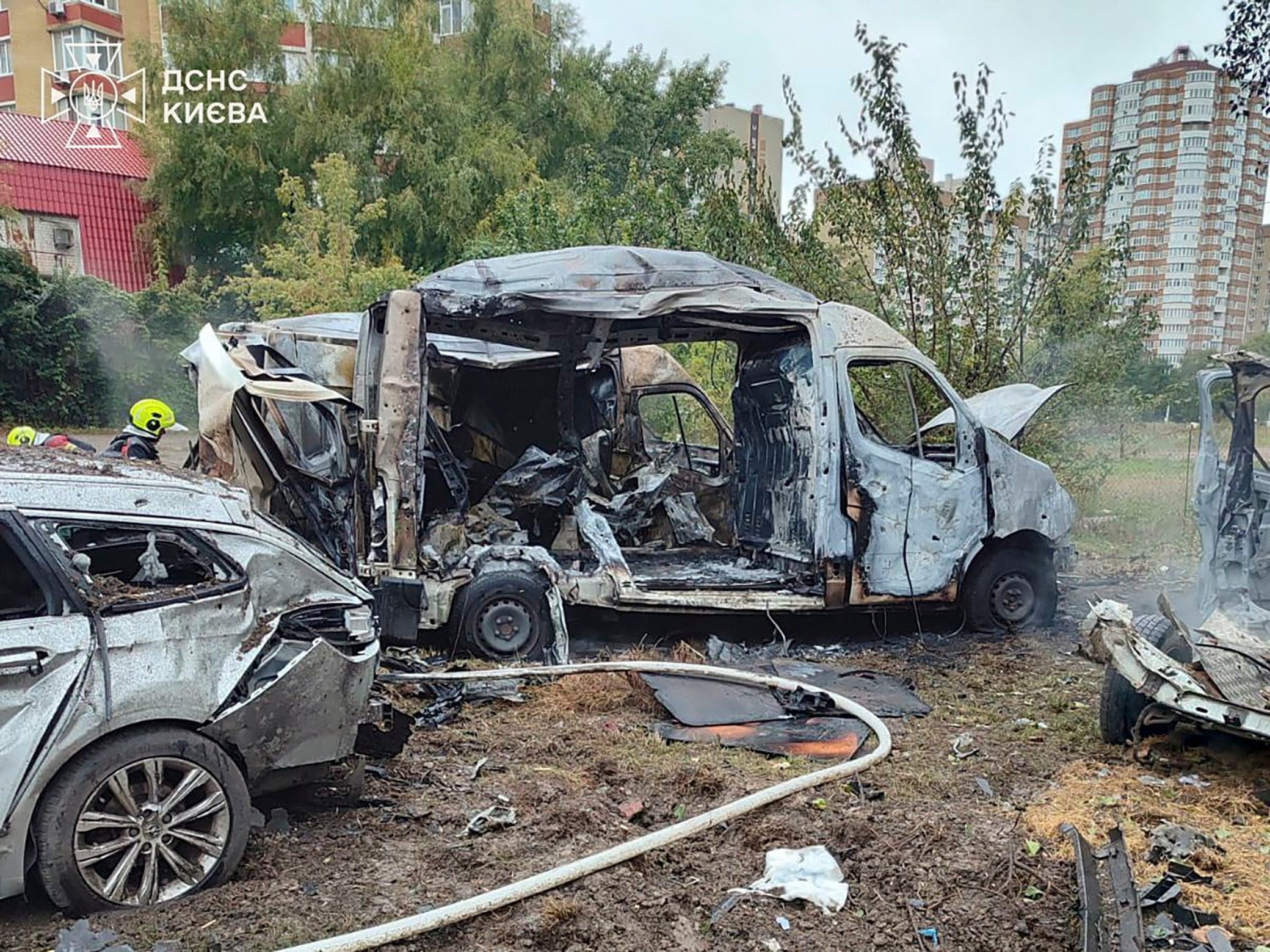
The article then details intensified Russian attacks on Ukraine. A strike on a farm in Kharkiv region killed six agricultural workers and injured 12. In Kyiv, overnight attacks involving drones and missiles killed two people and injured eight, damaged several businesses and disrupted internet service after data centres were hit. Ukrainian President Volodymyr Zelensky accused Russia of targeting civilian infrastructure and appealed in New York for ballistic interceptors. The report describes newer, faster Russian jet-powered drones as harder to intercept, while Ukraine seeks less expensive countermeasures. It also notes Ukraine’s own long-range strikes on Russian oil and postal facilities, and reports that Russian envoy Kirill Dmitriev was travelling to the United States for meetings with Trump administration officials. Russia’s foreign minister said there would be no pause in the war.
Entities: Krzysztof Gawkowski, Donald Tusk, Volodymyr Zelensky, Vladimir Putin, Sergei Lavrov • Tone: analytical • Sentiment: negative • Intent: inform
24-09-2026
A delegation of Ukrainian parliamentarians visiting Ottawa is asking Canada’s federal and provincial governments to help fund electrical transformers ahead of another winter of war. Ivanna Klympush-Tsintsadze, who chairs Ukraine’s committee on integration into the European Union, warned that Russia is intensifying attacks on energy infrastructure, water supplies and sewage systems to make Ukrainian cities unlivable. She said the resulting humanitarian crisis could be unprecedented. The delegation is also seeking Canadian electronic-warfare equipment to counter drones and more air-to-air missiles. It is urging governments to contribute to funding packages managed by the European Union’s Energy Community. North American transformers are incompatible with those used in Europe, making support for European transformer production especially useful. One Canadian province has already expressed interest, and the delegation planned to raise the proposal with Ontario officials.
The article describes a broader escalation in Russian attacks, including waves of drones, missiles and glide bombs, and reports that more than 800 civilians were killed in July and August, citing the UN refugee agency. Ukrainian MP Oleksandr Merezhko characterized the conflict as involving a wider coalition, including Iran and North Korea, which he said provide drones, munitions and personnel. At the United Nations, President Volodymyr Zelenskyy called for stronger sanctions and argued that stopping Russia’s ability to finance the war is essential to ending it. He also said people from 47 countries are being enlisted by Russia.
Klympush-Tsintsadze argued that countries nearer to Ukraine better understand the threat, while Western attention and political resolve are fading. She warned that Ukrainians’ resilience should not be mistaken for an indication that the war is under control, emphasizing the daily deaths and exhaustion facing the country.
Entities: Ivanna Klympush-Tsintsadze, Oleksandr Merezhko, Volodymyr Zelenskyy, Vladimir Putin, Ukraine • Tone: analytical • Sentiment: negative • Intent: inform
24-09-2026
Russia says it appreciates the U.S. invitation for President Vladimir Putin to attend the G20 summit in Miami in December, but the Kremlin has not decided whether he will go. The invitation, announced by U.S. Secretary of State Marco Rubio, could offer Putin and U.S. President Donald Trump a chance to meet. Rubio said the gathering could also allow Putin to engage with other world leaders, and suggested a meeting would be useful if it had a clear purpose. Kremlin spokesperson Dmitry Peskov said Moscow valued the invitation and would consider it before making a decision.
The proposal has drawn sharp criticism from European officials amid Russia’s full-scale invasion of Ukraine, which began in 2022. Polish Prime Minister Donald Tusk warned that Moscow might interpret the invitation as encouragement to continue its aggressive policies. EU foreign policy chief Kaja Kallas called the proposed treatment of Putin difficult to understand and argued that welcoming leaders who start wars and violate international law risks normalizing such conduct and encouraging more of it.
The invitation comes as diplomatic efforts to end the war have stalled. The article reports that the United States has shifted attention to its war against Iran, although negotiators Jared Kushner and Steve Witkoff recently traveled to Ukraine for talks with President Volodymyr Zelenskyy. At the United Nations General Assembly, Zelenskyy condemned Putin, describing him as the source from whom the idea of war spreads.
Ukraine has increased attacks on Russian oil refineries and logistics hubs and has warned it could make Russia’s coming winter painful if a truce is not reached in the coming weeks. Kyiv also acknowledges concern about facing another difficult winter itself. The proposed summit invitation thus sits against a backdrop of continuing attacks, strained diplomacy, and disagreement among U.S. and European leaders over how to engage with Putin.
Entities: Vladimir Putin, Donald Trump, Volodymyr Zelenskyy, Marco Rubio, Kaja Kallas • Tone: analytical • Sentiment: negative • Intent: inform
24-09-2026
The European Union says it will continue to condemn Russia’s invasion of Ukraine at the G20 summit in Miami in December, whether or not Russian President Vladimir Putin attends. The United States, which is hosting the summit, has invited Putin; the Kremlin says he will consider the invitation. EU spokesperson Olof Gill said the bloc has used G20 meetings since 2022 to denounce the invasion and call for it to end, and that this stance will not depend on who participates. He also noted that Russia remains a G20 member and has the right to attend. The EU and three of its member states—France, Germany, and Italy—are represented in the group.
US Secretary of State Marco Rubio said Washington views the invitation as an opportunity for Putin to engage with President Donald Trump and other world leaders, and said the US hopes Putin accepts. France, Germany, Italy, the United Kingdom, and Canada have supported excluding Russia from the G20 since the invasion began in February 2022. Putin did not attend the 2022 Bali or 2023 New Delhi summits, despite being invited. His most recent in-person meeting with Trump was in Alaska in August 2025, his first visit to a Western country since the invasion began.
The article also reports that Russian strikes killed at least eight people in Ukraine on Thursday. In the Kharkiv region, six agricultural workers were killed and 12 wounded in an attack on a warehouse that Ukrainian authorities said was hit by a Banderol cruise missile. At least two people were killed in Kyiv, and strikes near Odesa reportedly set a shopping mall on fire.
Entities: European Union (EU), G20 summit in Miami, Vladimir Putin, United States, Olof Gill • Tone: neutral • Sentiment: negative • Intent: inform
24-09-2026
Polish Deputy Prime Minister and Digital Minister Krzysztof Gawkowski said a fire at a Starlink station in central Poland was a deliberate act of sabotage. The fire broke out late Wednesday at a station belonging to Exatel, a Polish state-owned telecommunications company. Gawkowski told public broadcaster TVP that the suspected aim was to disable the station and disrupt internet access for institutions, including the Ukrainian army. The facility transmitted internet traffic through Poland, including traffic to neighboring Ukraine.
Gawkowski said the incident may be part of a new phase of hybrid warfare and pointed to indications connecting it with what he described as a new Russian doctrine of attack. The article reports these as Polish assessments; it does not provide independent evidence confirming the cause of the fire or attributing it to Russia.
The report places the accusation in the context of broader concerns among Poland and other EU and NATO countries about Russian hybrid warfare, including sabotage, since Russia’s full-scale invasion of Ukraine began in February 2022. Poland borders Ukraine, Russia’s Kaliningrad exclave, and Belarus, and is described as one of Kyiv’s strongest European supporters. It has also joined the newly launched Carpathian Eight regional summit with Ukraine. The article recalls Polish Prime Minister Donald Tusk’s warning earlier in September about possible Russian hybrid drone and missile strikes against Ukraine’s allies, as well as Poland’s accusation last year that Russia was responsible for sabotage on the Polish rail network, which Warsaw called state terrorism.
Entities: Krzysztof Gawkowski, Donald Tusk, Poland, Ukraine, Russia • Tone: neutral • Sentiment: neutral • Intent: inform
24-09-2026
At least eight people were killed in a wave of Russian strikes across Ukraine on Thursday: six agricultural workers in the east and two people in Kyiv. The attacks involved drones and missiles, including powerful ballistic missiles, and triggered air-raid sirens that sent residents seeking shelter. Ukrainian officials said a warehouse in the Chuhuiv district of Kharkiv region was hit while workers were sorting vegetables. The region’s prosecutor’s office shared images of the damaged facility, and its governor said eight settlements had been attacked in the previous 24 hours. Strikes in and around Odesa caused a fire at a shopping mall and damaged homes and businesses.
In Kyiv, emergency-service images showed burned-out cars and damaged buildings. The capital has faced particularly intense attacks in recent days, with strikes hitting petrol stations and rail infrastructure. The postal company Nova Post said a branch was destroyed and its sorting depot damaged. Residents are considering winter contingency plans amid concern that further attacks could disable the energy system needed for heating in sub-zero temperatures. Analysis of ACLED data by AFP found that Russian strikes on the Kyiv region in the first 18 days of September exceeded those in any full month since the war began, except March 2022.
The latest barrage followed deadly Russian attacks the previous day and came amid an intensifying exchange of long-range strikes. At the United Nations in New York, Ukrainian President Volodymyr Zelenskyy sought greater Western support, including stronger sanctions on Russia and US-made interceptors to counter ballistic missiles. He accused Moscow of deliberately targeting civilian infrastructure and warned that attacks on energy facilities could leave Ukraine with no choice but to respond. NATO Secretary General Mark Rutte met Zelenskyy in New York. US Secretary of State Marco Rubio urged both sides not to target energy infrastructure, while Russian Foreign Minister Sergei Lavrov said there would be no pause in the war, leaving little sign of an immediate path to peace.
Entities: Volodymyr Zelenskyy, Sergiy Koretsky, Oleg Synegubov, Mark Rutte, Marco Rubio • Tone: urgent • Sentiment: negative • Intent: inform
24-09-2026
The European Union says it will condemn Russia’s full-scale invasion of Ukraine at the upcoming G20 summit in Miami, regardless of whether Russian President Vladimir Putin attends. The EU’s position was outlined by European Commission deputy chief spokesperson Olof Gill, who said Russia’s war has contributed to global challenges and noted that Russian attacks on Ukrainian civilians had made July and August the deadliest months since the war began. The EU has used G20 meetings to condemn the invasion since 2022 and intends to continue doing so.
The United States, which holds the G20’s rotating presidency, has formally invited Putin to the summit, which President Donald Trump will host at his Miami golf resort. Secretary of State Marco Rubio described the invitation as an opportunity for Putin to engage with Trump and other leaders. The Kremlin said it was grateful for the invitation and would consider it. Putin has not attended an in-person G20 summit since 2019.
The invitation has unsettled European officials, who have sought to isolate Putin internationally, while the Trump administration favors Russia’s inclusion in high-level forums. A previous US invitation to Russian Finance Minister Anton Siluanov prompted European objections, and Siluanov was ultimately excluded from the official group photograph. The Commission declined to say whether its president, Ursula von der Leyen, would avoid a photograph featuring Putin. EU foreign policy chief Kaja Kallas criticized the prospect of normalizing a leader she said was responsible for starting a war and violating international law.
Ukrainian President Volodymyr Zelenskyy said Ukraine would support a proposed trilateral meeting with Trump and Putin if the format were agreed. Kyiv is seeking to revive US-led peace efforts, but Moscow has shown little willingness to engage and has continued airstrikes. The G20 includes Ukraine’s allies as well as countries, including China, India and Saudi Arabia, that maintain close ties with Moscow.
Entities: European Union, G20 summit in Miami, Russia’s full-scale invasion of Ukraine, Vladimir Putin, Donald Trump • Tone: analytical • Sentiment: neutral • Intent: inform
24-09-2026
France 24’s video segment, published on 24 September 2026, examines Russia’s attacks on Ukraine and their effects on civilians. Host Mark Owen speaks with Peter Zalmayev, founder and director of the Eurasia Democracy Initiative, who joins from Kyiv. Zalmayev argues that Russia’s military actions are part of a broader strategy in which force, political objectives and territorial ambitions are closely linked. In his analysis, attacks on civilian infrastructure are intended to place extreme pressure on Ukrainian society and to demonstrate forceful retaliation to audiences inside Russia.
The segment also draws a distinction between those attacks and Ukraine’s strikes on Russian energy infrastructure. Zalmayev characterizes Ukraine’s targets as assets that directly support Moscow’s war effort, rather than civilian infrastructure. The headline frames Putin’s aims as bringing Ukrainian civilians “to their knees,” while the description presents Zalmayev’s account of the strategic and political logic behind the attacks. The supplied article text contains a short description of the interview rather than a full transcript, so it does not provide further details about specific strikes, locations, or evidence. Overall, the piece analyzes the contrasting purposes attributed to Russian attacks on Ukrainian civilian infrastructure and Ukrainian attacks on Russian energy assets.
Entities: Vladimir Putin, Volodymyr Zelensky, Mark Owen, Peter Zalmayev, Eurasia Democracy Initiative • Tone: analytical • Sentiment: negative • Intent: analyze
24-09-2026
Russian drone and missile attacks across Ukraine killed at least eight civilians overnight, Ukrainian officials said Thursday. Six agricultural workers were killed and 12 wounded in the northeastern Kharkiv region, while strikes in Kyiv killed a man and a woman. Odesa also came under bombardment. Kyiv’s interior minister said more than 50 civilian sites were damaged, including apartment buildings, post offices, a maternity hospital and a textile plant. Residents described the fear and disruption caused by the attacks, while affirming their determination to remain in the country.
The strikes came as leaders gathered for the UN General Assembly, where Ukrainian President Volodymyr Zelensky called for sanctions and trade bans to cut Russia’s revenue. He urged de-escalation before winter but warned that Ukraine would continue fighting. Kremlin spokesman Dmitry Peskov said Moscow sought a comprehensive peace deal rather than a temporary truce. Russia’s demands, including that Ukraine surrender territory, remain unacceptable to Kyiv, and the article reports no sign of a diplomatic breakthrough. The war continues to affect global food and energy supplies and relations between Russia and Western countries.
The aerial conflict has intensified, with Russian missiles, glide bombs and drones attacking Ukraine, while Ukrainian long-range drones target Russian oil refineries and other economic infrastructure. The front line has changed little since last year. The UN reported that more Ukrainian civilians had been killed and wounded in the first eight months of 2026 than in all of 2025, and attributed at least 368 civilian deaths and 2,314 injuries to Russian attacks in August.
Separately, Russian regional officials reported Ukrainian drone strikes in Rostov and Krasnodar, while Romania said a drone entered its airspace and crashed near the Ukrainian border. Moldova also reported airspace incursions during the attacks and closed part of its northern airspace.
Entities: Volodymyr Zelensky, Ihor Vyhivskyi, Dmitry Peskov, Andrii Sybiha, Kyiv • Tone: analytical • Sentiment: negative • Intent: inform
24-09-2026
Russian drone and missile strikes killed eight people in Ukraine on Thursday, according to the article’s headline and opening report. The attacks hit Kyiv and northeastern Ukraine and damaged civilian sites, including a maternity hospital and a farm. Ukrainian President Volodymyr Zelensky said two people were killed in the latest assault on Kyiv. He was in New York attending the UN General Assembly at the time. In a statement on Telegram, Zelensky described explosions lighting the sky while people slept and said the targets included civilian infrastructure, residential buildings, a maternity hospital, energy infrastructure, and logistics facilities.
The article also places the strikes within a broader escalation in Russia’s air campaign. It reports that Moscow has stepped up attacks in recent months, using drones described as faster and harder to stop. Ukraine, meanwhile, is short of interceptors capable of bringing down ballistic missiles. The report presents the strikes as a threat to civilians and essential infrastructure, but provides limited detail about the damage, the identities of those killed outside Kyiv, or the response to the attacks. It is a brief Reuters report published by the South China Morning Post on September 24, 2026.
Entities: Russia, Ukraine, Kyiv, Northeastern Ukraine, Volodymyr Zelensky • Tone: neutral • Sentiment: negative • Intent: inform
24-09-2026
Polish Prime Minister Donald Tusk warned that inviting Russian President Vladimir Putin to the December G20 meeting in Miami could encourage Russia to continue its aggression against Ukraine. His comments came after US Secretary of State Marco Rubio said he hoped Putin would accept the invitation, which would provide an opportunity for him to engage with US President Donald Trump and other world leaders. Tusk said he would support Putin’s participation if it could help bring about a just peace. However, he said his experience led him to fear that, at this stage, Moscow might interpret the invitation as encouragement to maintain its aggressive policies. The Kremlin said Russia would consider the invitation. The article reports the differing perspectives without indicating whether Putin will attend or whether the invitation will affect Russia’s conduct. It also places Tusk’s remarks in the context of recent security tensions: the accompanying photograph caption describes him speaking near the site of an unidentified object, believed to be a Russian missile, that fell in Poland after violating Polish airspace. The report is from Warsaw and was published on September 24, 2026.
Entities: Donald Tusk, Vladimir Putin, Marco Rubio, Donald Trump, Poland • Tone: analytical • Sentiment: neutral • Intent: inform
24-09-2026
Russia’s southern Krasnodar region has declared a state of emergency after Ukrainian drone attacks disrupted port operations and grain shipping in the Black Sea, according to regional Governor Veniamin Kondratyev. The emergency measure allows people affected by the disruption to receive compensation. Kondratyev said attacks on logistics infrastructure had halted port activity and interfered with shipping. As a result, agricultural producers have struggled to sell their harvests, creating an oversupply of grain in the domestic market.
Krasnodar is a major agricultural region, and its harvest of grain and pulses reached 11.4 million metric tons this year—nearly 2 million tons more than in 2025. The port city of Novorossiysk, located in the region, is a frequent target of Ukrainian drone strikes and an important route for Russian exports of oil, oil products, grain and other commodities.
The article places the disruption within a wider escalation of attacks on grain vessels by both Russia and Ukraine in the Black Sea, which has contributed to higher global prices. Meanwhile, the Kremlin said that diplomatic contacts had taken place regarding a Turkish proposal for safe grain passage through the Black Sea. Russia is also seeking alternative export routes.
Turkey and the United Nations previously helped mediate the Black Sea Grain Initiative in July 2022, which enabled Ukrainian grain exports during the war. Russia withdrew from the agreement the following year, arguing that obstacles were hindering its food and fertiliser exports. The report presents the emergency declaration as a response to immediate export and market problems, while noting ongoing diplomatic efforts and the broader effects of attacks on Black Sea grain trade.
Entities: Veniamin Kondratyev, Krasnodar region, Novorossiysk, Russia, Ukraine • Tone: neutral • Sentiment: neutral • Intent: inform