24-09-2026
The National’s editorial argues that the UN General Assembly’s value lies not only in formal debate but also in bringing adversaries together. It points to a three-hour meeting in New York between US and Iranian officials, brokered by Qatar and Pakistan amid months of Middle East conflict, as a timely example of the practical work of diplomacy. The editorial cites Norwegian Foreign Minister Espen Barth Eide’s observation about “seeing the limitations of warfare” to make the case that military force rarely resolves modern conflicts on its own. Even when force can destroy targets and disrupt economies, its effects must eventually be translated into a political arrangement both sides can accept. Negotiation, the editorial says, is not capitulation but the mechanism through which conflicts—often lacking a decisive battlefield winner—can end. The piece emphasizes that achieving a settlement is difficult and that post-conflict recovery in the Gulf, including rebuilding institutions, restoring trade routes and rebuilding trust among neighbours, could take a generation. It presents the UAE’s continued commitment to dialogue, despite repeated attacks by Iran, as a clear-eyed response to the costs of continued conflict, citing Minister of State Lana Nusseibeh’s focus on de-escalation. The editorial acknowledges that mediation may stall, spoilers can undermine progress, and leaders’ public rhetoric can damage delicate diplomatic efforts. Nevertheless, it concludes that the alternative to diplomacy is not victory but continued escalation and greater costs for all sides. Even limited signs of talks between Washington and Tehran during UN General Assembly week would therefore be worthwhile, and all parties should recognize that escalation has limits.
Entities: United Nations General Assembly (UNGA), The National, New York, United States, Iran • Tone: analytical • Sentiment: neutral • Intent: analyze
24-09-2026
The National’s September 24, 2026 edition of its “Trending Middle East” podcast presents a concise roundup of five regional developments. First, Iran has reportedly given the United States a proposed road map to end the war. According to sources cited by The National, the proposal includes a region-wide ceasefire lasting up to 60 days, the gradual reopening of the Strait of Hormuz, and an end to the US blockade of Iran. Second, the US-backed Board of Peace has proposed a six-month plan worth $2.45 billion to begin rebuilding Gaza and restoring basic services. Third, the UAE Central Bank has barred Bank Melli Iran from conducting financial transactions between its branches in the Emirates and Iran, following investigations that found the lender had not complied with UAE anti-money-laundering regulations. Fourth, tourism in Syria is recovering: visitor numbers in the first half of the year more than doubled compared with the same period in 2025. Finally, the Emirates Foundation and the Responsible AI Future Foundation have partnered to apply artificial intelligence for social good in the UAE and internationally. The podcast notes that it is AI-assisted, drawing on original reporting published by The National and curated and edited by humans. Overall, the item is a factual, compact news briefing rather than an extended analysis of any one development.
Entities: Iran, United States, Strait of Hormuz, Gaza, Board of Peace • Tone: neutral • Sentiment: neutral • Intent: inform
24-09-2026
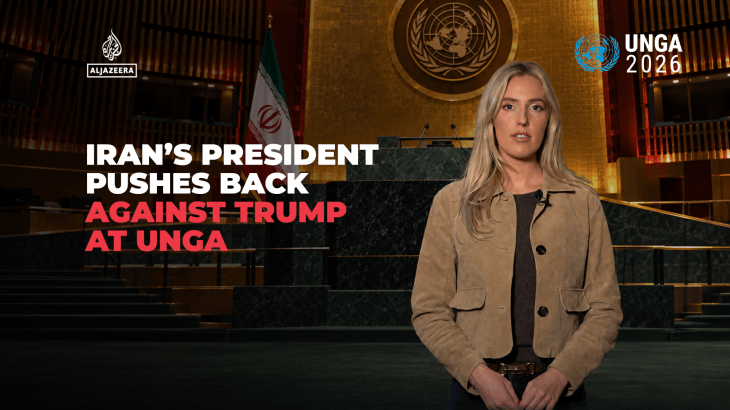
The Al Jazeera video report focuses on Iran’s president addressing the United Nations General Assembly one day after US President Donald Trump threatened to “annihilate” Iran. The headline characterizes the Iranian president as presenting evidence of US strikes on civilians, though the supplied description does not identify the evidence or provide details about the strikes. It says Iran is open to talks but will not negotiate while under threat, setting out Tehran’s stated position amid the war. The report poses the central question of whether the United States and Iran can find a way to end the conflict. Al Jazeera correspondent Emma Withrow is identified as explaining the situation. The item is dated September 24, 2026. Because the supplied article text is only a brief video description, it does not give the president’s name, quote his full UN address, describe the civilian casualties, or report any response from the US. Its focus is therefore the contrast between Trump’s threat and Iran’s conditional openness to negotiations, with the possibility of ending the war left unresolved.
Entities: Iran, Iran’s president, Donald Trump, United States, United Nations General Assembly (UNGA) • Tone: analytical • Sentiment: negative • Intent: analyze
24-09-2026
The article examines the public confrontation and tentative diplomatic contacts between President Donald Trump and Iranian President Masoud Pezeshkian during the United Nations General Assembly in New York. Foreign policy expert Behnam Ben Taleblu of the Foundation for Defense of Democracies told Fox News Digital that Pezeshkian’s sharp criticism of Washington would likely have prompted little more than a smirk from Trump, whom Taleblu believes understands that the United States has greater leverage in the standoff.
Pezeshkian accused the United States and Israel of attacking Iran and presented his country as a victim, saying Iran had only defended itself and that its people had suffered “cowardly attacks.” Trump, by contrast, defended the U.S. conflict with Iran and warned Tehran that it must choose between a deal and further destruction. Taleblu described both leaders’ speeches as predictable, given the countries’ current relationship and established foreign-policy positions. He also argued that Pezeshkian’s remarks framed Iran through an anti-American, anti-Israeli, anti-imperialist message, while contending that the Iranian people—not the government—were the enduring victims of the crisis.
Despite the public threats, diplomatic contacts reportedly continued behind the scenes. Trump said U.S. envoy Steve Witkoff and Jared Kushner spoke with Iranian officials for about three hours during the General Assembly and called the discussions productive. Witkoff said mediators carried messages between the delegations; reports identified Iranian Foreign Minister Abbas Araghchi as representing Tehran. Taleblu said both sides were trying to use time to their advantage and shift responsibility for choosing escalation or engagement to the other. The article concludes that the opposing public rhetoric and ongoing contacts underscore unresolved tensions, as officials explore whether negotiations can create a path away from conflict.
Entities: Donald Trump, Masoud Pezeshkian, Behnam Ben Taleblu, Steve Witkoff, Jared Kushner • Tone: analytical • Sentiment: neutral • Intent: analyze