24-09-2026
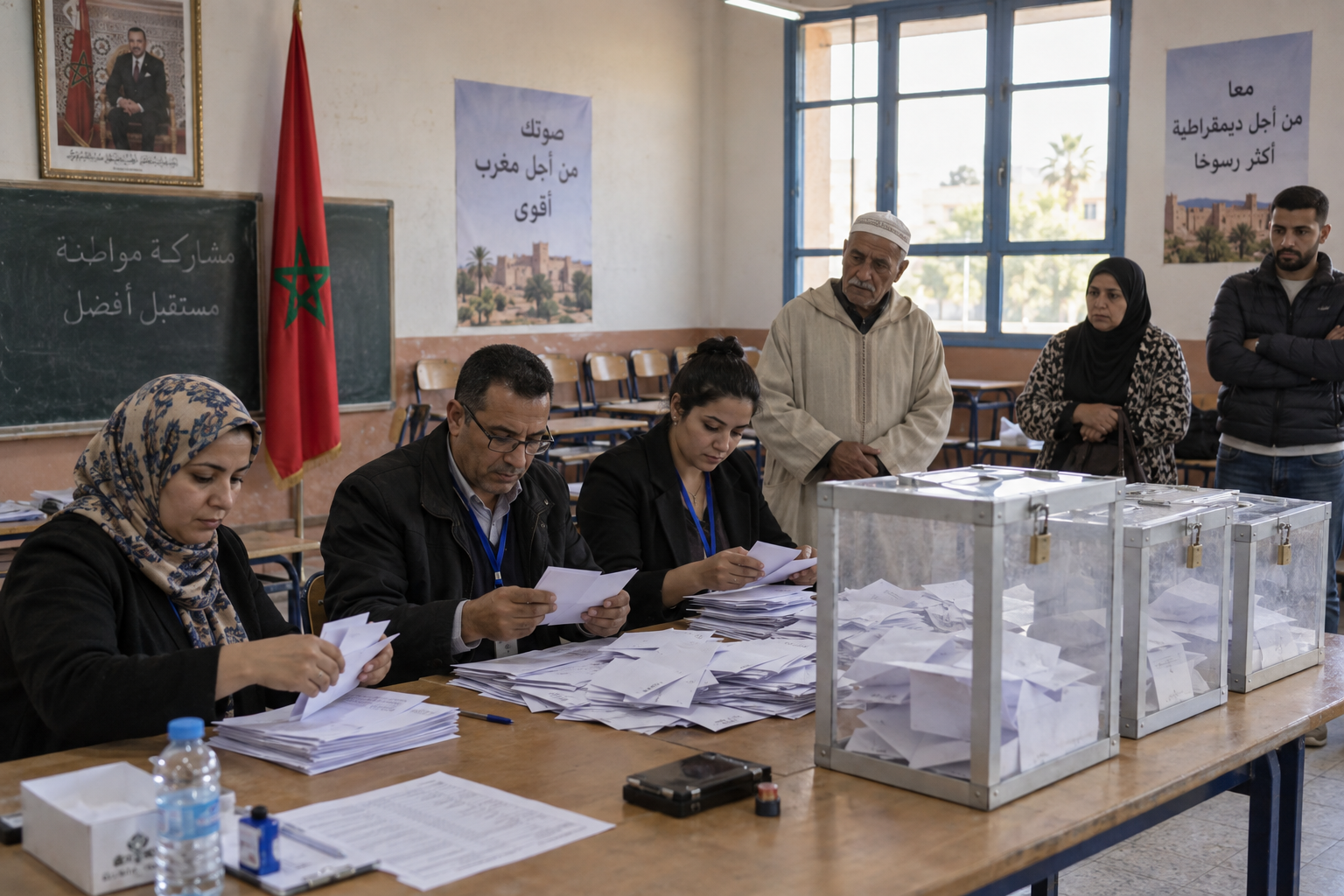
Morocco has elected a new parliament after Wednesday’s vote produced turnout of just 38 per cent, the lowest level in nearly two decades. Although nearly 16 million people were registered to vote, only about 4 per cent of registered voters were aged between 18 and 24. The election took place less than two months after tens of thousands of mainly young Moroccans crossed into the Spanish enclave of Ceuta during a mass migration crisis, and follows a Gen-Z protest movement in September 2025 that called for improvements to health and education.
Preliminary results published on Thursday show the centre-right Authenticity and Modernity Party (PAM) leading with 95 seats in the 395-seat parliament. The National Rally of Independents (RNI), which led the outgoing coalition, placed second with 66 seats. The right-wing Istiqlal party won 65 seats, while the Islamist opposition Justice and Development Party secured 54.
Morocco’s multi-party parliamentary system relies on power-sharing through coalitions. PAM’s lead in the provisional count does not itself determine the composition of the next government: the ruling coalition for the new term still needs to be negotiated and finalised. That government will oversee preparations for Morocco to co-host the 2030 World Cup, as well as initiatives intended to reduce inequalities and address youth discontent. The article presents the low turnout and the limited proportion of young registered voters alongside recent youth-related events, while reporting the preliminary distribution of parliamentary seats and the coalition-building process ahead.
Entities: Morocco, Moroccan legislative elections, Record-low voter turnout, Authenticity and Modernity Party (PAM), National Rally of Independents (RNI) • Tone: neutral • Sentiment: neutral • Intent: inform
24-09-2026
Morocco’s centre-right Authenticity and Modernity Party (PAM) won the largest number of seats in the country’s parliamentary election, according to provisional results announced by Interior Minister Abdelouafi Laftit. PAM secured 97 of the parliament’s 395 seats. The National Rally of Independents (RNI), which leads the outgoing governing coalition, came second with 66 seats, narrowly ahead of the Istiqlal Party with 65. The opposition Justice and Development Party (PJD) won 54 seats.
Voter turnout was 38 percent, a substantial drop from 50 percent in the 2021 election and the lowest level since 2007. The report links the low participation to public concerns over unemployment, inequality, healthcare and education. Those concerns have also been expressed in youth-led protests held last year, which called for improvements to public services.
The results will shape the next stage of government formation. The party with the most seats receives the first opportunity to form a government, and King Mohammed VI appoints the prime minister from that party. The provisional results therefore put PAM in the leading position in the process, although the article does not report a final government or coalition outcome.
The election takes place as Morocco prepares to co-host the 2030 FIFA World Cup and pursues major infrastructure projects and economic reforms. The article presents the election outcome alongside the exceptionally low turnout and the social and economic concerns facing the country, without offering further detail on coalition negotiations or the final results.
Entities: Morocco, Authenticity and Modernity Party (PAM), Abdelouafi Laftit, National Rally of Independents (RNI), Istiqlal Party • Tone: neutral • Sentiment: neutral • Intent: inform
24-09-2026
Morocco’s 2026 parliamentary elections have significantly reshaped the balance among the country’s major parties, while turnout fell to 38.08 percent, down from 50.86 percent in 2021 and 42.27 percent in 2016. Provisional results put the Authenticity and Modernity Party (PAM) first with 97 seats, followed by the National Rally of Independents (RNI) with 66 and Istiqlal with 65. The Justice and Development Party (PJD), which collapsed from 125 seats in 2016 to 13 in 2021, returned to parliament with 54 seats.
PAM’s leading position gives it the first opportunity in the government-formation process under Article 47 of Morocco’s Constitution, but it does not command a majority in the 395-seat House of Representatives. PAM, RNI and Istiqlal together hold 228 seats, enough to govern if they renew their coalition. However, tensions between PAM and RNI during the campaign—including accusations over recruitment of local officials and uncertainty about working together again—could complicate negotiations. PAM leaders had publicly questioned or rejected another coalition under certain circumstances.
The PJD’s comeback adds another potential factor to coalition talks. Its historic rivalry with PAM has included PJD accusations that PAM was created to counter its political influence. Fouzi Lekjaa’s move into PAM has intensified political discussion, although claims about the purpose of his arrival are presented as Abdelilah Benkirane’s interpretation, not established fact. The four largest parties together hold 282 seats, but the PJD’s eventual role remains uncertain.
The article places the low turnout in a wider context of social and political mobilization, including youth protests over jobs, healthcare, education and living costs. It notes that nonparticipation may reflect varied factors, such as dissatisfaction with established parties, economic concerns or doubts about electoral politics, while stressing that the results alone cannot explain individual decisions. Participation also varied sharply by region, reaching 77 percent in Laayoune-Sakia El Hamra and 61 percent in Dakhla-Oued Ed-Dahab. The election leaves two central questions: how a governing majority will be assembled and why most registered voters did not participate.
Entities: Morocco’s 2026 parliamentary elections, Authenticity and Modernity Party (PAM), National Rally of Independents (RNI), Istiqlal Party, Justice and Development Party (PJD) • Tone: analytical • Sentiment: neutral • Intent: analyze
24-09-2026
Morocco’s center-right Authenticity and Modernity Party (PAM) finished first in the parliamentary election, winning 97 of the legislature’s 395 seats, according to provisional results. The result gives PAM 10 more seats than it won in 2021. Founded in 2008 by an adviser to the king, the party supports social modernization and moderate secularist views and is widely regarded as close to the monarchy. PAM belongs to the outgoing governing coalition, but the election is not expected to significantly change Morocco’s political balance. King Mohammed VI retains substantial influence over policy and foreign affairs in the semi-constitutional monarchy. The coalition’s other parties lost ground: the National Rally of Independents, previously the largest party and senior coalition partner, fell from 102 seats to 66, while Istiqlal dropped by 16 seats to 65. The moderate Islamist opposition Justice and Development Party made a notable recovery, increasing its representation from 13 seats in 2021 to 54. The next coalition government will oversee preparations for the 2030 World Cup. Voter participation was a central concern. Turnout was 38%, the lowest since 2007, among nearly 16 million registered voters. Young people were particularly underrepresented: only about 4% of registered voters were aged 18 to 24. The result followed large Gen Z-led protests in 2025, the country’s biggest since the Arab Spring of the early 2010s. Mistrust of politicians and dissatisfaction with living conditions were cited as reasons for low participation. One voter told AFP she had lost faith in the political class and said politicians appeared not to care about healthcare, education, and purchasing power.
Entities: Authenticity and Modernity Party (PAM), Morocco, King Mohammed VI, National Rally of Independents (RNI), Istiqlal party • Tone: analytical • Sentiment: neutral • Intent: inform