24-09-2026
Ahead of Israeli Prime Minister Benjamin Netanyahu’s address to the United Nations General Assembly, the article describes continuing hardship in Gaza nearly three years after the war began. A ceasefire brokered a year earlier by U.S. President Donald Trump and Arab allies halted major military operations, secured the release of the remaining hostages and increased humanitarian access. However, the agreement’s broader goals have not been achieved: there is no new Palestinian administration supported by international forces, and Israel continues deadly strikes and control over more than half of the territory.
Israel says progress on these matters depends on Hamas fully disarming. Hamas and the Trump administration, by contrast, maintain that these steps should proceed in parallel. Netanyahu has taken a firmer position ahead of elections and has openly defied Trump, described in the article as his most important ally. The resulting political impasse has left Palestinians in Gaza in precarious conditions, many living in tent camps described as infested with rodents, amid neighborhood rubble or in damaged buildings at risk of collapse.
The article reports that Gaza’s Ministry of Health says more than 1,300 Palestinians have been killed since the ceasefire. It also notes that several international non-governmental organizations and a UN commission have found that Israel committed genocide in Gaza. Separately, Palestinian President Mahmoud Abbas will not attend the General Assembly in person for a second year because the United States refused him a visa. He is scheduled to address the assembly by video on the same day as Netanyahu. The article concludes by noting that, as the UN host country, the United States is required under its agreement with the organization to allow diplomats from all member states to attend meetings.
Entities: Gaza Strip, Benjamin Netanyahu, Mahmoud Abbas, Donald Trump, United Nations General Assembly • Tone: analytical • Sentiment: negative • Intent: inform
24-09-2026
The Al Jazeera video item looks back at Benjamin Netanyahu’s appearances before the United Nations General Assembly (UNGA). Its brief description says Netanyahu has indicated that his upcoming address will include “surprises,” then characterizes a recurring purpose of his UN speeches: presenting Israel as under threat, confronting or antagonising regional rivals, and defending policies directed at Palestinians. The item thus frames the speeches not simply as diplomatic remarks, but as a repeated way for the Israeli prime minister to advance a political account of Israel’s security and its regional relationships while justifying his government’s treatment of Palestinians.
The provided text does not include the video transcript, examples from individual speeches, or further detail about the promised surprises. It also does not identify which regional rivals or Palestinian policies are being referenced. Accordingly, the central focus is the pattern asserted in the description, rather than a detailed account or independent assessment of Netanyahu’s remarks over time. The item is titled “Netanyahu at UNGA over the years” and was published on September 24, 2026. Its critical framing is apparent in the choice of language—particularly “antagonise regional rivals” and “defend policies targeting Palestinians”—while the short description supplies no quotations or additional evidence to elaborate on those claims.
Entities: Benjamin Netanyahu, United Nations General Assembly (UNGA), Israel, Palestinians, Israeli prime minister • Tone: analytical • Sentiment: negative • Intent: analyze
24-09-2026
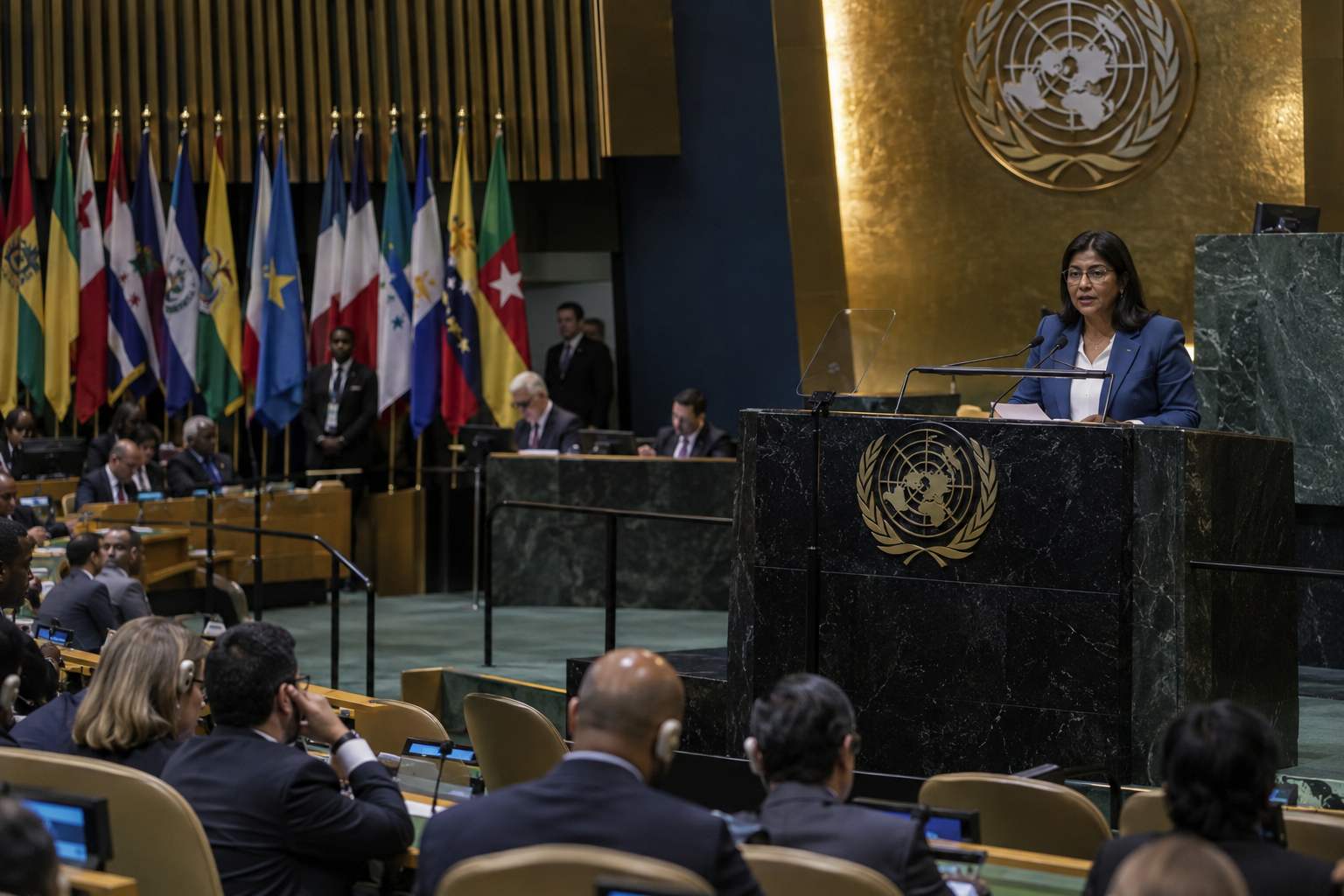
The supplied France 24 liveblog preview focuses on Israeli Prime Minister Benjamin Netanyahu’s scheduled address to the UN General Assembly on Thursday, September 24, 2026. It says that international scrutiny of Israel’s war on Gaza and its occupation of Palestinian territory is taking centre stage during the third day of the Assembly’s annual debate. Palestinian Authority President Mahmoud Abbas is also scheduled to address world leaders by video, after being denied a US visa. The excerpt does not include either leader’s speech or subsequent live updates, so it provides no account of what they ultimately said.
The article also recaps major developments from the previous day at the United Nations. Syrian President Ahmed al-Sharaa said the contested Golan Heights would “remain Syrian” despite Israel’s continuing military occupation. Iranian President Masoud Pezeshkian delivered a defiant wartime address, accused the United States of terrorism in Iran, and said Iran would not “bend at the knee.” Ukrainian President Volodymyr Zelensky said Russian President Vladimir Putin had recruited fighters from 47 countries—including North Korea, Ghana and India—to fight against Ukraine. Separately, leaders of major artificial-intelligence companies urged caution, warning that increasingly autonomous systems might advance beyond human oversight.
Overall, the excerpt presents a snapshot of diplomatic debate spanning Gaza, occupied territory, the Golan Heights, Iran, Russia’s war against Ukraine, and AI governance. Its framing is informational: it previews the day’s expected addresses and summarizes the prior day’s remarks, without offering detailed analysis or a stated conclusion. The supplied text ends with a page-unavailable notice, rather than the full liveblog.
Entities: Benjamin Netanyahu, Mahmoud Abbas, United Nations General Assembly, Gaza, Israel's occupation of Palestinian territory • Tone: neutral • Sentiment: neutral • Intent: inform
24-09-2026
Israeli Prime Minister Benjamin Netanyahu is expected to spend less than eight hours in New York for an address to the United Nations, a sharp contrast with his week-long US visit in 2025, when he met President Donald Trump. The brief trip, and the absence of any announced meetings with US officials, reflects strained relations between the two countries amid the Gaza war and tensions over West Bank settlements.
Netanyahu’s office said he would meet nine world leaders, most of them from Latin America, as Israel seeks to strengthen ties beyond traditional European partners. Former Israeli ambassador to Washington Michael Oren described the lack of a meeting with the US president, secretary of state or another senior American figure as a diplomatic blow, particularly before Israel’s Oct 27 election. Netanyahu’s office said his schedule was tight and that he needed to return before the Jewish holiday of Sukkot.
Polls suggest Netanyahu could lose the election, though the article notes he remains a formidable political contender. His security credentials have been weakened by the Hamas-led Oct 7, 2023, attacks on Israel. The article also describes disagreements between Trump and Netanyahu over the Iran conflict: after jointly launching a war in February, Trump sought to withdraw from it, while Israel opposed a US interim deal with Tehran in June. That deal later unravelled.
Israel’s international position has also deteriorated since the Gaza war began. US public support for Israel has fallen, especially among Democrats, and Britain, France and Canada recently announced sanctions targeting Israeli settlements in the West Bank. Washington’s response to those measures was muted. The article presents Netanyahu’s limited New York visit as a sign of broader diplomatic difficulties, compounded by domestic political pressure and unresolved regional conflicts.
Entities: Benjamin Netanyahu, Donald Trump, Michael Oren, Israel, United States • Tone: analytical • Sentiment: negative • Intent: analyze
24-09-2026
The supplied text contains only the article’s headline, byline, and opening paragraph, not the full Washington Post story. Based on that excerpt, Israeli Prime Minister Benjamin Netanyahu is traveling to New York to address the United Nations on Thursday, just weeks before high-stakes elections in Israel. The address comes at a consequential point for both Israel and Netanyahu’s political future. The excerpt identifies two sources of pressure: Israel is facing intensifying international isolation, and Netanyahu’s relationship with U.S. President Donald Trump is under strain. Together, these developments frame the U.N. appearance as a moment with diplomatic and domestic political significance, rather than simply a routine speech. The headline also signals that the article considers Netanyahu’s standing with Israeli voters, although the supplied opening does not provide polling, voter reactions, or details about the election campaign. Likewise, it offers no explanation of the causes or extent of Israel’s isolation, the nature of the tension with Trump, or what Netanyahu plans to say at the United Nations. Those details cannot be reliably summarized from the excerpt alone. The text is therefore best understood as an introduction to a broader report about Netanyahu facing pressure abroad and at home as he prepares for a major international address ahead of an election. A full account of the article’s evidence, events, and conclusions would require the remainder of the story.
Entities: Benjamin Netanyahu, Donald Trump, Susannah George, Lior Soroka, New York • Tone: analytical • Sentiment: negative • Intent: inform