17-09-2026
Scientists with the World Weather Attribution (WWA) group say climate change was a major factor in the deadly glacial mountain collapse and flooding that struck parts of Nepal and Tibet in August 2026. The disaster killed at least 1,446 people across the two countries and left at least 6,669 missing, according to updated figures cited in the article.
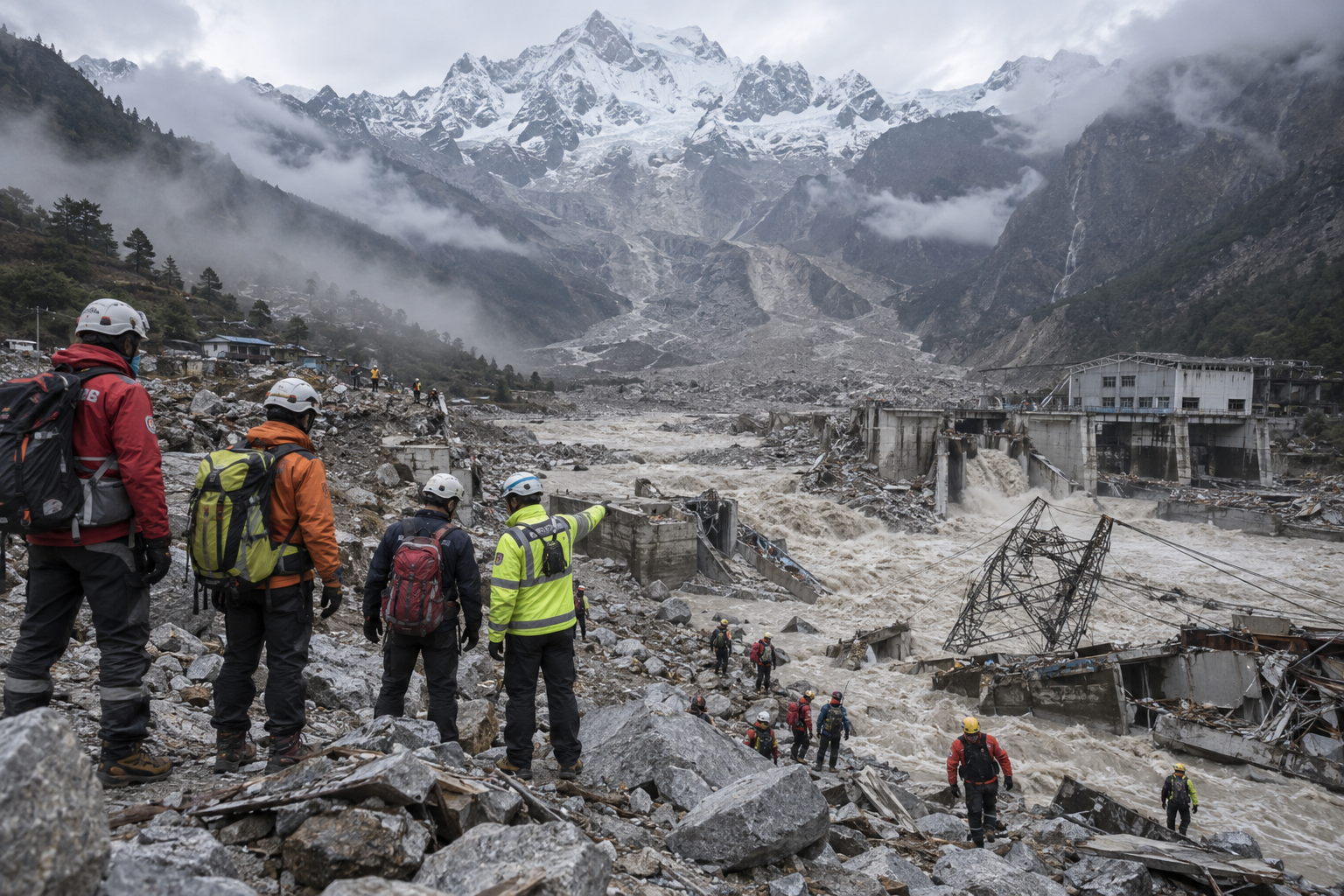
The WWA report characterizes the event as a “compound crisis” rather than the result of one isolated extreme-weather event. Long-term warming raised the freezing level in the Himalaya, exposing ice and permafrost in mountain bedrock to prolonged thawing. This weakened slopes already affected by glacier retreat and geological instability. On August 26, a large section of rock and glacier detached from Langtang Lirung mountain, sending water, ice and debris downstream and destroying communities and infrastructure.
Researchers found that July and August were the warmest locally recorded months, with temperatures approximately 5 degrees Celsius above normal. Heavy snowfall in late 2025 also created additional meltwater before the collapse. A magnitude 7.8 earthquake in 2015 may have weakened the slope, although scientists said its precise contribution remains uncertain.
The disaster has renewed concerns about whether adaptation measures can protect communities from increasingly interconnected climate and geological hazards. Nepal, which has a population of about 30 million and contributes only a small share of global greenhouse-gas emissions, estimates that reconstruction will cost $4.78bn. Climate scientist Friederike Otto said the event should be discussed in the context of climate-related loss and damage. Nepal’s missing-person count was revised to 6,150, while China reported 43 deaths and 519 missing people. Prime Minister Balendra Shah is expected to raise the issue at the United Nations General Assembly.
Entities: Climate change, Nepal floods and glacial mountain collapse, World Weather Attribution (WWA), Nepal, Tibet • Tone: analytical • Sentiment: negative • Intent: inform
17-09-2026
Nearly 1,400 people died and more than 5,000 remained missing after a mountain slope collapsed in Nepal, triggering flash floods that swept through valleys in Nepal and Tibet. Although the disaster was initially attributed to an earthquake, researchers concluded that it resulted from a complex chain of processes unfolding over years and decades, with climate change intensifying the underlying instability.
The event began with a massive rock avalanche on the north face of Langtang Lirung. A section of glacier collapsed simultaneously, sending approximately 110 million cubic meters of rock and ice down the mountain. The avalanche fell about 1,400 meters, gathering additional debris, water, ice and sediment. Its impact released energy comparable to a magnitude-5.2 earthquake and tore up buried glacier ice, adding as much as 30 million cubic meters of material to the flood. The resulting flow reached the Nepal-China border in about seven minutes and traveled 200 kilometers downstream in less than seven hours.
Scientists from World Weather Attribution identified several climate-related factors that weakened the slope. Rising temperatures accelerated glacier retreat, removing ice that supported the rock wall. Permafrost thawed at elevations between 4,500 and 5,500 meters, destabilizing the mountain. Exceptionally high temperatures in July and August, along with unusually heavy snow in October 2025, increased meltwater. Researchers also believe that the 2015 magnitude-7.8 earthquake weakened the rock mass.
The disaster was extremely difficult to anticipate because Nepal’s warning systems are designed primarily for rainfall-driven floods, not rapidly developing cascading events. The flood destroyed monitoring gauges and reached the border just seven minutes after the collapse, while the first mass warning was sent 38 minutes later. Researchers describe the event as exceeding the limits of local adaptation and warn that continued fossil-fuel emissions will increase the likelihood of similarly destructive disasters.
Entities: Nepal, Tibet, Langtang Lirung, Rasuwagadhi border, Devighat • Tone: analytical • Sentiment: negative • Intent: inform
17-09-2026
Nepal has sharply revised upward the number of people missing after the Aug. 26 floods, raising the figure from 5,179 to 6,150 following fresh verification by district authorities. The updated figures came as rescuers recovered 10 bodies from tunnels at two hydropower projects in Rasuwa: five at Chilime and five at Upper Trishuli-1, three weeks after the disaster.
Nepal’s national toll now stands at 1,403 dead and 6,150 missing. Tibet has reported 43 deaths and 519 missing, bringing the combined toll across the affected areas to 1,446 dead and at least 6,669 missing. At least 189 Indians are among those unaccounted for.
At the Chilime project, specialised Indian Army personnel and Nepali rescuers reached the underground powerhouse after excavators and wheel loaders could no longer advance, forcing teams to dig the final stretch by hand. Six workers were believed to have been trapped inside. Five bodies were recovered, while the search continued for the remaining worker. Hopes of survivors had briefly risen after engineer Shriram Neupane reported hearing what appeared to be voices or echoes deeper inside the tunnel.
Rastriya Swatantra Party lawmaker and engineer Sagar Dhakal said he had worked alongside the rescue teams and done everything possible to assist the operation. At the Upper Trishuli-1 project, a joint Nepal Army and hydropower-project team recovered five bodies from the Audit-3 tunnel during continuing search-and-rescue operations. The revised missing-person count underscores the continuing scale of the flood disaster and the challenges facing rescue teams in damaged hydropower infrastructure.
Entities: Nepal, Aug. 26 floods, Rasuwa, Chilime hydropower project, Upper Trishuli-1 hydropower project • Tone: urgent • Sentiment: negative • Intent: inform