16-09-2026
European Commission President Ursula von der Leyen used her annual State of the European Union address to present a vision of a more united, secure and technologically capable Europe. In a 73-minute speech to the European Parliament in Strasbourg, she proposed that Canada become the European Union’s first associate member. Canadian Prime Minister Mark Carney, who attended the address, received a standing ovation, although the proposal would require approval from all 27 EU member states and faces uncertainty because the bloc has traditionally resisted flexible forms of membership without a formal legal basis.
Von der Leyen also called for the creation of a European Security Council involving EU countries and partners such as Canada, the United Kingdom, Norway and Ukraine. The proposal comes as European governments confront Russian hybrid attacks and other security incidents. She proposed an emergency security protocol that would allow any EU member state to convene urgent discussions during a crisis.
On Ukraine, von der Leyen promised the EU’s “strongest-ever” support during what she described as the toughest winter of the war. This would include humanitarian aid, assistance with power and heating supplies, a jointly developed modular missile-defence system and increased investment in European military capabilities.
Her economic agenda focused on manufacturing, defence industries, energy, critical minerals, batteries, artificial intelligence, quantum computing, cyber-security and the Arctic. She framed these initiatives as an alliance for shared prosperity and economic security rather than a partnership directed against other countries.
Despite advocating technological development, von der Leyen supported calls to slow the development of advanced AI systems because of potential hacking, security and catastrophic risks. She proposed cooperation with Canada, Britain and other partners on AI evaluation and security. She also called for social media restrictions for children, including a ban for under-13s and a prohibition on personal accounts for those under 15 unless platforms can demonstrate that they are safe.
Entities: Ursula von der Leyen, European Union, Canada, Mark Carney, European Parliament • Tone: analytical • Sentiment: neutral • Intent: inform
16-09-2026
European Commission President Ursula von der Leyen has proposed that Canada become the European Union’s first “associate member,” signaling a possible deepening of ties between Ottawa and Brussels amid growing tensions with the United States under President Donald Trump. The proposal came during von der Leyen’s annual State of the European Union address in Strasbourg, which Canadian Prime Minister Mark Carney attended. Carney had previously said Canada was seeking a “unique alliance” with the EU rather than full membership.
Von der Leyen argued that democracies must cooperate more closely as the international rules-based system faces a “fracture.” She called for the relationship to move beyond trade toward an “alliance for the future,” involving cooperation in manufacturing, artificial intelligence, critical minerals and energy. She stressed that the partnership would not be directed against another country, but would instead strengthen both sides.
The EU treaties do not currently provide for associate membership. A similar concept was proposed by German Chancellor Friedrich Merz for Ukraine, potentially allowing participation in EU summits, representation in the European Commission and access to parts of the EU budget without voting rights. Ukraine reacted coolly to that proposal while continuing to seek full membership.
Canada and the EU already have extensive economic and strategic ties. Their Comprehensive Economic and Trade Agreement, or CETA, eliminated nearly all tariffs and has been associated with an increase of more than 80 percent in trade in goods and services since 2016. Canada also became the first non-EU country to join a major EU defence loan programme. The proposal is expected to be discussed further ahead of an EU-Canada summit in Montreal next month, while Carney is scheduled to address the European Parliament.
Entities: Ursula von der Leyen, Mark Carney, Donald Trump, European Union, European Commission • Tone: analytical • Sentiment: neutral • Intent: inform
16-09-2026
European Commission President Ursula von der Leyen has endorsed the idea of creating a new form of EU “associate membership” for Canada, saying she wants to explore “opening the door” to closer cooperation. Canadian Prime Minister Mark Carney, who attended von der Leyen’s annual State of the Union address in Strasbourg, has called for a “unique alliance” with the EU as relations between Canada and the United States deteriorate.
Trade negotiations between Canada and the US collapsed in August, leading to new tariffs. US President Donald Trump’s repeated suggestion that Canada could become the “51st state” has further strained relations. Von der Leyen said closer EU-Canada ties would not be directed against another country, but would strengthen shared interests and support the international rules-based system.
The proposed relationship could cover manufacturing, technology, artificial intelligence, defence, energy, critical minerals, supply chains and economic security. However, associate membership is not currently an EU status, and creating it could take years. Some EU governments may prefer to expand existing trade and defence agreements instead. Ten of the EU’s 27 members have yet to ratify a free-trade agreement with Canada.
Von der Leyen also proposed creating a European Security Council involving countries including the UK, Ukraine, Canada and Norway. The body would provide a forum for emergency consultations during security threats and would be intended to complement NATO, although some countries fear it could rival the alliance. Her wider agenda included AI regulation and industry discussions, reducing bureaucracy, restricting social-media access for children, and creating an emergency mechanism for mass migration. Human-rights groups warned that the migration proposal could result in vulnerable people being denied protection under international law.
Entities: European Union (EU), European Commission, Canada, United States, Ursula von der Leyen • Tone: analytical • Sentiment: neutral • Intent: inform
16-09-2026
Prime Minister Mark Carney is presenting Canada as a stable “safe harbour” for major global investors amid geopolitical uncertainty, economic disruption and an escalating trade dispute with the United States. He has set a goal of attracting C$1tn in investment over the next five years, partly to reduce Canada’s dependence on the US and build stronger economic links with Europe, Asia and the Middle East.
At a Toronto investment summit attended by more than 100 major investors, the Canadian government promoted over 160 potential projects, including data centres, pipelines and port expansions. Ottawa also highlighted new tax incentives and promised faster, more predictable approval processes, potentially completing reviews within a year. Carney held meetings with senior executives from BlackRock and Blackstone, while analysts said Canada must improve its tax, regulatory and labour-market conditions to remain competitive.
A major announcement was a plan to permit private investment in the operations of four major airports in Toronto, Vancouver, Montreal and Calgary. The government says this could raise billions for transport infrastructure, but labour unions and other critics called the plan privatization and warned it could harm workers, passengers and public ownership.
The summit reportedly generated nearly C$500bn in new investment commitments or interest, with artificial intelligence infrastructure attracting particular attention. Canada’s cold climate, available land and relatively clean electricity grid were presented as advantages for data-centre development.
Although Carney has taken a firm position against the US in the trade dispute, he also offered American investors a conciliatory message, emphasizing Canada’s enduring relationship with its neighbour. At the same time, protests accused his government of selling public assets to corporate and American interests. Carney’s next step is a trip to Europe, where he plans to pursue a broader economic and security partnership with the European Union while maintaining close ties with the US.
Entities: Mark Carney, Canada, Toronto, United States–Canada trade dispute, C$1tn investment target • Tone: analytical • Sentiment: neutral • Intent: inform
16-09-2026
European Commission President Ursula von der Leyen has proposed that Canada become the European Union’s first “associate member,” presenting the idea as part of a major effort to deepen ties between Canada and Europe. The proposal came during her state of the union address in Strasbourg, France, which Prime Minister Mark Carney attended. Von der Leyen said Canada and the EU should urgently rethink their relationship and move beyond their existing free-trade agreement toward an “alliance for the future.” She emphasized shared democratic values, cooperation on Ukraine and defence, and common interests involving artificial intelligence, climate change, the Arctic, critical minerals, energy, batteries and supply chains.
The proposal follows reports that Canada was exploring a form of association with the EU, as U.S. President Donald Trump’s tariffs have encouraged Ottawa to strengthen its economic and strategic relationships with Europe. Carney, however, has said Canada is not seeking full EU membership, describing the goal instead as a “unique alliance.” His government’s response to von der Leyen’s remarks welcomed the idea of moving beyond the free-trade agreement but avoided endorsing the specific “associate member” label.
Jonathan Wilkinson, Canada’s incoming ambassador to the EU, also downplayed the significance of the terminology. He said Canada and Europe were still “a ways away” from deciding how to describe their future relationship and that the immediate priority was achieving concrete results.
The proposal received a warm response in the European Parliament, where Carney received a standing ovation and was welcomed by several political figures. Green group leader Terry Reintke jokingly suggested she hoped to see him in the chamber often, while Ireland’s minister of state for European affairs, Thomas Byrne, highlighted the longstanding personal and historical ties between Canada and Europe. The idea has faced domestic criticism from Conservative Leader Pierre Poilievre, who rejected both closer EU alignment and any possibility of Canada becoming a U.S. state.
Entities: Ursula von der Leyen, Mark Carney, Jonathan Wilkinson, Pierre Poilievre, Roberta Metsola • Tone: analytical • Sentiment: neutral • Intent: inform
16-09-2026
European Commission President Ursula von der Leyen has proposed opening the European Union’s first associate-membership arrangement to Canada, signaling a substantial strengthening of political, economic and security ties between the EU and Ottawa. She made the announcement during her annual State of the Union address in Strasbourg, with Canadian Prime Minister Mark Carney in attendance. Carney is scheduled to address the European Parliament and has previously advocated a distinctive security and economic alliance with Europe, while ruling out full EU membership for Canada.
The proposal comes as Canada faces a serious trade conflict with the United States and has pledged to match President Donald Trump’s tariffs dollar for dollar. Von der Leyen said Canada and the EU share similar views on artificial intelligence, climate change, geopolitics and Arctic security. The two sides already have the Comprehensive Economic and Trade Agreement, or CETA, which provisionally took effect in 2017 and eliminated 99% of tariff lines. She described the next step as moving from a trade agreement toward a broader alliance focused on economic security and shared prosperity.
The initiative would represent a shift for an EU that has previously been cautious about flexible membership models, including proposals involving Ukraine. Economist Holger Schmieding said the move reflected Europe’s effort to deepen relations with like-minded democracies and reduce dependence on both the United States and China, rather than directly oppose Washington.
The idea also follows calls for a broader European political grouping. Finnish President Alexander Stubb has suggested expanding the EU to as many as 40 states and identified Canada, the United Kingdom, Turkey, Norway and Iceland as possible candidates. Canadian and European officials have increasingly emphasized cooperation among “middle powers” in response to U.S. unpredictability and China’s industrial policy. European Parliament trade committee chair Bernd Lange also urged stronger economic ties with Brazil, Indonesia, Japan and South Korea.
Entities: Canada, European Union (EU), Ursula von der Leyen, Mark Carney, Donald Trump • Tone: analytical • Sentiment: neutral • Intent: inform
16-09-2026
European Commission President Ursula von der Leyen said the European Union is prepared to consider creating a new “associate member” status for Canada, potentially making it the bloc’s first country in such a category. She made the proposal during her annual State of the European Union address at the European Parliament in Strasbourg, where Canadian Prime Minister Mark Carney was present. The comments followed reports that Carney was exploring an associate relationship with the EU, although he later described Canada’s goal as a “unique alliance” rather than formal membership.
Von der Leyen framed closer cooperation with Canada as part of Europe’s response to growing geopolitical and economic instability. She highlighted shared positions on Ukraine, defense, critical raw materials, supply chains, artificial intelligence, climate change, Arctic affairs and democracy. The EU and Canada have increasingly sought to cooperate as they attempt to reduce their respective dependence on the United States and China amid trade disputes and international conflicts.
In her speech, von der Leyen warned that Europe faces an “openly hostile world,” Russia’s war against Ukraine, global industrial competition and efforts to undermine confidence in the EU. She also announced plans for a European corporation focused on procuring and stockpiling critical raw materials, noting that the bloc remains heavily dependent on China for many supplies. She said the EU would use available tools to rebalance its relationship with China, citing a trade deficit of approximately €1 billion per day.
Von der Leyen identified climate change and artificial intelligence as decisive challenges for Europe’s future prosperity and security. She promised a new heatwave plan and measures to help Europe remain competitive in AI. She also proposed the KIDS Act, which would bar children under 13 from social media and create supervised, restricted accounts for those aged 13 to 15.
Entities: Ursula von der Leyen, European Union, Canada, Mark Carney, European Commission • Tone: analytical • Sentiment: neutral • Intent: inform
16-09-2026
Canada and the European Union are discussing whether Canada could join Erasmus+, the EU’s flagship programme for education, training and international exchanges. An agreement would allow students and other participants from Canada and EU countries to study and train at institutions on both sides of the Atlantic. The negotiations are at an early stage but reflect a broader effort to deepen EU-Canada relations.
The talks follow European Commission President Ursula von der Leyen’s invitation for Canada to become the EU’s first “associate member,” a status that would fall short of full membership. Full accession is not considered possible because Canada is not a European country, while the details of the proposed associate status have yet to be defined. Canada is currently an Erasmus+ partner country, meaning its universities and other organisations can participate in selected activities under specific conditions, but it is not an associated member. Six non-EU countries—North Macedonia, Serbia, Iceland, Liechtenstein, Norway and Türkiye—currently participate in the programme.
Canadian participation would be unprecedented because Canada would be the first non-European country to join Erasmus+. Spanish Member of the European Parliament Javier Moreno Sánchez said Canadians were willing to pay the costs of participation and described the initiative as a way to create tangible benefits for ordinary people.
The discussions may also expand cooperation through Horizon Europe, the EU’s research funding programme. Canada currently has limited access to areas involving global challenges and industrial competitiveness. Moreno additionally proposed extending an agreement recognising professional qualifications, currently covering architects, to doctors, engineers and professors. The article links the renewed relationship to Prime Minister Mark Carney’s efforts to strengthen ties with Europe amid the trade and foreign-policy approach of the second Trump administration.
Entities: Canada, European Union, Erasmus+, Horizon Europe, EU-Canada relations • Tone: analytical • Sentiment: positive • Intent: inform
16-09-2026
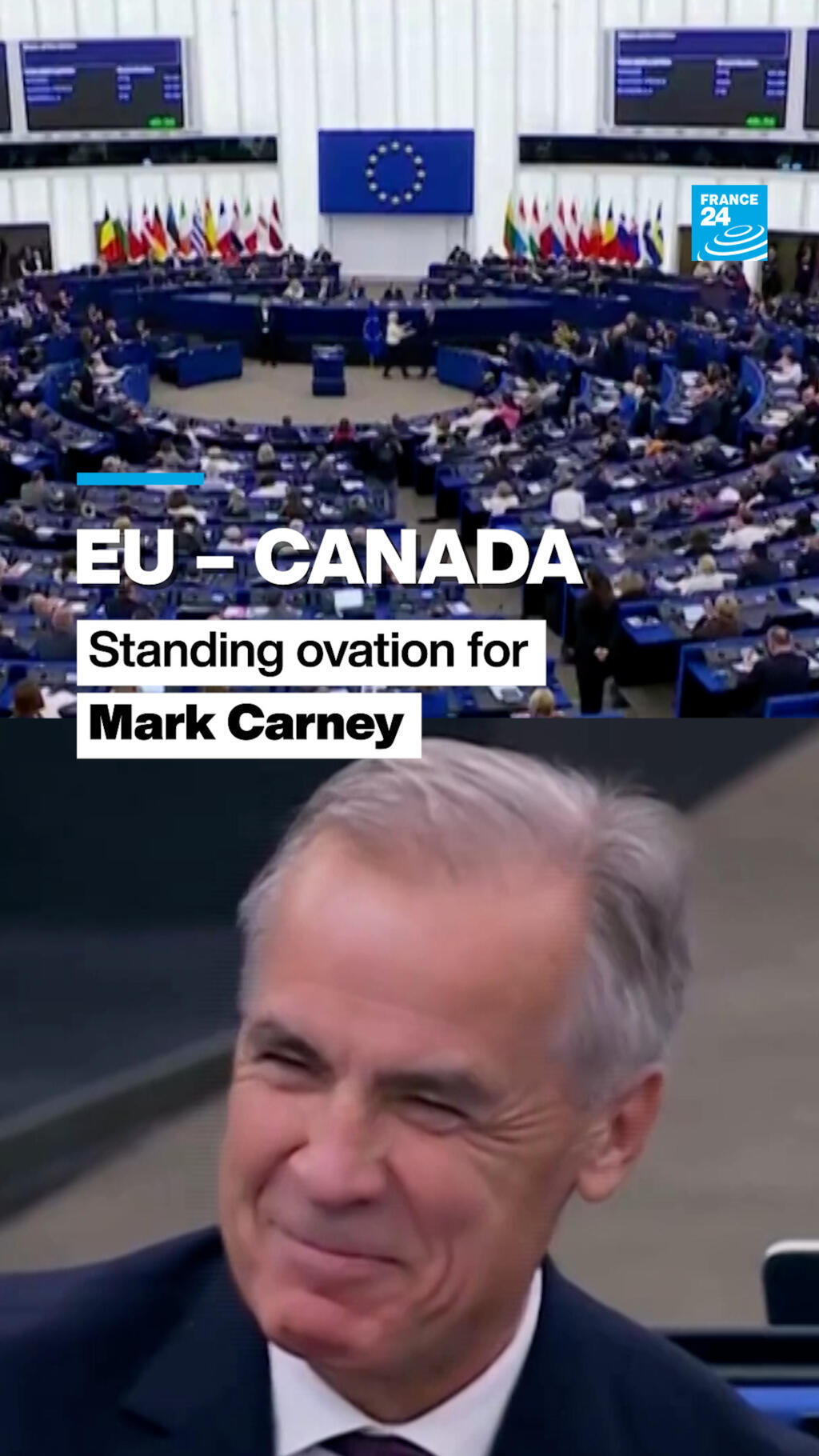
A France 24 video report describes a warm reception for Canadian Prime Minister Mark Carney during his visit to the European Parliament in Strasbourg, France, on Wednesday, 16 September 2026. Carney received a standing ovation from European lawmakers, signaling strong support for closer relations between Canada and the European Union. During the event, European Commission President Ursula von der Leyen raised the possibility of Canada becoming the 27-member bloc’s first “associate member.”
Von der Leyen said the EU wanted to take its relationship with Canada “to the highest level possible.” She presented closer cooperation as a way to deepen ties across several strategic sectors, specifically technology, defence and energy. The proposal would represent a significant expansion of the existing EU-Canada relationship, although the report does not provide details about the legal structure, rights or obligations associated with possible associate membership.
The report focuses on the symbolism of Carney’s reception and on the EU’s interest in strengthening its partnership with Canada. The standing ovation reflects the positive atmosphere surrounding the visit, while von der Leyen’s remarks indicate that Brussels is considering a more formal and comprehensive framework for cooperation. The 1-minute-14-second video was issued by France 24 and attributed to AFP. No further comments from Carney or details about next steps are included in the available article text.
Entities: Mark Carney, Ursula von der Leyen, Canada, European Union (EU), European Parliament • Tone: analytical • Sentiment: positive • Intent: inform
16-09-2026
This France 24 video replay presents European Commission President Ursula von der Leyen’s annual State of the European Union address, delivered in Strasbourg on 16 September 2026. The available article text does not provide a full transcript of the speech; instead, it gives a brief overview of two major proposals highlighted during the address.
Von der Leyen proposed restricting children under the age of 13 from accessing social media, online games and chatbots. The proposal reflects concerns about children’s exposure to digital platforms and the potential need for stronger protections for minors online. The article does not specify how such a restriction would be implemented, enforced or harmonized across EU member states.
The Commission president also called for closer ties between the European Union and Canada. One element of the proposal would be to grant Canada “associate member” status, suggesting a potentially deeper political and strategic relationship between Canada and the EU. The short description does not explain the proposed institutional arrangements or the areas of cooperation that associate membership would cover.
The video is identified as a full replay of the address and was issued by France 24 on 16 September 2026. The page also lists Ursula von der Leyen, Europe and the European Union as keywords. Much of the supplied page content consists of cookie-consent notices, video-player instructions and recommended links, rather than additional reporting about the speech. Consequently, the article provides only a concise account of the address’s highlighted proposals, not a detailed analysis of its broader political message or policy agenda.
Entities: Ursula von der Leyen, European Commission, European Union, Europe, Strasbourg • Tone: neutral • Sentiment: neutral • Intent: inform
16-09-2026
France 24 reports that European Commission President Ursula von der Leyen has proposed exploring an “associate member” status for Canada within the European Union. The idea would make Canada the first country to hold such a relationship with the 27-member bloc, although the brief report does not describe a formal application, a specific legal framework, or a timetable for negotiations. Von der Leyen raised the prospect while advocating closer cooperation between the EU and Canada in three strategic areas: technology, defence, and energy.
The proposal was presented in discussions with Canadian Prime Minister Mark Carney. It suggests an effort to deepen relations beyond conventional partnership arrangements and to establish a more structured form of cooperation between Canada and the EU. The report does not specify what rights or obligations associate membership would involve, whether it would include participation in EU programs or institutions, or how it would differ from Canada’s existing relationship with the bloc.
The item is a short, 1-minute-10-second France 24 video published on 16 September 2026. Its central focus is von der Leyen’s pitch and the possible political significance of closer EU-Canada ties. The emphasis on technology, defence, and energy indicates that the proposed relationship could involve strategic collaboration as well as economic or regulatory cooperation. However, the available text contains no response from Carney, no reaction from other EU member states, and no assessment of the proposal’s feasibility. It is therefore best understood as a concise report on a diplomatic initiative rather than a detailed account of an agreed policy.
Entities: Ursula von der Leyen, Mark Carney, European Union, Canada, France 24 • Tone: neutral • Sentiment: neutral • Intent: inform
16-09-2026
France 24 reports on European Commission President Ursula von der Leyen’s State of the Union speech, delivered on September 16, 2026. The address is presented as a major statement of her priorities for the European Union over the coming year and her broader vision for addressing the challenges facing the bloc. The report’s headline identifies Canadian Prime Minister Mark Carney as being present and highlights artificial intelligence as one of the issues on the agenda.
The article is a short video report presented by France 24 journalist Armen Georgian. Its central focus is von der Leyen’s effort to outline the EU’s political and strategic direction at a time when the bloc is confronting significant international and economic pressures. The accompanying text characterizes the European Union as the world’s biggest trading bloc, emphasizing the scale and importance of the challenges discussed in the speech.
However, the provided article contains only a brief introduction to the video and does not include a transcript or detailed account of von der Leyen’s proposals. It therefore does not explain the specific policies she announced on artificial intelligence, describe Carney’s role in the event, or provide detailed information about the global challenges referenced. The page also includes links to related France 24 reports, including coverage of the EU-Canada relationship and a replay of the full address, but those recommendations are separate from the main report. Overall, the item serves as an introduction to a significant EU policy speech rather than a full analysis of its contents.
Entities: Ursula von der Leyen, Mark Carney, European Commission, European Union, State of the Union speech • Tone: analytical • Sentiment: neutral • Intent: inform
16-09-2026
The European Union wants Canada to become its first “associate member,” European Commission President Ursula von der Leyen announced during her annual State of the Union address in France. Prime Minister Mark Carney was present for the speech, and von der Leyen directly addressed him, saying the EU should urgently reconsider and strengthen its partnerships with countries that share its values and worldview.
Von der Leyen described Canada and the EU as natural partners, emphasizing their shared Atlantic connection, values and international outlook. She said the goal was to bring Canada-EU relations to “the highest level possible” through a closer and more structured relationship.
The announcement builds on existing economic ties. Von der Leyen said trade between Canada and the EU has increased by 75 per cent in less than a decade since the Canada-European Union Comprehensive Economic and Trade Agreement, or CETA, was signed. However, CETA has only been provisionally implemented and has not yet been fully ratified by all EU member states. Belgium, Bulgaria, Cyprus, France, Greece, Hungary, Ireland, Italy, Poland and Slovenia still need to approve the agreement through their national legislatures.
Carney said in a social media post from Strasbourg that Canada is seeking to deepen its relationship with the EU and that a stronger partnership could benefit the economies and security of both sides while supporting their “mutual sovereignty.” He added that the two sides were moving quickly to develop the relationship.
The article does not provide specific details about what associate membership would involve, including the rights, obligations or institutional arrangements that could apply to Canada. It presents the proposal as a significant possible expansion of Canada-EU cooperation at a time when Canada is seeking stronger international partnerships and broader economic and security ties.
Entities: European Union (EU), Canada, Ursula von der Leyen, Mark Carney, European Commission • Tone: analytical • Sentiment: positive • Intent: inform
16-09-2026
European Commission President Ursula von der Leyen has proposed that Canada become the European Union’s first associate member, offering a new level of cooperation that would fall short of full EU membership. She made the proposal during her annual State of the European Union address at the European Parliament in Strasbourg, with Canadian Prime Minister Mark Carney present. Parliamentarians gave the exchange a standing ovation after Carney embraced von der Leyen.
The proposal comes as U.S. President Donald Trump’s tariffs and repeated suggestion that Canada could become the 51st U.S. state have encouraged Ottawa to seek stronger economic and security relationships with Europe. Canada sends roughly 70% of its exports to the United States, and Carney has advocated a “unique alliance” with the EU to reduce that dependence. His government welcomed the proposal and said it supported moving beyond the existing Canada-EU free trade agreement, CETA, toward an “Alliance for the Future.”
The potential partnership could include visa-free rights for Canadians to live and work in Europe, as well as cooperation in advanced manufacturing, technology, defense, Arctic affairs, energy, critical minerals, batteries, artificial intelligence, quantum computing, cybersecurity and economic security. Canada has already become the first non-European participant in the EU’s €150 billion SAFE defense procurement program.
Von der Leyen provided few details about how associate membership would function or how it would relate to countries seeking full EU membership. The initiative also highlights differing approaches to Washington: Canada has retaliated against U.S. tariffs, while the EU reached a trade agreement establishing a 15% ceiling on most EU exports to the United States.
Carney has urged middle powers to cooperate rather than negotiate individually with dominant states, arguing that bilateral negotiations can result in “subordination.” European lawmakers described Canada as a natural ally, though the proposal could further strain relations with Trump’s administration.
Entities: Ursula von der Leyen, Mark Carney, Donald Trump, Canada, European Union • Tone: analytical • Sentiment: neutral • Intent: inform
16-09-2026
Prime Minister Mark Carney presented Canada as an attractive destination for international investment while acknowledging that the country’s economic and political relationship with the United States remains essential. Speaking at the Canada Investment Summit in Toronto, Carney argued that Canada must diversify its economy because it has become too dependent on a US market that is growing more protectionist amid an escalating trade war.
The summit brought together representatives from Gulf sovereign wealth funds, European banks, the China Investment Corporation, US investors and Nigerian businessman Aliko Dangote, identified as Africa’s richest man. The broad international attendance reflected Carney’s effort to promote Canada beyond its traditional reliance on American capital and trade.
Carney set an ambitious target of catalysing C$1 trillion, or approximately US$720 billion, in investment over the next five years. To reach that goal, he promised tax deductions and reductions in regulatory red tape intended to make Canada more attractive to foreign investors.
At the same time, Carney did not portray diversification as a replacement for cooperation with Washington. He said ties with the United States remained crucial, despite current trade tensions. The article’s introduction also refers to an anecdote involving US President Donald Trump, who reportedly gave Carney a key to the White House while joking, “maybe they’ll shoot you.” This episode illustrates the complicated tone of the relationship: close and strategically important, but also marked by political uncertainty and tension.
Overall, the article describes Carney’s investment campaign as an attempt to balance two priorities: reducing Canada’s vulnerability to US protectionism and preserving the longstanding US relationship that remains central to the Canadian economy.
Entities: Mark Carney, Canada, United States, Toronto, Canada Investment Summit • Tone: analytical • Sentiment: neutral • Intent: inform
16-09-2026
European Commission President Ursula von der Leyen is expected to use her annual address to the European Parliament to call for greater solidarity among the European Union’s 27 member states. She will argue that no individual country can manage major challenges such as climate change, artificial intelligence and economic competition from China alone.
A central theme of the speech will be European strategic independence. Von der Leyen is expected to emphasize cooperation in energy, raw materials and clean technologies, while also calling for stronger partnerships with countries outside the bloc. Canada will be a particular focus: Prime Minister Mark Carney is scheduled to address the European Parliament the following day. Although Canada cannot join the EU, von der Leyen is expected to advocate bringing it closer to the bloc because of shared values and its potential to help reduce Europe’s dependence on China for raw materials and processing.
Trade relations with China will also feature prominently. Von der Leyen has supported negotiations aimed at reducing the EU’s unsustainable trade deficit with China, estimated at €1 billion a day. However, she is expected to warn that the talks must produce results soon or the EU may take additional measures to protect its economy.
The speech will address climate change adaptation as well as emissions reduction. Officials said von der Leyen would point to recent unprecedented heat waves and wildfires as evidence that Europe is experiencing severe climate impacts. She is also expected to discuss concerns that artificial intelligence could threaten jobs and cybersecurity, while stressing the need to ensure that Europe benefits economically from the technology.
Migration will be another issue, including lessons from events in Ceuta in late July and the possible expansion of the EU border agency Frontex’s role.
Entities: European Union (EU), European Commission, Ursula von der Leyen, European Parliament, Strasbourg • Tone: analytical • Sentiment: neutral • Intent: inform
16-09-2026
The article explains European Commission President Ursula von der Leyen’s proposal to explore “associate membership” for Canada, following Canadian Prime Minister Mark Carney’s call for a “unique alliance” with the European Union without pursuing full membership. The proposed relationship has no formal basis in current EU treaties, although different forms of associate status have previously been discussed, including as a possible interim arrangement for Ukraine.
Canada and the EU are seeking closer cooperation amid repeated threats by US President Donald Trump against Canadian sovereignty and shared concerns about US and Chinese economic influence. The proposed partnership could create a “common prosperity and economic space” covering manufacturing, technology, defence industries, the Arctic, artificial intelligence, energy and critical minerals. Both sides also view the relationship as a way to support democracy and the rules-based international order.
However, creating associate membership would be legally and politically complicated. Von der Leyen can propose the idea, but EU member states would have to approve it. Establishing a new status in the treaties would require unanimous agreement from all 27 member states and domestic ratification. Canada already has a trade agreement with the EU, CETA, but several EU countries have yet to ratify it fully, more than a decade after it was signed.
If Canada sought access to the EU Single Market, it would likely have to align its regulations with EU law while having no formal say in policymaking. This could be difficult because Canada’s rules have traditionally been oriented toward the United States. The proposal would not formally alter the accession prospects of European candidate countries, but those countries could resent Canada receiving special treatment. Full EU membership is reserved for European states and includes voting rights, representation, funding and access to the European Court of Justice.
Entities: Ursula von der Leyen, Mark Carney, Donald Trump, European Commission, European Union • Tone: analytical • Sentiment: neutral • Intent: inform
16-09-2026
Canadian Prime Minister Mark Carney used the Canada Investment Summit in Toronto to present Canada as an attractive destination for global capital, despite an intensifying trade dispute with the United States. He set a target of catalysing C$1 trillion in investment over the next five years and promised tax deductions, reduced regulation and infrastructure opportunities to encourage foreign investment.
Carney highlighted Canada’s critical-mineral reserves and clean-energy resources as foundations for greater strategic autonomy. He also promoted plans for a new pipeline capable of moving one million barrels of low-emission Alberta oil per day to Asian markets and said the country’s four largest airports would be opened to private investment. BlackRock chief executive Larry Fink said international investors would likely pursue these opportunities if the government implemented its proposals.
The summit took place only hours after US President Donald Trump imposed new tariffs on certain Canadian goods. Although Carney argued that Canada must diversify its economy and reduce its dependence on the increasingly protectionist United States, he stressed that the two countries would remain important partners. He described their relationship as close but unpredictable, recalling an incident in which Trump gave him a White House key and joked that security personnel might shoot him if he used it.
Former Canadian prime minister Stephen Harper also supported reducing reliance on the United States to protect Canadian sovereignty and industrial capacity. Carney subsequently travelled to Strasbourg, where he was scheduled to become the first head of government to attend the State of the European Union address. Canada is seeking a closer relationship with the European Union, including a proposed “unique alliance” to be discussed at an October summit in Montreal. Carney said Canada needed dependable international partners while maintaining stronger and more independent ties with Washington.
Entities: Mark Carney, Donald Trump, Canada, United States, European Union • Tone: analytical • Sentiment: neutral • Intent: inform