16-09-2026
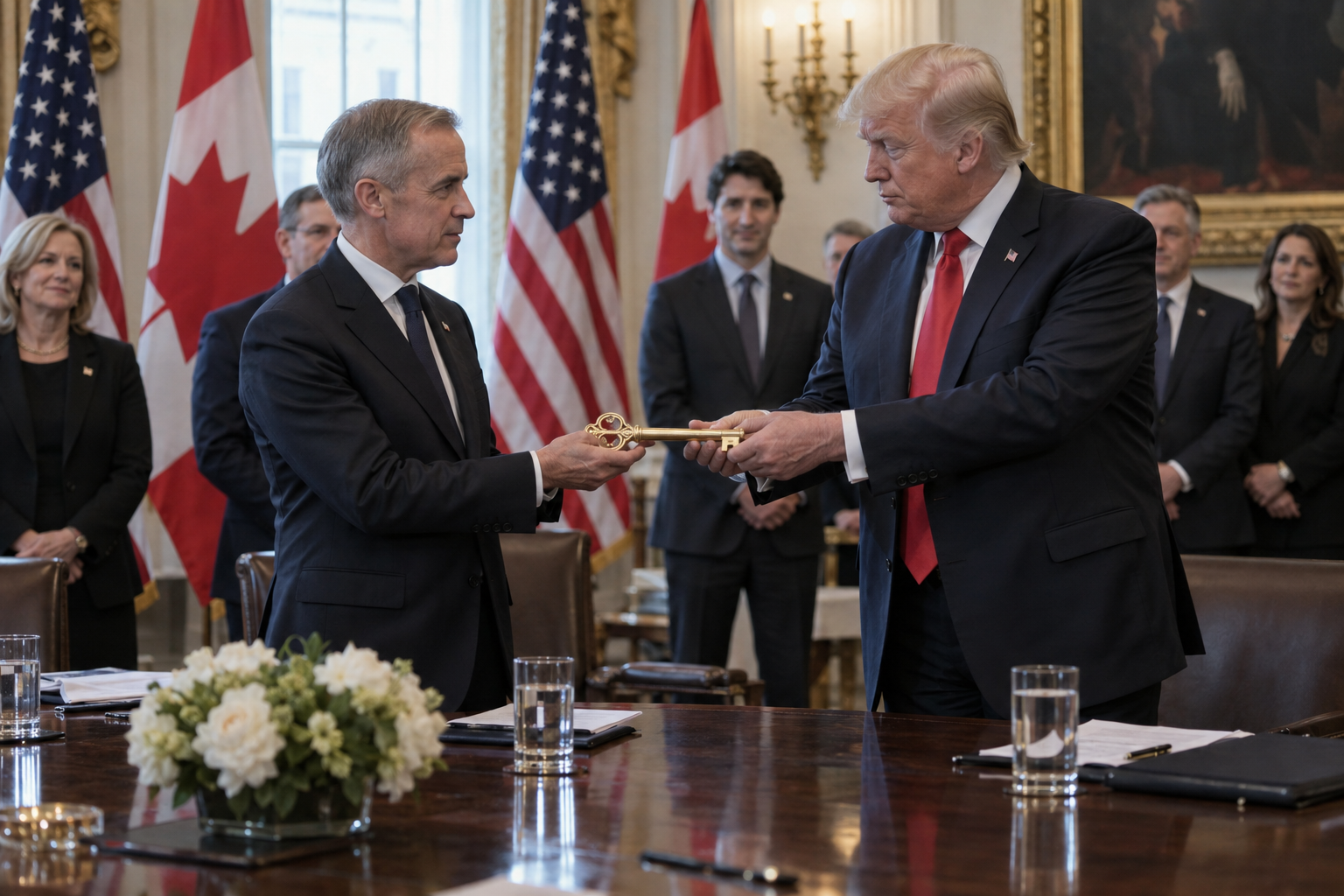
Canadian Prime Minister Mark Carney has described an unusual gift from US President Donald Trump: a large gold key that Trump said could be used to enter the White House. Carney recounted the exchange while speaking at the Canada Investment Summit in Toronto, saying Trump told him, “You just bring it, they’ll let you in,” before adding jokingly, “Maybe they’ll shoot you.” The remark prompted laughter and, according to Carney, reflected the complicated relationship between the two neighboring countries.
Carney said he remained grateful for the gesture and praised Trump as a good host. He contrasted the joke with Canada’s more welcoming approach, saying that anyone given a key to Canada would be welcomed. The anecdote comes amid heightened tensions between Washington and Ottawa, including a trade dispute, stalled negotiations, and additional US restrictions on some Canadian products. Canada is also trying to diversify its economic partnerships, reduce its reliance on the United States, and strengthen ties with Europe.
At the summit, Carney presented Canada as an attractive destination for international investment and argued that the country could emerge from the trade conflict as a stronger and more independent economy.
The article also notes that Trump has given ceremonial White House keys to other leaders and visitors. He reportedly gave Israeli Prime Minister Benjamin Netanyahu a similar key, describing it as valid even after Trump left office. According to a book by Jared Kushner, Trump said Netanyahu could present the key at the White House gate and be admitted. Trump also gave a key to former Japanese Prime Minister Taro Aso during a 2024 meeting at Trump Tower. The article contains an apparent date inconsistency, referring both to 2015 and to Carney’s meeting with Trump in May 2025.
Entities: Mark Carney, Donald Trump, White House, Canada Investment Summit, Toronto • Tone: analytical • Sentiment: neutral • Intent: inform
16-09-2026
A global poll of more than 35,000 people in 34 countries finds growing support for international institutions and multilateral cooperation, alongside declining confidence in the United States and China as global leaders. The survey, commissioned by the Rockefeller Foundation and conducted from July 21 to August 5, reports widespread pessimism about economic and security conditions: nearly 70 per cent of respondents said the world had worsened over the previous year, while only 38 per cent expected their national economies to improve over the next five years. Economic optimism fell particularly sharply in India and China.
Despite these concerns, 57 per cent supported countries cooperating to address global challenges even when doing so required compromises on national interests, up from 55 per cent in 2025. Sixty-one per cent supported cooperation that excluded both the US and China. Canada was the country most widely viewed as suitable for a leading role in world affairs, followed by Japan and Australia. The European Union, Britain and the United Nations also scored higher than the US, China and Russia.
Only 39 per cent were comfortable with the US taking a leading role, compared with 37 per cent for China and 26 per cent for Russia. Eric Pelofsky of the Rockefeller Foundation said the results showed that the “middle powers” approach associated with Canadian Prime Minister Mark Carney had global credibility and reflected a serious erosion of US leadership. Views varied by wealth: respondents in developing countries were substantially more comfortable with China than those in advanced economies.
Trust in international institutions improved across the board. Confidence in the World Health Organization, United Nations, World Bank, International Monetary Fund, International Criminal Court and World Trade Organization all rose from the previous year. However, Russia, the US and China were frequently identified as major threats. The poll was released before the United Nations General Assembly amid the economic and geopolitical effects of war in the Middle East, energy-market disruption, inflation and US tariffs.
Entities: Global poll of more than 35,000 people in 34 countries, Rockefeller Foundation, Eric Pelofsky, Mark Carney, Donald Trump • Tone: analytical • Sentiment: negative • Intent: inform
16-09-2026
France’s incoming ambassador to the United States, Aurélien Lechevallier, has been cleared to take up his post after a diplomatic dispute between Paris and Washington was resolved. Lechevallier, selected by President Emmanuel Macron to replace Laurent Bili, had been awaiting US approval since late July. He is expected to arrive in Washington in the coming weeks.
The dispute followed criticism by France’s mission to the United Nations of a US vote concerning the extension of Volker Türk’s term as UN human rights chief. On July 24, the United States was among 10 countries that voted against extending Türk’s mandate during a UN General Assembly meeting. After the vote, the French mission posted on X that the United States had once been “a beacon of human rights” but was “not anymore.” Türk has repeatedly questioned US policies under President Donald Trump.
Washington reacted strongly to the French mission’s comments. Several days later, the US representative walked out of a UN Security Council meeting when France’s ambassador began speaking, in protest against the criticism. The US State Department subsequently held up approval of Lechevallier’s appointment, even though such approval is normally considered a formality.
Over the weekend, France’s UN mission apologised for its remarks. The apology was positively received by Washington and removed the obstacle to Lechevallier’s appointment. A US State Department official confirmed to Agence France-Presse that the new ambassador could now assume his post. The episode demonstrates how public criticism between diplomatic missions temporarily disrupted a routine ambassadorial appointment.
Entities: Aurélien Lechevallier, Emmanuel Macron, Laurent Bili, Jean-Noël Barrot, Donald Trump • Tone: neutral • Sentiment: neutral • Intent: inform