16-09-2026
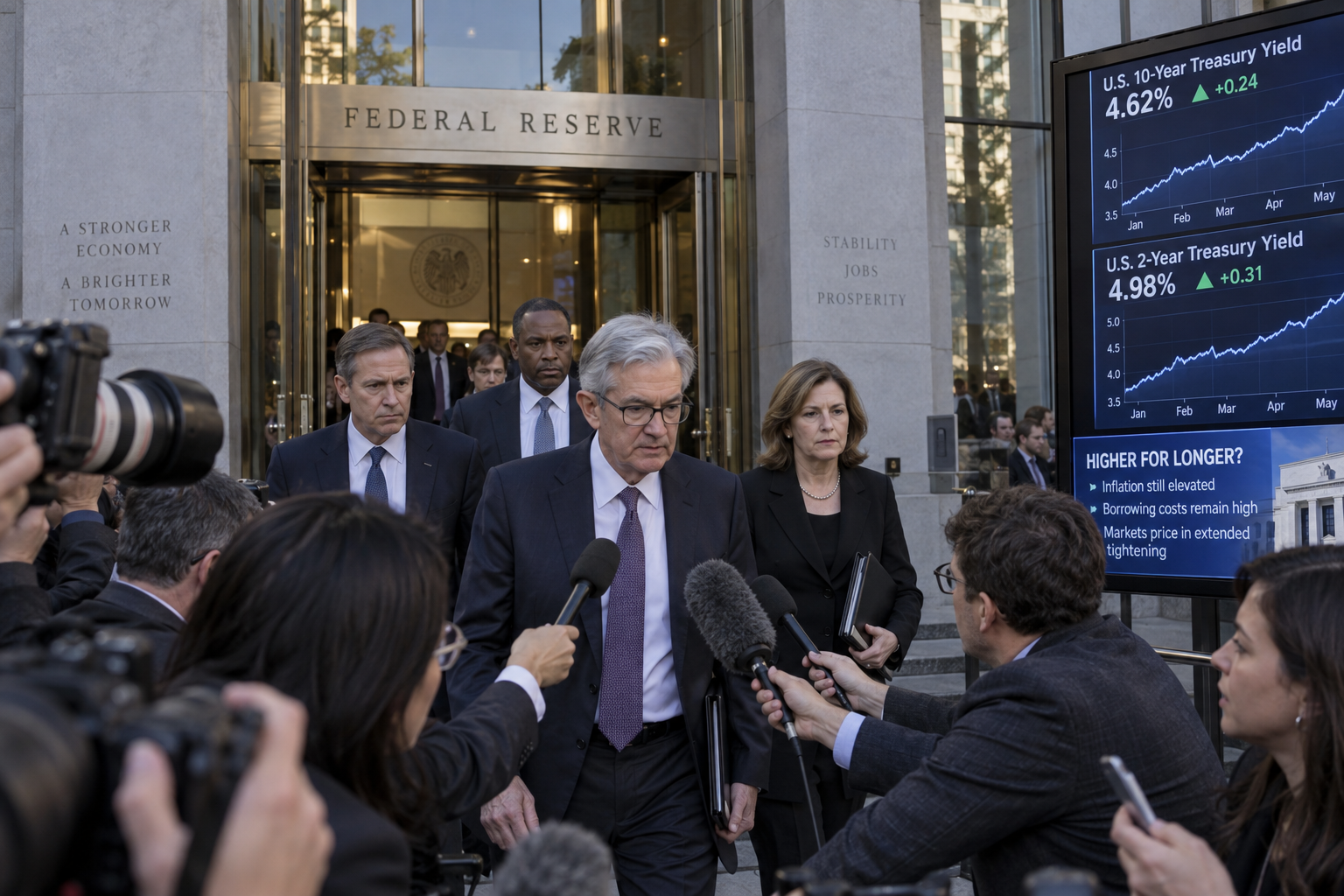
The 10-year U.S. Treasury yield rose above the closely watched 5% level after the Federal Reserve increased interest rates and Chairman Kevin Warsh emphasized that inflation remains a significant risk. The benchmark 10-year yield gained 2 basis points to 5.016%, while the 2-year yield rose more than 7 basis points to 4.738%, reversing an earlier decline. Bond yields and prices move in opposite directions.
The Fed raised its overnight lending-rate target for the first time in three years, bringing the range to 3.75%-4% from 3.5%-3.75%. In its policy statement, the Federal Open Market Committee said inflation remained elevated and that the rate increase was intended to support a faster return to its 2% inflation goal. Warsh told reporters that recent summer inflation data did not show meaningful improvement and that inflation had been too high for too long.
The policy decision followed a sharp increase in oil prices linked to escalating conflict in the U.S.-Iran war. Higher energy costs have begun appearing in inflation data, including the August consumer price index. Persistent inflation has put upward pressure on longer-term Treasury yields, with the 10-year yield reaching its highest level since 2007 on Tuesday.
Kay Haigh of Goldman Sachs Asset Management said the Fed had not signaled an aggressive tightening cycle. Most Federal Open Market Committee members reportedly expect two total rate increases this year, and the central bank may skip its October meeting because of its proximity to the midterm elections. Haigh said another increase in December was the firm’s base case, although that outlook depends on upcoming inflation readings and energy prices.
Entities: Kevin Warsh, Federal Reserve, Federal Open Market Committee (FOMC), 10-year U.S. Treasury note, 2-year U.S. Treasury note • Tone: analytical • Sentiment: negative • Intent: inform
16-09-2026
The US Federal Reserve raised its benchmark interest rate by 25 basis points, bringing the target range to 3.75%-4.00%. The article presents the increase as an effort to combat inflation that policymakers consider persistently too high and too distant from the Fed’s 2% objective. Federal Reserve Chair Kevin Warsh said price stability was the central focus of the decision and argued that the move would support a faster return to the inflation target.
The increase conflicts with President Donald Trump’s preference for substantially lower interest rates. Trump has called for rates of 1% or below and criticized the Fed as political and hostile, although he reportedly told Warsh that he might as well support the board’s decision because his vote would not change the outcome. The article links current inflationary pressures to several factors, including Trump’s import tariffs, an energy shock connected to the US-Israeli war with Iran, and capital investment related to the artificial-intelligence boom.
The decision was unanimous and was notable because Warsh had faced speculation that political pressure from Trump could influence the central bank. Warsh emphasized that the Fed acted independently and said monetary policymakers should remain within their mandate while trade and fiscal officials handle their own areas of policy.
The rate increase will raise borrowing costs for people financing homes, cars, appliances, and credit-card balances. However, the article notes that household debt payments remain relatively low compared with after-tax income, meaning many households may not experience a major short-term burden. Savers could benefit as interest rates on savings accounts and certificates of deposit increase.
Entities: Federal Reserve, Kevin Warsh, Donald Trump, United States, Federal Open Market Committee interest-rate decision • Tone: analytical • Sentiment: neutral • Intent: inform
16-09-2026
The Federal Reserve raised its benchmark interest rate by 0.25 percentage points to a range of 3.75% to 4%, marking its first increase since July 2023. The decision was unanimous, with all 12 voting members supporting the move, placing Fed Chair Kevin Warsh in direct opposition to President Donald Trump, who appointed him and has repeatedly called for substantially lower interest rates.
The rate increase ended a pause that had lasted since December and reflected persistent inflationary pressure, intensified by rising energy costs linked to the Iran war. The Fed said inflation remained elevated and reaffirmed its commitment to returning inflation to its 2% target. Its unusually brief policy statement offered no forward guidance but described economic activity, consumer spending, productivity, capital investment and employment as resilient or strong, suggesting that officials did not believe higher rates posed an immediate threat to growth.
The article says the decision had been anticipated for months. Three regional Fed presidents had favored a hike in July, while inflation remained above target. The personal consumption expenditures index was 3.7% in June and July, core inflation was 3.3%, and consumer prices rose 3.4% year-on-year in August. Inflation has remained above the Fed’s target for more than five years.
The Fed’s new projections indicate that policymakers may continue tightening. Twelve of 18 officials expect another quarter-point increase by the end of 2026, while most see interest rates remaining above current levels through 2027 and 2028. The longer-run rate projection also increased, implying that officials believe neutral interest rates have risen. The move may strengthen perceptions of the Federal Reserve’s independence after months of political pressure and criticism of former Chair Jerome Powell.
Entities: Federal Reserve, Federal Open Market Committee, Kevin Warsh, Donald Trump, Jerome Powell • Tone: analytical • Sentiment: neutral • Intent: analyze
16-09-2026
France 24 reports that the US Federal Reserve has raised its key interest rates for the first time in three years. The move is presented as an effort to reduce high inflation and represents a significant shift in US monetary policy after an extended period without a rate increase. The report does not specify the size of the hike or provide additional economic data, but it emphasizes the political consequences of the decision.
The rate increase could lead to a confrontation between Federal Reserve Chairman Kevin Warsh and President Donald Trump. According to the report, Trump has repeatedly urged the central bank to lower interest rates, placing him at odds with the Fed’s decision to tighten monetary policy. The headline characterizes the move as the Federal Reserve “defying” Trump, while the accompanying text frames the disagreement as a potential institutional and political conflict.
The item is a short segment from France 24’s business programming, with a listed duration of five minutes and 48 seconds and an issue date of September 16, 2026. It also previews two other stories in the same broadcast: France’s extension of fuel subsidies as fishermen’s protests gain momentum, and Hong Kong’s efforts to align with Beijing’s economic vision. These additional topics broaden the program beyond US monetary policy, touching on domestic economic support in France and the relationship between Hong Kong and China.
Overall, the article is a concise news update focused primarily on the Federal Reserve’s rate decision, inflation, and the resulting tension with the White House. It provides a factual overview rather than detailed economic analysis or commentary.
Entities: US Federal Reserve, Kevin Warsh, Donald Trump, United States, Interest rate hike • Tone: neutral • Sentiment: neutral • Intent: inform
16-09-2026
The article reports that the US Federal Reserve raised interest rates for the first time since 2023, despite President Donald Trump’s demand for immediate rate cuts. The Federal Open Market Committee voted unanimously to increase the benchmark rate by 25 basis points, bringing the target range to between 3.75 per cent and 4.00 per cent. The decision represents a direct disagreement between the central bank and the president over the appropriate direction of monetary policy.
Fed Chair Kevin Warsh defended the increase at a press conference, arguing that inflation remains “too high” and has stayed elevated for “too long.” He described the decision as serious but necessary, emphasizing the Fed’s responsibility to address persistent price pressures. The article presents the rate hike primarily as an anti-inflation measure rather than a response to economic weakness.
The increase may not be the final rate hike of the year. According to the Fed’s Summary of Economic Projections, a large majority of policymakers indicated that at least one additional increase could be needed before the end of 2026. This suggests that the central bank remains concerned about inflation and is prepared to maintain or intensify restrictive monetary policy even in the face of political pressure.
The decision risks further antagonizing Trump, who has called for lower borrowing costs. The article therefore highlights both the economic rationale for the Fed’s action and the growing tension between the independent central bank and the administration. Overall, it portrays the rate increase as a significant policy disagreement centered on inflation control, interest rates, and presidential pressure.
Entities: US Federal Reserve, Federal Open Market Committee (FOMC), Donald Trump, Kevin Warsh, United States • Tone: analytical • Sentiment: negative • Intent: inform
16-09-2026
The US Federal Reserve has raised interest rates for the first time in three years, prompting debate over whether the move marks the beginning of a new major tightening cycle. The 12-0 decision was influenced by renewed inflation risks linked to oil prices, which have risen toward $100 a barrel amid the Iran war, as well as increased government borrowing. Although the Fed’s updated projections indicate that most policymakers expect one additional rate increase before the end of 2026, traders largely anticipate that the next hike will come in December after a pause in October.
The central bank’s projections point to a “higher-for-longer” approach. Officials expect inflation to remain elevated and do not foresee further rate increases next year, while projecting that the federal funds rate will eventually decline to 3.9 percent in 2028 and 3.6 percent in 2029. However, the article notes that the Fed’s dot plot is not a firm policy commitment and has often misled markets.
Market reaction suggested investors were preparing for tighter policy, with the yields on two-year and 10-year US Treasury securities rising after Chair Kevin Warsh’s news conference. Warsh declined to submit his own rate projection and offered little forward guidance, saying he was not “into the forward-guiding business.”
Analysts disagree on the significance of the latest increase. Oxford Economics’ Michael Pearce views it as a risk-management measure rather than the start of another major tightening campaign, while Equiti strategist Noureldeen Al Hammoury warned that persistent upside inflation surprises could make the current dot plot merely the “floor” of the cycle. The outcome may depend heavily on the duration of the Iran war and whether energy-price pressures prove temporary or become embedded in inflation.
Entities: US Federal Reserve, Kevin Warsh, Federal Open Market Committee (FOMC), United States, Iran war • Tone: analytical • Sentiment: neutral • Intent: analyze
16-09-2026
NPR’s September 16, 2026, Up First briefing covers expected Federal Reserve interest-rate increases, the costs and military consequences of the Iran war, the planned closure of the Kennedy Center, limited access to subsidized contraception, and additional consumer and cultural stories. The Federal Reserve is widely expected to raise its benchmark interest rate by a quarter percentage point, to a range of 3.75% to 4%, marking its first increase in more than three years. The decision is intended to reduce demand and control inflation, but it will also increase borrowing costs for consumers and businesses. With two policy meetings remaining in the year, further increases remain possible if inflation stays high.
A new analysis from Power to Decide and the Guttmacher Institute estimates that 21.4 million U.S. women who need subsidized birth control live in counties with limited access. The researchers caution that the situation may be worse than the maps indicate because the underlying data dates from 2020 to 2023, during which many clinics closed and federal Title X funding changed.
Reports from the Congressional Budget Office and the Pentagon Inspector General say the Iran war has damaged U.S. bases, destroyed roughly 60 aircraft, and depleted important weapons stocks. The war has already cost more than $30 billion, excluding the cost of rebuilding bases, and could cost an additional $2 billion to $3 billion per month if the United States maintains a large military presence. The administration has requested another $67 billion, but Congress has not approved the funds.
The Kennedy Center board voted to close the arts complex after a federal judge blocked President Trump’s effort to add his name to the center. Planned events may move elsewhere, while support for the National Symphony Orchestra is expected to continue, though details remain unclear.
The newsletter’s deep dive examines real-estate junk fees, while its “Behind the story” section discusses a former British crime reporter who left journalism to become a clown. The supplied article ends mid-sentence during that discussion.
Entities: Federal Reserve, Kevin Warsh, Congressional Budget Office (CBO), Pentagon Inspector General, Iran war • Tone: analytical • Sentiment: neutral • Intent: inform