17-09-2026
The article reports a confrontation between US President Donald Trump and the Federal Reserve over interest rates and international trade. Trump had sought to pressure the Fed into lowering rates, but the central bank instead voted unanimously to raise them. The decision prompted a threat from Trump to end trade with countries where the United States records a trade deficit.
The countries and region identified in the report are Canada, Mexico and the European Union. The article therefore links a domestic monetary-policy dispute with a potentially far-reaching trade response. Trump’s threatened action would target major US trading partners and could significantly escalate tensions in North American and transatlantic economic relations if implemented.
The report does not provide details about how trade would be ended, what products or agreements would be affected, or whether any formal policy steps had been taken. It presents Trump’s statement as a response to the Fed’s rate increase rather than as the result of a separate trade announcement. The central issue is the president’s use of trade policy to respond to an interest-rate decision and his focus on trade deficits as justification for possible action.
The brief news item is primarily informational. Its framing emphasizes the sequence of events: Trump attempted to influence the Fed, the Fed rejected that pressure by raising rates unanimously, and Trump subsequently threatened trade restrictions against Canada, Mexico and the European Union. The language signals a serious escalation, while the limited details leave the practical consequences and likelihood of the threatened action unresolved.
Entities: Donald Trump, United States, Federal Reserve (Fed), Canada, Mexico • Tone: urgent • Sentiment: negative • Intent: inform
17-09-2026
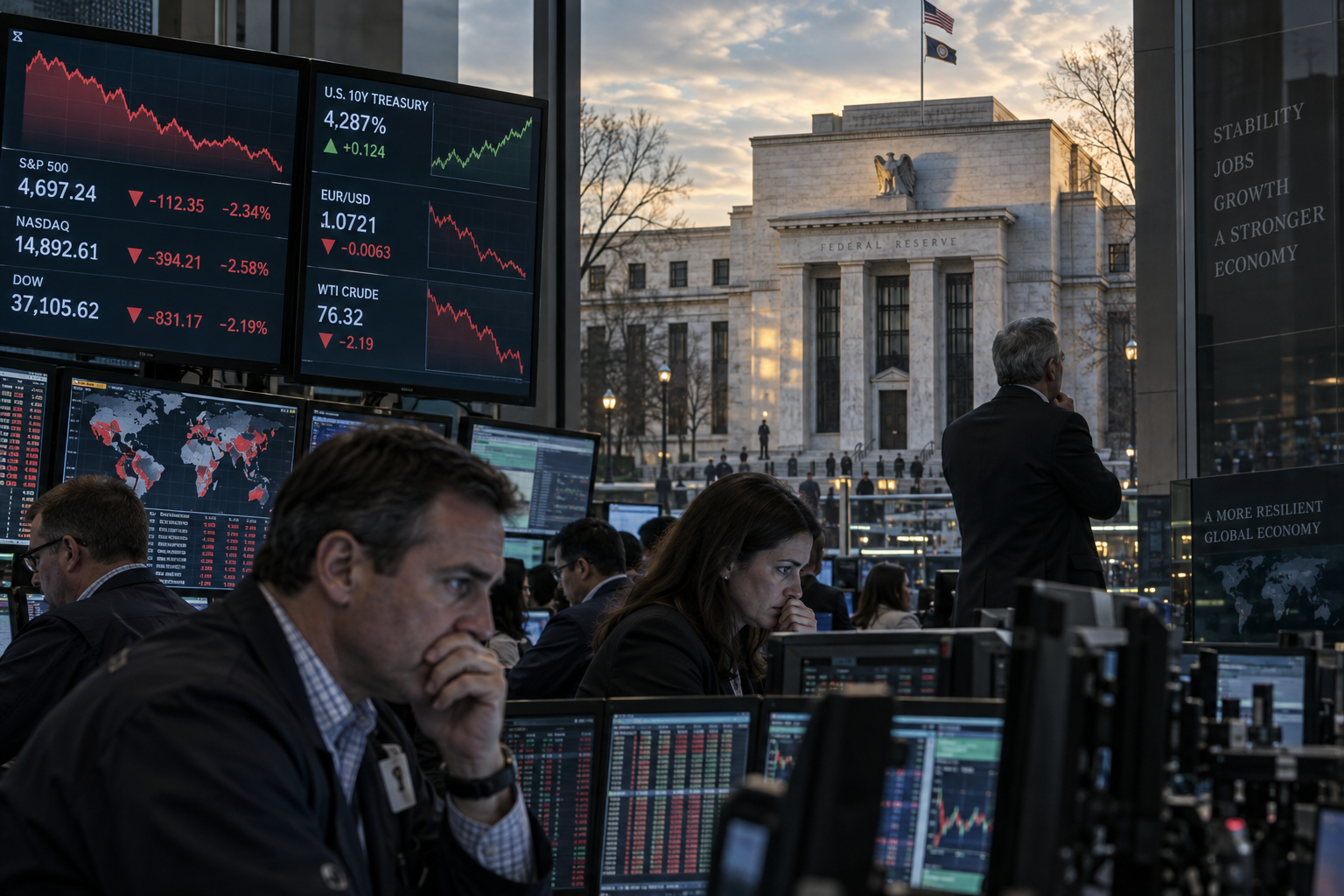
CNBC’s Daily Open examines a week of major central-bank decisions after the U.S. Federal Reserve raised its benchmark interest rate for the first time in three years. The Fed lifted the federal funds target range to 3.75%-4%, with policymakers voting unanimously. Fed Chair Kevin Warsh said inflation remained too high and had persisted for too long, signaling that additional increases could follow rather than treating the move as a one-time adjustment. The decision unsettled financial markets: all three major U.S. stock indexes closed lower, while the 10-year Treasury yield climbed above 5%. President Donald Trump strongly criticized the decision and called for rates to be reduced to 1% or less.
The Fed’s action was the first of several closely watched central-bank decisions. The Bank of England was expected to leave rates unchanged, while the Bank of Japan was forecast to raise rates on Friday. Oil prices, another source of inflation pressure, fell after U.S. Energy Secretary Chris Wright said damage to Saudi Arabia’s East-West pipeline was temporary and that operations could resume within days. West Texas Intermediate fell 3.2% to $102.43 per barrel, and Brent crude declined 2.7% to $105.83. Independent analysts, however, warned that satellite imagery indicated the pipeline’s damage could take weeks to repair.
The article also covers a proposed closer relationship between the European Union and Canada. European Commission President Ursula von der Leyen invited Canada to become the bloc’s first associate member, building on Prime Minister Mark Carney’s interest in a distinctive security and economic partnership. Trump dismissed the proposal as “laughable” and threatened tariffs or limits on trade if he viewed it as hostile.
Finally, Reddit co-founder Alexis Ohanian criticized the technology industry for explaining artificial intelligence poorly and allowing misinformation about its risks to spread. He argued that public discussion should focus on substantive, practical risks rather than sensational scenarios such as “Terminator and Skynet.”
Entities: U.S. Federal Reserve, Kevin Warsh, Donald Trump, Bank of England, Bank of Japan • Tone: analytical • Sentiment: neutral • Intent: inform
17-09-2026
CNBC’s Daily Open focuses on rising political and economic tensions surrounding U.S. monetary policy and international trade. The Federal Reserve raised interest rates by 25 basis points on Wednesday, its first increase since 2023. Although Fed Chair Kevin Warsh indicated that inflation remains too high and that additional hikes could be considered later in the year, President Donald Trump criticized the central bank’s governors as “very hostile” and “very political.” His comments raised further questions about the Fed’s independence. Bond investor Jeff Gundlach separately argued that the Fed should have delivered a more aggressive “stun and done” increase.
Markets were expected to recover on Thursday after initially falling sharply following the Fed decision. U.S. and European stock futures pointed higher, while Asian markets had broadly rallied. The Bank of England was widely expected to keep its policy rate unchanged at 3.75%, even as Governor Andrew Bailey warned that inflation risks remain elevated. In Japan, short-term government bond yields reached their highest level since 1995 ahead of an expected Bank of Japan rate hike on Friday.
Trade tensions also featured prominently. Trump described the European Union’s invitation for Canada to become an associate member as a “hostile act,” criticizing Canada’s trade relationship with the United States and threatening additional tariffs or a broader suspension of trade with Europe. Oil prices retreated after Saudi Arabia made additional crude shipments available to Asian refiners, potentially easing supply concerns.
The article concludes with a report on Russia’s parliamentary election, the first since its full-scale invasion of Ukraine. Although the ruling United Russia party is expected to retain control of the State Duma, observers will monitor turnout and the size of its victory for evidence of public dissatisfaction with the war and Russia’s struggling economy.
Entities: Donald Trump, Kevin Warsh, Federal Reserve, Jeff Gundlach, Bank of England • Tone: analytical • Sentiment: neutral • Intent: inform