17-09-2026
The article examines why inflation is rising again globally, focusing on a renewed surge in energy prices and the difficult choices facing major central banks. Oil prices recently exceeded $100 per barrel, increasing costs for households and businesses and contributing to broader inflationary pressure. The disruption is linked to the war involving Iran, the continued instability around the Strait of Hormuz, and advances by Houthi forces that threaten Saudi oil supplies.
The situation challenges a long-standing approach among central banks. For decades, policymakers generally regarded oil-price shocks as temporary disruptions that monetary policy could not effectively resolve. Raising interest rates does not directly increase oil production or reduce the price of a barrel, but it can slow economic growth and increase borrowing costs for consumers and businesses. As a result, central banks often preferred to wait for energy shocks to fade rather than tighten monetary policy in response.
The article suggests that current conditions may be different because the disruption could be more persistent and widespread. Higher energy costs are feeding into household and business bills, potentially creating sustained inflation beyond the initial oil shock. This is forcing policymakers to reconsider whether the traditional response remains appropriate. Central banks may raise interest rates to prevent energy-driven inflation from becoming embedded in the wider economy, even though doing so risks weakening growth. The central dilemma is therefore how to contain inflation without causing unnecessary economic damage when the original pressure comes from geopolitical conflict and constrained energy supplies.
Entities: Inflation, Rising energy prices, Major central banks, Interest-rate increases, Oil-price shocks • Tone: analytical • Sentiment: negative • Intent: analyze
17-09-2026
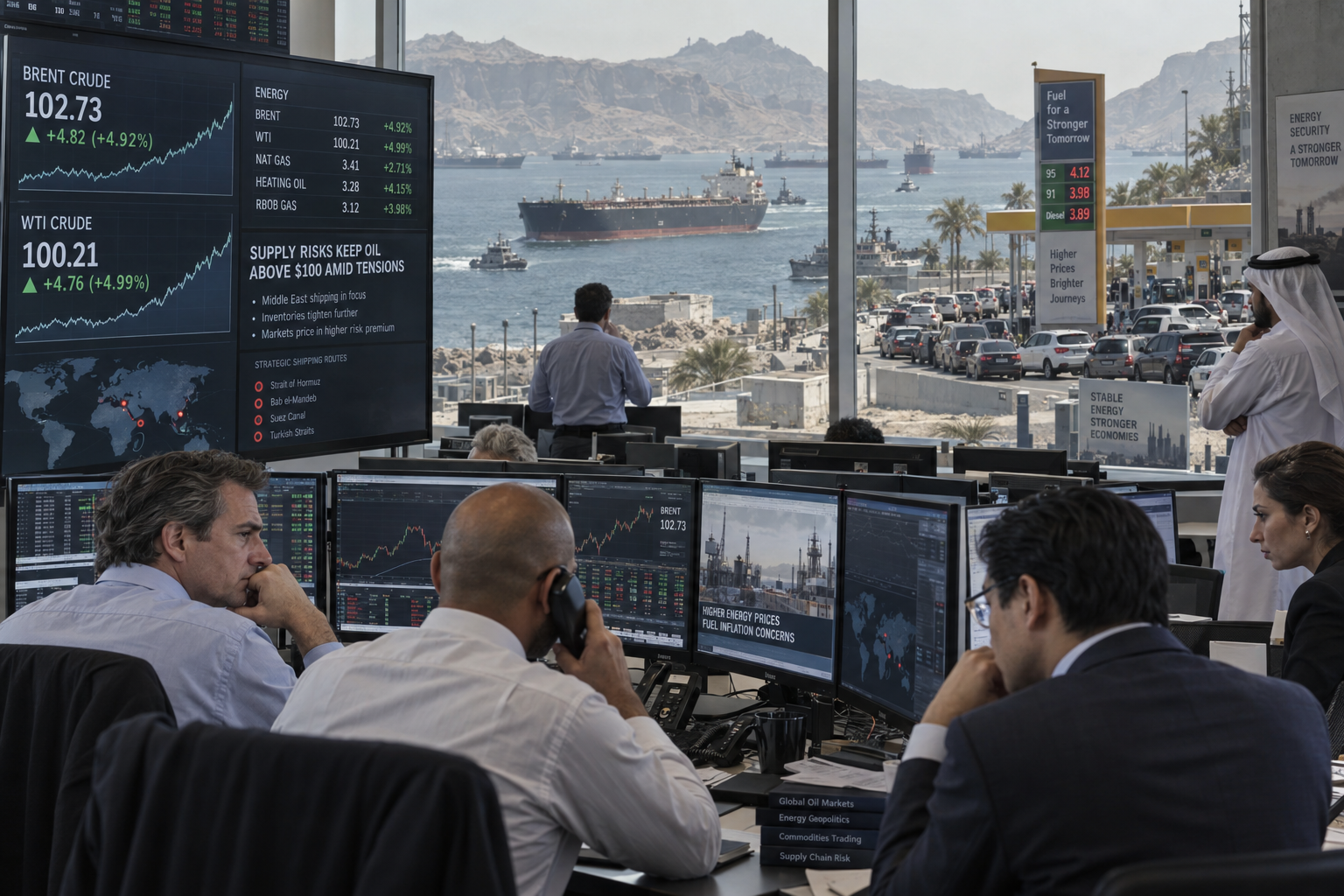
Oil prices declined on Thursday after Saudi Arabia began redirecting some crude exports through the Strait of Hormuz, reducing concerns that a pipeline outage would trigger a broader disruption to global supplies. Brent crude, the international benchmark, fell 2.8% to $102.89 per barrel, while West Texas Intermediate briefly dropped below $100 and was last down 1.8% at $100.54. Despite the daily decline, both benchmarks have risen more than 12% this month amid escalating tensions in the Middle East.
Saudi Arabia is making additional crude cargoes available to Asian refiners through ship-to-ship transfers near Oman’s Sohar port, according to Reuters sources. The move follows the suspension of crude loadings at the Red Sea export terminal in Yanbu and the cancellation of some Saudi shipments to European customers. Yanbu had become Saudi Arabia’s primary oil-export route after Iran began blockading the Strait of Hormuz following U.S. and Israeli attacks on Iran in late February.
U.S. Energy Secretary Chris Wright described the East-West pipeline outage as a brief, temporary interruption expected to last days, and said Riyadh had acted quickly to increase exports through the Gulf and Hormuz with U.S. military assistance. However, Rapidan Energy estimates that the outage will reduce Saudi crude exports by approximately 400,000 barrels per day this month. Increased shipments through the Gulf and Hormuz may partly offset the decline in Yanbu exports.
The market remains vulnerable to further disruption. Rapidan warned that risks would increase substantially if the pipeline outage continues beyond September or if Iran, the Houthis, or other proxy groups intensify attacks. The article therefore portrays the immediate price decline as a response to improved supply expectations, while emphasizing that geopolitical and logistical risks remain elevated.
Entities: Brent crude, West Texas Intermediate (WTI), Saudi Arabia, Strait of Hormuz, Iran • Tone: analytical • Sentiment: negative • Intent: inform
17-09-2026
This NPR report, published on September 17, 2026, describes protests linked to rising gasoline and fuel prices in countries around the world. Its central theme is the international ripple effect of escalating energy costs, which the report connects to the expanding consequences of the U.S. war on Iran. The article specifically identifies Saudi Arabia as being drawn more deeply into the conflict, suggesting that developments in the Middle East are affecting fuel markets and provoking public unrest far beyond the immediate region.
The supplied content presents the story as a report heard on NPR’s Morning Edition and lists Aya Batrawy and Michel Martin as its authors or contributors. It also includes a short audio segment lasting approximately four minutes and 21 seconds. However, the provided page text does not contain the audio transcript or the detailed reporting that would explain which countries experienced protests, how large the demonstrations were, what governments said or did in response, or how much fuel prices increased.
Based solely on the available excerpt, the story frames rising fuel prices as both an economic hardship and a geopolitical consequence. The wording emphasizes a chain reaction: war-related developments affect Saudi Arabia, energy markets respond, and people in multiple countries protest the resulting costs. The article therefore appears intended to inform readers about the global repercussions of the conflict, while highlighting the connection between international events, energy prices, and domestic political pressure. No additional factual details should be inferred from the supplied material.
Entities: NPR, Aya Batrawy, Michel Martin, Morning Edition, Saudi Arabia • Tone: urgent • Sentiment: negative • Intent: inform