17-09-2026
The European Union has announced a proposed EU Kids Act that would restrict social media access for children across all member states. The plan would ban children under 13 from accessing social media platforms, while 13- to 15-year-olds would be limited to one hour a day through “mini accounts” linked to a parent or guardian’s account. Children aged 15 and over would be allowed to create their own social media accounts.
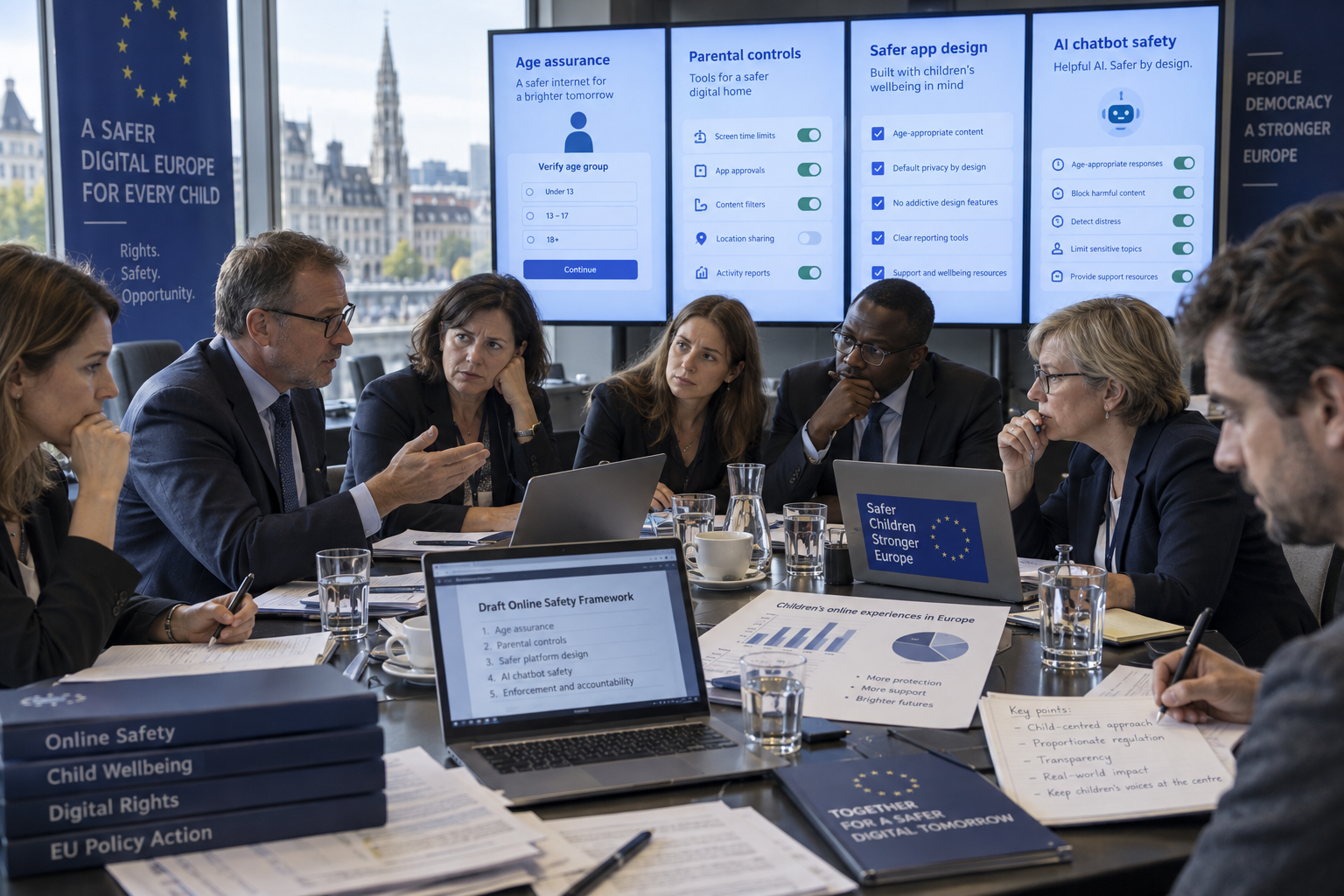
The proposed rules would apply broadly to TikTok, Instagram and Snapchat, as well as YouTube, other video-sharing services, AI chatbots and online games. Platforms would have to demonstrate that their services are safe by design and submit detailed child-safety plans. They would be prohibited from using toxic or addictive features and could face fines of up to 6% of their global sales for non-compliance. EU Commission President Ursula von der Leyen said the legislation would give parents greater control and help children navigate the internet more safely.
The legislation still requires approval from EU member states and the European Parliament. If adopted, it would be legally binding and would supersede conflicting national laws, including existing measures in France and Spain. However, enforcement and the final shape of the rules are likely to be controversial. France’s highest court recently blocked a proposed ban for under-15s on freedom-of-expression grounds, while critics have raised concerns about privacy and the collection of personal information during age verification. The Commission says an existing EU age-verification app would be used without collecting or sharing personal data.
The proposal follows growing concern about online harms, including bullying, compulsive use and addictive platform design. The Commission cited research showing strong public support for better online protection. It also drew on Australia’s experience with an under-16 ban, which has proved difficult to enforce. A similar UK restriction is expected to begin next spring.
Entities: European Union (EU), EU Kids Act, Ursula von der Leyen, European Commission, European Parliament • Tone: analytical • Sentiment: neutral • Intent: inform
17-09-2026
European Commission President Ursula von der Leyen has proposed stricter rules to protect children from risks associated with social media and other online services. The plan would seek to prevent children under 13 from accessing platforms such as Facebook, TikTok, and Instagram, establishing what von der Leyen described as an age-appropriate starting point for joining social media. The proposal is part of a reform of the EU Kids Act and reflects similar initiatives in Australia, the United Kingdom, China, India, Turkey, and several European countries, amid growing concern about social media’s effects on children’s mental health and development.
The proposed rules would give parents greater control over accounts used by children aged 13 to 15. They would also apply stricter requirements to social media platforms, video-streaming services, online video games, and chatbots aimed at people under 18. Platforms could be prohibited from using features considered addictive, including infinite scrolling and autoplay. Algorithmic recommendations, personalized profiling, reward-based engagement systems, and unsolicited contact from strangers would also face restrictions.
The European Parliament has additionally called for child-safe designs and algorithms, simple parental controls, and stronger age-verification systems. Companies that fail to comply could be fined up to 6% of their global annual revenue and would be expected to devote more resources to content supervision and moderation.
The proposal has prompted criticism from CCIA Europe, a technology-industry group representing companies including Google and Meta. The organization warned that collecting age information, identity documents, and data connecting children with parents could create significant privacy and cybersecurity risks. It also argued that the EU Kids Act may overlap with existing European laws, producing regulatory duplication and potentially weakening protections. The initiative must still be debated by EU member states and the European Parliament before it can become law.
Entities: Ursula von der Leyen, European Commission, European Union, EU Kids Act, CCIA Europe • Tone: analytical • Sentiment: neutral • Intent: inform
17-09-2026
European Commission President Ursula von der Leyen has proposed a broad package of measures to protect children from online risks, including a ban on social media access for children under 13. The proposal, known as the EU Kids Act, would also require online platforms to create safer accounts and environments for young users.
Under the plan, children aged 13 to 15 would use accounts subject to parental control. Social media platforms, video-sharing services, online video games, AI companions and chatbots intended for users under 18 would face restrictions on potentially harmful features. These would include addictive design elements, profiling-based recommendation feeds, infinite scrolling, reward mechanisms and unsolicited contact from strangers. AI companions and chatbots would have to be disabled by default.
Platforms would be required to develop child-safe algorithms, provide accessible parental controls, and offer tools to block or mute other users. They would also need to verify users’ ages through age-assurance systems. Companies that failed to comply could face fines of up to 6 per cent of their global annual revenue, as well as supervisory fees to fund regulators.
The initiative follows similar measures or proposals in Australia, Britain, China, India, Turkey and several EU countries. However, Australia’s difficulties enforcing its under-16 social media ban suggest that implementing the European plan could be challenging.
The proposal must still be negotiated by EU member states and the European Parliament before it can become law. Tech industry group CCIA Europe, which represents companies including Google and Meta, criticized the plan, warning that the collection of age, identity and parental-linking data could create privacy and cybersecurity risks. It also argued that overlapping EU legal requirements could complicate enforcement and weaken child and consumer protections.
Entities: European Commission, Ursula von der Leyen, Strasbourg, France, EU Kids Act, Under-13 social media ban • Tone: analytical • Sentiment: neutral • Intent: inform
17-09-2026
France 24 reports on European Union plans to impose stricter age limits for children accessing social media, online games and AI assistants. The proposals would also require technology companies to ensure that their platforms are safe for minors before children are allowed to use them.
The report features an interview with Lisa Dittmer, a researcher focused on children and young people’s digital rights at Amnesty International. Speaking to FRANCE 24’s Mark Owen, Dittmer argues that the negative effects of social media now outweigh its benefits. She says regulation should address the way platforms are designed rather than relying primarily on parents to protect children from harmful online experiences.
Dittmer’s comments frame the issue as a structural and regulatory problem. In her view, platforms should be required to change potentially harmful features at the design level, while companies—not only families—should bear responsibility for preventing risks to minors. The article links this debate to broader concerns about children’s safety online and the role of major technology platforms, including social media services and other digital products.
The report is brief and centers on the EU’s proposed approach and Amnesty International’s assessment of it. It does not provide detailed information about the proposed age thresholds, enforcement mechanisms, specific companies affected, or the timetable for implementing the plans. Its main message is that protecting children online requires stronger institutional oversight and changes to platform design, rather than placing the burden solely on parents.
Entities: European Union (EU), Lisa Dittmer, Amnesty International, FRANCE 24, Mark Owen • Tone: analytical • Sentiment: negative • Intent: analyze