17-09-2026
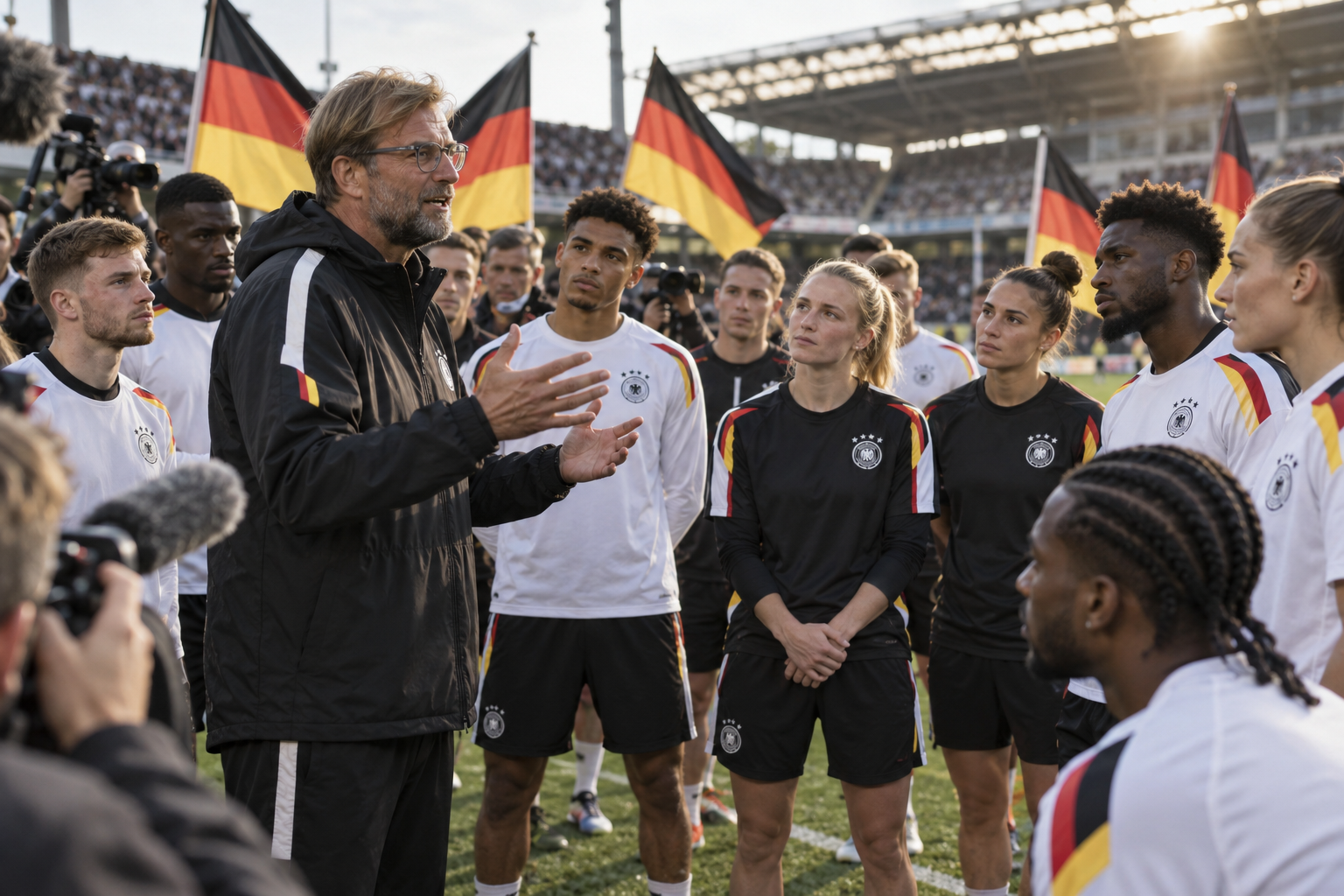
New Germany coach Jurgen Klopp says the national football team can help reclaim the German flag and promote a form of inclusive patriotism following a significant election victory for the far-right Alternative for Germany (AfD) party. The AfD won 43.8% of the vote in Saxony-Anhalt, narrowly missing an absolute majority, and is expected to perform strongly in upcoming elections in Berlin and Mecklenburg-Western Pomerania.
Speaking while announcing his first Germany squad, Klopp said he was not a political expert but argued that national pride should not be “entrusted to the wrong people.” He said he wanted Germans to be able to display the flag without it being associated exclusively with extremist views. Klopp described his preferred form of patriotism as open-minded, diverse, kind and friendly, while acknowledging the historical sensitivities surrounding German nationalism. His comments come in the context of Germany’s history under the Nazi regime and the Holocaust.
Klopp also emphasized that football should not overshadow essential public services, saying that the country needs enough doctors and caregivers. However, he believes sport can foster community and help people experience a shared sense of belonging.
For his first international matches, Klopp selected a 44-man squad containing 16 uncapped players. A 24-player group will face the Netherlands in Amsterdam on 24 September and Greece in Augsburg three days later. A second group of 20 players will then join the squad for matches against Serbia in Munich on 1 October and Greece in Thessaloniki on 4 October. The squad includes Premier League players Kai Havertz, Kevin Schade and Anton Stach, as well as Jamal Musiala. Brentford’s Vitaly Janelt received his first call-up. Manuel Neuer and Antonio Rudiger have retired from international football, while former coach Julian Nagelsmann departed after Germany’s World Cup exit. Klopp was appointed after working as global head of soccer for Red Bull.
Entities: Jurgen Klopp, Germany national football team, Alternative for Germany (AfD), Saxony-Anhalt, Berlin • Tone: analytical • Sentiment: neutral • Intent: inform
17-09-2026
Jürgen Klopp has begun his tenure as Germany head coach by selecting an unusually large squad of 44 players for the team’s next four matches. Because the September and October international breaks have been combined, Klopp divided the players into two groups, with each squad scheduled to play two matches. Goalkeeper Finn Dahmen was named in both groups, while Nico Schlotterbeck, Jamal Musiala and Serge Gnabry could remain with the team for the entire two-week period.
Klopp said the expanded selection was intended to help him evaluate as many players as possible rather than establish a first- and second-choice team. Eleven players are new to the senior squad, including Hoffenheim’s Bambasé Conté, Stuttgart defender Finn Jeltsch, Celtic midfielder Mika Baur, Freiburg forward Derry Scherhant and Eintracht Frankfurt breakout player Younes Ebnoutalib. Elversberg midfielder Felix Keidel was another surprise inclusion.
The squad also includes several returning or established players. Marc-André ter Stegen, now playing for Ajax, returns after a lengthy injury absence and was described by Klopp as Germany’s current number one. Young Cologne player Said El Mala, who was previously called up without making an appearance, is also included. Deniz Undav, Leroy Sané and Oliver Baumann are among the notable omissions.
Beyond team selection, Klopp discussed the national team’s relationship with German identity. He said he hoped Germany could “win back the flag” by creating a sense of pride that was welcoming rather than divisive. He emphasized that football should complement, rather than overshadow, the contributions of doctors, nurses and workers in other professions, while helping foster a sense of community.
Germany will face the Netherlands in Amsterdam, Greece in Augsburg, Serbia in Munich and Greece again in Thessaloniki between September 24 and October 4.
Entities: Jürgen Klopp, Germany national football team, 44-player squad, Combined September–October international break, Marc-André ter Stegen • Tone: analytical • Sentiment: neutral • Intent: inform
17-09-2026
Jürgen Klopp used his first Germany squad announcement as national-team head coach to make a broader argument about patriotism, national identity and the social power of football. He said he wanted to “reclaim the flag” from far-right groups and promote a form of positive patriotism that allows Germans to feel proud of their country while remaining open-minded, diverse, kind and welcoming. His remarks appeared to respond partly to the Alternative for Germany’s landslide victory in the recent Saxony-Anhalt state election and to concerns that national pride has become associated with the political right.
Klopp stressed that he was not a political expert and did not intend to discuss politics at every press conference. However, he argued that national pride should not be left to people who might use it to promote exclusion. He compared his approach to selecting the national squad with how society should view Germany: focusing on the country’s strengths and possibilities rather than constantly emphasizing its shortcomings.
The former Borussia Dortmund and Liverpool manager also cited comments from former Germany coach Julian Nagelsmann, who called for greater solidarity, less envy and negativity, and stronger support among neighbors and communities. Klopp acknowledged that doctors, nurses and workers in many other professions are more important to society than footballers, but argued that sport can still create a powerful sense of community.
The article presents Klopp’s communication strategy as deliberate and effective. His 44-player squad, which includes 11 newcomers, reflects the diversity he praised, while his appeal to the media suggests that coverage should help develop the new generation rather than undermine it through excessive negativity. A cap bearing the words “one of 83 million” reinforced his message that every German shares responsibility for the national team. By invoking the pride generated by the 2006 World Cup, Euro 2024 and other sporting successes, Klopp positioned football as a vehicle for restoring a more inclusive sense of national pride.
Entities: Jürgen Klopp, Germany national football team, Positive patriotism, Alternative for Germany (AfD), Saxony-Anhalt • Tone: analytical • Sentiment: positive • Intent: analyze