15-09-2026
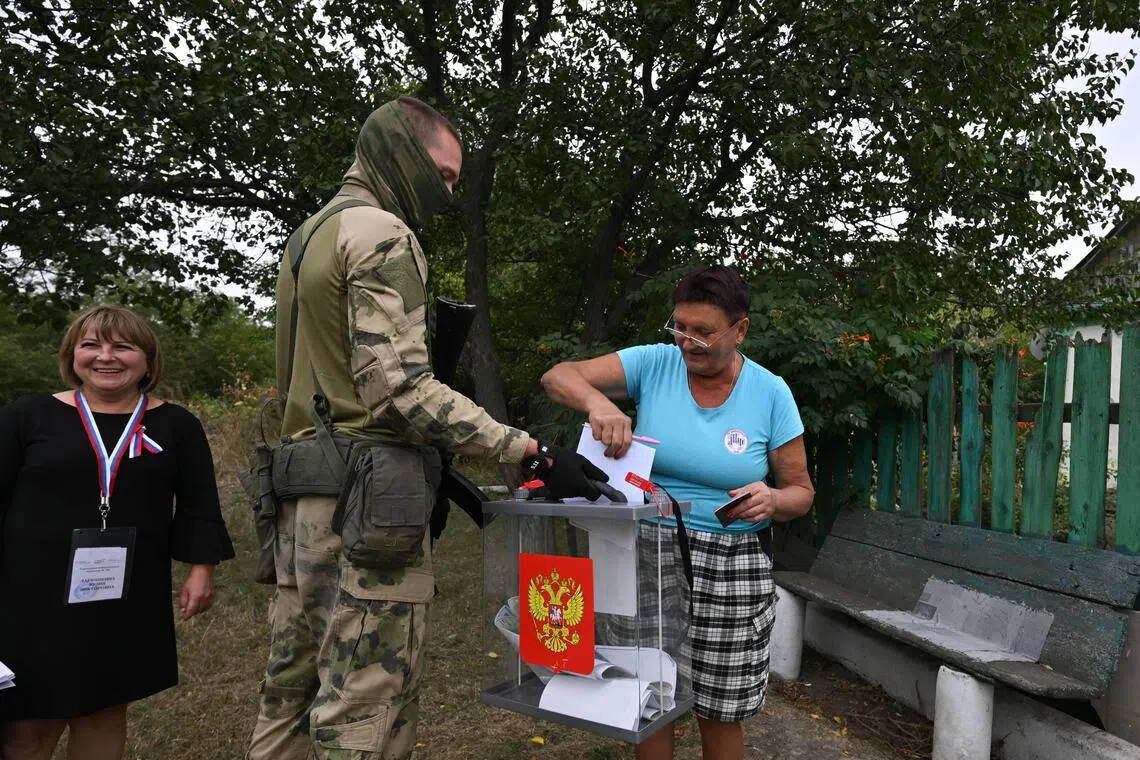
Russia has begun early voting in Ukrainian territories occupied by Russian forces ahead of the country’s parliamentary election, scheduled nationwide for 18–20 September. On 14 September, mobile polling teams visited homes in rural areas with ballot boxes and portable voting booths. Video footage showed residents voting outside their homes while Russia’s Central Electoral Commission officials supervised alongside Russian servicemen and police officers.
The Kremlin presents the election as a way to measure public opinion about the war in Ukraine, which the article says has entered its fifth year. Early voting is also taking place in several Russian-controlled frontline regions. Russian authorities say the special arrangements are necessary because of martial law imposed by Moscow and are intended to protect voters and election workers. In Donetsk, election officials travelled between settlements accompanied by police and armed military personnel. However, the footage did not indicate how many people had voted or provide turnout figures.
Ukraine’s Security Service has urged residents in occupied areas not to participate, warning that organising or promoting the elections could violate Ukrainian law and lead to prison sentences of up to 10 years. The presence of armed soldiers at voters’ homes raises questions about whether residents can freely choose whether to participate. Kyiv and Western governments reject the elections in occupied Ukrainian territory as illegal, calling them a “sham election” designed to legitimise Moscow’s control over the regions. The report therefore highlights the opposing narratives: Russia describes the process as a lawful wartime electoral measure, while Ukraine and its allies view it as coercive and an attempt to consolidate the occupation.
Entities: Russia’s parliamentary election, Occupied Ukrainian territories, Ukraine, Russia’s Central Electoral Commission, Ukraine’s Security Service (SBU) • Tone: analytical • Sentiment: negative • Intent: inform
15-09-2026
Russia has begun early voting for its parliamentary elections in Russian-controlled parts of Ukraine’s Donetsk region, according to video footage reported by Euronews. The voting took place on 14 September, ahead of Russia’s nationwide parliamentary election scheduled for 18–20 September. Mobile polling teams travelled to rural settlements, visiting residents’ homes with ballot boxes and portable voting booths. Footage showed people voting outside their houses while officials from Russia’s Central Electoral Commission supervised the process alongside Russian servicemen and police officers.
Russian authorities have also introduced early voting in several frontline regions. Moscow says these arrangements are necessary because of martial law and are intended to protect both voters and election workers. In Donetsk, election officials reportedly moved between settlements under armed escort. The footage did not indicate how many people had voted or provide turnout figures.
The vote is politically contentious because it is being conducted in Ukrainian territory occupied and controlled by Russia. Ukraine’s Security Service warned residents not to participate, stating that organising or promoting the elections could violate Ukrainian law and result in a prison sentence of up to 10 years. The report also raises the question of whether residents can freely refuse to participate when armed soldiers are present at their homes.
Kyiv and Western governments regard elections held in occupied Ukrainian territory as illegal. They describe the process as a “sham election” designed to legitimise Moscow’s control over the regions. The Kremlin, meanwhile, presents the parliamentary vote as a measure of public opinion on the war in Ukraine, which the article says has entered its fifth year. The report provides no independent assessment of participation or voter choice.
Entities: Russia, Ukraine, Donetsk region, Russian parliamentary elections, Ukraine’s Security Service (SBU) • Tone: analytical • Sentiment: negative • Intent: inform
15-09-2026
Russia is scheduled to hold tightly controlled parliamentary elections from Sept 18 to Sept 20, 2026, the first nationwide legislative vote since Moscow launched its full-scale offensive against Ukraine in February 2022. The Kremlin is presenting the election as a gauge of public opinion on the war, which has entered its fifth year, while also using it to demonstrate continued public loyalty to President Vladimir Putin and his leadership.
The outcome is expected to be a guaranteed majority for Putin’s United Russia party. Criticism of the war has been banned, opposition figures have been jailed, exiled or killed, and Russia’s only remaining active anti-war party, Yabloko, was barred from participating. The other parties allowed on the national ballot—the Communist Party, A Just Russia, nationalist LDPR and New People—support Putin and the war to varying degrees. Half of the 450 State Duma seats will be allocated through a nationwide party-list vote, while the remainder will be decided in single-member districts. Voting is also planned in areas of Ukraine occupied by Russian forces.
The election is taking place amid economic stagnation, intensified Ukrainian strikes inside Russia, fuel shortages, civilian deaths and widespread war-related repression. Some Russians fear that Putin could order another mass mobilisation after the vote, following the unpopular 2022 call-up of 300,000 reservists. However, expert Tatiana Stanovaya of the Carnegie Russia Eurasia Centre considers a new mobilisation unlikely, arguing that the Kremlin has worked hard to reassure the public.
Although the vote is widely viewed as predetermined, analysts say it remains important to the Kremlin as a ritual of loyalty and a way to reassure political elites that Putin retains popular support. The muted campaign in Moscow and the absence of genuine political choice underscore the election’s controlled nature. The result is therefore expected to provide Putin with another claim to legitimacy for both his presidency and the war.
Entities: Russia, Ukraine, Vladimir Putin, Russian parliamentary elections, Kremlin • Tone: analytical • Sentiment: negative • Intent: inform
15-09-2026
In the lead-up to Russia’s parliamentary elections, residents and businesses in Yaroslavl describe an economy under increasing strain despite visible state-funded redevelopment in the city. The picturesque Volga River tourist hub is benefiting from rebuilding projects, but locals face high inflation, expensive borrowing, fuel shortages, weak consumer spending and difficulties maintaining businesses.
The most immediate problem for employers is a severe labour shortage. Business owners say they have plenty of work but cannot find enough workers, particularly young people willing to take low-status or demanding jobs. Official unemployment is just above 2%, while residents and analysts connect the shortage to demographic decline, falling birth rates and the impact of the war with Ukraine. Some villagers say people are postponing having children because of the conflict and uncertainty.
Households are also struggling. A pensioner supplements her 17,000-rouble pension by selling forest mushrooms, but says consumers are buying fewer because dried mushrooms have become a luxury. Other residents report sharply higher prices for essentials, including sugar needed by a beekeeper to feed his bees through winter. Recent tax increases intended to support military spending have added to the pressure.
Macroeconomic conditions have deteriorated. Growth fell from 4.9% in 2024 to 1% in 2025, the economy contracted slightly in early 2026, and the government now forecasts only 0.6% growth for the year. Inflation remains above 6%, while the central bank’s 14% interest rate makes borrowing punitive.
The article also highlights the war’s direct economic and physical effects. Ukrainian drone attacks have disrupted oil refining, agriculture, tourism, retail and fuel distribution, while sanctions and trade disruptions have raised costs. At a local refinery, shipping containers and metal wires protect infrastructure from drones; nearby, a resident repairs a house damaged by one. Few residents expect the tightly controlled election to change policy, but the Kremlin views it as a measure of public fatigue with the war.
Entities: Yaroslavl, Volga River, Russia, Moscow, Russian parliamentary elections • Tone: analytical • Sentiment: negative • Intent: analyze
15-09-2026
Alexander Ovechkin is expected to miss Russia’s parliamentary elections in person because he has returned to the United States to prepare for his 22nd NHL season with the Washington Capitals. However, before leaving Russia, the hockey star appeared in a campaign video supporting United Russia, the ruling party that backs President Vladimir Putin. Ovechkin is visible among supporters behind Foreign Minister Sergey Lavrov, who is leading the party’s parliamentary list. His participation drew criticism, including from Ukrainian skeleton pilot Vladyslav Heraskevych.
The article places Ovechkin’s latest appearance in the context of his long-standing and highly public support for Putin. In 2017, he launched PutinTeam, a group intended to support Putin’s 2018 presidential campaign. Ovechkin also posted messages invoking the fight against fascism after Russia’s seizure of Crimea in 2014, language that echoes Putin’s rhetoric about Ukraine. After Russia launched its full-scale invasion of Ukraine in February 2022, Ovechkin said Putin was his president and described himself as an athlete rather than a political figure. He called for an end to the war but did not directly condemn Russia’s military action.
The second half of the article focuses on Ovechkin’s hockey career. At 40, soon to turn 41, he is preparing for another season and hopes to help Washington win a second Stanley Cup. Ovechkin has already broken Wayne Gretzky’s NHL career goal-scoring record and enters the 2025-26 campaign with 929 regular-season goals. He scored 32 goals in the previous season, a remarkable total for a player over 40. Although Ovechkin remains confident in the Capitals, bookmakers rate them only 18th among 32 Stanley Cup contenders. By contrast, United Russia’s victory in the parliamentary elections is presented as highly likely.
Entities: Alexander Ovechkin, Vladimir Putin, United Russia party, Russian parliamentary elections, Sergey Lavrov • Tone: analytical • Sentiment: neutral • Intent: inform
15-09-2026
The supplied excerpt reports that Alexander Ovechkin, captain of the Washington Capitals and a prominent National Hockey League player, appeared in a campaign video supporting United Russia. United Russia is identified as Russia’s governing political party and as a group that supports President Vladimir Putin. The article emphasizes that Ovechkin used his considerable visibility and status as an international sports star to promote the party.
The report presents the endorsement in the context of Russia’s war in Ukraine, characterizing United Russia as one of the political forces responsible for the conflict. This framing makes the appearance more than a routine political advertisement: it highlights the way a celebrated athlete’s public profile can be used to lend legitimacy and reach to a government-aligned political organization.
The excerpt does not provide details about when or where the video was released, what Ovechkin said in it, or whether he offered additional comments about the campaign. It also does not describe reactions from the Washington Capitals, the NHL, Ukrainian officials, Russian opposition groups, or other public figures. Based on the available text, the central news is Ovechkin’s participation in a United Russia campaign video and the political implications of that endorsement. The article’s language is critical, particularly in linking the party to Putin and to Russia’s war in Ukraine, while also underscoring Ovechkin’s influence as a leading hockey player. The supplied material is only a short excerpt rather than the complete Washington Post article, so additional context and reporting may not be included.
Entities: Alexander Ovechkin, Washington Capitals, National Hockey League (NHL), United Russia, Vladimir Putin • Tone: negative • Sentiment: negative • Intent: inform