15-09-2026
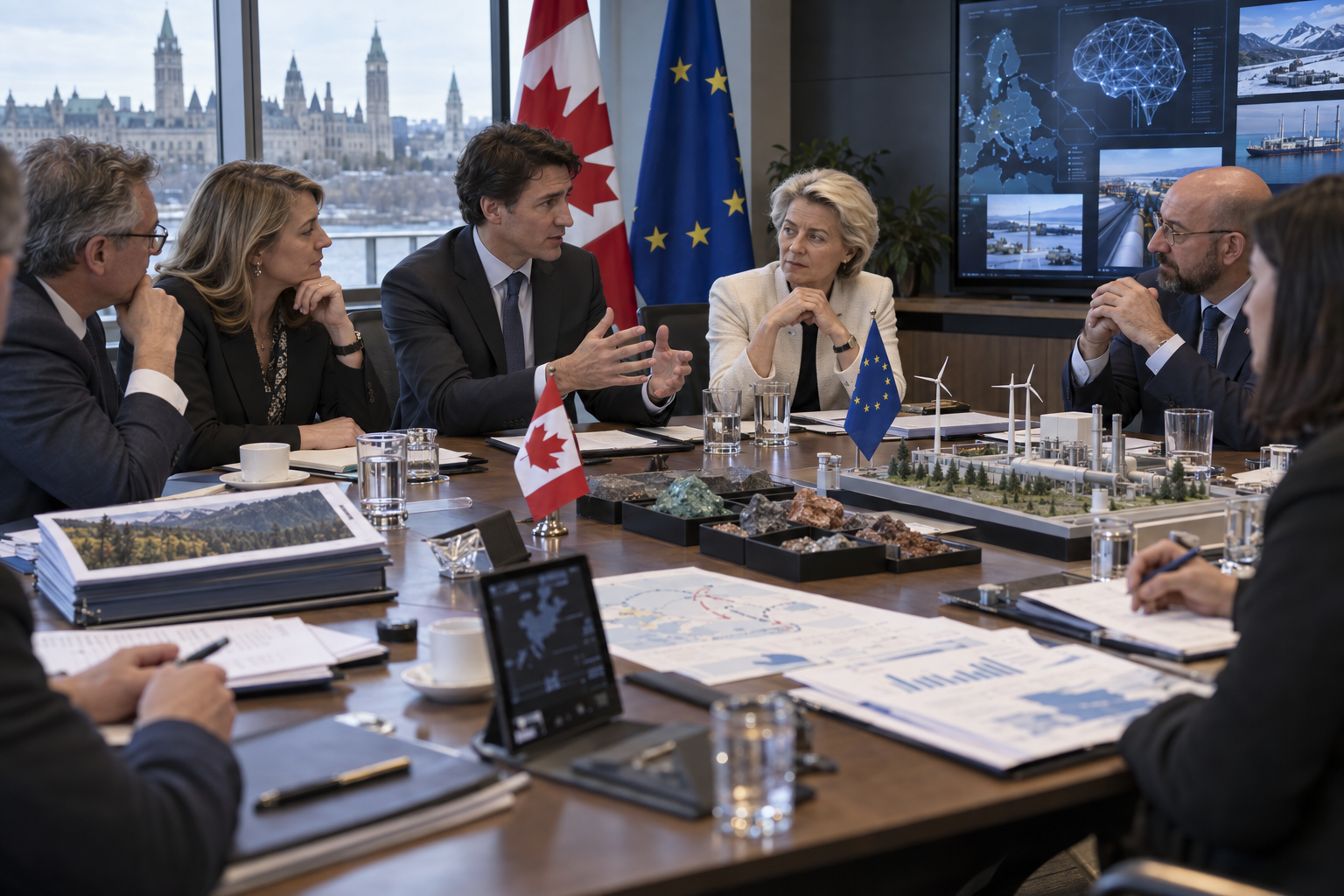
Canada is seeking a closer, but non-membership, relationship with the European Union as President Donald Trump’s tariff policies and threats to make Canada the 51st US state push Ottawa to diversify its economic, political and security partnerships. Prime Minister Mark Carney has described the proposed arrangement as a “unique alliance” and is expected to discuss it with EU leaders in Strasbourg, while Commission President Ursula von der Leyen is preparing to outline a more ambitious EU-Canada partnership.
The article examines what such an alliance might involve and stresses that “associate membership” has no clear legal or political precedent. Analysts expect Brussels to avoid creating a formal new membership category and instead deepen cooperation through existing mechanisms. Trade is a central motivation for Canada, particularly improved access to the EU’s €18 trillion single market. However, arrangements comparable to those enjoyed by Norway or Switzerland would require extensive alignment with EU rules, judicial structures and regulatory standards—conditions Ottawa may be reluctant to accept. Fully upgrading the existing Canada-EU trade agreement, CETA, could also face political resistance because of previous opposition to the deal in parts of Europe.
The article identifies more feasible areas for cooperation, including critical raw materials, clean-energy procurement, defence-industry partnerships and support for Ukraine. Canada has already joined the EU’s SAFE defence procurement programme and is negotiating a contribution to an EU loan for Ukraine. Both sides are also discussing Canadian access to the EU’s “Made in Europe” scheme in exchange for reciprocal market access.
Despite the strategic opportunity, the relationship could involve difficult negotiations. Canada may seek stronger political backing from Europe in disputes with Washington, arguing that Ottawa supported European allies during Trump’s threats against Greenland while the EU hesitated during Canada’s trade confrontation with the United States.
Entities: Canada, European Union (EU), Mark Carney, Donald Trump, Ursula von der Leyen • Tone: analytical • Sentiment: neutral • Intent: analyze
15-09-2026
Canadian Prime Minister Mark Carney is preparing to travel to Europe as Ottawa seeks stronger political, economic and security ties with the European Union amid worsening trade relations with the United States. During a visit to Strasbourg, Carney is scheduled to address the European Parliament, meet lawmakers and attend European Commission President Ursula von der Leyen’s State of the European Union address. He is also due to travel to Liverpool, where he will meet British counterpart Andy Burnham to discuss defence and security, artificial intelligence, energy and critical minerals.
A senior Canadian official told the Associated Press that Ottawa hopes to negotiate a tailored arrangement with the EU that could allow Canadians to live and work throughout the bloc without visa restrictions. The official said Canada is not seeking a Norway- or Switzerland-style relationship, nor has it proposed associate membership. Instead, the government wants a bespoke agreement focused on investment and aligned with Canadian priorities. Carney has said Canada does not want to join the EU, but is pursuing what he calls a “unique alliance.”
Canada’s renewed interest in Europe follows the collapse of talks with Washington aimed at preventing high tariffs on Canadian goods. US duties of 50% on approximately C$28 billion of Canadian imports took effect in late August, prompting Ottawa to impose counter-tariffs of up to 15%, 25% or 50% on about C$27.6 billion in US imports.
Despite the dispute, Carney told investors in Toronto that the United States would remain Canada’s most important partner in many areas, emphasizing the countries’ longstanding ties. The European trip therefore reflects an effort to diversify Canada’s partnerships while maintaining its relationship with Washington.
Entities: Mark Carney, Canada, European Union (EU), Donald Trump, Ursula von der Leyen • Tone: analytical • Sentiment: neutral • Intent: inform
15-09-2026
Canadian prime minister Mark Carney has announced that Canada will pursue a “unique security and economic alliance” with the European Union as Ottawa seeks to reduce its economic dependence on the United States. Speaking at the inaugural Canada Investment Summit in Toronto, Carney presented Canada as a stable “safe harbour” for international capital and argued that the country must strengthen its domestic capabilities while diversifying its international partnerships.
His comments come after 18 months of worsening relations with the US, including tariff threats from Donald Trump and discussion of a broader US political and economic sphere in North America. Carney said economic integration was increasingly being used as a weapon and that Canada had to take care of itself and its partners.
Canada is seeking closer cooperation with the EU on defence, energy, raw materials, artificial intelligence, professional mobility, student exchanges and potentially visa-free travel and work. Carney will address the European Parliament in Strasbourg, while European Commission president Ursula von der Leyen is expected to outline new areas of cooperation. Although EU officials want a relationship close to membership, they do not plan to offer associate-member status or divide the single market’s four freedoms. Canada has already joined the EU’s €150bn defence loans scheme.
The relationship faces obstacles, particularly the failure of 10 EU member states to ratify the Comprehensive Economic and Trade Agreement, or Ceta. Although EU-Canada trade reached €130bn in 2025, it remains far below Canada-US trade, worth nearly US$880bn. Carney acknowledged that the US will remain Canada’s largest trading partner.
At the summit, Carney also promoted increased foreign investment, an accelerated budget-balancing timetable, a corporate tax “mega-deduction” and plans to open four major airports to foreign investment. The strategy has drawn criticism from protesters who fear public funds will absorb private investment risks while communities bear the social and environmental costs.
Entities: Mark Carney, Canada, European Union (EU), United States, Donald Trump • Tone: analytical • Sentiment: neutral • Intent: inform
15-09-2026
This France 24 article reports on an interview with Dr. Walaa-Eldeen Bakry, Principal Lecturer in Project Management and Finance and Director of Executive Education at Westminster Business School. Speaking with FRANCE 24’s Mark Owen, Bakry discusses Canadian Prime Minister Carney’s approach to trade policy and argues that Canada is deliberately seeking to diversify its international commercial relationships.
According to Bakry, this diversification could create a more dependable route for Canadian energy exports to the European Union. She points to a significant increase in Canadian oil exports to some European countries during the previous year as evidence that Canada’s energy relationship with Europe is already expanding. The article does not identify the countries involved, provide export figures, or describe specific infrastructure projects, agreements, or transportation routes.
The report frames closer Canada-Europe trade as particularly relevant amid tensions in Canada’s relationship with the United States and broader concerns about tariffs and trade dependence. It suggests that Canada may be attempting to reduce its reliance on the US market by strengthening links with European partners, especially in the energy sector. Bakry’s comments present this as a potential reliability and diversification opportunity for the EU as well as for Canada.
The piece is primarily an expert commentary rather than a detailed policy analysis or report of a newly signed agreement. Its central message is that Canada could become a more dependable supplier and trading partner for European energy markets, while its trade-policy diversification could support closer economic ties between Canada and the EU.
Entities: Canada, European Union (EU), Dr. Walaa-Eldeen Bakry, Mark Owen, Westminster Business School • Tone: analytical • Sentiment: positive • Intent: analyze
15-09-2026
In this France 24 Spotlight interview, François Picard speaks with Anne Applebaum, a staff writer at The Atlantic and author of Autocracy, Inc., about what she describes as a fundamental transformation in US diplomacy and foreign policy. Applebaum argues that the shift extends beyond any single administration and represents a change in how the United States exercises power.
According to her analysis, Washington is moving away from leading a democratic alliance and toward a transactional, “mafia-style” model that combines ideology, private economic interests, personal relationships and geopolitical pressure. The effects are already being felt internationally. Canada is pursuing stronger economic and political relationships with the European Union, India and China as Carney seeks to reduce the country’s long-standing dependence on the United States. European governments, meanwhile, are being forced to deal with an ally they view as increasingly unpredictable and adversarial.
Applebaum also says that the United States’ harder-line, populist and increasingly autocratic politics are creating opportunities for far-right movements in other countries. More broadly, governments are beginning to diversify their economic and security partnerships because they no longer regard Washington as a consistently reliable partner.
She characterizes the moment as both a revolution and the beginning of a counter-revolution: Trump’s political model has imitators, but it is also provoking strong resistance. As confidence in US leadership declines, countries are preparing for a world in which the United States is no longer automatically at the center of global affairs. The article concludes that an isolationist effort intended to restore American dominance may instead accelerate the emergence of a new international order in which the US has a diminished role.
Entities: Anne Applebaum, François Picard, Donald Trump, Canada, United States • Tone: analytical • Sentiment: negative • Intent: analyze