15-09-2026
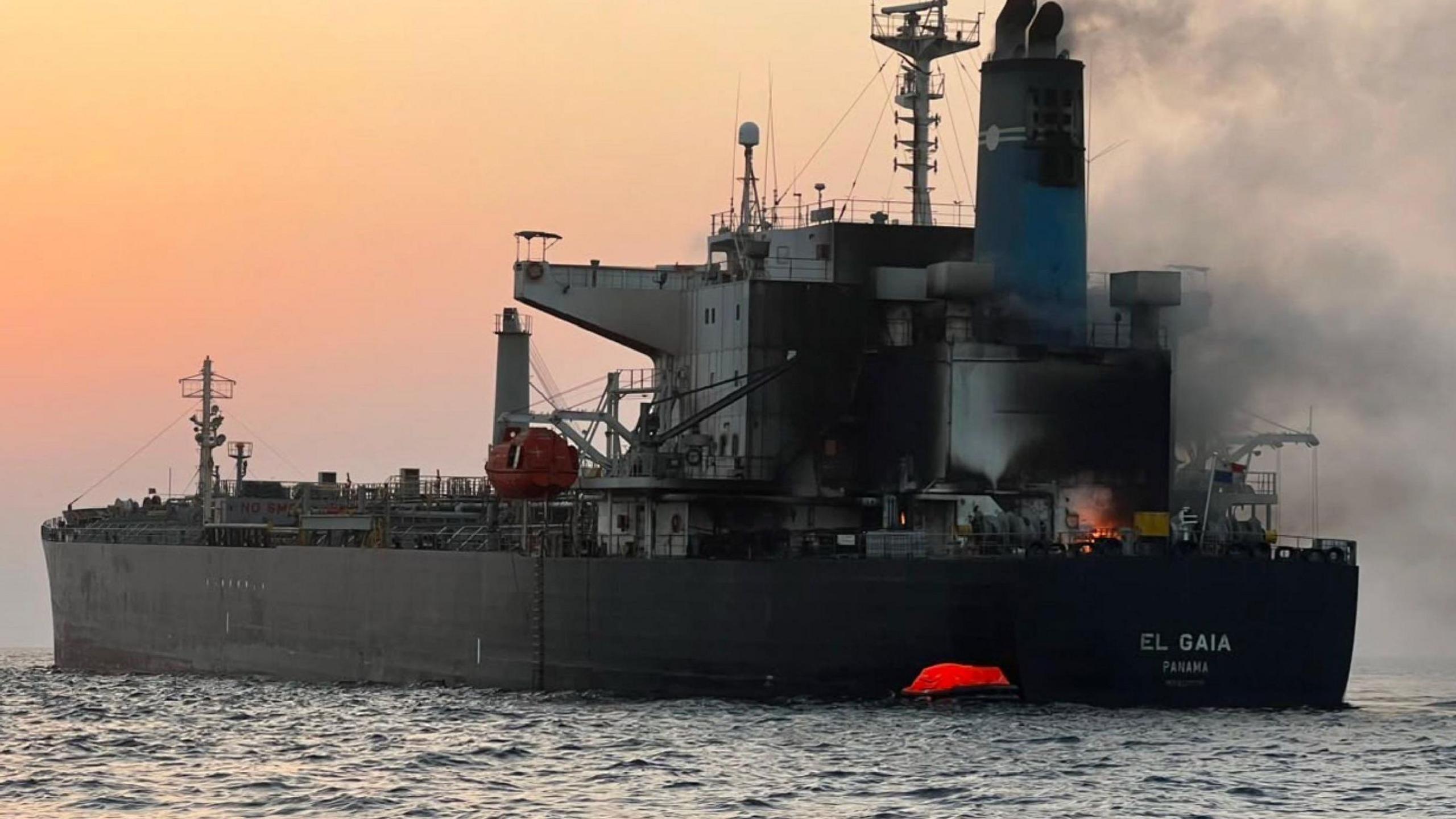
Two sailors are missing and 23 have been rescued after the Panama-flagged oil tanker El Gaia was attacked in the Strait of Hormuz, according to Oman’s Maritime Security Centre. The tanker caught fire in its engine room and was being towed toward an Omani port. The incident occurred 1.3 nautical miles north of the Musandam Peninsula, near a route through Omani waters.
The cause of the attack remains disputed. Iran’s Revolutionary Guards said the tanker struck naval mines while using a restricted and unsafe route. The US military rejected that account, saying El Gaia was hit by an Iranian missile last month and by a drone over the weekend. The UK Maritime Trade Operations centre separately reported that a vessel had caught fire after being struck by an unknown projectile while transiting the strait on Sunday.
The article places the incident in the context of escalating attacks on commercial shipping connected to the conflict between Iran, the US and Israel. A similar incident earlier in the month involving the Saudi-owned supertanker Sidr killed two Filipino sailors. Iran also attributed that fire to a naval mine, while Saudi authorities and maritime security companies said the ship had been targeted by Iran or struck by projectiles.
According to the International Maritime Organization, at least 22 seafarers have died in 79 confirmed incidents in the Strait of Hormuz and elsewhere in the Middle East since the war began at the end of February. The strait normally carries about one-fifth of global oil and gas shipments but has effectively been closed because of attacks and a US naval blockade. A preliminary US-Iran agreement to reopen it collapsed after shipping attacks resumed and the blockade was reinstated.
Entities: El Gaia, Strait of Hormuz, Oman, Oman Maritime Security Centre, Musandam Peninsula • Tone: urgent • Sentiment: negative • Intent: inform
15-09-2026
Iran’s Islamic Revolutionary Guard Corps (IRGC) reported that the oil tanker El Gaia exploded in the Strait of Hormuz after striking a sea mine. According to Iran’s state broadcaster, IRIB, the tanker was travelling on the southern route through the waterway, an area the report said had been mined by Iran. The IRGC said the detonation caused the entire vessel to catch fire.
The United States rejected Iran’s account of the incident. US Central Command (CENTCOM) said El Gaia, which was flying the Panama flag, had previously been struck by an Iranian missile in the previous month and rendered inoperable. CENTCOM alleged that Iran had subsequently attacked the tanker with a drone over the weekend while the vessel was stationary in waters off Oman.
The competing accounts place the explosion within a broader period of heightened maritime and military tensions involving Iran, the United States and the strategically important Strait of Hormuz. Iran’s version attributes the incident to a sea mine, while the US version characterizes it as a repeated Iranian attack involving a missile and a drone. The brief report does not provide independent confirmation of either account, nor does it state the condition or whereabouts of the tanker’s crew, the extent of any environmental damage, or the exact circumstances of the explosion. It also does not include a response from the tanker’s operator or the Omani authorities. The incident highlights the risks to commercial shipping in the Strait of Hormuz, a major route for global oil transportation, amid escalating accusations and military activity in the region.
Entities: Iran, Islamic Revolutionary Guard Corps (IRGC), El Gaia, Strait of Hormuz, Sea mine • Tone: neutral • Sentiment: neutral • Intent: inform
15-09-2026
The United States has rejected a claim by Iran’s Islamic Revolutionary Guard Corps (IRGC) that the Panama-flagged oil tanker El Gaia struck a naval mine and caught fire in the Strait of Hormuz. The US Central Command (CENTCOM) said the incident was not caused by a mine, but by two separate Iranian attacks.
According to CENTCOM, El Gaia was hit by an Iranian missile the previous month, leaving it inoperable. Over the weekend, while the tanker was in waters off Oman, Iran allegedly attacked it again using a drone. CENTCOM said the vessel is now being towed by a regional partner.
The US military characterized the IRGC’s account as “false” and accused Iran of spreading misinformation and attempting to intimidate commercial shipping. CENTCOM linked the incident to what it described as Iran’s virtual blockade of the Strait of Hormuz, one of the world’s most important maritime corridors. The article states that Tehran imposed the blockade in March in retaliation for US-Israeli strikes on Iran on February 28, which reportedly triggered the ongoing Middle East war.
Iran’s state-run Fars news agency had earlier reported, citing the IRGC, that a tanker identified as El Gaia struck a naval mine in the strait, exploded, and caught fire. The vessel was also reported to have come under attack off Oman on Sunday. Thirteen of its 14 Indian crew members were rescued, while search-and-rescue efforts continued for the remaining Indian national.
The competing accounts underscore escalating tensions between Iran and the United States over maritime traffic through the Strait of Hormuz, with the tanker incident becoming another point of dispute in the broader regional conflict.
Entities: El Gaia, Islamic Revolutionary Guard Corps (IRGC), US Central Command (CENTCOM), United States, Iran • Tone: analytical • Sentiment: neutral • Intent: inform
15-09-2026
The supplied material does not contain the body of the Al Jazeera liveblog. It consists primarily of repeated advertising and promotional interface text, along with the headline: “Iran war live: CENTCOM disputes IRGC claim supertanker struck by Hormuz nav | Donald Trump News | Al Jazeera.” Consequently, the article’s detailed claims, chronology, quotations, responses from officials, and supporting evidence cannot be reliably summarized.
Based on the headline alone, the live coverage appears to concern an alleged maritime incident connected to the Iran war. The Islamic Revolutionary Guard Corps (IRGC) reportedly claimed that a supertanker had been struck by naval mines or another weapon in the Strait of Hormuz. CENTCOM, the United States Central Command, reportedly disputed that claim. The headline indicates that the disagreement between the IRGC and CENTCOM is the central development, but it does not establish what actually happened, whether a vessel was damaged, who was responsible, or whether the incident affected shipping through the waterway. The reference to Donald Trump appears to identify the broader news section or topic classification rather than provide a specific statement from Trump in the supplied text.
The available content therefore supports only a limited, provisional interpretation: this was likely a breaking-news report focused on conflicting military accounts of a possible attack or mine strike involving a supertanker near Hormuz. No further conclusions should be drawn without the missing article text.
Entities: Iran war, United States Central Command (CENTCOM), Islamic Revolutionary Guard Corps (IRGC), Strait of Hormuz, Hormuz naval mines • Tone: analytical • Sentiment: neutral • Intent: inform