15-09-2026
Poland is strengthening security infrastructure at its border crossings with Ukraine following Russian drone attacks near the frontier over the weekend, according to Defence Minister Wladyslaw Kosiniak-Kamysz. The incidents occurred only a short distance from Polish border posts and raised concerns about the potential spillover of Russia’s war in Ukraine into the territory or immediate vicinity of the NATO member.
On Sunday, a Russian drone struck a passenger train near Ukraine’s border with Poland in the Volyn region. Another drone hit a truck at a nearby petrol station. Ukrainian border guards subsequently suspended crossings, evacuated people from vehicles and sought shelter while the attacks were underway.
Kosiniak-Kamysz said the recent events demonstrated that Russia’s actions pose a threat to the security of Europe as a whole. He announced that infrastructure used by Poland’s Border Guard would be reinforced in accordance with a government decision. Soldiers from the 18th Engineer Regiment have already begun work on checkpoints and other infrastructure near the Polish-Ukrainian border.
The Polish army said the engineers were constructing fortifications from collapsible, wire-mesh-lined containers. Once filled with sand or gravel, the containers can serve as blast walls or retaining structures. The construction effort also includes observation and guard posts near crossings at Dorohusk, Medyka and Korczowa.
The measures reflect Poland’s effort to improve protection for border personnel, travelers and key crossing infrastructure amid continuing Russian attacks in western Ukraine. Although the article does not report damage or casualties in Poland, the proximity of the strikes has prompted a rapid defensive response from Polish authorities.
Entities: Poland, Ukraine, Russia, NATO, Wladyslaw Kosiniak-Kamysz • Tone: urgent • Sentiment: negative • Intent: inform
15-09-2026
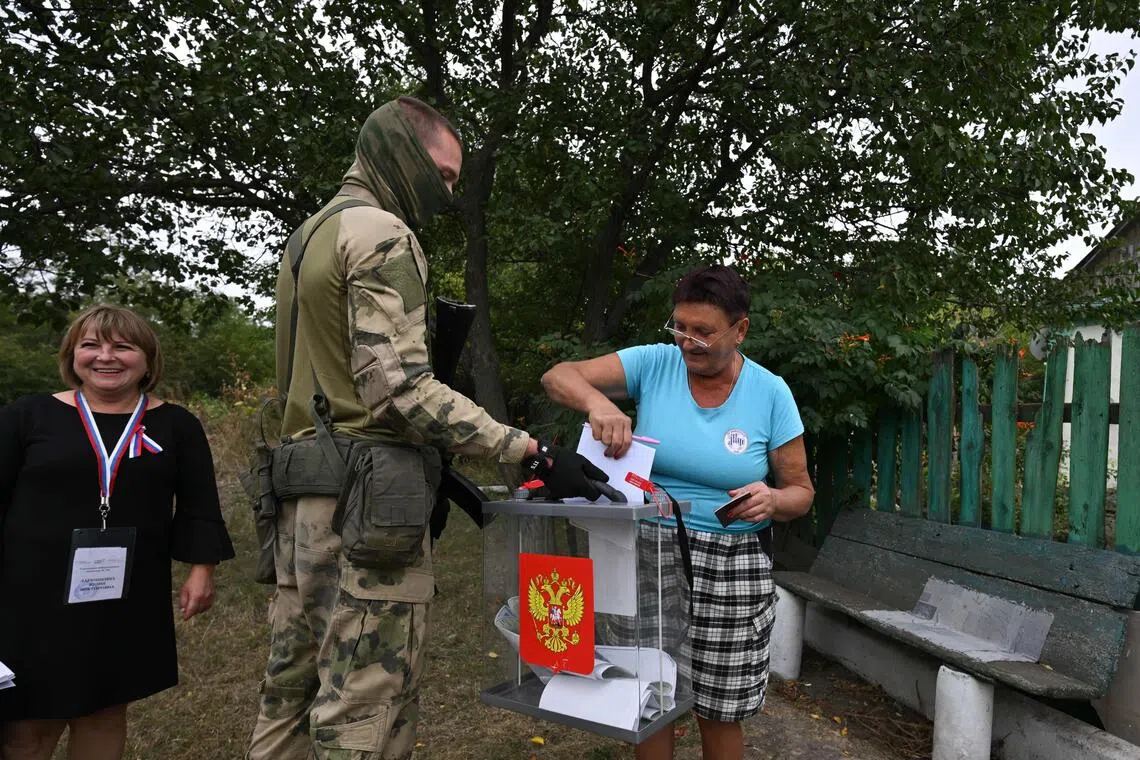
Russia is scheduled to hold tightly controlled parliamentary elections from Sept 18 to Sept 20, 2026, the first nationwide legislative vote since Moscow launched its full-scale offensive against Ukraine in February 2022. The Kremlin is presenting the election as a gauge of public opinion on the war, which has entered its fifth year, while also using it to demonstrate continued public loyalty to President Vladimir Putin and his leadership.
The outcome is expected to be a guaranteed majority for Putin’s United Russia party. Criticism of the war has been banned, opposition figures have been jailed, exiled or killed, and Russia’s only remaining active anti-war party, Yabloko, was barred from participating. The other parties allowed on the national ballot—the Communist Party, A Just Russia, nationalist LDPR and New People—support Putin and the war to varying degrees. Half of the 450 State Duma seats will be allocated through a nationwide party-list vote, while the remainder will be decided in single-member districts. Voting is also planned in areas of Ukraine occupied by Russian forces.
The election is taking place amid economic stagnation, intensified Ukrainian strikes inside Russia, fuel shortages, civilian deaths and widespread war-related repression. Some Russians fear that Putin could order another mass mobilisation after the vote, following the unpopular 2022 call-up of 300,000 reservists. However, expert Tatiana Stanovaya of the Carnegie Russia Eurasia Centre considers a new mobilisation unlikely, arguing that the Kremlin has worked hard to reassure the public.
Although the vote is widely viewed as predetermined, analysts say it remains important to the Kremlin as a ritual of loyalty and a way to reassure political elites that Putin retains popular support. The muted campaign in Moscow and the absence of genuine political choice underscore the election’s controlled nature. The result is therefore expected to provide Putin with another claim to legitimacy for both his presidency and the war.
Entities: Russia, Ukraine, Vladimir Putin, Russian parliamentary elections, Kremlin • Tone: analytical • Sentiment: negative • Intent: inform
15-09-2026
In the lead-up to Russia’s parliamentary elections, residents and businesses in Yaroslavl describe an economy under increasing strain despite visible state-funded redevelopment in the city. The picturesque Volga River tourist hub is benefiting from rebuilding projects, but locals face high inflation, expensive borrowing, fuel shortages, weak consumer spending and difficulties maintaining businesses.
The most immediate problem for employers is a severe labour shortage. Business owners say they have plenty of work but cannot find enough workers, particularly young people willing to take low-status or demanding jobs. Official unemployment is just above 2%, while residents and analysts connect the shortage to demographic decline, falling birth rates and the impact of the war with Ukraine. Some villagers say people are postponing having children because of the conflict and uncertainty.
Households are also struggling. A pensioner supplements her 17,000-rouble pension by selling forest mushrooms, but says consumers are buying fewer because dried mushrooms have become a luxury. Other residents report sharply higher prices for essentials, including sugar needed by a beekeeper to feed his bees through winter. Recent tax increases intended to support military spending have added to the pressure.
Macroeconomic conditions have deteriorated. Growth fell from 4.9% in 2024 to 1% in 2025, the economy contracted slightly in early 2026, and the government now forecasts only 0.6% growth for the year. Inflation remains above 6%, while the central bank’s 14% interest rate makes borrowing punitive.
The article also highlights the war’s direct economic and physical effects. Ukrainian drone attacks have disrupted oil refining, agriculture, tourism, retail and fuel distribution, while sanctions and trade disruptions have raised costs. At a local refinery, shipping containers and metal wires protect infrastructure from drones; nearby, a resident repairs a house damaged by one. Few residents expect the tightly controlled election to change policy, but the Kremlin views it as a measure of public fatigue with the war.
Entities: Yaroslavl, Volga River, Russia, Moscow, Russian parliamentary elections • Tone: analytical • Sentiment: negative • Intent: analyze
15-09-2026
The Kremlin said Russia would continue striking targets across the entirety of Ukraine after Poland reported a rare Russian attack near the two countries’ shared border. Polish authorities said on Sunday that a Russian strike hit a railway locomotive inside Ukraine, approximately two kilometres from the Polish border. The incident was notable because Russian attacks close to Ukraine’s western borders are uncommon, although western Ukrainian regions have previously been targeted.
Responding to questions about the reported strike, Kremlin spokesman Dmitry Peskov emphasized that the location was Ukrainian territory. “If I understand correctly, this is about Ukrainian territory,” Peskov said. He added that Russia’s military was carrying out its assigned tasks throughout Ukraine and would continue doing so.
The report places the incident within the wider Russia-Ukraine war, where attacks near NATO-member Poland raise concerns because of the potential for escalation or accidental spillover into alliance territory. However, the article does not report that the strike crossed into Poland or caused damage there. It states only that the attack occurred inside Ukraine, close to the border.
The report also refers to a separate recent development in which Kyiv said it had struck a crossing at Ukraine’s border with Moldova. The juxtaposition suggests that military activity has continued around Ukraine’s western borders, even as Russia maintains that its operations are directed at targets within Ukraine. Overall, the article presents the Kremlin’s position and Poland’s account of the reported strike without independently verifying the incident or providing details about casualties, damage, or the specific military target beyond the railway locomotive.
Entities: Russia, Ukraine, Poland, Kremlin, NATO • Tone: neutral • Sentiment: negative • Intent: inform
15-09-2026
The provided excerpt from The Washington Post describes a dangerous train journey through Ukraine, traveling west from Kyiv toward the Polish border. The narrator and other passengers initially believed the immediate threat had diminished, but that sense of safety proved premature. During the trip, passengers had already been evacuated twice, indicating that the train’s route remained exposed to serious wartime dangers. Among those aboard was David Petraeus, a former U.S. Army general and CIA director, whose presence underscores the significance and potentially sensitive nature of the journey.
Approximately two hours before the events described, passengers heard a large explosion. Information circulating among them suggested that the blast had struck a nearby gas station. The article’s headline indicates that drones targeted the train, although the supplied excerpt ends before describing the attack itself, the passengers’ response, or the broader consequences. The dateline places the account in Yahodyn, Ukraine, near the country’s border with Poland.
The passage conveys uncertainty, fear, and the persistent danger faced by civilians and prominent travelers moving through Ukraine during the war. It also establishes a first-person, eyewitness perspective: the narrator recounts what passengers thought, what they heard, and how they responded to rapidly changing security conditions. Because only the opening portion of the article was provided, details about the drone strike, damage, injuries, evacuation procedures, and subsequent travel are not available. The excerpt primarily functions as a suspenseful introduction to an on-the-ground account of wartime travel and the continuing threat posed by aerial attacks.
Entities: Jack Wright, David Petraeus, The Washington Post, Yahodyn, Ukraine, Kyiv • Tone: urgent • Sentiment: negative • Intent: inform