15-09-2026
The US Supreme Court has rejected the Trump administration’s request to reinstate a Postal Service rule restricting how mail-in ballots are processed before the November 2026 midterm elections. In an unsigned order, the conservative-majority court declined to lift an injunction issued by US District Judge Indira Talwani, who found that the rule likely violated the Constitution and would be impractical to implement so close to the elections.
The Postal Service adopted the restrictions after President Donald Trump signed an executive order in March seeking tighter controls on mail-in voting. The rule required states to provide the agency with lists of approved ballot recipients and to use Postal Service-approved ballot envelopes. It also permitted the agency to reject ballots that did not meet those standards or were not linked to registered voters on state lists.
The administration had urged the Supreme Court to allow the policy to take effect, describing it as necessary to prevent the mails from being used for voter fraud. The court had temporarily allowed Trump’s executive order to proceed on procedural grounds in August but did not decide whether the policy was legal. In its latest ruling, however, the justices said the administration was unlikely to succeed on the merits.
Justices Samuel Alito and Clarence Thomas dissented. Alito argued that some plaintiffs lacked standing and that the remaining legal challenge resembled a “Hail Mary pass,” a phrase previously used by the court. Justice Brett Kavanaugh, a Trump appointee, joined the majority but indicated he might support the policy later.
Voting-rights critics said the restrictions could delay or prevent the delivery of thousands of ballots and disproportionately affect voters who depend on mail voting, particularly in Democratic-leaning states. Alabama, North Carolina and Wisconsin had already begun sending ballots. The article also notes that Trump has repeatedly promoted debunked claims of widespread mail-in voting fraud, despite voting by mail himself, including in 2024.
Entities: US Supreme Court, Donald Trump, US Postal Service, Indira Talwani, Samuel Alito • Tone: analytical • Sentiment: negative • Intent: inform
15-09-2026
The US Supreme Court has refused to immediately reinstate President Donald Trump’s plan to impose new restrictions on mail-in ballots before the November 2026 midterm elections. The justices upheld a federal judge’s injunction blocking the US Postal Service (USPS) from implementing the requirements, representing a setback for the White House. However, the ruling is preliminary and may not determine the final outcome of the broader legal challenge.
Justice Brett Kavanaugh joined the decision but suggested that he could ultimately support Trump’s position. He wrote that there was “at least a fair prospect” that the USPS had statutory authority to introduce the rules, but concluded that applying them so close to the 2026 elections would be “arbitrary and capricious.” Justices Samuel Alito and Clarence Thomas dissented, arguing that the challenge was unlikely to succeed and that the Postal Service has broad authority over mail regulation.
Trump’s March executive order directed the USPS to deliver ballots only to voters listed as citizens, introduce unique barcodes on ballot envelopes, and require election officials to provide voter information to an online portal. Trump has claimed that mail voting facilitates fraud and allows non-citizens to vote, although the article notes that he has previously made false claims about widespread fraud in the 2020 election and has himself voted by mail.
Twenty-three states and Washington DC, along with the postal workers’ union, challenged the order. Judge Indira Talwani blocked its implementation on 4 September, warning that the changes could disenfranchise voters because they were being introduced shortly before the election. Other courts subsequently ruled against the administration’s efforts to suspend that injunction. The midterm elections will determine control of Congress, and some states have already begun distributing mail ballots. The Supreme Court also ruled in June that states may count ballots postmarked by Election Day even when they arrive afterward.
Entities: Donald Trump, US Supreme Court, US Postal Service (USPS), Brett Kavanaugh, Samuel Alito • Tone: analytical • Sentiment: negative • Intent: inform
15-09-2026
The US Supreme Court denied President Donald Trump’s request to reinstate restrictions on mail-in voting before the November midterm elections. Trump had asked the justices to overturn a lower-court order blocking his proposed changes. In a concurring opinion, conservative Justice Brett Kavanaugh said the plan might ultimately be found legal, but state and local election officials lacked enough time to implement it reasonably before voting began. Justices Samuel Alito and Clarence Thomas dissented.
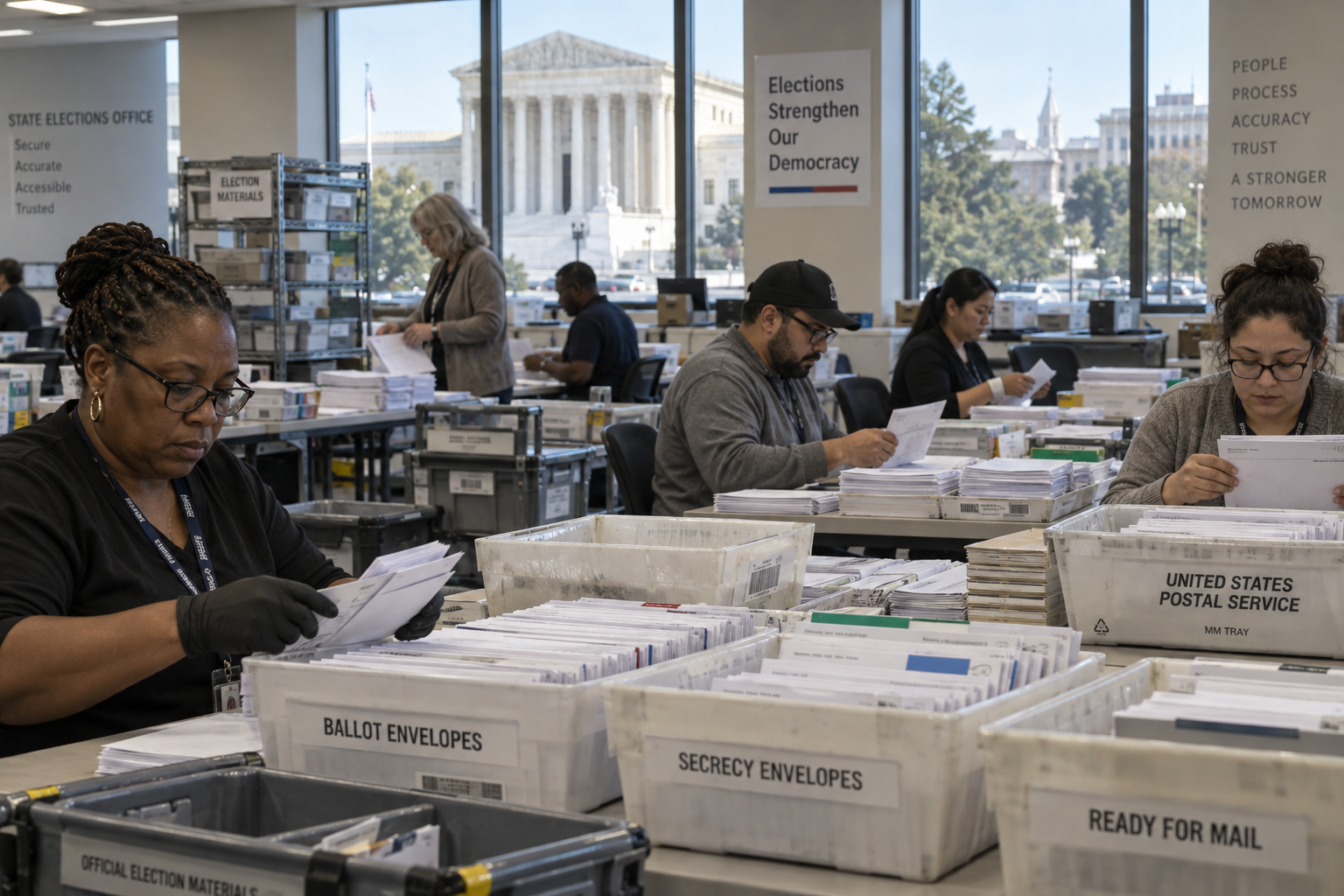
The ruling allows states to continue distributing mail ballots under the procedures they have used for years. The case was considered consequential because nearly one-third of Americans vote by mail. Trump’s proposal would have required states to use a uniform envelope design and provide the US Postal Service with lists of mail-ballot recipients. The Postal Service could then have refused to deliver ballots that did not meet the new requirements. A whistleblower report warned that the system might malfunction and prevent millions of ballots from being sent. Critics said the changes could disrupt the delivery of legitimate ballots, particularly because several states had already begun mailing them.
Democratic state officials and voting-rights organizations challenged the policy, arguing that the president lacked constitutional authority to establish federal election rules so close to an election. Trump had claimed mail voting was vulnerable to fraud, though the article says he provided no evidence. He has also used mail voting himself and falsely blamed it for his 2020 defeat by Joe Biden. Because Democratic voters are more likely to vote by mail, surveys suggested that the restrictions could benefit Republicans during a closely contested election.
California Governor Gavin Newsom, the American Civil Liberties Union, and Senate Democratic Leader Chuck Schumer welcomed the ruling. Their statements portrayed the decision as a protection for voting rights, constitutional limits, and election administration.
Entities: US Supreme Court, Donald Trump, Brett Kavanaugh, Samuel Alito, Clarence Thomas • Tone: analytical • Sentiment: neutral • Intent: inform
15-09-2026
The US Supreme Court has rejected the Trump administration’s attempt to impose new restrictions on mail-in ballots before the 2026 midterm elections. The emergency decision allows states to continue using their existing mail-voting procedures, which have accounted for nearly one-third of votes cast and were already being used as ballots were sent to voters. The court did not fully explain its reasoning, but the majority indicated that the administration’s restrictions would probably fail in court. Justices Samuel Alito and Clarence Thomas dissented. Justice Brett Kavanaugh agreed that the rules should not apply to the upcoming midterms but suggested he might support the administration in a future case.
The proposed rules would have required states to use a uniform envelope design and submit lists of eligible voters through an online portal. The Postal Service could have refused to deliver ballots from states that did not comply. Officials warned that implementing the changes only weeks before the election would be impractical, particularly in states that conduct much of their voting by mail. A whistleblower also warned that technical problems with the portal could cause entire batches of ballots to be discarded because of a single barcode error.
Democratic state officials and voting-rights organizations challenged the restrictions, arguing that the president lacks constitutional authority to impose election rules and that the changes could effectively eliminate mail voting shortly before a major election. Lower courts blocked the plan, and the Supreme Court’s decision prevents it from taking effect for the midterms. Officials in Washington, Arizona and Utah welcomed the ruling, saying it would allow election preparations to continue without disruption. The White House and Justice Department did not immediately comment, but the administration has described the measures as commonsense election-security reforms. The ruling represents a significant legal and political setback for Trump, who has repeatedly criticized mail voting despite using it himself and despite the lack of substantial evidence of widespread fraud.
Entities: US Supreme Court, Donald Trump, 2026 US midterm elections, mail-in voting, US Postal Service • Tone: analytical • Sentiment: neutral • Intent: inform
15-09-2026
The US Supreme Court has rejected President Donald Trump’s attempt to impose new restrictions on mail-in voting ahead of the November 2026 midterm elections. The decision allows states to continue using their existing procedures for distributing and processing mail ballots, which have accounted for nearly one-third of votes cast and were already being sent in several states.
The administration’s plan would have required states to use a standardized ballot-envelope format and upload lists of eligible voters to an online federal portal. The Postal Service could have refused to deliver ballots from states that failed to comply. Election officials and voting-rights advocates argued that the changes were unconstitutional, impractical, and likely to disrupt voting because they were proposed only weeks before the election. A whistleblower report also warned that flaws in the portal could result in millions of ballots not being sent, with a single barcode error potentially invalidating an entire batch.
The Supreme Court issued a brief emergency-order ruling without explaining its reasoning. Justices Samuel Alito and Clarence Thomas dissented, while Justice Brett Kavanaugh agreed that the restrictions should not take effect for the midterms but suggested he could support the administration in a future case.
Lower courts had already blocked the plan, and states including Alabama, North Carolina, and Wisconsin had begun distributing ballots under their existing systems. The changes posed particular risks to Washington and Oregon, where voting is conducted almost entirely by mail. Officials in Washington and Colorado welcomed the ruling as a defense of established election procedures and American democracy.
The decision represents a significant setback for Trump, who has long opposed mail voting and has falsely attributed his 2020 defeat to mail ballots despite the lack of substantial evidence of widespread fraud. The White House had not immediately commented on the ruling.
Entities: US Supreme Court, Donald Trump, Mail ballots, 2026 US midterm elections, US Postal Service • Tone: analytical • Sentiment: negative • Intent: inform
15-09-2026
The article reports that the US Supreme Court has rejected President Donald Trump’s attempt to impose new restrictions on mail ballots ahead of the 2026 midterm elections. The brief order allows states to continue using their existing procedures for sending and processing mail ballots, despite a last-minute legal challenge from the Trump administration. Voting is already under way, making the timing of the ruling particularly significant.
The administration had asked the Supreme Court to clear the way for restrictions before the November elections, which will determine control of Congress. The case placed the court at the centre of another major political controversy involving election rules and access to voting. Its importance is amplified by the fact that nearly one-third of US voters cast their ballots by mail.
Justices Samuel Alito and Clarence Thomas publicly dissented from the decision. The article does not provide details about the legal reasoning behind the majority’s brief order, nor does it specify the precise restrictions sought by the administration. Instead, it focuses on the immediate practical effect: states may continue distributing mail ballots under procedures they have used for years.
The ruling represents a setback for Trump’s effort to change mail-voting rules before the midterms. It also preserves the existing voting framework while election activity is already in progress. Because mail voting is used by a substantial portion of the electorate, the decision could have broad implications for the administration of the upcoming congressional elections and for the continuing political debate over election procedures in the United States.
Entities: United States, US Supreme Court, Donald Trump, Trump administration, Samuel Alito • Tone: neutral • Sentiment: neutral • Intent: inform