15-09-2026
Oil prices extended their gains on Tuesday as escalating conflict involving Iran, the United States, Yemen’s Houthi movement, and Saudi Arabia raised concerns about further disruptions to global crude supplies. Brent crude futures for November delivery rose 1.28% to $107.03 per barrel, while U.S. West Texas Intermediate futures for October gained 1.50% to $102.91.
The market was already tight after Saudi Arabia closed its East-West pipeline, which normally allows oil to bypass the Strait of Hormuz. The closure followed drone damage to the pipeline attributed to launches from Iraq, increasing pressure on supplies as tensions continued across the Gulf region. The Saudi-led coalition in Yemen reportedly said that 13 civilians were injured in a wave of Houthi ballistic-missile and drone attacks on Saudi Arabia.
Iran also said its military had destroyed an advanced U.S. drone over the Strait of Hormuz, following other operations targeting American unmanned naval systems. U.S. President Donald Trump said the United States could continue its campaign against Iran and potentially take control of Iranian oil, adding to fears of a broader confrontation.
The United States and Iran also disputed the circumstances surrounding the Panama-flagged oil tanker El Gaia. Iran’s Islamic Revolutionary Guard Corps claimed that the vessel had struck a naval mine, but U.S. Central Command said the tanker had instead been hit by an Iranian missile the previous month and rendered inoperable. CENTCOM described Iran’s account as an attempt to intimidate commercial shipping.
Economist Komal Sri-Kumar warned that attacks on oil infrastructure and the closure of Saudi Arabia’s pipeline could push inflation higher. He also said an accelerating tariff war could add further upward pressure to prices and bond yields.
Entities: Brent crude, West Texas Intermediate (WTI), Saudi Arabia, East-West pipeline, Strait of Hormuz • Tone: urgent • Sentiment: negative • Intent: inform
15-09-2026
The France 24 liveblog reports that a series of Houthi attacks using ballistic missiles and drones wounded 13 civilians in southern Saudi Arabia on September 15, 2026. The incidents occurred amid a broader escalation involving Yemen’s Houthi movement, Saudi Arabia, Iran and the United States. The Houthis are described as Iran-backed forces, while Saudi Arabia reportedly responded to attacks on military facilities in the kingdom with dozens of airstrikes in western Yemen.
The article also highlights a reported assessment by the US Department of Defense’s inspector general that the United States is experiencing an ammunition shortfall because of the costly war in Iran. The report places this development within the wider context of the ongoing Middle East conflict and the military demands associated with it.
The liveblog’s recap of the previous day includes several significant diplomatic and military developments. US President Donald Trump said he was willing to negotiate with Iran, reversing or softening his earlier position that it was too soon to pursue a deal with Tehran to end the war. Saudi Arabia also requested that a meeting between Tehran and Gulf countries on the Strait of Hormuz be postponed. The meeting had been scheduled to take place in Oman.
The available material is a brief opening update rather than a complete liveblog, and the webpage subsequently indicates that the requested content is unavailable. It does not provide further details about the casualties, the precise locations of the attacks, the extent of damage, or the US ammunition shortage. The report credits France 24 along with Reuters, the Associated Press and Agence France-Presse for its updates.
Entities: Houthi armed forces, Yemen, Saudi Arabia, Iran, United States • Tone: urgent • Sentiment: negative • Intent: inform
15-09-2026
Saudi Arabia has warned that it will respond “firmly” to a series of Houthi missile and drone attacks that wounded 13 civilians in the kingdom’s southern regions. The Houthi movement claimed it launched a large-scale assault involving dozens of ballistic missiles and drones against the King Khalid airbase in Khamis Mushait. Saudi authorities also reported attacks on Abha and Taif, while air-raid alerts were issued in six regions. The Saudi-led coalition said it had conducted more than 50 retaliatory strikes in Yemen.
The attacks follow a major escalation in Yemen’s civil war. The Houthis have renewed fighting with Saudi-backed government forces since July, declared a maritime blockade on Saudi Arabia, and targeted shipping in the Red Sea. The group reportedly seized Yemen’s Red Sea coast and the Bab al-Mandab Strait, a strategically important waterway whose significance has increased as the wider US-Iran conflict disrupts traffic through the Strait of Hormuz. Houthi attacks on Saudi oil infrastructure have also contributed to crude prices rising above US$100 a barrel.
The conflict has caused further casualties and displacement. Eight government soldiers were reportedly killed in western Yemen, while government forces said they recaptured positions in Taiz and killed at least 10 Houthi fighters. The UN’s migration agency said renewed fighting had forced 93,864 people from their homes.
The escalation is occurring amid stalled regional diplomacy. A planned Gulf states-Iran meeting about the future of the Strait of Hormuz was postponed, with Tehran accusing Riyadh of using Yemen as a pretext. Iran says the Houthis act independently, although it has long supported them with weapons and technology. US President Donald Trump said he remained open to talks with Iran, but Iranian officials rejected negotiations until their conditions are met. Saudi Crown Prince Mohammed bin Salman also held discussions with senior Egyptian and US military officials about regional developments.
Entities: Saudi Arabia, Houthi movement, Yemen civil war, Saudi-led coalition, Khamis Mushait • Tone: urgent • Sentiment: negative • Intent: inform
15-09-2026
The article reports a sharp escalation in the Yemen conflict, with Iran-aligned Houthi forces claiming to have launched dozens of missiles and drones at a Saudi military airbase in Khamis Mushait, near the Yemen border. The Houthis said the attack struck aircraft hangars, radar systems, runways and ammunition depots, describing it as retaliation for hundreds of Saudi airstrikes on Yemen in recent days. Saudi authorities issued emergency alerts in several southern cities that have previously been targeted by Houthi attacks.
The latest violence follows a Houthi advance in Yemen that culminated in the seizure of an island at the entrance to the Red Sea. A separate attack, blamed by Riyadh on Iran-backed fighters in Iraq, damaged Saudi Arabia’s east-west oil pipeline. The pipeline is a major route for transporting oil while bypassing the Strait of Hormuz, and its closure reportedly pushed crude prices up by more than 3%. Traders warned that as much as 4% of global oil supply could be affected if the pipeline is not reopened quickly. Diesel prices in the United States also reached a record level.
A planned meeting between Iran and Gulf states in Oman, focused on reopening the Strait of Hormuz, was postponed. Oman cited the need for consensus, while Iran said Saudi Arabia had requested the delay. Iran separately listed 77 ships accused of violating its rules for operating in the strait and threatened restrictions on their future passage.
The conflict presents a dilemma for the United States, which faces pressure to support Saudi Arabia but is reluctant to expand the war. Washington has reportedly rejected Saudi Crown Prince Mohammed bin Salman’s requests for intervention, while President Donald Trump confirmed speaking with him. The article also highlights the humanitarian consequences for civilians near Taiz. Separately, Saudi Arabia announced the discovery of 110 million tonnes of raw materials containing uranium concentrations in Medina.
Entities: Yemen’s Houthis, Saudi Arabia, Iran, Khamis Mushait, Saudi military airbase • Tone: urgent • Sentiment: negative • Intent: inform
15-09-2026
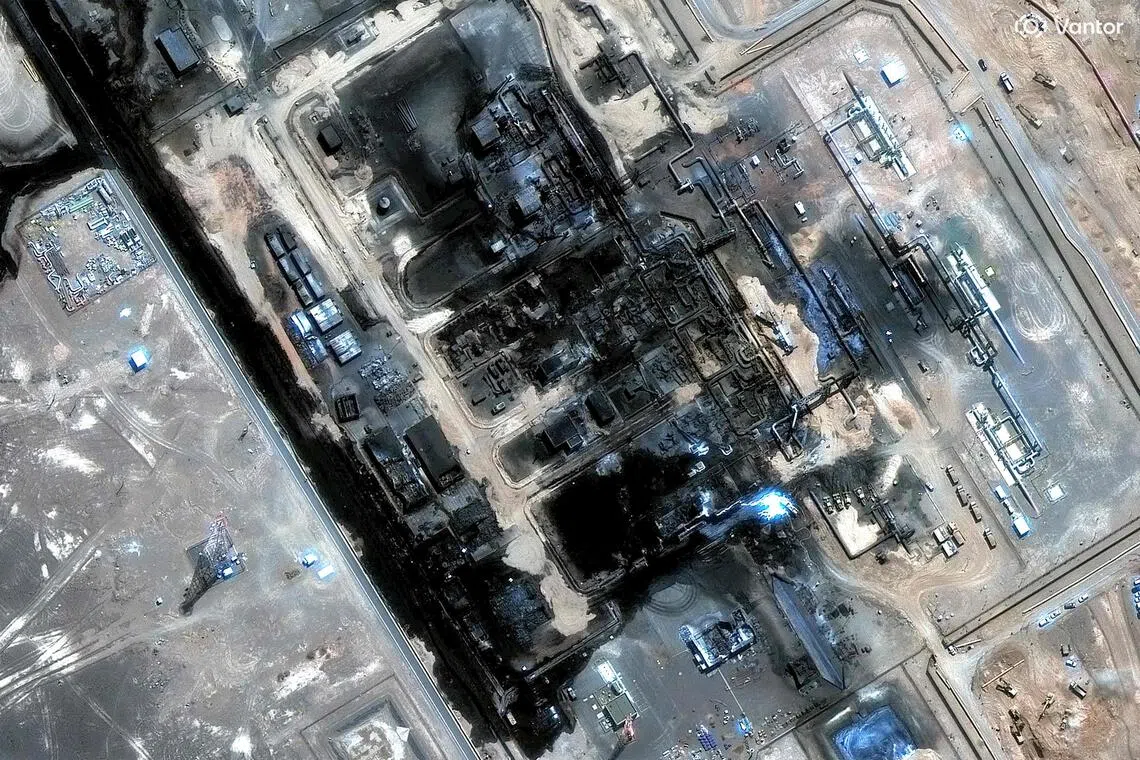
The supplied extract is a live-news page from The National covering the latest developments in the Iran war and its wider regional consequences. It does not include the full narrative article body; instead, it contains the headline, update summaries and related video headlines. The main development is an exchange of fire between Saudi Arabia and the Houthis. The Houthis claim to have attacked Saudi military facilities after hundreds of Saudi-led air strikes in Yemen, while another update reports that a Houthi projectile struck Saudi Arabia’s Jazan region. Saudi Arabia has reportedly shut a pipeline amid the attacks, pushing oil prices close to $108 per barrel. Satellite imagery is said to show damage to the East-West pumping station, highlighting the potential impact on energy infrastructure and global markets. The page also reports that the Saudi Crown Prince and the head of US Central Command discussed regional developments. Other updates describe Israeli strikes on a town in southern Lebanon that killed 13 people and an Israeli strike on a residential area in Gaza. The humanitarian consequences include Djibouti receiving approximately 1,400 refugees from Yemen. A separate report says an Iranian attack left a hole in a tanker off the Iraqi coast. Related videos focus on US and Gulf resilience, allegations that the Houthis may use artificial intelligence in weapons development, and comments by Donald Trump and Pete Hegseth condemning Iran. Trump is also quoted as saying he has no regrets about the Iran action and predicting that the war will end after the US midterm elections. Because the supplied material is primarily a collection of headlines, it provides limited detail about the chronology, evidence or official responses behind each development.
Entities: Iran war, Saudi Arabia, Houthis, Yemen, Saudi Crown Prince • Tone: urgent • Sentiment: negative • Intent: inform