06-10-2026
Belgian physicist Francis Halzen has won the 2026 Nobel Prize in Physics for his contributions to the IceCube Neutrino Observatory at the South Pole and his discovery of high-energy neutrinos originating in space. Halzen, 82, is affiliated with the University of Wisconsin–Madison. The Royal Swedish Academy of Sciences recognised his scientific vision and leadership in developing the observatory, a cubic kilometre of Antarctic ice fitted with light sensors that enables researchers to detect neutrinos—rare subatomic particles produced by extremely energetic processes in the distant universe. Academy and Nobel Committee representatives described the particles as “ghostly messengers from space” and highlighted the observatory’s unusual setting and role in detecting them. Halzen said by telephone that the award came as a surprise and that he was pleased to hear the news. The prize is worth 12 million Swedish kronor, or about $1.718 million, whether awarded to an individual, a group, or an organisation. The article places the announcement within Nobel week: the medicine prize had already been awarded to three scientists for work involving a light-based tool to help unravel how the brain works, while the chemistry and literature prizes were still to come. The Nobel Peace Prize was scheduled to be announced on Friday, local time. The report also recalls that the previous year’s physics prize went to three scientists for research on quantum tunnelling, which enabled ultra-sensitive measurements used in MRI machines and helped lay groundwork for improved cellphones and faster computers.
Entities: Francis Halzen, IceCube Neutrino Observatory, Nobel Prize in Physics, Royal Swedish Academy of Sciences, Ellen Moons • Tone: neutral • Sentiment: neutral • Intent: inform
06-10-2026
Belgian physicist Francis Halzen has received the 2026 Nobel Prize in Physics for his central role in creating the IceCube Neutrino Observatory in Antarctica. The Royal Swedish Academy of Sciences announced the award in Stockholm, recognizing work that has enabled scientists to detect neutrinos—tiny, electrically neutral particles that pass through matter with almost no interaction. The observatory uses sensors buried in the clear ice beneath the South Pole to record brief flashes of light produced when a neutrino occasionally strikes an atomic nucleus.
Halzen first proposed the IceCube project in 1988. The neutrinos detected there can help researchers investigate the origins of high-energy particles and study distant cosmic events, including exploding stars and the formation of galaxies. Nobel Committee member Eva Olsson described the particles as messengers carrying information from the cosmos, while researcher Eva Lindroth said neutrinos offer scientists a way to study sources and processes that cannot be examined by other means.
Halzen, 82, said he was surprised by the award, despite earlier predictions that he might win. He also joked that he was working on a proposal and hoped the prize would help secure its approval. Physics Today editor-in-chief Richard Fitzgerald acknowledged that hundreds of people helped build IceCube, while emphasizing Halzen’s role in initiating the effort.
The article places the award within the week’s Nobel announcements: the previous year’s physics prize went to John Clarke, Michel Devoret and John Martinis, and the 2026 medicine prize had been awarded to two American scientists. The Chemistry Prize was scheduled to be announced the following Wednesday. Nobel laureates are due to receive their awards at a December 10 ceremony, the anniversary of Alfred Nobel’s death, attended by members of the Swedish and Norwegian royal families.
Entities: Francis Halzen, IceCube Neutrino Observatory, 2026 Nobel Prize in Physics, Royal Swedish Academy of Sciences, Stockholm • Tone: analytical • Sentiment: positive • Intent: inform
06-10-2026
Belgian-born physicist Francis Halzen has won the 2026 Nobel Prize in Physics for his pioneering role in developing the IceCube Neutrino Observatory at the South Pole. The observatory uses thousands of light sensors embedded in a cubic kilometre of Antarctic ice to detect high-energy neutrinos arriving from distant cosmic events. The Royal Swedish Academy of Sciences credited Halzen’s vision and scientific leadership as fundamental to the project. Halzen first proposed detecting neutrinos at the South Pole in 1988. Now a US citizen and professor at the University of Wisconsin–Madison, he said he was surprised that the ambitious idea worked so well, noting that few people—including himself—expected it to succeed.
Neutrinos are subatomic particles that rarely interact with matter. Billions from the Sun pass through a fingernail-sized area every second, but IceCube focuses on much higher-energy neutrinos produced by violent processes beyond the Solar System. When a neutrino occasionally interacts with an atomic nucleus in the ice, it creates charged particles that emit a faint blue light. Sensors record the light’s pattern and timing, helping researchers infer the neutrino’s direction and energy, and trace it to its source.
Because neutrinos can pass through dense regions that block ordinary light and are not deflected by magnetic fields, they provide a distinctive way to study otherwise difficult-to-observe cosmic environments. Their signals can help scientists investigate events such as exploding stars and the regions around giant black holes. Nobel Committee chair Mark Pearce praised IceCube as a remarkable instrument and said Halzen’s persistence had enabled a new kind of astronomy. Other scientists also highlighted how the observatory has opened a new window on energetic and mysterious processes in the universe.
Entities: Francis Halzen, IceCube Neutrino Observatory, 2026 Nobel Prize in Physics, South Pole, Antarctica • Tone: analytical • Sentiment: positive • Intent: inform
06-10-2026
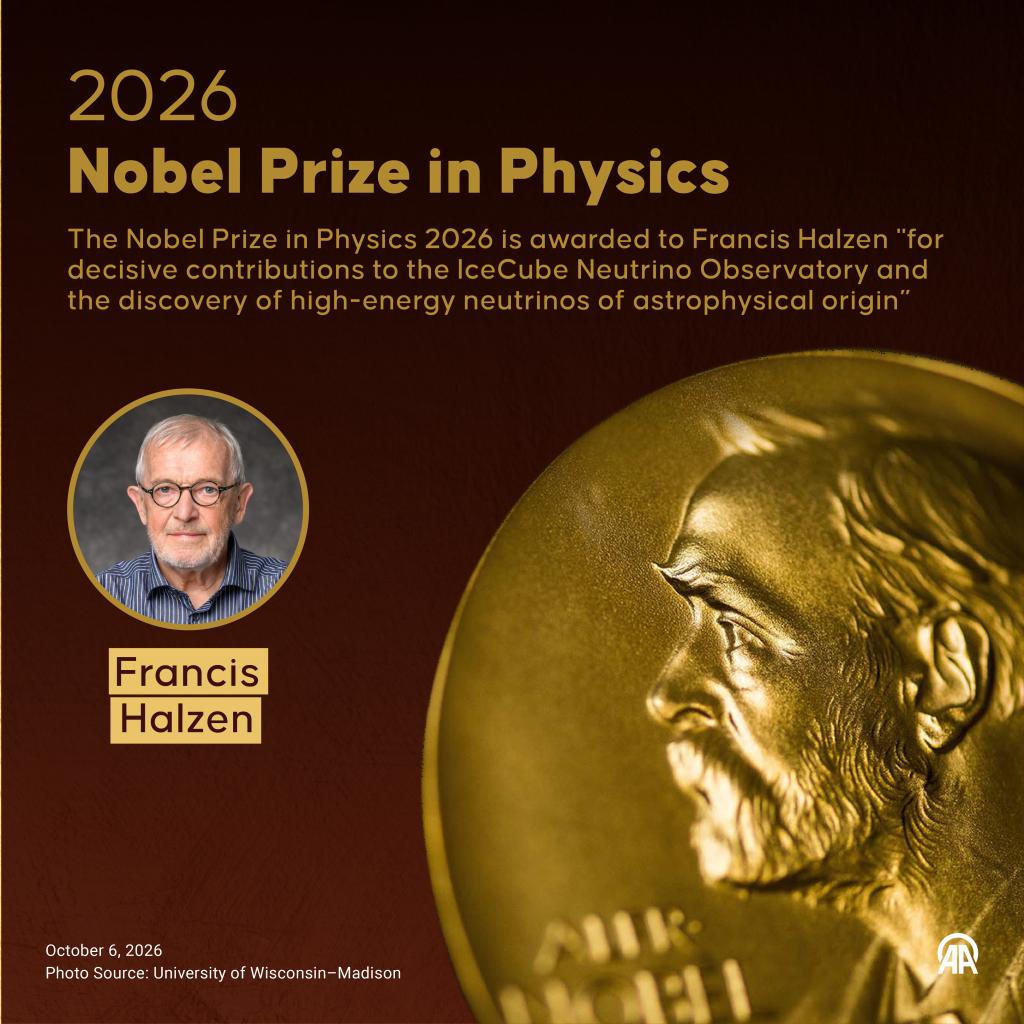
Belgian-American physicist Francis Halzen, 82, has been awarded the 2026 Nobel Prize in Physics for his decisive contributions to the IceCube Neutrino Observatory and the discovery of high-energy neutrinos from astrophysical sources. The Royal Swedish Academy of Sciences announced the award in Stockholm. Halzen, affiliated for decades with the University of Wisconsin–Madison, developed the idea that South Pole ice could be used to detect neutrinos, elusive particles that rarely interact with matter and can pass through Earth and human bodies almost unnoticed.
IceCube is situated at the Amundsen–Scott South Pole Station in Antarctica. Covering a cubic kilometre, it began operating in 2011 after a project envisioned in the late 1980s. Rather than observing neutrinos directly, scientists detect the flashes of light or charged particles produced when neutrinos collide with matter. High-energy neutrinos can serve as cosmic messengers, providing information about distant galaxies and events such as exploding stars, as well as clues to the universe’s evolution.
Halzen told the academy by phone that he was delighted and surprised by the news while attending a conference in Italy. Nobel Committee for Physics chair Mark Pearce credited Halzen’s persistence and scientific vision, saying the instrument he helped create has enabled a new kind of astronomy. The prize is worth 12 million Swedish crowns, or about $1.7 million Canadian.
The article also notes that Canadian scientist Arthur McDonald shared the 2015 Nobel Prize in Physics for work on neutrino oscillations. It outlines the schedule for the other 2026 Nobel announcements and explains that the prizes were established under Alfred Nobel’s will. An earlier version of the report misstated McDonald’s first name; CBC says the article was corrected.
Entities: Francis Halzen, IceCube Neutrino Observatory, 2026 Nobel Prize in Physics, Amundsen–Scott South Pole Station, Antarctica • Tone: analytical • Sentiment: positive • Intent: inform
06-10-2026
The Royal Swedish Academy of Sciences has awarded the Nobel Prize in Physics to Francis Halzen for his decisive contributions to the IceCube Neutrino Observatory and the discovery of high-energy neutrinos originating in space. The academy described neutrinos as “ghostly messengers from space.” Halzen, an 82-year-old Belgian-born physics professor at the University of Wisconsin–Madison, said he was surprised by the award and thanked the many people who contributed to the project. He characterized the research as a long adventure whose success was uncertain, and hoped the prize would recognize the courageous people who supported the idea. Belgium’s Prime Minister Bart De Wever congratulated him, noting that Halzen is the 11th Belgian Nobel laureate and the second Belgian to receive the physics prize.
Neutrinos are extremely light particles that are widespread in the universe; trillions pass through the human body every second. Because they cannot be observed directly, researchers detect them through interactions with other matter. Halzen’s proposal to capture neutrinos at the South Pole dates to the 1980s. The IceCube observatory was later constructed in Antarctica to detect and study them. Its researchers use neutrinos as clues—or “fingerprints”—to investigate the cosmic sources that produce them. The collaboration includes about 450 physicists from 58 institutions in 14 countries and studies questions including dark matter and neutrino properties.
The article also places the award in the context of Nobel announcements that week. It says the physics prize had been awarded 119 times to 230 laureates between 1901 and 2025, and notes that the previous year’s prize recognized research on quantum tunneling. The medicine prize had also been announced that week, for work on optogenetics and the brain. Chemistry, literature, and peace laureates were still to be named. The prizes were scheduled to be presented on December 10, with prize money of 12 million Swedish kronor, approximately $1.2 million or €1 million, for an individual, group, or organization.
Entities: Francis Halzen, Royal Swedish Academy of Sciences, Nobel Prize in Physics, IceCube Neutrino Observatory, neutrinos • Tone: neutral • Sentiment: positive • Intent: inform
06-10-2026
Francis Halzen, an 82-year-old Belgian-born scientist affiliated with the University of Wisconsin–Madison, won the Nobel Prize in Physics for work that helped reveal how neutrinos can provide information about the universe. The Nobel Committee credited his efforts with helping bring about the IceCube Neutrino Observatory in Antarctica, which uses South Pole ice to detect signals produced when neutrinos interact with matter. Committee member Eva Olsson said the particles act as messengers from distant parts of the cosmos, helping researchers study phenomena such as exploding stars and the evolution of the universe.
Speaking by phone from Italy during the announcement, Halzen said the award came as a surprise. He joked that he hoped the prize might help secure approval for a proposal he is working on. The article describes neutrinos as extremely light particles produced by stars, with trillions passing through the human body every second. Because scientists cannot observe them directly, they detect flashes of light or charged particles created when neutrinos collide with other matter. Halzen’s work advanced the use of these rare cosmic neutrinos for astronomy, a development described by the American Institute of Physics’ chief executive as a revolutionary way to understand the universe.
Belgian Prime Minister Bart De Wever congratulated Halzen, calling the award recognition of a lifetime spent exploring cosmic mysteries. Halzen is the 11th Belgian Nobel laureate, according to De Wever. The prize, announced in Stockholm by Royal Swedish Academy of Sciences secretary-general Ellen Moons, carries 12 million Swedish kronor—about US$1.2 million—whether awarded to an individual, group or organization. The article also places the announcement within the week’s Nobel schedule, following the medicine prize and preceding awards in chemistry, literature, peace and economics.
Entities: Francis Halzen, Nobel Prize in Physics, Neutrinos, IceCube Neutrino Observatory, Antarctica • Tone: neutral • Sentiment: positive • Intent: inform
06-10-2026
Francis Halzen, an 82-year-old Belgian-born scientist affiliated with the University of Wisconsin–Madison, has won the Nobel Prize in Physics for his contributions to the IceCube Neutrino Observatory and the discovery of high-energy neutrinos originating in space. The observatory, located at the South Pole in Antarctica, is led by the university. Halzen’s work on detecting neutrinos there began in the 1980s.
Nobel Committee for Physics chair Mark Pearce praised Halzen for leading an international team of researchers and engineers and for helping create an instrument that opened a new kind of astronomy. Speaking by phone to the committee from Italy, Halzen said the award was a great surprise, even though he had heard predictions that he might win.
Neutrinos are extremely light particles produced by sources including the sun, and trillions pass through the human body every second. Because they cannot be observed directly, scientists detect the flashes of light or charged particles created when neutrinos collide with matter. The high-energy neutrinos studied by Halzen are considered cosmic messengers that can provide clues about the evolution of the universe.
The Royal Swedish Academy of Sciences announced the award in Stockholm. This year’s prize is worth 12 million Swedish kronor, about $1.2 million, whether awarded to an individual, a small group, or an organization. The article also places the announcement within the week’s Nobel schedule: the medicine prize had already been awarded, chemistry and literature were next, followed by the peace prize and the economics prize. The previous year’s physics award recognized research into quantum tunneling and its role in sensitive measurements and technologies.
Entities: Francis Halzen, Nobel Prize in Physics, IceCube Neutrino Observatory, University of Wisconsin–Madison, Mark Pearce • Tone: neutral • Sentiment: neutral • Intent: inform
06-10-2026
Francis Halzen, an 82-year-old Belgian-American particle physicist affiliated with the University of Wisconsin–Madison, has won the 2026 Nobel Prize in Physics. The Nobel Committee recognized his contributions to the IceCube Neutrino Observatory and his discovery of high-energy neutrinos of astrophysical origin. Committee chair Mark Pearce praised Halzen’s leadership of an international team of researchers and engineers, saying the observatory opened a new kind of astronomy.
Halzen said he was surprised by the award, despite predictions that he might win. Speaking by phone from Italy during the announcement, he joked that the prize might help secure approval for a proposal he is working on. The article notes that his research on detecting neutrinos at the South Pole dates to the 1980s.
IceCube is located at the South Pole in Antarctica, with the University of Wisconsin–Madison as its lead institution. Neutrinos are extremely low-mass particles produced by sources including the Sun; trillions pass through the human body every second. Because they are difficult to detect directly, scientists study the flashes of light or charged particles generated when neutrinos collide with matter. The high-energy neutrinos investigated by Halzen are regarded as cosmic messengers that can provide clues about the universe’s evolution.
The article reports that this year’s Nobel Prize carries 12 million Swedish kronor, approximately $1.2 million. It also places the physics award within the wider Nobel announcements: the medicine prize was announced Monday, chemistry and literature were scheduled for Wednesday and Thursday, the peace prize for Friday, and the economics prize for the following Monday. Last year’s physics laureates were recognized for work on quantum tunneling and its contributions to sensitive measurements and technologies.
Entities: Francis Halzen, 2026 Nobel Prize in Physics, IceCube Neutrino Observatory, high-energy astrophysical neutrinos, University of Wisconsin–Madison • Tone: analytical • Sentiment: neutral • Intent: inform
06-10-2026
Belgian-American particle physicist Francis Halzen has won the 2026 Nobel Prize in Physics for his work developing an observatory capable of detecting high-energy neutrinos of astrophysical origin. The award recognizes both the creation of the observatory and efforts to understand how these elusive particles are produced. Halzen, 82, recognized that Antarctic ice at the South Pole could serve as a detector for neutrinos, which are often called “ghost particles” because they pass through matter, including the Earth and human bodies, with almost no interaction. The article describes how observations from the IceCube observatory in Antarctica capture neutrino interactions and provide clues about the origins of high-energy neutrinos. According to the Royal Swedish Academy of Sciences, these particles act as messengers from the cosmos, carrying information from distant galaxies and processes such as exploding stars. The academy said IceCube’s findings could also help reveal phenomena not yet known to science. A statement by academy representative Eva Olsson emphasized the observatory’s potential to open new avenues for learning about the universe. The report presents the Nobel award as recognition of Halzen’s contribution to an emerging way of studying cosmic events through neutrinos.
Entities: Francis Halzen, 2026 Nobel Prize in Physics, Belgian-American particle physics, high-energy neutrinos, astrophysical origin • Tone: neutral • Sentiment: positive • Intent: inform
06-10-2026
Belgian physicist Francis Halzen won the 2026 Nobel Prize in Physics for decisive contributions to the IceCube Neutrino Observatory and the discovery of high-energy neutrinos originating in space. The Royal Swedish Academy of Sciences described the award as recognition of work that has opened a new kind of astronomy by using a cubic kilometre of Antarctic ice fitted with light sensors to detect neutrinos from energetic processes in the distant universe.
Neutrinos are rare subatomic particles that can travel to Earth without changing direction or losing energy. This allows them to carry information about cosmic events that other particles cannot provide. Because high-energy cosmic neutrinos are so rare, researchers need an enormous volume of ice to detect enough particle collisions. Halzen first proposed the observatory in 1988; early tests followed within a few years, and the facility was completed in 2011.
Halzen, 82, was born in Tienen, Belgium, and is a professor at the University of Wisconsin-Madison and a US citizen. He said the prize came as a surprise and expressed pleasure at receiving it. He also said he hoped the recognition would reflect the contributions of the people who joined the project in its early days.
The article places the physics award within the wider 2026 Nobel season. It notes that the medicine prize had gone to Karl Deisseroth, Peter Hegemann and Georg Nagel for work in optogenetics, which uses light to control nerve signals. It also recalls the 2025 physics prize, outlines the upcoming chemistry, literature, peace and economics announcements, and reports that Donald Trump had lobbied for the 2025 peace prize. The Nobel awards consist of a diploma, gold medal and 12 million kronor, shared when there is more than one laureate. The winners are to receive their awards at a ceremony on December 10, the anniversary of Alfred Nobel’s death.
Entities: Francis Halzen, Nobel Prize in Physics (2026), IceCube Neutrino Observatory, High-energy astrophysical neutrinos, South Pole • Tone: neutral • Sentiment: neutral • Intent: inform