06-10-2026
Tens of thousands of students, teachers and parents demonstrated across France in the largest day of protests so far over underfunded, understaffed and deteriorating schools. The movement began with school protests in the Paris region in mid-September and has expanded nationally, putting pressure on the government of outgoing President Emmanuel Macron during the early stages of the presidential election campaign. Demonstrations in Marseille and Nantes were largely peaceful, while protests in Strasbourg, Lyon and Rennes included fires, thrown projectiles and clashes in which police used tear gas. The Interior Ministry estimated that 86,000 people joined demonstrations outside Paris on Tuesday morning, with more expected in the capital. Unions said more than half of the country’s high schools were blockaded or closed, and the Education Ministry reported that classes were fully or partly suspended at 891 schools. The protests have followed more than two weeks of class boycotts and blockades; police operations have led to more than 6,100 arrests, mostly of minors. Authorities have also faced criticism over the use of riot-control weapons. A 15-year-old boy lost a hand in an incident involving a police stun grenade, while Interior Minister Laurent Nunez defended police conduct as proportionate in almost all cases and said 715 officers had been injured. The government has begun closing schools amid damage and injuries, and the Education Ministry has opened an online portal for students to report problems and propose changes. Students’ complaints include shortages of staff and basic classroom equipment, poor building conditions, high workloads and inadequate opportunities, particularly in disadvantaged schools. The demonstrations have also resonated amid wider public concerns about spending constraints, poverty and inequality, as well as rising fuel prices linked to the Iran war.
Entities: Emmanuel Macron, Laurent Nunez, France, Paris, Strasbourg • Tone: analytical • Sentiment: negative • Intent: inform
06-10-2026
Tens of thousands of students and activists have joined demonstrations across France, demanding improvements to the country’s education system. The protests began two weeks earlier in disadvantaged suburbs of Paris and have spread to cities including Marseille, Nantes, Lyon, Strasbourg, Rennes and Lille. Students have called for better-resourced schools, more capable teachers, longer lunch breaks and changes to the school day. Nearly 2,000 high schools have been blockaded or closed, according to the High School Students Union, while unions representing farmers, energy workers and teachers have also expressed support.
Some demonstrations have turned violent. Police have fired tear gas, while protesters have set fires and thrown projectiles. On Monday, a 15-year-old lost a hand and part of his arm after picking up a police grenade during clashes in northern France, according to La Voix du Nord. The government said around 200 to 250 protesters had thrown objects at police. Prime Minister Sebastien Lecornu reported that at least 215 teenagers and 715 police officers had been injured. The Interior Ministry said 6,100 people had been arrested since the protests began, most of them minors; the Justice Ministry said more than 1,800 people, including 1,483 minors, would be prosecuted.
Lecornu has instructed ministers to respond to students’ demands and submit proposals by the end of October, including plans to repair old school buildings. However, concerns remain about the government’s ability to fund improvements amid France’s debt and budget problems. Protesters and supporters also voiced concern about the distance between political elites and young people, as well as the risks of excessive police force and troublemakers joining demonstrations.
Entities: France, Paris, Marseille, Nantes, Lyon • Tone: analytical • Sentiment: negative • Intent: inform
06-10-2026
The article reports that student protests are growing in France in response to concerns about teacher shortages, crowded classrooms, and poor school conditions. Al Jazeera correspondent Bernard Smith reports from France, where the unrest has led authorities to close hundreds of schools. The brief description identifies these issues as the focus of the protests but does not provide further details about the scale or location of demonstrations, the number of schools closed, how long closures are expected to last, or the response from students, teachers, government officials, or school administrators. It also does not describe specific protest actions, give statements from participants, or explain what steps authorities might take to address the complaints. The item was published on October 6, 2026. Overall, it presents a concise news update linking school disruptions to protests over staffing, overcrowding, and conditions, while leaving the causes and consequences unexplored in greater depth.
Entities: France, Bernard Smith, Al Jazeera, student protests, teacher shortages • Tone: neutral • Sentiment: neutral • Intent: inform
06-10-2026
Students, teachers and parents demonstrated across France on Tuesday, blockading or closing hundreds of schools in the largest day of action in a wave of protests over crowded classrooms, teacher shortages and deteriorating school buildings. Demonstrations began peacefully in Marseille, Nantes and Lyon, with a major Paris march expected later in the day. The protests followed two weeks of unrest that began in Paris suburbs. The government deployed riot police, describing the movement as having shifted toward urban violence.
Clashes have caused serious injuries and widespread arrests. A 15-year-old reportedly lost a hand and part of his forearm after picking up a police dispersal grenade during a protest in northern France; officials did not confirm the precise circumstances. The education minister said more than 5,000 young people had been arrested and dozens of schools burned or ransacked. The Interior Ministry later reported 6,100 arrests since the protests began, most involving minors. Authorities said at least 715 police officers and 215 teenagers were injured. The High School Students Union said 1,800 high schools were blockaded or expected to close, while some authorities moved classes online.
Prime Minister Sébastien Lecornu directed ministers to address students’ demands, including replacing absent teachers, reviewing the long school day and extending lunch breaks. The government also plans to assess repairs to aging school buildings, with initial proposals due by the end of October. Funding these measures may be difficult as France faces a widening budget deficit, weak growth and rising borrowing costs; the 10-year bond yield briefly exceeded five per cent, a 24-year high. The article also notes pressure on the euro and debate over whether the European Central Bank should intervene.
With a presidential election approaching, the protests have become politically contentious. Government figures and Marine Le Pen’s National Rally have accused France Unbowed lawmakers and mayors of encouraging unrest; LFI denies this. Saint-Denis Mayor Bally Bagayoko said he opposed violence but supported the protesting students as residents he represents.
Entities: France, French student protests and school blockades, Paris, Nantes, Marseille • Tone: analytical • Sentiment: negative • Intent: inform
06-10-2026
France is facing escalating student protests alongside a severe budget debate and growing pressure on its public finances. Demonstrations that began in Paris have spread nationwide, with students blockading schools over teacher shortages, long school days and deteriorating buildings. The unrest has involved arson and violent clashes; Education Minister Edouard Geffray reported 190 student injuries, including a 15-year-old who reportedly lost a hand, while authorities said more than 5,000 people had been arrested, most of them minors. Student groups say mobilization will continue, though the Interior Ministry argues the unrest has moved beyond legitimate student demands.
The protests coincide with the government’s preparation of a 2027 budget that aims for a 54-billion-euro fiscal adjustment. Planned measures include freezing public-sector wages, even as political divisions make passage uncertain. Past budget deadlocks have brought down governments, and France’s borrowing costs have risen amid concerns about its fiscal outlook and instability. The euro has also fallen to a 17-month low against the dollar.
Marine Le Pen, the presidential frontrunner in polls, says her proposals—including tax abolition, pension-system changes, a limit on France’s EU budget contribution and action against multinational tax avoidance—could bring the deficit below 3% within 18 months and generate 140 billion euros in savings by 2032. Critics, including Eurasia Group’s Ian Bremmer, question how those targets can be achieved if she rules out tax increases and major social-spending cuts.
Investors have demanded higher compensation to hold French debt, though recent trading offered some relief. Analysts say elevated bond spreads reflect both concern about France’s fiscal direction and political uncertainty. The article also notes that France remains under the EU’s excessive deficit procedure, with a deficit of 5.1% of GDP last year and debt reaching 119% of GDP by the end of June.
Entities: France, Marine Le Pen, Sébastien Lecornu, Roland Lescure, Ian Bremmer • Tone: analytical • Sentiment: negative • Intent: analyze
06-10-2026
Tens of thousands of people have joined nationwide protests and blockades in France, where high-school students and trade unions are demanding action on understaffed, underfunded schools. The movement began in struggling Paris suburbs in recent weeks and has spread across the country, including to students from more affluent areas who say they are acting in solidarity. Since late September, students have blocked hundreds of school entrances. Their complaints include teacher shortages, overloaded schedules, deteriorating classrooms and buildings ill-equipped for high temperatures.
Many demonstrations have been peaceful, but some have involved fires, damage to bus shelters and clashes with riot police. Police have used batons, tear gas and riot-control rounds, while authorities have characterized some of the unrest as urban violence. The Justice Ministry says 5,060 people have been arrested since the protests began, 87% of them minors. More than 1,800 people face charges, including 1,483 minors, though about 790 cases have been dismissed.
Trade unions and human rights groups accuse police of using excessive force against children. Interior Minister Laurent Nunez said police have opened 10 internal investigations. Reported cases include a 15-year-old who lost a hand in Lens, a 16-year-old who lost the use of an eye after a head injury in Tours, and a 14-year-old who lost most of his teeth after an officer allegedly fired a projectile at close range in Saint-Ouen-L'Aumone.
Prime Minister Sebastien Lecornu condemned violence and rejected claims that the government ordered police repression. He said ministers would examine student demands, including replacing absent teachers, reconsidering the 8 a.m. to 6 p.m. school day, extending lunch breaks and repairing ageing buildings. The government expects initial proposals by the end of October. The demonstrations are putting pressure on a government also seeking to reduce a growing budget deficit.
Entities: France, Emmanuel Macron, Sebastien Lecornu, Laurent Nunez, French high-school students • Tone: analytical • Sentiment: negative • Intent: inform
06-10-2026
French high school students are expected to resume nationwide protests after a weekend pause, pressing the government for better-resourced schools, fairer educational opportunities, reforms to the school system and relief from long school days. The movement began in mid-September at a lycée in Créteil, where teachers and students protested staff shortages, and spread from the Paris region to schools across the country. A major test of its reach is expected Tuesday, when the CGT labour union has called on workers to join demonstrations.
The protests have also raised concerns about clashes and the police response. France’s interior minister says officers made more than 5,000 arrests last week, 85% involving minors, and that hundreds of people were injured in confrontations. The education minister says damage and attacks on staff have forced roughly 400 to 500 schools to close, with more than 170 students and 78 staff members injured. Police officers have also been hurt.
Students describe unequal facilities and opportunities in disadvantaged areas, deteriorating buildings, classrooms that are uncomfortable in both hot and cold weather, and schedules that can run from 8 a.m. into the evening. The article notes that French high school students have among the longest compulsory school hours in Europe. The government’s proposed 2027 budget allocates €65.5 billion to schools, more than its proposed €63.4 billion for defence.
The protests have drawn support from politicians in the far-left France Unbowed party, including lawmaker Clémence Guetté and leader Jean-Luc Mélenchon. Mélenchon has condemned police tactics and called for supporters to protect pupils, while saying his party supports the movement but does not organise it and wants it to remain peaceful. Critics accuse the party of exploiting the demonstrations for political gain. The article also notes that Mélenchon is seeking the presidency for a fourth time in 2027 and may hope to mobilise young voters.
Entities: France, Paris, Créteil, Emmanuel Macron, Jean-Luc Mélenchon • Tone: analytical • Sentiment: negative • Intent: inform
06-10-2026
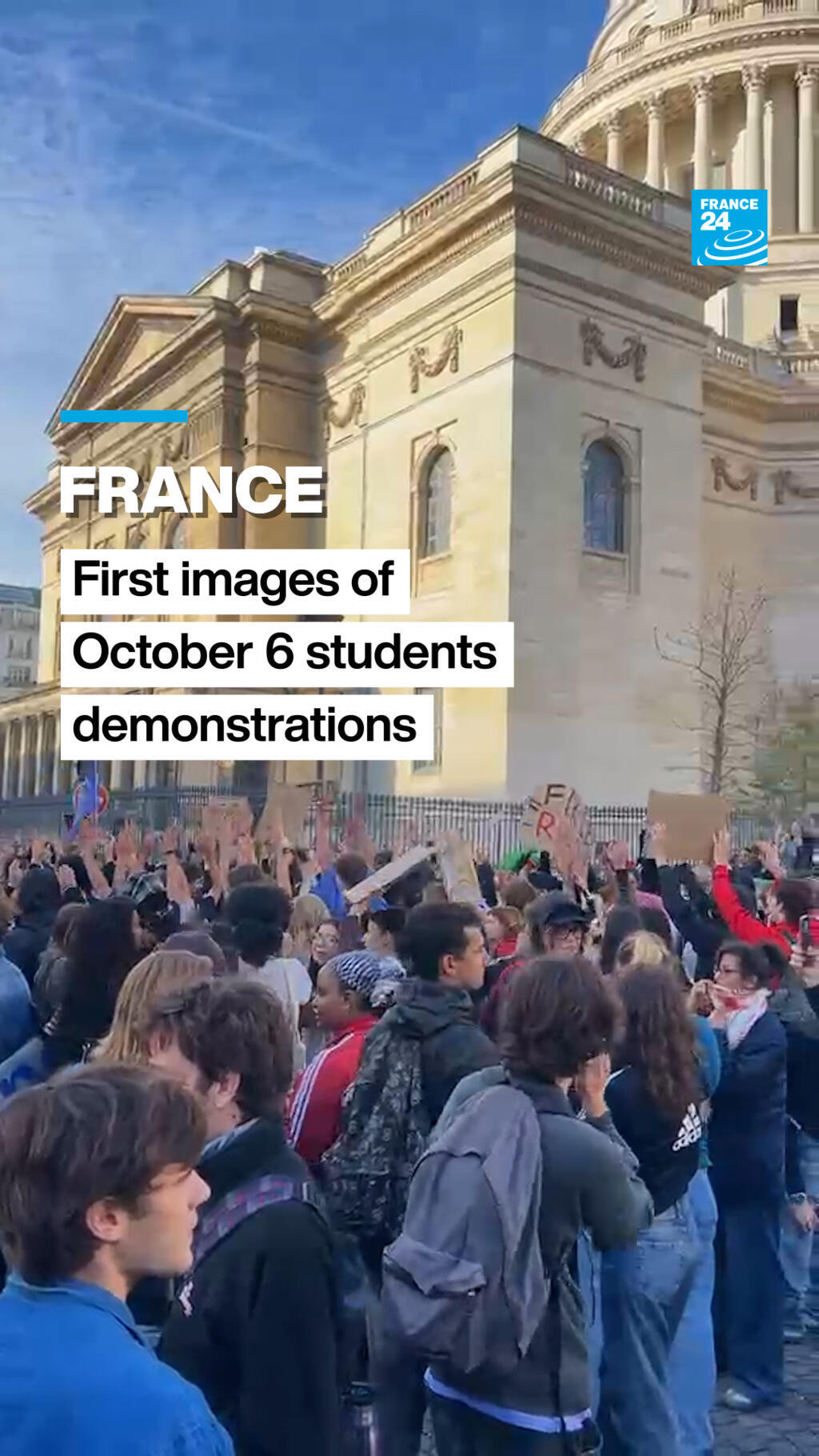
France 24 reports that thousands of demonstrators gathered across France on Tuesday, October 6, 2026, amid heavy police surveillance. The protests involve high school students, with unions and teachers also joining. Students had been demonstrating for several days to demand better conditions, and the protests had included violent confrontations.
The report focuses on students outside a Paris high school. France 24 correspondent Luke Shrago says that the students he spoke with remained determined to secure what they regard as meaningful concessions from the government. The headline echoes that aim, describing students as seeking “concessions that mean something.”
The supplied article text does not specify the students’ particular demands, describe the confrontations in detail, identify government responses, or say how many people were involved beyond reporting that thousands were massing across the country. It is a brief introduction to a video report rather than a full account of the protests. Its central points are the breadth of the demonstrations, the participation of students alongside unions and teachers, the demand for improved conditions, and the students’ determination to continue pressing for government concessions. The article presents these developments in a straightforward news-reporting style, without taking an explicit position on the protesters’ demands or the authorities’ handling of the demonstrations.
Entities: France, Paris, France 24, Luke Shrago, high school students • Tone: analytical • Sentiment: neutral • Intent: inform
06-10-2026
France 24 reports that a major student march is scheduled to leave central Paris on the afternoon of October 6, 2026. The demonstration is part of ongoing protests by French students over classroom conditions. In a brief report, France 24 correspondent Claire Paccalin describes a heavy police presence in central Paris as marchers prepare to set off. The report notes that earlier protests were marred by violence, providing context for the heightened police presence. It does not specify the nature or extent of that earlier violence, the number of officers or demonstrators, the students’ particular demands, or the march’s route and expected duration. Nor does the supplied text include any outcome from the march; it is a preview of a demonstration that is about to begin. The page identifies the item as a 3-minute, 48-second video, issued at 14:57 and modified at 15:09 on October 6, 2026. The available article text is limited to this brief description, so further details about events on the ground cannot be established from the supplied material.
Entities: Paris, Central Paris, French students, Claire Paccalin, France 24 • Tone: neutral • Sentiment: neutral • Intent: inform
06-10-2026
The France 24 liveblog reports on a major day of student demonstrations across France on October 6, 2026, with tens of thousands of people joining protests over education funding and conditions. French Prime Minister Sébastien Lecornu accused the hard-left France Unbowed (LFI) party of “sowing chaos” and rejected the claim that police repression was government policy, as clashes broke out in some cities. The liveblog says students had been protesting since late September, with pupils blocking entrances to hundreds of schools. Their complaints included teacher absences, overloaded timetables, deteriorating classrooms and buildings poorly suited to rising temperatures.
A roundup of previous developments cites figures from the French justice ministry: more than 5,000 people had been detained since the protests began, and 87 percent of those detained were minors. It also reports that at least 589 schools had been disrupted and more than 215 students injured. One particularly severe incident involved a 15-year-old protester in Lens, in northern France, who lost a hand after picking up a police grenade.
The supplied page is a partial liveblog extract rather than a complete account: it contains an opening report and a list of earlier developments, but no subsequent live updates. The headline and content frame the protests around education grievances, clashes, arrests and questions about policing. The page’s “not found” notice is website clutter, not part of the report.
Entities: Sébastien Lecornu, France Unbowed (LFI), France 24, French justice ministry, Human Rights League • Tone: analytical • Sentiment: negative • Intent: inform
06-10-2026
France 24 reports that France was preparing for nationwide high-school blockades and street demonstrations on Tuesday, October 6, 2026. The protests were expected to involve students and trade unions and were described as supporting students who want President Emmanuel Macron’s government to address problems in public schools. The article identifies two central concerns: insufficient staffing and deteriorating school buildings. It characterizes the government as cash-strapped but does not provide further details about its finances, planned response, or education policy.
The page is primarily a short video item, labeled as lasting 49 seconds, and the supplied text contains only a brief description rather than a full report or transcript. It does not give the number or locations of demonstrations, identify particular schools or unions, include statements from protesters or officials, or report on how events unfolded. Consequently, the account establishes the protests’ planned purpose and broad national scope but offers little evidence or context with which to assess their scale or likely impact. Related headlines displayed on the page refer to other coverage of French school protests, but they are not part of this article and do not substantiate additional details about this video. Overall, the item informs readers of planned demonstrations and the grievances behind them, without taking an explicit position on the protesters’ demands or the government’s response.
Entities: France, Paris, France 24, Emmanuel Macron, French government • Tone: neutral • Sentiment: neutral • Intent: inform
06-10-2026
Students, teachers and parents marched in cities across France on Tuesday, while protesters blockaded hundreds of schools, in the largest day of demonstrations so far in a wave of unrest over understaffed and deteriorating classrooms. Protests began peacefully in Marseille, Nantes and Lyon during the morning, with the largest demonstration expected in Paris later in the day. Young demonstrators carried smoke flares and placards expressing anger and frustration at what they described as political neglect.
The demonstrations followed roughly two weeks of protests that began in deprived suburbs of Paris and spread nationwide. The government deployed riot police and said the movement had developed into urban violence. The article also reports that a teenager lost a hand in a clash with riot police in northern France on Monday. Pas-de-Calais prefect Francois-Xavier Lauch declined to discuss the precise circumstances, but said about 200 to 250 protesters had thrown objects at police. The article presents the protests as a nationwide dispute over school conditions alongside escalating confrontations between demonstrators and police.
Entities: France, Paris, Marseille, Nantes, Lyon • Tone: analytical • Sentiment: negative • Intent: inform
06-10-2026
The article reports that student demonstrations are spreading across France amid the government’s efforts to rein in public spending and bring public finances under control. The protests come months before a key presidential election, adding a significant political backdrop to the dispute. For more than two weeks, students have demonstrated and blockaded schools in locations across the country. On Tuesday, the activity broadened into a nationwide day of protest, with people taking to the streets. Several influential French unions joined the rallies, and crowds gathered in Paris, Lille, Lyon, Marseille, Toulouse, and other cities. The report presents the demonstrations as an escalating movement, moving from student-led school blockades to broader street protests supported by unions. It identifies government spending restraint and fiscal management as the central policy context, while noting the approaching presidential election as an important timing factor. The supplied article excerpt does not specify the protesters’ particular demands, the government’s response to Tuesday’s rallies, the size of the crowds, or whether the school blockades continued after the nationwide demonstrations. Its focus is on the geographic spread and escalation of the protests and the convergence of students, unions, and other participants in rallies around France.
Entities: France, Paris, Lille, Lyon, Marseille • Tone: analytical • Sentiment: neutral • Intent: inform