04-09-2026
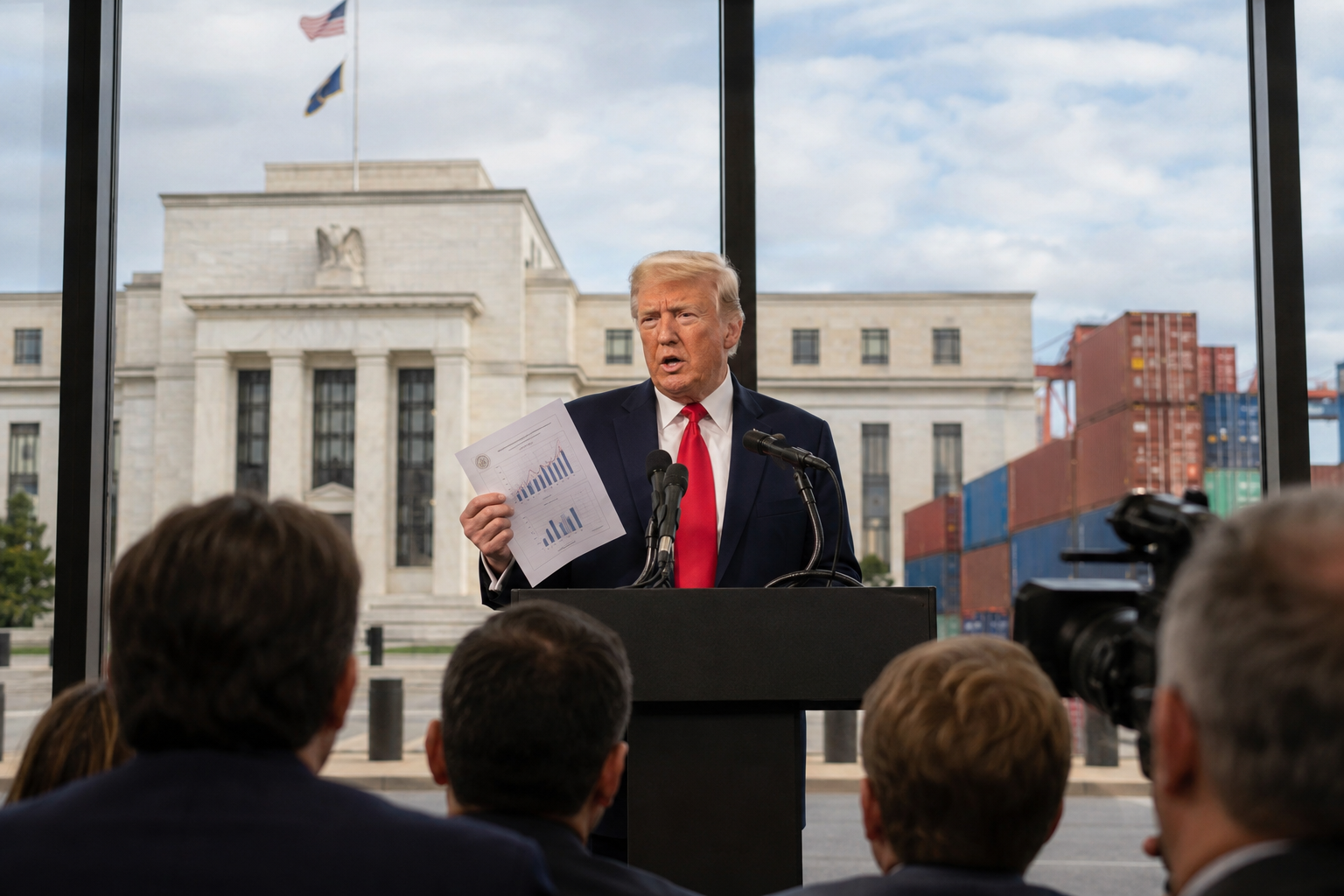
President Donald Trump demanded that the Federal Reserve sharply lower interest rates, threatening to halt trade with countries that run trade surpluses with the United States if the central bank does not comply. In a post on Truth Social, Trump responded to an unexpectedly strong August jobs report, which showed employers adding 162,000 jobs—about twice or three times above some estimates. He argued that the strength of the U.S. economy and its credit standing justified the world’s lowest interest rate and said high rates placed the country at an unfair disadvantage.
Trump’s threat would have sweeping implications because the United States runs trade deficits with dozens of countries, including many of its largest trading partners. The Federal Reserve declined to comment, and the White House had not provided further clarification. The article characterizes the proposal as extreme and portrays it as a renewed escalation of Trump’s pressure campaign against the central bank.
The pressure comes two months before the U.S. midterm elections, with persistent inflation remaining a major source of public dissatisfaction. Trump has frequently criticized both high interest rates and U.S. trade deficits. His position also conflicts with recent comments from Fed Chair Kevin Warsh, whom Trump appointed to succeed Jerome Powell. Warsh said the central bank remains committed to returning inflation to its 2% target and suggested that rate increases could soon be considered. Vice President JD Vance separately advocated lower rates, calling them a responsible response to recent inflation data. National Economic Council Director Kevin Hassett said the Federal Reserve would make its own decision, while acknowledging that the case for holding rates steady was strong. The episode highlights tension between the administration’s demands for cheaper borrowing and the Fed’s mandate to control inflation while supporting employment.
Entities: Donald Trump, Federal Reserve, Kevin Warsh, Jerome Powell, JD Vance • Tone: analytical • Sentiment: negative • Intent: inform
04-09-2026
President Donald Trump threatened to stop trading with countries that run trade surpluses with the United States unless the Federal Reserve lowers interest rates. In a Truth Social post and later remarks in the Oval Office, Trump argued that the U.S. is a stronger credit than many countries but pays significantly higher borrowing costs. He said the United States should have the lowest interest rate in the world, potentially as low as 1% or 0.5%, rather than roughly 4%.
Trump issued the threat after an unexpectedly strong August jobs report showed that employers added 162,000 jobs. He urged Federal Reserve Chair Kevin Warsh to cut rates and said high interest rates put the U.S. at an unfair disadvantage. The Fed declined to comment, while the White House did not provide further details.
The article notes that implementing Trump's threat would be extreme because the U.S. has trade deficits with dozens of countries, including many of its largest trading partners. Economists generally argue that trade deficits are not inherently harmful and can reflect a country's purchasing power and demand for imported goods. Countries that run trade surpluses with the U.S. also frequently invest their dollar earnings in U.S. Treasury securities, returning capital to the domestic economy.
Trump cited Canada as an example, claiming that ending trade with it would eliminate a $90 billion deficit. His comments represent a renewed pressure campaign against the Federal Reserve, following Warsh's suggestion that rate increases could eventually be considered to bring inflation back to the Fed's 2% target. Vice President JD Vance also called for lower rates, while National Economic Council Director Kevin Hassett emphasized that the Fed would make its own decisions and that its independence should be respected. The dispute comes two months before the midterm elections, as inflation remains a major political concern.
Entities: Donald Trump, Federal Reserve, Kevin Warsh, U.S. interest-rate policy, U.S. trade deficits • Tone: analytical • Sentiment: negative • Intent: inform
04-09-2026
US President Donald Trump has intensified his campaign for lower interest rates, threatening to halt trade with countries that run goods deficits with the United States if the Federal Reserve does not reduce borrowing costs. Trump made the demand in a lengthy social media post on Friday, following a stronger-than-expected August jobs report. The employment data could strengthen the case for Federal Reserve officials to consider raising rates at their policy meeting beginning September 15, directly conflicting with Trump’s position.
Trump praised his hand-picked Fed chairman, Kevin Warsh, while urging Warsh and other board members to “get smart” and act as “patriots.” He argued that high interest rates place the United States at an unfair disadvantage and declared that he would not accept that situation. His proposed response would link monetary policy to trade policy by threatening to stop commerce with economies that maintain trade surpluses over the US.
Trump also claimed that the US Supreme Court, which invalidated his earlier tariff regime, had recognised his authority to impose such measures. However, the article notes that any attempt to introduce trade embargoes would almost certainly face a legal challenge. It also remains unclear how cutting trade with deficit-running countries would reduce US borrowing costs. The comments suggest that Trump is becoming increasingly impatient with the central bank, only months after Warsh replaced former chair Jerome Powell. The threat adds to tensions surrounding the Federal Reserve’s independence and raises questions about the legal and economic consequences of using tariffs or trade restrictions to pressure monetary policymakers.
Entities: Donald Trump, Kevin Warsh, Jerome Powell, Federal Reserve, US Supreme Court • Tone: urgent • Sentiment: negative • Intent: inform