04-09-2026
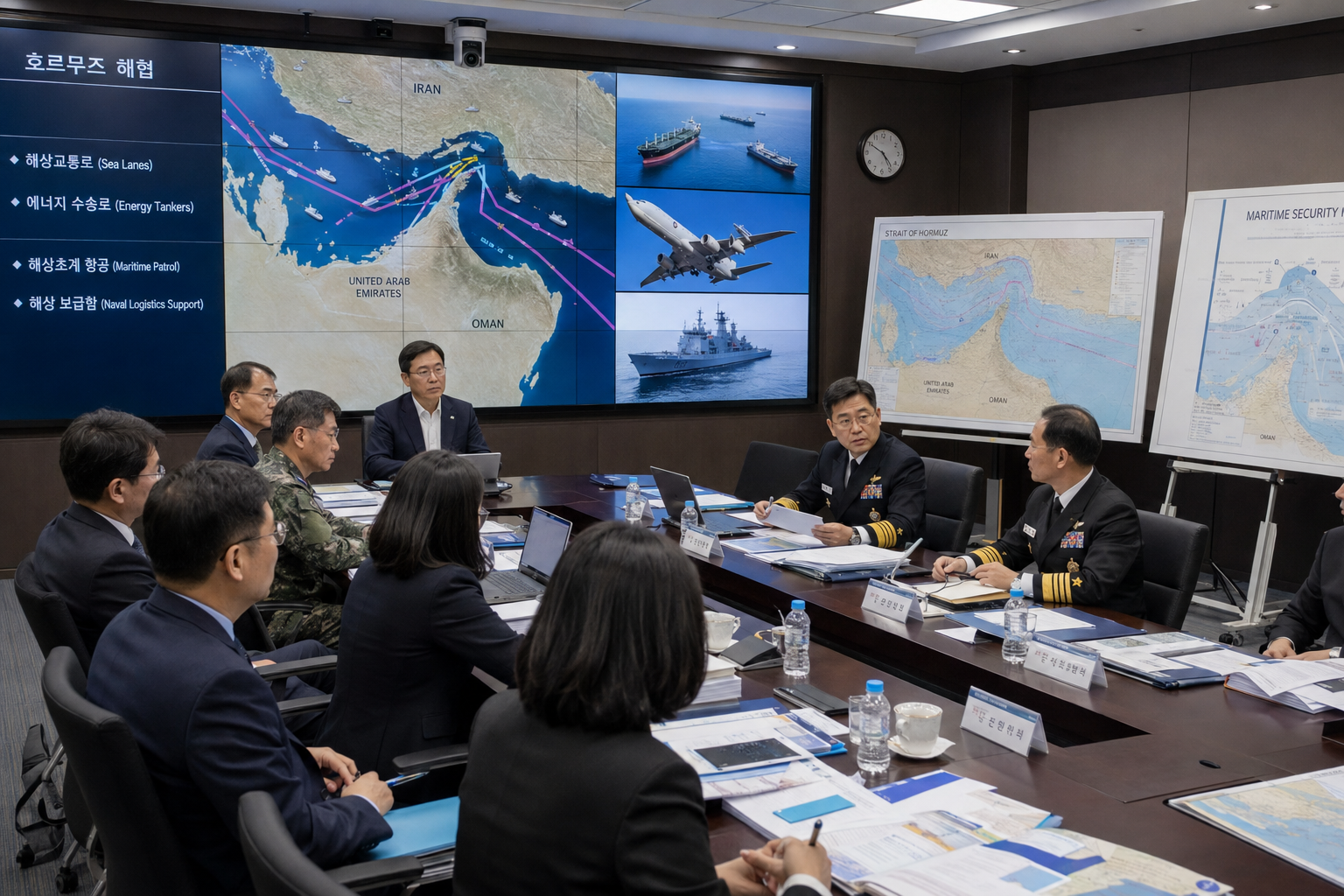
South Korea is considering whether to make a military or other contribution to efforts to ensure freedom of navigation through the Strait of Hormuz, according to its presidential office. The strategic waterway has become a focus of international concern after Iran restricted maritime traffic during its war with the United States, threatening a major route for global energy supplies.
Reports by South Korean broadcaster JTBC suggested that Seoul was leaning toward sending troops and was reviewing the details before seeking approval from the National Assembly. The presidential office subsequently emphasized that no decision had been made. Officials said possible options could include combat participation, non-combat roles, and search operations, but stressed that any contribution would have to preserve South Korea’s military readiness and comply with domestic legal procedures.
A deployment would require approval from the National Security Council, a cabinet resolution, and consent from the National Assembly. The issue could also be discussed when President Lee Jae Myung meets French President Emmanuel Macron the following week.
The proposal faces limited domestic support. A March Gallup Korea poll found that 55 percent of respondents opposed sending South Korean warships to the strait. At the same time, South Korea has significant economic reasons to protect access to the waterway: in the previous year, 61 percent of its crude oil imports and 54 percent of its naphtha imports passed through the Strait of Hormuz.
Seoul is also under pressure from Washington, its most important ally. US President Donald Trump said he had canceled joint US-South Korea military exercises partly because Seoul declined to assist the US war effort against Iran. South Korea had previously said it would consider deploying forces only after the conflict ended. The presidential office rejected claims that Seoul had provided no assistance, noting that practical contributions had long been discussed internationally. In late 2019, South Korea expanded its anti-piracy deployment from Somalia to waters around Hormuz after US requests for help protecting oil tankers.
Entities: South Korea, Strait of Hormuz, Iran, United States, President Lee Jae Myung • Tone: analytical • Sentiment: neutral • Intent: inform
04-09-2026
The European Union has formally endorsed the U.S.-led “Operation Economic Outcast,” a sanctions campaign intended to isolate Iran from the global financial system. U.S. Treasury Secretary Scott Bessent welcomed the EU’s support and said Washington and its allies would continue cutting off financial channels that Tehran could use to fund its nuclear activities, weapons programs, and regional proxies. The campaign, launched by the Trump administration in late August, targets Iran’s access to digital assets, advanced technology, gold, commercial aviation, and shipping. Bessent has also warned that banks and other institutions facilitating Iran-related transactions could face secondary sanctions and exclusion from the dollar-based financial system.
The EU said its endorsement was aimed at countering Iran’s “destabilizing activities” and supporting a return to peace talks. However, Iran’s Foreign Ministry rejected the move as “economic terrorism,” accusing the bloc of surrendering its sovereignty to U.S. pressure. The EU already maintains separate sanctions on Iran’s nuclear and ballistic missile programs and its military support for Russia. China remains Iran’s largest trading partner and reportedly purchased most of the country’s sanctioned crude exports before the conflict.
At the same time, South Korea is considering whether to provide military assistance to a U.S. effort to reopen the Strait of Hormuz to commercial shipping. Seoul has denied reports that it has already decided to deploy troops, although local media said a Gulf deployment could occur before the end of the year and might require parliamentary approval. The issue follows U.S. frustration with South Korea’s reluctance to provide military support.
The developments come amid escalating hostilities. The U.S. has launched strikes on Iranian military targets, while Iran has retaliated against American bases across the Middle East. Shipping through the Strait of Hormuz, a major route for global oil flows, remains heavily disrupted. The U.S. says it has redirected 87 commercial vessels, disabled three, and boarded two while enforcing a naval blockade around Iranian ports.
Entities: European Union, United States, Iran, South Korea, Strait of Hormuz • Tone: analytical • Sentiment: negative • Intent: inform
04-09-2026
South Korea is reviewing, but has not approved, a possible deployment of military assets to the Strait of Hormuz as pressure grows from US President Donald Trump for Seoul to support regional security efforts. South Korean media, citing unnamed government and military sources, reported that preparations were under way and that the government planned to seek parliamentary approval. The reports mentioned a P-8 Poseidon maritime patrol aircraft, a naval logistics support ship and, according to one outlet, a navy explosive ordnance disposal team. The deployment’s size and timing reportedly remain undecided.
South Korea’s presidential office rejected claims that a deployment had been finalized, telling The Guardian that the reports were “different from the facts” and that “nothing related to the matter has been decided”. It nevertheless confirmed that discussions were continuing with international partners about contributing to the restoration of free navigation through the strait and to Middle East stability.
Any new mission would require review by the national security council, a cabinet resolution and approval from the national assembly. Seoul is particularly sensitive to disruptions in the waterway because it imports more than 90% of its primary energy, including about 70% of its crude oil, through the Strait of Hormuz. In 2020, the Moon Jae-in government expanded an existing anti-piracy unit’s mandate to cover the strait without seeking approval for a separate deployment, but Defence Minister Ahn Gyu-back said in March that a substantially different mission would require parliamentary consent.
The reports come amid tensions in the US-South Korea alliance. Trump has criticized Seoul for declining a request related to Iran, and joint US-South Korean military exercises were subsequently reduced. The allies are also dealing with delays over a $350bn investment agreement, alleged restrictions on intelligence sharing and a dispute involving the South Korean e-commerce company Coupang. Separately, Seoul is interested in renewed US-North Korea diplomacy as Trump signals openness to meeting Kim Jong-un again.
Entities: South Korea, Strait of Hormuz, Donald Trump, Lee Jae Myung, Ahn Gyu-back • Tone: analytical • Sentiment: neutral • Intent: inform