04-09-2026
Giorgia Meloni’s right-wing government has become the longest-serving single government in Italy since the country became a republic after World War II. On Friday, it reached 1,413 days in office, surpassing the previous record for a continuous government held by Silvio Berlusconi. Berlusconi, however, remains Italy’s longest-serving prime minister overall, having spent nine years in office across several different governments.
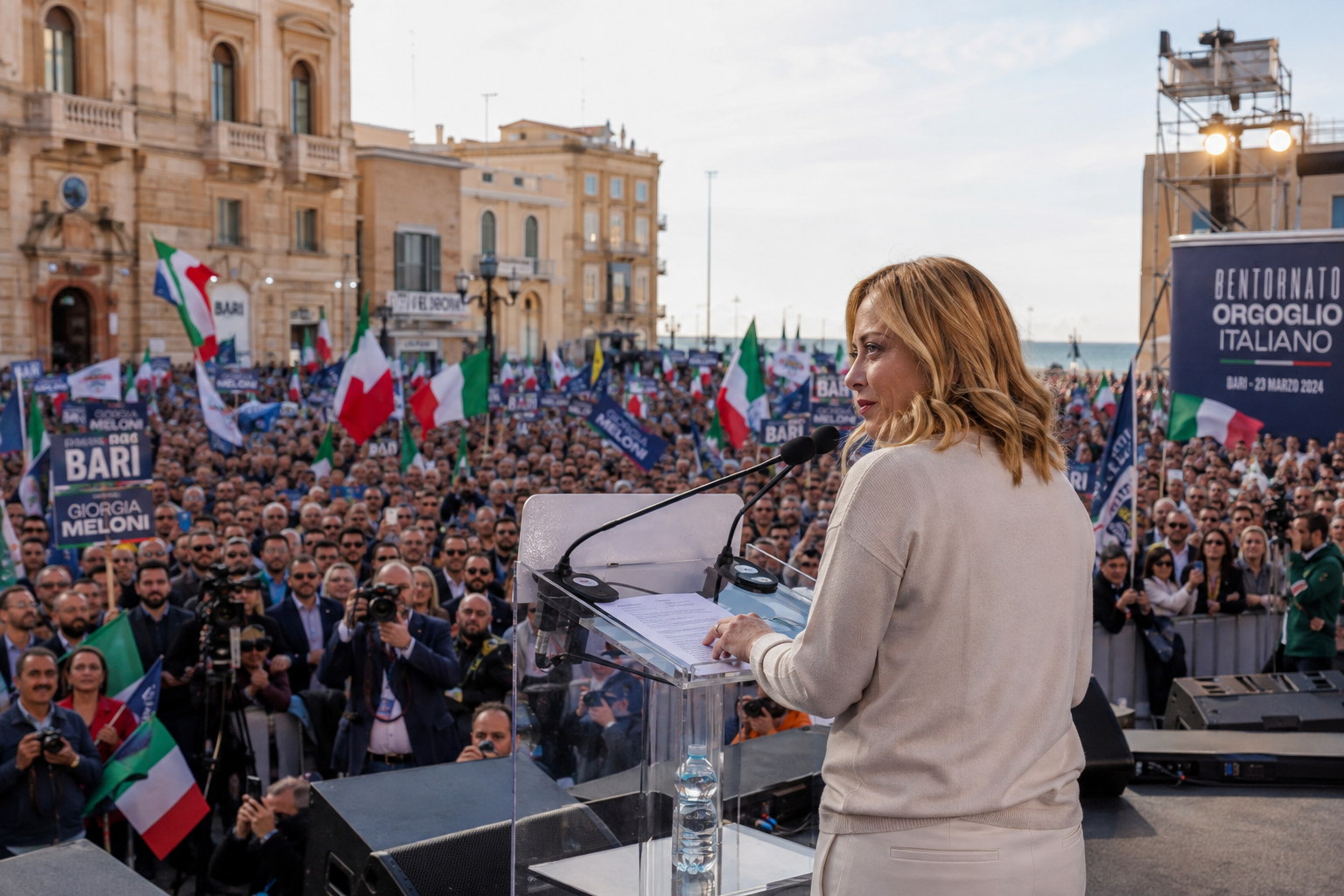
The milestone is significant in a country that has had 68 governments in 80 years, with administrations lasting an average of roughly 13 months. Meloni and her Brothers of Italy party plan to mark the occasion with a rally in Bari, in the southern Puglia region. Around 80 coaches are expected to bring supporters to the event, where Meloni will speak and Deputy Prime Ministers Matteo Salvini and Antonio Tajani will participate by video. The gathering is also expected to serve as an early campaign event ahead of Italy’s 2027 election.
Government supporters point to economic and political achievements, including one million additional people in employment, unemployment below 6%, a €21 billion reduction in personal income taxes and a reported decline in migrant arrivals. Meloni also argues that Italy has gained greater international influence. Her nationalist approach has been popular with many supporters, including after she rejected Donald Trump’s claim that she had begged him for a photograph, saying, “Italy doesn’t beg.”
Critics counter that major structural problems remain, including weak productivity, demographic decline, inefficiencies in healthcare, education and public administration, and the rising cost of living. Trade union leader Maurizio Landini said wages had not risen while fuel costs, job insecurity and pressure on healthcare had increased. Opposition groups accuse the government of promoting a “war and weapons economy,” building a “police state” and encouraging hostility toward migrants. At the same time, some figures on the far right believe Meloni has become too moderate. Retired general Roberto Vannacci and his party have reportedly gained support by taking harder-line positions on immigration and national identity.
Entities: Giorgia Meloni, Brothers of Italy (FdI), Italy’s postwar government longevity, Silvio Berlusconi, Bari • Tone: analytical • Sentiment: neutral • Intent: inform
04-09-2026
Italian Prime Minister Giorgia Meloni used a rally in Bari to celebrate her coalition government reaching 1,413 days in office, surpassing the 1,412-day record set by Silvio Berlusconi’s second government and becoming the longest-serving single administration in the history of the Italian Republic. Meloni presented the milestone as evidence that her center-right coalition had achieved unusual stability in a country where governments have frequently collapsed before completing their mandates. She called stability “our first great reform,” arguing that continuity had allowed the government to pursue economic and foreign-policy objectives more effectively.
The rally also served as an early platform for Meloni’s preparations for the 2027 elections. She highlighted her government’s reforms and cited a YouTrend poll showing her Brothers of Italy party at 26.5%, slightly above its 26.04% result in the 2022 election. She focused particularly on justice and security, promising to build more prisons and rejecting pardons or amnesties as solutions to overcrowding. Meloni also said her government would continue pursuing justice reform despite losing a 2026 referendum on proposed changes to the judiciary, including separating the career paths of judges and prosecutors.
Meloni acknowledged the difficulties of governing and resisting institutional opposition, telling supporters that some days felt like “swimming through glue,” but insisting that she would not give up. Opposition parties, however, argue that the government’s longevity has not resolved Italy’s major structural problems, including weak productivity, low wages and inefficient public services. They say the coalition has offered few concrete measures to generate long-term growth and accuse it of reducing funding for healthcare and education. As the government’s survival becomes less of a question, the central electoral issue is whether voters believe its record merits another term.
Entities: Giorgia Meloni, Bari, Italy / Italian Republic, Meloni government, Right-wing coalition • Tone: analytical • Sentiment: neutral • Intent: inform
04-09-2026
This France 24 video examines why Giorgia Meloni has remained in power for an unusually long period and why Italy’s opposition has struggled to present a credible alternative. Political analyst Lorenzo Pregliasco, co-founder of the polling agency YouTrend and an adjunct professor at the University of Bologna, argues that Meloni’s longevity should not be interpreted solely as evidence of exceptional political strength. Instead, he attributes it to a carefully calibrated governing strategy, favorable political circumstances, and the weaknesses of her opponents.
According to Pregliasco, Meloni has preserved stability in part by avoiding major structural reforms that could provoke several social and political groups simultaneously. By limiting potentially disruptive policy changes, her government has reduced the likelihood of broad opposition mobilization. This approach has allowed her to maintain support while avoiding a unified backlash from competing constituencies.
Her position is further strengthened by her dominance over Fratelli d’Italia, the leading force within the governing coalition. The party’s internal cohesion gives Meloni greater control than many other coalition leaders might have. At the same time, the opposition remains fragmented and has not produced a leader capable of uniting its various parties or offering a persuasive alternative government. The resulting political imbalance means that, despite potential criticism of Meloni’s policies, there is no obvious replacement for her.
The discussion therefore presents Meloni’s durability as the product of several factors: tactical political management, party dominance, opposition fragmentation, and the absence of a credible rival. The video’s central argument is that her continued success is linked less to sweeping policy achievements than to her ability to preserve coalition stability and benefit from the weaknesses of Italy’s opposition.
Entities: Giorgia Meloni, Lorenzo Pregliasco, Alison Sargent, YouTrend, University of Bologna • Tone: analytical • Sentiment: neutral • Intent: analyze
04-09-2026
France 24 reports that Italian Prime Minister Giorgia Meloni is marking a major political milestone: her government has become the longest-lasting administration in Italy’s postwar history. The achievement is particularly significant because Italy has long been associated with political instability and frequent changes of government. Meloni’s hard-right coalition has therefore demonstrated an unusual degree of durability since taking office.
The report presents the longevity record as an important political success for Meloni, who is Italy’s first female prime minister. However, it also emphasizes that the milestone does not eliminate the substantial challenges facing her government. With elections scheduled for next year, Meloni will need to maintain the coalition’s cohesion and demonstrate that its stability can translate into continued political support.
The article offers limited detail about the government’s specific policies or the nature of the challenges ahead. Instead, it focuses on the symbolic and historical importance of the record, placing Meloni’s achievement in the broader context of Italy’s postwar political history. The accompanying report, produced by France 24’s Italy correspondent Seema Gupta, suggests that the government’s endurance is notable in a country where administrations have traditionally struggled to remain in power for long periods.
Overall, the coverage is factual and restrained. It acknowledges the significance of Meloni’s accomplishment without presenting it as an unqualified victory, balancing the celebratory milestone against the political uncertainty associated with the approaching election. The report’s central message is that longevity itself represents a considerable achievement for an Italian government, but that Meloni’s longer-term success will depend on how effectively she addresses the remaining challenges and preserves her coalition’s position.
Entities: Giorgia Meloni, Italy, Italian government, Meloni’s hard-right coalition, Postwar Italian political history • Tone: analytical • Sentiment: neutral • Intent: inform
04-09-2026
The France 24 article examines why Giorgia Meloni remains politically strong in Italy, arguing that her influence is less a result of transformative domestic policies than of her party’s dominant position within the governing coalition. In an interview with Dr. Giulia Sandri, an associate researcher at the Free University of Brussels, presenter William Hilderbrandt discusses the significance of Meloni’s unusually long tenure in office.
According to Sandri, four years of governmental stability have given Meloni an advantage that is historically uncommon in Italian politics. Her continuity in office has enabled her to build diplomatic relationships, improve Italy’s position within Europe and increase Rome’s visibility internationally. These achievements have contributed substantially to her image as a successful and credible leader.
However, the article contrasts Meloni’s international profile with a less decisive domestic record. Italy has seen some improvements in employment and fiscal credibility, but these gains have been accompanied by weak economic growth, stagnant wages and declining purchasing power. The government also continues to face longstanding structural difficulties in healthcare, education, demographic trends and public administration.
The article therefore presents Meloni’s success as a product of political durability, coalition dominance and international positioning rather than clear evidence of broad domestic transformation. It does not portray her government as an outright failure, but emphasizes the gap between its political strength and the limited progress experienced in several key areas of Italian life. Overall, the discussion offers an analytical assessment of how stability and diplomatic visibility can reinforce a leader’s standing even when economic and social challenges remain unresolved.
Entities: Giorgia Meloni, William Hilderbrandt, Dr. Giulia Sandri, Free University of Brussels, Italy • Tone: analytical • Sentiment: neutral • Intent: analyze