04-09-2026
This feedback article brings together readers’ responses to Nepal’s devastating floods and the country’s efforts to secure international support. The letters express sympathy for victims, praise the Nepal Army’s rescue work and commend the United Arab Emirates for sending food supplies and power generators. One reader argues that humanitarian assistance reflects compassion and solidarity beyond national, religious and geographic boundaries, and says Nepal needs such help as it begins recovering from the disaster.
Several readers focus on Nepal’s plan to take a climate-compensation case to the United Nations. They note that Nepal produces only 0.1 per cent of global emissions but is experiencing severe consequences of climate change, including melting glaciers, unpredictable monsoons and catastrophic floods. The letters argue that the countries most responsible for historic fossil-fuel emissions should bear greater responsibility for climate-related loss and damage. They also criticize the slow conversion of climate-finance pledges into accessible funding and call for accountability and actual delivery of support.
Other responses address the human cost of the floods. One reader offers condolences to families mourning relatives who died or remain missing, while another describes the survival of a 97-year-old woman pulled from mud as a symbol of hope and resilience. The article’s contributors collectively call for Nepal to receive immediate humanitarian aid, fair treatment in global climate discussions and continued solidarity as communities grieve and rebuild. The dominant message is that Nepal’s crisis is both a humanitarian emergency and an international climate-justice issue.
Entities: Nepal, Kathmandu, United Arab Emirates (UAE), Nepal Army, United Nations (UN) • Tone: emotional • Sentiment: positive • Intent: persuade
04-09-2026
This France 24 Access Asia segment examines the risks surrounding development and disaster response in the Himalayan region following devastating flash floods in Nepal and Tibet. The report begins with ongoing rescue operations, noting that some survivors were found more than a week after the disaster. It states that the death toll had risen above 1,200, while thousands of people remained unaccounted for, and describes reporters’ interviews with victims and families waiting for information about missing relatives.
The program then broadens its focus to the fragile Himalayan environment. Dr Arun Bhakta Shrestha, an expert in environmental issues and risk management, explains why detecting glacier movements in advance is particularly difficult. He argues that the disaster could provide an opportunity for countries in the region to reassess how they plan and build infrastructure, particularly by making risk management a central part of development decisions.
The segment also explores the rapid expansion of hydropower projects across the Himalayas. FRANCE 24 journalist Leela Jacinto discusses concerns that water resources are becoming tools of geopolitical influence, with some countries allegedly beginning to “weaponise water.” Regional political tensions can limit information sharing and transparency, making it harder to assess environmental threats and coordinate responses. Overall, the report connects the immediate humanitarian consequences of the floods with longer-term questions about climate change, glacier instability, sustainable development, hydropower construction and cross-border cooperation. Its central message is that infrastructure development in the resource-rich Himalayas must be paired with improved monitoring, transparency and comprehensive risk management.
Entities: Himalayas, Nepal, Tibet, France 24, Access Asia • Tone: analytical • Sentiment: negative • Intent: analyze
04-09-2026
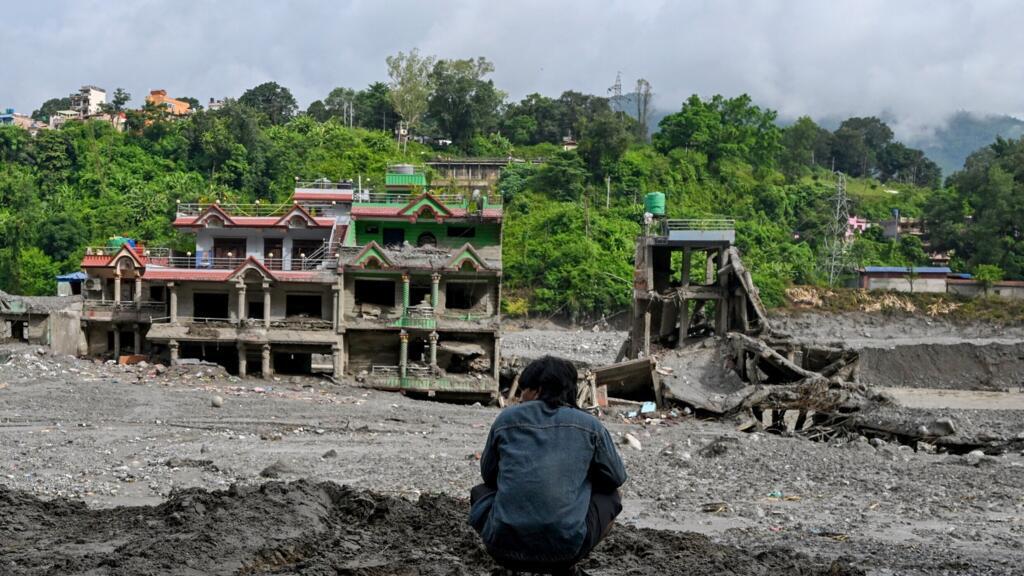
Nepal is using the devastation caused by late-August floods to draw international attention to climate justice. More than 1,250 people have been confirmed dead and nearly 4,000 remain missing after flash floods swept through the Bhotekoshi-Trisuli river basin. The disaster destroyed homes, bridges, roads and more than a dozen hydropower facilities, causing an estimated $2.6 billion in damage to public and private infrastructure. Search-and-rescue operations are continuing, while the precise cause of the glacial collapse that contributed to the disaster remains unclear.
The article argues that Nepal’s losses raise a broader question about responsibility for climate-related disasters. Nepal produces only about 0.1% of global greenhouse gas emissions and approximately 0.5 tons of carbon dioxide per person annually, yet it is highly exposed to flooding, landslides, glacier-related hazards and other effects of a warming climate. Prime Minister Balendra Shah has described disaster response as a global responsibility, and the government plans to raise climate justice at the United Nations General Assembly. Nepal also wants to build a coalition of climate-vulnerable countries and secure international support for adaptation, which it estimates could cost $18 billion to $20 billion between 2025 and 2035.
Kathmandu has requested assistance from the UN-backed Loss and Damage Fund, although the fund has limited resources, depends on voluntary contributions and has not yet begun distributing money. Experts quoted in the article say Nepal could turn the catastrophe into an opportunity for stronger global climate action and a legally binding system for addressing climate impacts. They emphasize that financial support should not be treated as charity, but as a fair distribution of responsibility because Nepal contributed little to the crisis it is experiencing.
Entities: Nepal, Bhotekoshi-Trisuli river basin, Balendra Shah, Shisir Khanal, National Disaster Risk Reduction and Management Authority (NDRRMA) • Tone: analytical • Sentiment: negative • Intent: analyze