27-10-2026
Israelis are voting in a pivotal election that places Prime Minister Benjamin Netanyahu’s leadership under scrutiny after three years of regional war and deepening domestic divisions. It is the first election since Hamas’s October 7, 2023 attack in which voters are directly judging Netanyahu’s leadership in light of the attack, continuing security concerns, and questions about the government’s handling of the crisis. Netanyahu cast his ballot in Jerusalem and urged people to vote “the right way.” Early turnout was 16.68 percent in the first three hours, the highest turnout recorded at that point in an election since 1981.
Opposition leader Gadi Eisenkot met voters in Nir Oz, a southern community attacked by Hamas-led fighters on October 7. Among those he met was former hostage Gadi Moses. Eisenkot promised to dismantle Hamas’s military and governing capabilities and said he would bring “a different spirit” to the country. He also pledged to establish a state commission of inquiry into security failures surrounding the attack, an investigation Netanyahu’s government has resisted.
The article describes divided views among voters in Jerusalem: some called for accountability and a change of government, while others said they still trusted Netanyahu to protect Israel. Security, accountability, and national unity are central campaign issues. The election’s outcome could shape Israel’s political future, though the article does not report a result.
Entities: Benjamin Netanyahu, Gadi Eisenkot, Gadi Moses, Israel, Jerusalem • Tone: analytical • Sentiment: neutral • Intent: inform
27-10-2026
The supplied material does not contain the body of the Al Jazeera liveblog. It includes the headline, URL, and a short page extract consisting of advertising and a prompt to enable alerts. Consequently, it is not possible to provide a comprehensive, evidence-based account of the election coverage, the candidates or parties discussed, the polling details, or the events reported in the live updates. The headline frames Israel’s 2026 election as a consequential contest and describes it as a tough test for Benjamin Netanyahu. That indicates the article is about the election and its significance for Netanyahu, but the extract does not explain why the test is difficult, report any poll results, or state what outcomes are possible. The page label “11 Updates” suggests the source was a liveblog with multiple entries, but none of those entries are present in the supplied content. The most reliable assessment is therefore limited to the headline: the intended coverage appears to inform readers about a high-stakes Israeli election and Netanyahu’s position in it. The tone appears news-oriented and somewhat urgent because of the phrases “tough test” and “high-stakes polls”; the headline alone does not establish a positive or negative sentiment toward any person or outcome. The advertising and alert prompt are not part of the article’s substantive reporting. A full summary and cleaned article would require the liveblog’s actual updates.
Entities: Israel, Israeli election, 2026 election, Benjamin Netanyahu, Israeli polls • Tone: urgent • Sentiment: neutral • Intent: inform
27-10-2026
Israel’s October 2026 election is presented as a consequential contest taking place after the Hamas-led October 7, 2023 attack and Israel’s subsequent war in Gaza, alongside wider regional conflicts. Benjamin Netanyahu is seeking to remain prime minister after leading a coalition that included far-right and ultra-Orthodox parties. His political prospects are complicated by public scrutiny of alleged security failures, his corruption trial, and International Criminal Court charges related to Gaza, which he denies or contests as applicable.
The article argues that Israel’s movement to the right predates Netanyahu’s latest government, reflecting the collapse of the peace process, repeated security crises, settlement expansion, and legislation such as the 2018 Nation-State Law. However, analysts say the shift accelerated under his coalition, citing efforts to weaken judicial review, disputes over ultra-Orthodox military service, and the influence of ministers Itamar Ben-Gvir and Bezalel Smotrich. An opposition victory might change the political atmosphere and restore greater respect for legal processes, but analysts caution that it would not necessarily reverse the country’s broader rightward direction.
The article also contends that the election offers little prospect of a fundamental change in policies toward Palestinians. It describes continued deadly attacks in Gaza despite a ceasefire, escalating violence and military raids in the occupied West Bank, and the exclusion of Arab-led parties from mainstream coalition plans. A sociologist quoted in the story argues that this exclusion reflects a political system organized around Jewish supremacy and restrictions on Palestinian rights. The election is therefore framed not only as a choice about Netanyahu, but as a test of Israel’s democratic institutions and of the political framework governing Palestinians.
Entities: Benjamin Netanyahu, Israel, Gaza, West Bank, Hamas-led attack of October 7, 2023 • Tone: analytical • Sentiment: negative • Intent: analyze
27-10-2026
Israelis are voting in a closely contested election that has drawn record turnout and is widely viewed as a referendum on Benjamin Netanyahu’s leadership. Recent polling places Netanyahu and former military chief Gadi Eisenkot almost neck-and-neck, but neither political bloc is projected to secure the 61 seats needed to form a majority. Because Israel’s proportional system requires coalition governments, negotiations could be difficult and prolonged; failure to form a government could lead to another election, as happened repeatedly between 2019 and 2022.
Eisenkot leads the newly formed Yashar Party and a diverse “change bloc” that includes former prime minister Naftali Bennett, Avigdor Lieberman and Yair Golan. Netanyahu’s path back to power depends on cooperation with the far-right and ultra-Orthodox parties in his current coalition. Arab parties could potentially influence the balance of power, but most major Jewish parties have ruled out working with them, and Lieberman has rejected the possibility of informally supporting an Eisenkot-led minority government.
Security, democracy and military conscription have dominated the campaign. Opposition leaders blame Netanyahu for the security failures preceding the Hamas-led 7 October attacks and demand an independent inquiry, while also criticizing his corruption trial and judicial reform proposals. Netanyahu rejects the allegations against him and presents himself as the candidate best able to protect Israel, citing military achievements and his relationship with US President Donald Trump. He denied reports that he sought new military action against Iran before the election, and drew criticism after sharing an AI-generated image of a nuclear strike on Tel Aviv.
Eisenkot broadly shares Netanyahu’s stated goal of ending Hamas rule in Gaza, while proposing a US-led plan or military action. The article also notes continued Israeli strikes, the high Palestinian death toll reported by Gaza’s health ministry, international criticism of Israel’s conduct, and disagreement over settlements and Palestinian political autonomy. Results may be affected by soldiers’ ballots, many of which will be counted later. Exit polls are expected after voting ends, but the eventual coalition outcome remains uncertain.
Entities: Benjamin Netanyahu, Gadi Eisenkot, Yashar Party, Likud, Naftali Bennett • Tone: analytical • Sentiment: neutral • Intent: inform
27-10-2026
The BBC report examines what Israel’s election could mean for Gaza, the occupied West Bank and international relations. Israelis are voting in an election described as one of the most pivotal in the country’s history. Polling published on Friday indicates a close contest between incumbent Prime Minister Benjamin Netanyahu and former military chief Gadi Eisenkot, with the two reported to be nearly neck and neck in the race to become prime minister.
The report focuses on the rivals’ foreign-policy positions and asks how their approaches might differ, particularly regarding Gaza and the occupied West Bank. BBC diplomatic correspondent James Landale reports from Jerusalem. The supplied article text does not detail either candidate’s policies or predict the election’s result; instead, it presents the election’s significance and frames the questions the report investigates. Its central concern is how the outcome and the candidates’ choices could affect Palestinians, Israel’s relations with the wider world, and the region more broadly.
Entities: Israel, Gaza, occupied West Bank, Benjamin Netanyahu, Gadi Eisenkot • Tone: analytical • Sentiment: neutral • Intent: analyze
27-10-2026
Israelis voted in record numbers in an election widely viewed as a referendum on Prime Minister Benjamin Netanyahu’s leadership and his government’s handling of the wars following the Hamas-led attacks of Oct. 7, 2023. The Central Elections Committee said 44.9 per cent of eligible voters had cast ballots in the first seven hours, a record pace. Polls suggested a close contest between Netanyahu’s Likud-led coalition and an opposition alliance led by Gadi Eisenkot, with neither side assured of a governing majority.
The election is the first since the Oct. 7 attacks, which killed 1,200 people according to Israeli tallies and led to wars in Gaza, Lebanon and Iran. Netanyahu, Israel’s longest-serving leader, defended his record and portrayed himself as uniquely able to confront the country’s enemies. His opponents focused on accountability for the security failures preceding the attacks and promised a national inquiry, which Netanyahu’s government has resisted. Eisenkot said he wanted a new spirit and pledged to dismantle Hamas’s military and governing power in Gaza within 18 months of forming a government. He has also called Israel’s war response a failure because Hamas remains in power.
Turnout among Arab Israelis, who make up about one-fifth of the population, could shape the outcome and the coalition arithmetic. Netanyahu urged his supporters to vote after warning of strong participation among Arab and left-wing voters. Opposition figures said Arab turnout could help create an alternative government, though Eisenkot has ruled out partnering with Arab parties. The article also describes Netanyahu’s campaign alliance with U.S. President Donald Trump, far-right coalition leader Itamar Ben-Gvir’s confidence in a Netanyahu return, and controversy over Netanyahu’s messaging about Arab voters.
If neither main contender can assemble a coalition in the 120-seat parliament, Netanyahu could remain caretaker prime minister until another election. Israel’s fragmented political system has repeatedly made it difficult for his opponents to replace him. Meanwhile, the war’s consequences remain central: Israel occupies around two-thirds of Gaza under a U.S.-brokered ceasefire, while negotiations on Hamas disarmament and Israeli withdrawal have stalled.
Entities: Benjamin Netanyahu, Gadi Eisenkot, Ruth Epstein, Itamar Ben-Gvir, Ahmad Tibi • Tone: analytical • Sentiment: neutral • Intent: inform
27-10-2026
Israelis are voting in a closely contested election after three years of war on multiple fronts. Polls disagree over whether Benjamin Netanyahu’s right-wing and religious coalition or the diverse bloc seeking to replace him has the advantage. Most surveys suggest neither side will secure a majority of the Knesset’s 120 seats, making a stalemate, lengthy coalition negotiations, a minority government, or another election possible, according to Israel Democracy Institute president Yohanan Plesner.
The election is the first since Hamas’s October 7, 2023, attack, which Israeli authorities have described as the country’s most catastrophic security failure since its founding. Voters are also weighing the continuing conflicts in Gaza, Lebanon, and Syria, as well as two direct rounds of conflict with Iran. Netanyahu argues that he alone can govern without Arab-party support and should remain in office to complete Israel’s military campaigns. He has also emphasized his relationship with U.S. President Donald Trump and the threat of Iran acquiring nuclear weapons. Trump endorsed Netanyahu, while Netanyahu’s campaign has used stark warnings about Iran. Supporters portray him as an experienced, charismatic world leader.
The opposing “change bloc” consists of Arab, right-wing, left-wing, and centrist parties united mainly by their desire to remove Netanyahu. Its potential leader, former military chief Gadi Eisenkot of the centrist Yashar party, presents himself as a unifying alternative. He has criticized Netanyahu’s use of fear-based messaging and promised a state inquiry into the security and intelligence failures preceding the October 7 attack. Eisenkot has personal ties to the war: his son and two nephews died while serving in Gaza.
Turnout could be decisive, particularly among Arab-Israeli voters, who make up about 20% of the population. Higher Arab turnout could make it harder for Netanyahu’s coalition to retain power. Two new parties focused on requiring ultra-Orthodox Jews to serve in the military may also affect the result if they cross the threshold for Knesset representation. If neither bloc wins a majority, lawmakers could switch sides or other unconventional arrangements may be needed. The article’s supplied text ends before detailing all possible outcomes.
Entities: Benjamin Netanyahu, Gadi Eisenkot, Donald Trump, Yohanan Plesner, Israel • Tone: analytical • Sentiment: neutral • Intent: analyze
27-10-2026
Tens of thousands of Israelis living abroad have traveled to Israel to vote in a consequential national election, with some spending thousands of dollars for brief visits. Ronnie Teram Gil-Ad, who moved to the United States with her family a year ago, paid about $3,000 to return for roughly 36 hours before flying back to Boston. She described voting as a civic duty and said living abroad does not make Israel any less her home. Yael Natra traveled from Toronto, saying this is the first Israeli election in two decades that she has felt compelled to vote in. She expressed concern that the Israel she grew up in is disappearing, pointing to eroding democracy and a deeply divided society.
AID Coalition, a U.S.-based nonprofit focused on strengthening Israeli democracy, estimates that as many as 67,000 citizens have arrived from abroad to vote. Its estimate draws on expatriate surveys and registration data collected for its Fly&Vote initiative. About half reportedly came from the United States, with others traveling from Europe, Canada, Australia and New Zealand. UnXeptable, co-founded by Offir Gutelzon, helped organize flights. The group says it aims to remove Prime Minister Benjamin Netanyahu from office. Many voters view the election as a referendum on Netanyahu, who has dominated Israeli politics for 30 years, and on the country’s direction since the Hamas attack and the start of the Gaza war three years earlier.
The opposition bloc, led by former military chief Gadi Eisenkot, is polling for a likely plurality. Eisenkot left Netanyahu’s government in 2024, accusing him of unnecessarily prolonging the Gaza war and delaying a hostage deal with Hamas. Political analyst Dahlia Scheindlin said the scale of expatriate mobilization is unusual, but cautioned that not all returning voters oppose Netanyahu; some support his side. Turnout could reach 70% of Israel’s approximately 7.3 million registered voters. After ballots are counted, parties will face the challenge of forming a stable governing coalition.
Entities: Ronnie Teram Gil-Ad, Yael Natra, Offir Gutelzon, Benjamin Netanyahu, Gadi Eisenkot • Tone: analytical • Sentiment: neutral • Intent: inform
27-10-2026
Israelis are set to vote in an election shaped by the aftermath of the Oct. 7, 2023, Hamas attacks, the continuing war in Gaza, and the U.S.-Israeli war with Iran that began in February. The vote is the first since those events, and national security is central to the campaigns. The article reports that the Hamas attacks killed around 1,200 people and led to the abduction of more than 250, while the Palestinian Ministry of Health says Israel’s subsequent Gaza campaign has killed more than 74,500 people.
Israel uses proportional representation: voters choose parties, and seats in the 120-member Knesset are allocated according to each party’s share of the vote. Parties need at least 3.25% to enter parliament. Since neither Prime Minister Benjamin Netanyahu’s bloc nor the opposition bloc led by former military chief Gadi Eisenkot is currently polling at the 61 seats required for a majority, smaller parties—and potentially Arab parties—could determine who forms the next government. Netanyahu’s coalition, which includes far-right and ultra-Orthodox parties, has faced disputes over a Gaza ceasefire and the conscription of ultra-Orthodox men.
The election also concerns public confidence in government, accountability for the Oct. 7 failures, military service, and the economic burden of prolonged conflict. Expert László Csicsmann says voters are likely to favor whichever side persuades them it can better protect the population, while pointing to high military spending and the widespread impact of reservists leaving their jobs. Political scientist Daniel Schatz describes a divide between supporters who see Netanyahu as experienced and critics who question his preparedness and strategic direction. However, dissatisfaction with Netanyahu does not necessarily mean support for the political left. The article adds that a change in government may not produce a dramatic shift on Palestinian statehood, Iran, or other foreign-policy issues.
Entities: Benjamin Netanyahu, Gadi Eisenkot, László Csicsmann, Daniel Schatz, Israel • Tone: analytical • Sentiment: neutral • Intent: inform
27-10-2026
The article examines whether Israel’s general election, the first since the Hamas-led October 7, 2023, attack, could alter the country’s policy toward Iran. The contest is presented as a close race between incumbent Prime Minister Benjamin Netanyahu and Gadi Eisenkot, a former Israel Defense Forces chief of staff leading the centrist Yashar party. Although US President Donald Trump publicly endorsed Netanyahu and warned that a different leader could affect Israel’s relationship with Washington, reports suggested disagreements between the US and Israeli governments over the timing of possible further strikes on Iran. Other reporting disputed whether Israel’s military had a concrete plan for such an operation.
Experts interviewed by DW largely expect continuity in Israel’s approach to Tehran, whoever wins. Raz Zimmt and Danny Citrinovitch of the Institute for National Security Studies argue that Israeli political factions differ little in their view of Iran’s nuclear threat, that the US president’s decisions weigh heavily on any military escalation, and that Netanyahu’s influence and policies would persist even if he left office.
The article traces this broad consensus to the October 7 attack. Before then, some observers favored containing Iran’s influence by confronting its regional allies. The assault, carried out by Iran-allied Hamas, strengthened the perception among many Israelis that Tehran poses a direct and serious threat. Researcher Damon Golriz describes Israel and US policy as seeking to remove Iranian leaders, damage infrastructure, and foment internal conflict. The article also notes Reuters reporting that Iran has prepared retaliatory plans, including possible attacks on communications cables and data infrastructure in the Gulf.
Diplomacy is presented as a possible alternative, though not an especially likely one. Golriz points to an Islamabad framework under which Iran reportedly agreed not to initiate military action against Israel, arguing that it could offer a foundation for peace. Citrinovitch, however, says returning to a nuclear deal has little support in Israel’s political arena. Overall, the article concludes that an election victory by either candidate is unlikely by itself to produce a dramatic change in Iran policy.
Entities: Benjamin Netanyahu, Gadi Eisenkot, Donald Trump, Israel, Iran • Tone: analytical • Sentiment: neutral • Intent: analyze
27-10-2026
Exit polls from Israel’s 27 October 2026 legislative election showed no clear winner. Prime Minister Benjamin Netanyahu’s bloc and the opposition led by former military chief Gadi Eisenkot were each projected to win roughly 50–53 of the Knesset’s 120 seats, short of the 61 needed for a governing majority. Likud was projected to remain the largest single party, with 25 seats. The reported turnout exceeded 77%, the highest-stakes national vote since Hamas’s 7 October 2023 attacks and a widely viewed referendum on Netanyahu’s leadership.
Israeli Arab parties were projected to gain 17–18 seats. Their increased support was linked in the article to anger at derogatory rhetoric from Netanyahu’s far-right allies and high turnout in some Arab communities. Arab leader Mansour Abbas said the right had suffered a major loss and indicated openness to working with Eisenkot. However, Eisenkot had said he would not govern with Arab lawmakers, while Netanyahu argued that a government dependent on Arab votes would lack legitimacy. Arab lawmakers might still support a minority government in parliamentary votes; without a workable arrangement, Israel could face another election.
The exit polls prompted competing claims. Eisenkot and left-wing leader Yair Golan portrayed the results as a rejection of Netanyahu’s government, while Foreign Minister Gideon Sa’ar cautioned that such celebrations were premature, emphasizing Likud’s position as the largest party. Far-right politician Itamar Ben Gvir warned Netanyahu against forming a unity government with Eisenkot.
Netanyahu urged opponents to support a strong right-wing government, rejected reliance on Arab parties as dangerous, and invoked security concerns, including Iran, while citing his government’s military record. Eisenkot, in turn, warned Netanyahu not to use national security for political purposes and described him as a caretaker prime minister lacking a mandate. The close projections left coalition formation uncertain, with political choices over Arab-party support, a unity government, or fresh elections still unresolved.
Entities: Benjamin Netanyahu, Gadi Eisenkot, Mansour Abbas, Itamar Ben Gvir, Yair Golan • Tone: analytical • Sentiment: neutral • Intent: inform
27-10-2026
Israel’s first national election since the Oct. 7, 2023, Hamas attack produced record voter participation but no clear path to a governing majority, according to preliminary exit polls. An updated Channel 12 projection put Prime Minister Benjamin Netanyahu’s right-wing and religious bloc at 53 seats, the main opposition led by former military chief Gadi Eisenkot at 49, and Arab parties at 19. Together, the opposition and Arab factions would have 68 seats in the 120-member Knesset, but their differences could make a shared government difficult. Netanyahu said Likud was the country’s largest party and called for a strong right-wing government, while warning against one dependent on Arab parties. He also described cooperation with President Donald Trump as an opportunity to address the threat from Iran. Eisenkot urged Netanyahu to accept the results and step aside after earlier projections appeared to favor the opposition. The contest’s next major question is who will receive the first opportunity to form a government. Eisenkot could potentially gain the mandate with recommendations from at least 61 lawmakers, including Arab representatives, but that would not ensure he could assemble a coalition. Netanyahu may still be asked to form a government, or could get another chance if Eisenkot fails, potentially prolonging negotiations for weeks. The exit polls are preliminary and may change as votes are counted. Turnout reached 77.7% of eligible voters, the highest recorded since 1999, with long lines at polling stations. The article characterizes the election as a referendum on Netanyahu’s leadership, although the supplied text ends before elaborating on that point.
Entities: Benjamin Netanyahu, Gadi Eisenkot, Donald Trump, Israel, Tel Aviv • Tone: analytical • Sentiment: neutral • Intent: inform
27-10-2026
Israel’s Oct. 27, 2026, national election is framed as a pivotal referendum on Prime Minister Benjamin Netanyahu’s political future and accountability for the security failures preceding Hamas’s Oct. 7, 2023, attack, the deadliest in Israel’s history. The vote could also produce another political deadlock. Netanyahu has resisted taking personal responsibility and has opposed an independent state commission of inquiry, instead backing a politically appointed investigation that bereaved families have criticized.
The article places the election in the context of divisions that predate the attack. Months earlier, mass protests against Netanyahu’s proposed judicial overhaul raised concerns that the changes would weaken democracy. The dispute reached the military, where reservists threatened to suspend volunteer service. Some critics say the turmoil signaled weakness to Israel’s enemies, though its influence on Hamas’s decision to attack is disputed. In the years since, political loyalties have further strained personal relationships, with debate often reduced to support for or opposition to Netanyahu, known as “Bibi.”
Families bereaved on Oct. 7 are divided too. Shir Shai, whose soldier brother Yaron was killed fighting Hamas, urged people who vote for Netanyahu not to visit the family again, arguing that another vote would perpetuate the failure. Other bereaved families credit Netanyahu for standing firm through years of conflict and place primary blame on Israel’s military and intelligence services for failing to anticipate the attack.
The campaign has grown increasingly bitter. Two days before the election, Netanyahu shared an AI-generated image of a nuclear explosion over Tel Aviv while warning about the danger Iran poses if Israel chooses a leader unable to confront Tehran. Police are preparing for possible post-election unrest, and experts warn of disputes over the results’ legitimacy, including an extreme scenario likened to the Jan. 6 attack on the U.S. Capitol. The supplied article ends mid-sentence as it begins to describe divisions within the opposition over how to govern after Netanyahu.
Entities: Benjamin Netanyahu, Gadi Eisenkot, Shir Shai, Yaron Shai, Israel • Tone: analytical • Sentiment: negative • Intent: inform
27-10-2026
The France 24 program “The Debate” examines Israel’s first general election since the October 7, 2023 attacks, framing the vote as both a judgment on the country’s deadliest day and a choice about Israel’s future. The article’s introduction points to unusually high turnout, described as the largest in decades, and asks what that participation says about voters’ priorities and the direction in which the country may move.
The discussion is set against Israel’s war and the continuing conflict surrounding Gaza and the West Bank. It notes that traditional allies have lost sympathy for the punishment inflicted on Gaza and for attacks by Jewish settlers in the West Bank, while Israeli voters are portrayed as divided over the country’s “new normal”: a prolonged or permanent state of war. Prime Minister Benjamin Netanyahu’s invocation of a “super Sparta state” is presented as a sign of a more militarized, isolated Israel, alongside his promise to keep the United States on Israel’s side.
The program also raises questions about which groups could shape the result. It asks about the growing ultra-Orthodox constituency, Palestinian citizens—described as one in five citizens and as a group that usually votes at lower rates—and Israelis who have flown in from abroad. Rather than predicting an outcome, the introduction emphasizes the possibility of surprises and leaves open how the electorate will divide. Overall, it presents the election as a high-stakes contest over security, political identity, Israel’s international position, and the country’s future after October 7.
Entities: Benjamin Netanyahu, François Picard, Maya Yataghène, Juliette Laffont, Ilayda Habip • Tone: analytical • Sentiment: neutral • Intent: inform
27-10-2026
France 24’s video interview features Ibrahim Abu Ahmad, introduced as a Palestinian Israeli political and peace activist and Head of Social Media for Israel’s left-wing Democrats. Speaking with Erin Ogunkeye, Ahmad describes the political mood in Israel as shaped by “fear and trauma.” He points to a gap between public opinion and political leadership: while many people want an Arab-Jewish coalition, he says, leaders are afraid to openly advocate for one. The interview’s central argument is that cooperation between Arab and Jewish citizens is more than a tactical choice in an election. Ahmad frames such a partnership as crucial to democratic survival, emphasizing the importance of Arab citizens having an ally within the Jewish community. The video was issued on 27 October 2026, amid an Israeli election that the surrounding France 24 coverage presents as a consequential vote involving Benjamin Netanyahu, security, and the future of Israeli democracy. The supplied article text does not include the full video transcript or additional details about Ahmad’s reasoning, so its account of the interview is limited to the description and selected remarks provided.
Entities: Ibrahim Abu Ahmad, Erin Ogunkeye, George Shantzek, France 24, Israel • Tone: analytical • Sentiment: neutral • Intent: analyze
27-10-2026
Israel’s election ended without either Prime Minister Benjamin Netanyahu’s hard-right bloc or challenger Gadi Eisenkot’s opposition bloc securing a parliamentary majority. The vote, the first since the Hamas-led October 7, 2023 attack, drew nearly 78 percent turnout—the highest since 1999—and was shaped by debate over Netanyahu’s divisive rule, the wars that followed the attack, and Israel’s political direction. Exit polls put both main blocs at about 51 seats, short of the 61 needed to govern, while Arab Israeli parties made substantial gains, winning a projected 17 to 18 seats.
Netanyahu called for a strong right-wing government and invoked Israel’s Jewish and Zionist majority. He also described an opportunity, alongside US President Donald Trump, to eliminate the perceived threat from Iran. Eisenkot urged Netanyahu not to use national security for political advantage, argued that Netanyahu lacked a mandate, and said voters had chosen change. Although Eisenkot has supported the Gaza offensive, he has promised a more inclusive domestic climate and action to rein in extremist settlers in the West Bank.
The Arab parties’ gains could give Eisenkot parliamentary support for a minority government, though he had said during the campaign he would not govern with Arab lawmakers. Netanyahu questioned the legitimacy of a government reliant on Arab votes. Far-right politician Itamar Ben Gvir opposed the prospect of a unity government between Netanyahu and Eisenkot. Political scientist Gideon Rahat cautioned that Netanyahu’s potential loss would not necessarily mean Eisenkot had won.
The article places the uncertain coalition negotiations against a backdrop of international isolation, war in Gaza and Iran, West Bank settlement expansion and violence, and Netanyahu’s International Criminal Court arrest warrant and domestic corruption cases. Eisenkot, a former military chief and political newcomer, could become Israel’s first prime minister of Middle Eastern or North African descent. His son’s death fighting in Gaza has drawn public sympathy. With no clear governing majority, the country may face another election if coalition-building fails.
Entities: Benjamin Netanyahu, Gadi Eisenkot, Israel, Jerusalem, Tel Aviv • Tone: analytical • Sentiment: negative • Intent: inform
27-10-2026
France 24 reports that initial exit polls from Israel’s election on Tuesday, October 27, 2026, showed no definitive winner. The opposition bloc, led by opposition candidate Gadi Eisenkot, was projected to hold a narrow advantage over the bloc associated with Prime Minister Benjamin Netanyahu and his Likud party in the Knesset. At the same time, Likud was projected to remain the largest individual party in parliament. These projections therefore suggested a close contest in which the overall balance between political blocs and the size of the largest party pointed to different aspects of the result. The headline also highlights gains by Arab parties, although the brief article text provides no figures, names of parties, or further explanation of those gains. It likewise does not report final vote counts or say whether the exit-poll projections would translate into a governing majority. The item is a short video report, credited to Tanishk Saha, and was issued at 22:41 on October 27. Its central message is cautious: the early polling indications offered a narrow edge to the opposition bloc, but did not establish a clear winner. The article supplies only a brief account of the projections, so it does not provide further detail about turnout, coalition negotiations, or the parties’ policies.
Entities: Israel, Gadi Eisenkot, Benjamin Netanyahu, Likud, Knesset • Tone: analytical • Sentiment: neutral • Intent: inform
27-10-2026
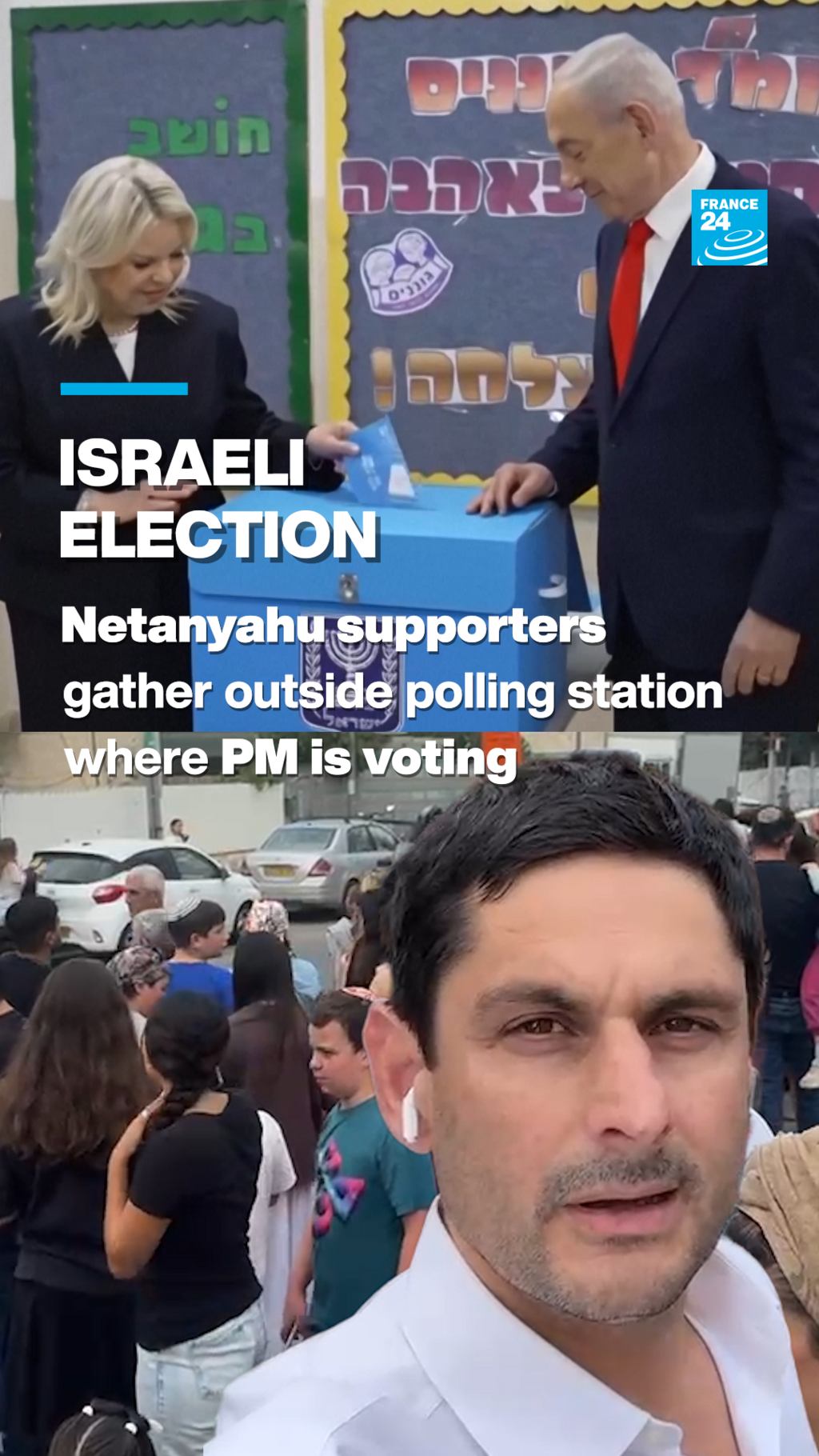
The France 24 video report describes supporters of Israeli Prime Minister Benjamin Netanyahu gathering outside a polling station in Jerusalem as he voted in Israel’s election on Tuesday, October 27, 2026. The election is the first national vote since the Hamas attack of October 7, 2023, and is widely viewed as a referendum on Netanyahu and his leadership. France 24 correspondent Clovis Casali reports from Jerusalem. The supplied article text contains no further reporting details, voter quotations, election results, or account of the supporters’ views, so it does not establish how the gathering affected the vote or what the outcome was.
Entities: Benjamin Netanyahu, Clovis Casali, Israel, Jerusalem, France 24 • Tone: neutral • Sentiment: neutral • Intent: inform
27-10-2026
France 24 reports that Israelis are voting in a pivotal national election on Tuesday, October 27, 2026. The article frames the contest as decisive for the country’s political direction and leadership, with Benjamin Netanyahu’s position a central point of interest. The accompanying video, presented by France 24 International Affairs Editor Angela Diffley, focuses on what happens after polls close and on how Israel’s political system shapes the process of forming a government. The supplied article text does not provide a detailed account of the post-election procedure, polling results, or the eventual outcome, so those details cannot be established from this material alone.
The election is taking place amid significant national strain. Israel is dealing with unresolved wars and the continuing repercussions of Hamas’s 2023 attack. The country is also deeply divided over the character of the state and who should lead it. These issues give the vote importance beyond a routine change of government: it is presented as a verdict on leadership and a moment of choice amid conflict and political division.
The page’s surrounding headlines reinforce the election’s high stakes, mentioning turnout, Netanyahu’s political survival, voter opposition and support, and concerns among Palestinians in the West Bank about further escalation if Netanyahu remains prime minister. These are related headlines rather than details developed in the main article. Overall, the available report introduces the election and its context, while directing viewers to a short video for an explanation of what follows when voting ends.
Entities: Israel, Benjamin Netanyahu, Angela Diffley, France 24, Hamas • Tone: analytical • Sentiment: neutral • Intent: inform
27-10-2026
Israelis are voting in the country’s first general election since the Hamas-led October 7, 2023 attack, in a contest that could determine Prime Minister Benjamin Netanyahu’s political future and Israel’s direction after years of regional conflict. Polls indicate a close race between Netanyahu and former military chief Gadi Eisenkot, but Israel’s fragmented parliamentary system makes a clear majority unlikely. With 61 of 120 seats required to govern, coalition negotiations may take weeks or months; Arab-led parties could become pivotal if they support one candidate or bloc.
The election is unfolding amid unresolved wars, heightened tensions with Iran, and deep disagreements over religion, nationalism, liberal values, and democratic institutions. Netanyahu’s supporters credit him with steering Israel through multiple wars and protecting its Jewish identity. Critics blame him for polarizing the country, weakening the judiciary, failing to accept responsibility for the October 7 security failures, and prolonging the Gaza war and hostage crisis for political reasons. They also oppose his support for exemptions that allow many ultra-Orthodox men to avoid military service, as the military faces personnel shortages.
Eisenkot’s supporters point to his security experience and say his potential governing partners would restore Israel’s international standing, strengthen judicial independence, and seek to conscript ultra-Orthodox men. Eisenkot has promised an independent inquiry into the October 7 failures, though he has also opposed Palestinian statehood and supported Israeli settlements while pledging action against violent settlers. Neither candidate has said whether he would partner with predominantly Arab party lists.
The vote also reflects Israel’s growing international isolation over its conduct in Gaza and the occupied West Bank, where settler violence has intensified. Families of those killed or taken hostage on October 7 marked the opening of polls with a moment of silence. With the outcome uncertain, the election is both a referendum on Netanyahu’s lengthy leadership and a contest over Israel’s political and social character.
Entities: Israel, Benjamin Netanyahu, Gadi Eisenkot, Hamas, October 7, 2023 attack • Tone: analytical • Sentiment: negative • Intent: inform
27-10-2026
France 24’s video segment presents Israel’s October 27, 2026 election as a referendum on Benjamin Netanyahu, national security and the future of Israeli democracy. Erin Ogunkeye speaks with Ron Gerlitz, chief executive of the aChord Center at Hebrew University, an Israeli organization focused on the social psychology of relations between groups. Gerlitz identifies the struggle over Israeli democracy as the election’s central issue. The article’s introduction links that institutional conflict to what it describes as a weakening of Netanyahu’s longstanding association with national security.
The interview also considers why Netanyahu continues to attract support, including the psychological foundations of that backing and the influence of conspiracy narratives. It addresses the electoral importance of Arab parties and the uncertain future of the two-state solution. These themes frame the vote as involving not only political leadership and security, but also democratic institutions, intergroup relations and the Israeli-Palestinian question.
The supplied text does not include a full transcript or detailed answers from Gerlitz; it provides a short description of the video’s subjects. Related headlines on the page report that early exit polls showed no clear winner and that Arab parties made gains, as well as discussing voter turnout and disputes over the judiciary. Those items are separate linked stories, not findings presented in the article description itself.
Entities: Israel, Israeli elections, Benjamin Netanyahu, Ron Gerlitz, Erin Ogunkeye • Tone: analytical • Sentiment: neutral • Intent: analyze
27-10-2026
France 24 reports that Israeli Prime Minister Benjamin Netanyahu cast his ballot on Tuesday, October 27, during Israel’s general election. The video report, issued at 13:42 on October 27, 2026, is introduced with the headline “Israeli PM casts his ballot as voters voice opposition to Netanyahu outside polling stations.” France 24 correspondent Clovis Casali is identified as the reporter who provides further information. The page does not include a transcript or additional details about the vote, the people expressing opposition, the location of the polling station, or the election’s results. It therefore establishes two central points: Netanyahu voted in the general election, and some voters voiced opposition to him outside polling stations. The headline frames the election against a backdrop of public dissent, but the supplied article text does not elaborate on the scale or specific reasons for that opposition. The page also displays links to related coverage, including stories about the election as a referendum on Netanyahu, the political stakes for his leadership, voter turnout, and the election being Israel’s first national vote since the October 7 attack. Those headlines provide context for the wider coverage but are not details substantiated in the main report text provided. Overall, this is a brief video-news item about Netanyahu voting and visible opposition to him during election day, with further explanation attributed to Casali but not reproduced in the supplied text.
Entities: Benjamin Netanyahu, Clovis Casali, Israel, Israeli general election, France 24 • Tone: neutral • Sentiment: neutral • Intent: inform
27-10-2026
The France 24 article reports that Israelis were voting on Tuesday, October 27, 2026, in a national election described as tense and politically consequential. The vote was widely viewed as a referendum on Prime Minister Benjamin Netanyahu’s leadership, particularly his handling of the period since the Hamas-led October 7, 2023 attack on Israel and the wars that followed, which have shaken the Middle East. The available article text does not provide election results, candidate or party details, voter interviews, or a fuller account of the issues debated. It therefore establishes the election’s central significance rather than explaining its outcome: voters were being asked, in effect, to pass judgment on Netanyahu’s leadership amid the attack’s aftermath and continuing regional conflict. The surrounding page includes links to other France 24 reports, including coverage of exit polls, turnout, Arab parties, democratic institutions, and what might happen after polls close. Those are related headlines, not additional reporting contained in the article excerpt itself, and their claims should not be treated as part of this article’s account. The report’s framing emphasizes the election’s high stakes and its connection to security, leadership, and regional instability, while offering little detail beyond that central context. The excerpt identifies the election date and the historical events against which Netanyahu’s leadership was being assessed, but does not state whether he won or lost.
Entities: Israel, Israeli voters, Benjamin Netanyahu, Hamas, Hamas-led October 7, 2023 attack • Tone: analytical • Sentiment: neutral • Intent: inform
27-10-2026
The available France 24 liveblog text reports that Israel’s October 27, 2026 general election resulted in a deadlock, according to exit polls. On Wednesday morning, Prime Minister Benjamin Netanyahu and his rival Gadi Eisenkot each appeared to lead blocs that fell short of the parliamentary majority needed to form a government. Netanyahu vowed to form a new government and argued that no leader should govern with the backing of Israeli Arab parties, which had made strong gains. The excerpt identifies the election as Israel’s first since the October 7 attack and notes that supporters of Itamar Ben Gvir’s Otzma Yehudit party reacted to the initial exit-poll results in Modi’in. The liveblog was credited to FRANCE 24, with updates attributed to AFP, AP and Reuters. The supplied page contains only an opening update rather than the full liveblog: it also includes website and video-player notices and ends with a message that the requested content is unavailable. Consequently, the available text does not provide further results, party seat counts, coalition negotiations, or subsequent developments.
Entities: Israel, Modi’in, Benjamin Netanyahu, Gadi Eisenkot, Itamar Ben Gvir • Tone: analytical • Sentiment: neutral • Intent: inform
27-10-2026
France 24’s video segment features presenter Annette Young interviewing Alain Greilsammer, a professor of political science at Bar-Ilan University in Tel Aviv, about Israel’s election and the country’s political direction. The segment places the election against several pressures: the aftermath of the October 7 attacks, regional tensions with Iran, and growing divisions within Israel. Greilsammer argues that voters’ concerns about democratic accountability, the independence of the judiciary, and the unequal distribution of civic obligations will fundamentally shape the election. He characterizes the Netanyahu government’s actions as an attack on Israel’s judicial system, Supreme Court, and democratic institutions, and warns that its policies could turn the country into “something like an authoritarian or non-democratic state.” The segment also highlights the potential influence of Arab political parties, which Greilsammer says could play a decisive role in determining the election’s outcome. The supplied page text contains a brief description of the interview rather than a full transcript, so it does not provide further detail about the guest’s arguments or the interview’s questions.
Entities: Benjamin Netanyahu, Alain Greilsammer, Annette Young, Bar-Ilan University, Israel • Tone: analytical • Sentiment: negative • Intent: analyze
27-10-2026
The France 24 article reports that Israelis turned out in unusually large numbers for a national election on Tuesday, October 27, 2026. The vote is described as the first election since the October 7, 2023 attack and as a verdict on Prime Minister Benjamin Netanyahu, with the electorate deeply divided over his leadership. The article notes that turnout was at a level unseen in decades, underscoring the importance of the election and the intensity of public engagement. Former France 24 correspondent Irris Makler provides additional commentary on the vote. The supplied article text does not report the election result, give turnout figures, or explain the competing parties’ positions; it focuses on the high participation and the election’s significance for Netanyahu. Related headlines and website notices in the source are not part of the article itself.
Entities: Israel, Israeli voters, Benjamin Netanyahu, Irris Makler, France 24 • Tone: analytical • Sentiment: neutral • Intent: inform
27-10-2026
The available text reports that exit polls in Israel’s election suggest a setback for Prime Minister Benjamin Netanyahu, but do not identify a clear winner. The Associated Press headline characterizes the result as a possible rebuke of Netanyahu while emphasizing that the contest remains unresolved. A video description says Netanyahu is facing a strong challenge from a political bloc led by Gadi Eisenkot, and that the election was initially considered too close to call. The accompanying preview says the balance of power may depend on how the vote is resolved and raises the possibility that voters could return to the polls soon.
The material provided does not include the full article. It ends after the video preview and page controls, so it supplies no vote totals, seat projections, detailed exit-poll findings, explanations of the parties or blocs, or reactions from candidates and voters. It is therefore possible to describe the article’s central framing—a close, uncertain election that may weaken Netanyahu politically—but not to establish the eventual result or the specific factors determining it. The report is attributed to Associated Press journalists Tia Goldenberg and Cara Anna, with a Global News video preview narrated by Redmond Shannon. Overall, the available excerpt is a brief, factual election update focused on uncertainty and the possible balance of power rather than a complete account of the election.
Entities: Benjamin Netanyahu, Gadi Eisenkot, Tia Goldenberg, Cara Anna, Redmond Shannon • Tone: analytical • Sentiment: neutral • Intent: inform
27-10-2026
Israelis voted in record numbers in a tense parliamentary election that could end Prime Minister Benjamin Netanyahu’s leadership or return him to power. The Central Elections Committee reported turnout of 77.7% by 10 p.m., the highest since 1999. Netanyahu’s Likud party and the opposition led by Gadi Eisenkot, a former military chief of staff, appeared to be in a close contest, with exit polls shifting in their projections. Early results indicated Likud had won the most seats, but neither side had a majority in the 120-seat Knesset. Final tallies and negotiations among party blocs would determine who could form a government, a process that might take days or weeks.
The election was the first since the Hamas-led attack of October 2023 and the ensuing wars in Gaza and elsewhere in the region. Voters weighing whether to change leadership cited security, government accountability, and the country’s international standing. Some blamed Netanyahu’s government for failing to heed warnings before the attack and for policies that have strained relations abroad. Arab citizens also participated, with one voter criticizing the government as harmful to everyone. Netanyahu, meanwhile, urged right-wing supporters to vote and emphasized wartime unity and security.
Eisenkot’s supporters welcomed the preliminary results as a mandate for change, while analysts described them as favorable to his newly formed party but far from conclusive. Netanyahu’s supporters argued that he could still prevail, pointing to his political resilience and the need for leadership during war. At his election-night event, Netanyahu celebrated Likud’s position as the largest party and said he would seek to form a strong right-wing government. He also described a potential opportunity, alongside U.S. President Donald Trump, to address what he called the existential threat from Iran. The article notes that the final electoral picture remained uncertain as votes continued to be counted.
Entities: Benjamin Netanyahu, Gadi Eisenkot, Likud Party, Yashar party, Central Elections Committee • Tone: analytical • Sentiment: neutral • Intent: inform
27-10-2026
Israel’s election, the first since the Hamas-led attacks of October 7, 2023, and the conflicts that followed, is presented as a consequential vote shaped by war, political accountability and the country’s future direction. Prime Minister Benjamin Netanyahu is seeking another term, campaigning on military achievements, his relationship with U.S. President Donald Trump and a promise to confront Iran. His main challenger is Gadi Eisenkot, a former military chief leading the new center-right Yashar party. Polls suggest Eisenkot may be best positioned to replace Netanyahu, but neither candidate appears to have a clear route to a parliamentary majority.
Israelis vote for parties, not directly for prime minister. After the election, party leaders must negotiate a coalition of at least 61 members in the 120-seat Knesset. Arab parties could prove pivotal, although most major Jewish parties are reluctant to depend on them, potentially complicating efforts by Netanyahu’s opponents to form a government.
The campaign’s central issues include whether to investigate failures preceding the October 7 attack; whether to expand military service to ultra-Orthodox men; the independence and power of the judiciary; and Israel’s strained international relationships. Netanyahu has resisted a state inquiry and expanded conscription, while Eisenkot supports both. They also differ over judicial reform and how to address Israel’s international isolation.
Possible outcomes include an opposition coalition supported by Arab parties, a unity government, a deal involving Netanyahu stepping down, or a deadlock followed by another election. Even without forming a government, an anti-Netanyahu parliamentary majority could pursue an inquiry and military-service legislation. The article warns that claims by Likud that the election was stolen could contribute to post-election chaos. It notes that neither leading candidate currently supports establishing a Palestinian state; the supplied article ends mid-sentence.
Entities: Benjamin Netanyahu, Gadi Eisenkot, Itay Stern, Israel, Knesset • Tone: analytical • Sentiment: neutral • Intent: inform
27-10-2026
Polling stations across Israel opened at 7 a.m. on Tuesday, Oct. 27, for elections to the 26th Knesset, with most due to close at 10 p.m. Around 7.33 million people are eligible to vote, 543,177 more than at the previous election four years earlier. The Central Elections Committee listed 12,018 regular polling stations, including 6,208 accessible locations. About 330,000 young Israelis are voting for the first time. The election is Israel’s first general election since the Hamas-led Oct. 7, 2023, massacre.
Acting committee director-general Dean Livne described Election Day as a celebration of Israeli democracy and said staff had worked to make voting accessible and safe. The committee warned that misinformation could circulate online and advised people to verify the source and context of reports, images and videos before sharing them. Election Day is a national holiday, and schools, kindergartens and most workplaces were expected to close.
Israelis vote for party lists, not directly for a prime minister or local representatives. The Knesset has 120 seats, allocated proportionally according to each party’s share of the nationwide vote. Parties must receive at least 3.25% of valid votes to gain representation; votes for parties below that threshold are discarded. Because no party has ever won a majority of votes, Israeli governments have been formed by coalitions. The president assigns the task of forming a government to the Knesset member considered most capable of assembling a coalition. That member must present a government and policy guidelines and secure Knesset approval before taking office as prime minister.
Voting began earlier for eligible military personnel serving at bases and outposts, including in Gaza, Lebanon and Syria, and for diplomats and their family members abroad. President Isaac Herzog urged citizens to vote, calling the day “the people’s day.” The article also places Israel’s political system in a historical context, citing a 2019 World Economic Forum ranking that included the country among the world’s 20 oldest continuous democracies. It describes Israel’s continued parliamentary democracy amid conflict, security threats, political upheaval and social change, and emphasizes the equal voting rights of citizens from different religious, social and geographic communities.
Entities: Israel, 26th Knesset election, Israeli Central Elections Committee, Dean Livne, Isaac Herzog • Tone: analytical • Sentiment: neutral • Intent: inform
27-10-2026
Israel’s 2026 election was seeing unusually strong participation, with nearly 45% of the country’s 7.3 million eligible voters—about 3.3 million people—having voted by 2 p.m. local time. The Central Elections Committee said this was the highest turnout recorded by that hour since 1973. The election is a closely watched contest between Prime Minister Benjamin Netanyahu’s right-wing alliance and an opposition bloc led by former military chief Gadi Eisenkot, whose Together coalition was ahead in most major pre-election polls. Neither side was assured of winning the 61 Knesset seats needed for a majority.
Actor Gal Gadot voted Tuesday and urged Israelis to exercise their democratic right. She said she was voting for change but did not disclose her choice. Her appeal came after she received an honorary doctorate from Bar-Ilan University, where she had also encouraged people to vote. The article describes Israel as a regional exception for its regular free and fair elections, noting that this was the country’s sixth election in seven years and the first since the October 7 attacks.
Voters interviewed by The Post offered sharply different views of Netanyahu and the war with Iran. Eisenkot supporters May Kurtz and Ella Alkabets criticized Netanyahu, with Kurtz accusing him of using the conflict for political advantage and Alkabets objecting to his reliance on President Donald Trump. Netanyahu supporters, including Itzik Cohen and Benik Gregorian, said he was better positioned to handle Iran and expected him to win. Some opposition voters said relations with Trump could remain strong under a different prime minister. The Israel Defense Forces also reported that military voting was ahead of the pace in the 2022 election, with at least 48% of registered military voters participating by 1 p.m.
Entities: Israel, 2026 Israeli elections, Gal Gadot, Benjamin Netanyahu, Gadi Eisenkot • Tone: analytical • Sentiment: neutral • Intent: inform
27-10-2026
Exit polls from Israel’s Oct. 27, 2026, legislative election indicated that Prime Minister Benjamin Netanyahu’s Likud party and right-wing bloc had lost substantial support, while opposition leader Gadi Eisenkot’s “Change” bloc made gains. Likud was projected to win 25 seats and Netanyahu’s alliance 50, down from the 32 seats the alliance currently holds. The opposition was forecast to receive 52 to 53 seats, but neither side appeared close to the 61 seats needed for a Knesset majority. Although Likud was still projected to be the largest individual party, opposition leaders described the results as a defeat for Netanyahu’s government.
A major development was the projected increase in representation for Israeli Arab parties, which were expected to win 17 seats—up from 10 before the election. Higher Arab voter turnout could make those parties decisive in government negotiations. Eisenkot has campaigned against working with them, however, so their potential role as kingmakers may require him to reconsider that position. A candidate from the left-wing Democrats party said the anti-Netanyahu coalition had met with Arab leaders about forming a government.
The article cautions that the figures were exit polls, not official results. Ballots would take time to count, and negotiations to form a coalition could take three weeks to a month. President Isaac Herzog would ultimately select a party leader he believes can command majority support. If the Knesset could not rally behind a candidate after Herzog’s attempts, Israel could hold another election. Netanyahu would remain acting prime minister until a successor was chosen.
Entities: Benjamin Netanyahu, Gadi Eisenkot, Yair Lapid, Isaac Herzog, Israeli Knesset • Tone: analytical • Sentiment: neutral • Intent: inform
27-10-2026
Palestinians protested in Hebron on October 27 against an Israeli military operation that has displaced thousands of residents and restricted movement across the occupied West Bank. Israeli troops fired a stun grenade to disperse the demonstrators, saying they needed to clear the area so the operation could continue. The military campaign began after Palestinian gunmen killed two Israeli soldiers at a checkpoint on Friday, and Israeli authorities say it is a response to that attack. The military has announced plans to demolish homes in the area, though it said searches had not uncovered weapons in the houses.
The protests took place as Israelis voted in an election where policy toward the West Bank was a significant political issue. Palestinian officials accused Prime Minister Benjamin Netanyahu of timing the crackdown to mobilize right-wing voters; his government rejected that claim and described the operation as a security response. Netanyahu and his main rival, Gadi Eisenkot, both oppose an independent Palestinian state alongside Israel.
The United Nations said more than 3,000 Palestinians had been forced from their homes. UN human rights chief Volker Türk warned that collective punishment violates international law and that threats to empty entire neighborhoods raise concerns about ethnic cleansing. Residents described difficulty accessing medical care because of closures and questioned whether Israeli elections would change conditions for Palestinians living under occupation. The article also notes the expansion of Israeli settlements, which the UN and most countries consider illegal, a position Israel disputes, as well as an increase in militant settler violence under Netanyahu’s coalition.
Entities: Hebron, Israeli-occupied West Bank, Palestinians displaced by military operation, Israeli military, Benjamin Netanyahu • Tone: analytical • Sentiment: negative • Intent: inform
27-10-2026
Arab voter turnout in Israel’s October 27 election could rise from roughly 50 per cent to 70 per cent, potentially giving Arab parties greater influence over the next government. Final pre-election polls cited in the article put the opposition at 56 seats, Benjamin Netanyahu’s Likud at 50, and Arab parties at 14 in the 120-seat Knesset. Since 61 seats are needed for a majority, opposition leader Gadi Eisenkot could seek a minority government supported by Arab parties or form a coalition with Mansour Abbas’s Ra’am. Another possibility is a unity government that includes Likud and Netanyahu; a centre-right and ultra-Orthodox coalition is also discussed.
Opposition sources say that if the bloc opposing Netanyahu takes power, it would act against settler violence and unauthorised construction in the occupied West Bank. The article also highlights uncertainty among around 700,000 first-time voters, whose political preferences are unknown, and Israelis returning from abroad to vote. Some observers believe many returning emigrants oppose Netanyahu or lean liberal, though the final result remains uncertain.
Other major issues include whether ultra-Orthodox men should be required to serve in the military, proposals for a written constitution and prime-ministerial term limits, international sanctions, and Israel’s declining birth rate. The article notes that Arab and ultra-Orthodox communities account for about half of schoolchildren. Despite the possible influence of Arab voters, some observers doubt mainstream Zionist parties will accept cooperation with Arab parties, and warn that political convenience could lead to a unity government with Netanyahu instead. The article presents the election as consequential but unpredictable, with several coalition arrangements and social and security questions in play.
Entities: Arab-Israelis, Israel, Benjamin Netanyahu, Gadi Eisenkot, Mansour Abbas • Tone: analytical • Sentiment: neutral • Intent: analyze
27-10-2026
The supplied page is a live-update page about Israel’s election on October 27, 2026. Its headline reports that voter turnout has reached its highest level in decades, putting pressure on Benjamin Netanyahu’s campaign. The update list says the Elections Committee described turnout as the highest since 1977, while voting was scheduled to run from 7am to 10pm local time. The page notes that parties must receive at least 3.25% of the vote to enter the Knesset, with a final tally expected by Friday and official results due on November 4.
The listed developments include Netanyahu accusing Arab voters in Israel of “trying to steal the election,” three arrests over alleged electoral interference, and the arrest of a man carrying a large knife. The page also links to short video reports featuring voters and protesters. Their titles highlight divided views among right-wing voters in Jerusalem, fears that the political status quo may persist whoever wins, calls for change in northern Israel and near the Gaza border, and questions about the stakes of the election. One video describes the contest as what some call the world’s first “AI election.”
The material provided is largely a headline, a brief list of live developments, election logistics, and video headlines; it does not include the full reporting, supporting evidence, or detailed explanations behind these items. It therefore establishes the central context—high turnout and a closely contested political moment—but does not provide enough information to assess the election outcome or independently evaluate the allegations and voter perspectives.
Entities: Benjamin Netanyahu, Israel, Arab voters in Israel, Elections Committee, Knesset • Tone: analytical • Sentiment: neutral • Intent: inform
27-10-2026
Israeli voters went to the polls on October 27 in an election that will determine whether Prime Minister Benjamin Netanyahu remains in office after a four-year term marked by the October 7, 2023 attacks, the war in Gaza and military campaigns elsewhere in the region. Polls indicated a close contest, with former army chief Gadi Eisenkot seen as the strongest opposition challenger. The result could lead to protracted coalition negotiations, given Israel’s fragmented political landscape and history of deadlock. Around 7.3 million people were eligible to vote for the 120-seat Knesset, with 36 parties contesting the election. Voters from Israel’s Arab minority could prove decisive: turnout was expected to be unusually high, and opposition figures raised the possibility of forming a minority government with Arab parties. Netanyahu campaigned on hardline security policies, warning about Iran’s nuclear ambitions and pledging to work with US President Donald Trump. He denied reports that he intended to dismiss military chief of staff Eyal Zamir, while Eisenkot accused Netanyahu of putting political interests ahead of national security and called for accountability over the October 7 attacks. Netanyahu has resisted demands for a formal inquiry. Israel’s international standing has suffered amid its devastating Gaza campaign and settlement expansion in the West Bank. The article reports that more than 70,000 people have been killed in the Gaza war, and that Palestinians expressed little hope the election would materially change their circumstances. A Palestinian analyst said the situation was unlikely to change significantly regardless of the result. Some Israeli voters also voiced fear about Netanyahu’s possible return. Exit polls were expected after voting centres closed at 10pm, followed by preliminary results overnight.
Entities: Benjamin Netanyahu, Gadi Eisenkot, Eyal Zamir, Donald Trump, Israel • Tone: analytical • Sentiment: negative • Intent: inform
27-10-2026
Arab Israeli voters turned out in unusually large numbers in Israel’s October 27, 2026 election, with participation reportedly reaching its highest level since 1981. In Nazareth and elsewhere, voters described a desire for change after what they called more than three years of catastrophe for Arab citizens, alongside concerns about safety, crime, discrimination and political exclusion. Some who had previously abstained said they now believed voting could influence the country’s direction and help Arab citizens reclaim a political voice.
The Arab minority makes up about one-fifth of Israel’s population. If turnout rises from roughly 50 per cent to more than 70 per cent, Arab parties could win as many as 16 of the Knesset’s 120 seats, up from their current 10. The Ra’am party, led by Mansour Abbas, and the Joint List could therefore become pivotal in coalition negotiations. The anti-Netanyahu bloc, led by Gadi Eisenkot, is expected to fall short of the 61 seats needed for a majority, potentially making Arab support important to forming or sustaining a government.
A larger Arab vote could also raise the number of votes needed to pass the 3.25 per cent electoral threshold, potentially disadvantaging smaller hard-right parties and weakening Benjamin Netanyahu’s bloc. Netanyahu acknowledged long lines in Arab areas and urged supporters to vote, saying the future of the Jewish state was at stake.
Voters also reported obstacles and pressure, including Hebrew-only ballot papers, alleged intimidation by Jewish settlers, and a heavy police presence. The article notes that Arab citizens have faced high crime and home demolitions in the Negev. Despite peaceful queues and a surge in participation, the account cautions that centre-right Zionist parties may avoid partnering with Arab parties. It presents the turnout as a possible turning point in Arab Israelis’ political influence.
Entities: Arab Israelis, Israel, Nazareth, Nazareth Baptist School, Knesset • Tone: analytical • Sentiment: neutral • Intent: inform
27-10-2026
Families affected by the Hamas-led attacks of 7 October 2023 gathered in Tel Aviv on Tuesday to remember relatives killed in the attacks. They held photographs of their loved ones, observed a minute of silence and sang beside a white installation marked “7.10.23.” Among those present were Yona Adam, whose daughter Mapal was killed at the Nova music festival, and Einav Zangauker, the mother of former hostage Matan Zangauker.
The commemoration coincided with Israel’s first general election since the attacks. On Tuesday, 27 October, voters went to the polls to elect the 26th Knesset. The article describes voting activity in several locations: queues outside polling stations in Kiryat Arba, an Israeli settlement near Hebron in the occupied West Bank; election officials preparing ballot papers at al-Aqwas school in the Arab-majority city of Umm al-Fahm; and similar scenes at polling stations in Jerusalem. Far-right National Security Minister Itamar Ben-Gvir also voted in Kiryat Arba, described as a nationalist-right stronghold.
Exit polls were expected at 21:00 CET on Tuesday. However, the article notes that the process of forming a new government could take weeks. The report presents the day through two simultaneous events: families’ remembrance of victims and the country’s election, with scenes from polling stations illustrating participation in the vote across different communities and locations.
Entities: Hamas-led attacks of 7 October 2023, Tel Aviv, Yona Adam, Mapal, Nova music festival • Tone: neutral • Sentiment: neutral • Intent: inform
27-10-2026
France 24’s October 27 press review surveys how Israeli, Palestinian and Lebanese newspapers are interpreting Israel’s election and its consequences for the region. The Times of Israel reports from Kibbutz Be’eri, where residents suffered devastating losses on October 7, 2023, and quotes the view that Netanyahu’s continued leadership would further break hearts and minds. A Jerusalem Post commentator instead emphasizes the need for a stable, broad Zionist coalition. Haaretz places Palestinians at the centre of the stakes, citing the displacement of two million Gazans, settler violence in the West Bank and the prospect of international sanctions if Netanyahu continues current policies. It says centrist Gadi Eisenkot recognizes that Western governments expect a change in West Bank policy. Palestinian newspaper Al Quds reports that Israel’s Supreme Court rejected a proposed ban on weapons inside polling stations in majority-Arab towns, prompting concerns about intimidation by armed right-wing groups. Lebanese outlets focus on Israeli soldiers voting at polling stations in southern Lebanon, Gaza and Syria, interpreting their presence as a sign Israel does not plan to withdraw. A Lebanese journalist writing in L’Orient-Le Jour argues that the election could have a greater effect on his life than elections in Lebanon and is fundamentally about ending Netanyahu’s rule. The review then turns to French student protests. The government has promised changes to higher-education admissions, smaller classes, more university places and €4 billion for school renovations, but protests remain planned. Commentators question whether the concessions are adequate, noting that renovation funding consists of loans and that earlier university places were cut. Finally, the review covers Harry Kane winning his first Ballon d’Or after scoring 73 goals in 65 matches during the 2025–26 season. Newspapers discuss why Kylian Mbappé and Lamine Yamal did not win, with some arguing the award reflected individual performance and that their opportunity may come later.
Entities: Benjamin “Bibi” Netanyahu, Gadi Eisenkot, Harry Kane, Kylian Mbappé, Lamine Yamal • Tone: analytical • Sentiment: neutral • Intent: inform
27-10-2026
Israeli police arrested a man carrying a knife near an event for Yair Golan, leader of the left-wing Democrats party, on election day. Golan’s party described the incident as a suspected stabbing attempt, saying an unidentified man approached Golan in a threatening manner while he was campaigning in Tel Aviv. Security guards intervened, and a large knife reportedly fell from beneath the man’s clothing. They subdued him, and police arrested him.
Police confirmed that the suspect had a knife but disputed the description of the event as an attempted stabbing, stating that no such attempt took place. Officers said they noticed an object protruding from the suspect’s coat, detained him, and found the knife during a search. The suspect, whom police identified as a Jerusalem resident in his 20s, was taken for questioning.
Golan, a former military officer and former Knesset member, urged voters not to be deterred by incitement and violence. He blamed the incident on what he called the “poison machine” run by Prime Minister Benjamin Netanyahu and encouraged people concerned about security and democracy to vote. Golan is the only candidate for a major Israeli party who continues to support a two-state solution with the Palestinians. His party is part of an electoral alliance led by former army chief Gadi Eisenkot.
The incident followed a dispute over Golan’s security arrangements. His party said the Shin Bet, Israel’s counterintelligence and internal security agency, took responsibility for his security only after a prolonged legal battle, effective the day before the incident. The party said it believed the outcome could have been worse without its campaign for that protection. The article reports competing characterizations of the encounter, distinguishing the party’s account from the police statement.
Entities: Yair Golan, The Democrats, Benjamin Netanyahu, Gadi Eisenkot, Shin Bet • Tone: neutral • Sentiment: neutral • Intent: inform
27-10-2026
The live update reports how the nearly eight-month Iran war is shaping Israeli politics and widening regional tensions. Israelis were voting in a national election, with Defense Minister urging support for Prime Minister Benjamin Netanyahu’s government to “finish the job” in Iran. Oil prices remained near $116 a barrel as officials from Saudi Arabia, Turkey and Pakistan held talks with Iran aimed at preventing the conflict from reigniting.
Several updates describe escalating security incidents. Yemen’s Iran-backed Houthis claimed a ballistic-missile strike on Saudi Arabia’s Ras Tanura refinery, a major facility capable of refining 550,000 barrels per day, and Saudi-led coalition forces said they intercepted two missiles aimed at Riyadh. Residents reported explosions and received alerts directing them to shelter. Egypt’s reported decision to send troops to Saudi Arabia to defend against Houthi attacks was denounced by the rebels as a “declaration of war.”
The article also reports that Kuwait sentenced three men to death over an alleged plot to assassinate a senior government official. Prosecutors accused them of spying for Iran, communicating with Iran-linked entities, and joining Hezbollah. The report emphasizes that the allegations do not establish that Iran’s government directed the alleged plot. In Britain, prosecutors charged two men under the National Security Act in connection with an alleged Iran-linked plot involving RAF Fairford, a base used by the U.S. military to launch strikes on Iran. Separately, a Saudi television report said U.S. embassy air defenses in Baghdad shot down two drones.
Iranian Parliament Speaker Mohammad Bagher Ghalibaf said Supreme Leader Mojtaba Khamenei was in “perfect health” after a meeting. Khamenei was reportedly seriously wounded in the strikes that killed his father, Ali Khamenei, and has not appeared publicly since the war began. Overall, the updates depict a volatile conflict affecting elections, energy infrastructure, diplomacy and security across the region.
Entities: Iran war, Israel, Benjamin Netanyahu, Mojtaba Khamenei, Mohammad Bagher Ghalibaf • Tone: neutral • Sentiment: negative • Intent: inform