23-09-2026
The National’s editorial argues that the Houthis’ ability to sustain attacks depends not only on military strength and Iranian support, but also on a diversified war economy. It opens with the G7 foreign ministers’ call for Tehran to stop arming and financing the Yemeni group, following warnings that Iran’s backing threatens international trade and stability. The editorial points to Houthi strikes reaching Riyadh’s international airport and Saudi Aramco infrastructure, condemning attacks on civilian-serving airports and energy facilities as a danger to Gulf prosperity, energy security and global trade.
The editorial says diplomatic condemnation alone is unlikely to deter the Houthis, while a purely military response has also proved inadequate. It therefore urges greater attention to the group’s sources of money. These include taxing goods in Houthi-controlled territory, collecting port revenues, fuel and commodity smuggling, and international money-moving channels. The article cites independent estimates that Houthi maritime revenues alone may amount to hundreds of millions of dollars per month.
It also links the group’s recent capture of Mokha and strategic Red Sea islands to its increasing control over the Bab Al Mandeb strait, which could enable further revenue extraction from traffic through the maritime chokepoint. The editorial concludes that efforts to restore calm in Yemen should target the Houthis’ financial architecture as seriously as their military capabilities. It calls for stronger sanctions enforcement, port oversight and disruption of smuggling networks, and argues that financial pressure should form part of a comprehensive effort to hold the group accountable and compel it to change course.
Entities: The National, The Houthis, Iran, G7, Yemen • Tone: analytical • Sentiment: negative • Intent: persuade
23-09-2026
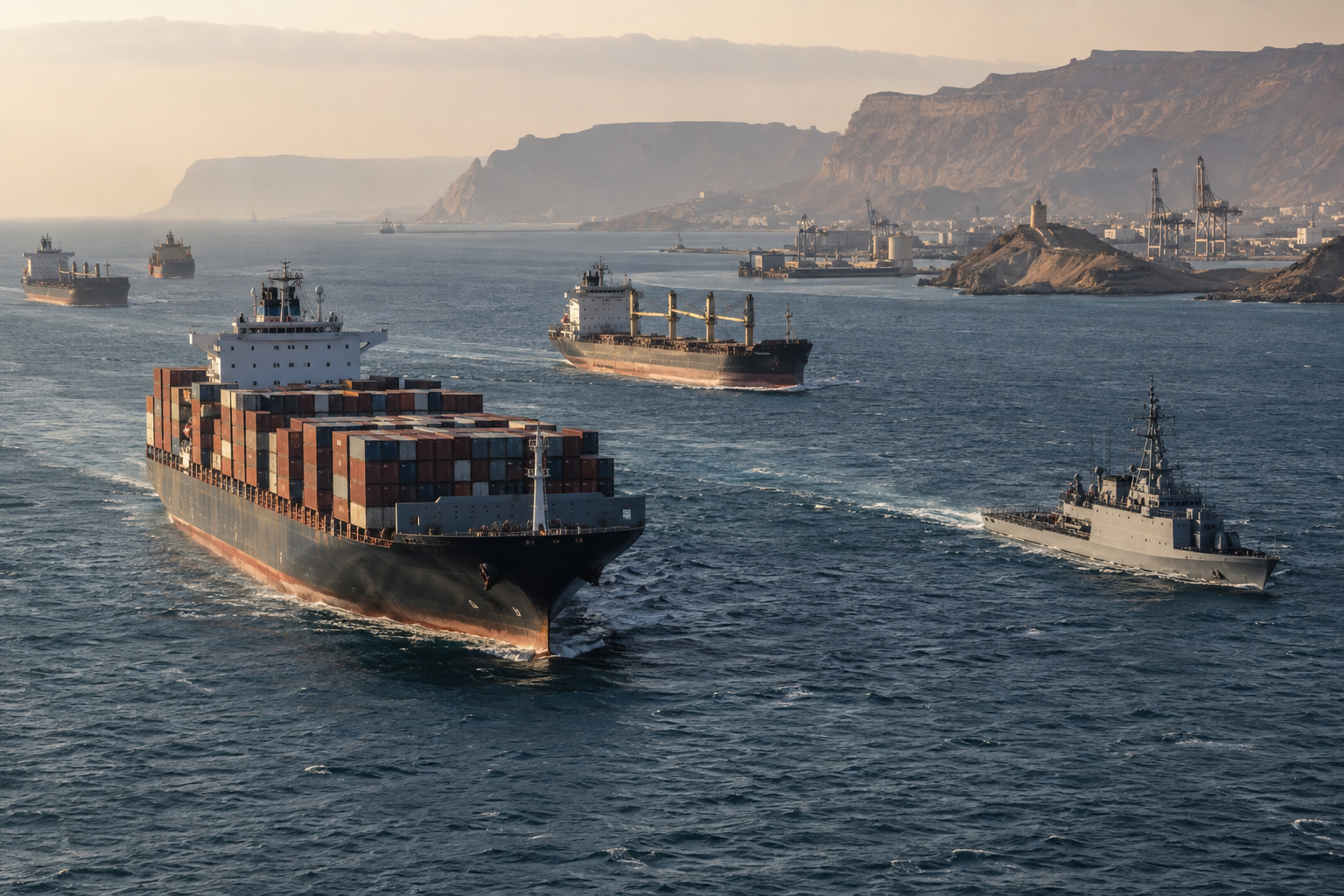
A Houthi military adviser has warned that the group would target US interests in the Middle East if Washington supports Saudi Arabia’s military campaign in Yemen or attempts to take control of the Bab al-Mandab strait. Abed Mohammed al-Thawr told AFP that American military intervention would cross a “red line” and that the Houthis could close the strategic shipping lane to US vessels. The Iran-backed group seized the strait, a gateway to the Red Sea, in September, raising concerns about international shipping. Saudi Arabia, the world’s largest oil exporter, has reportedly sought military assistance from US President Donald Trump, while Yemen’s government has also requested help, according to sources cited in the report.
Fighting resumed in July, ending a four-year truce, and the Houthis say Saudi Arabia has carried out hundreds of strikes since then. Houthi forces have pushed Saudi-backed government troops from Yemen’s Red Sea coast and launched drones and missiles at Saudi targets, including Riyadh. The article places this renewed conflict within a wider confrontation between Washington and Tehran, whose respective allies are now fighting in Yemen as the United States and Iran remain stalemated in the Gulf. Thawr denied that Iran directs Houthi decisions, while describing Iran as a friendly ally and saying the Houthis are independent.
The adviser vowed that the group would continue fighting as long as Saudi Arabia strikes Yemen, and claimed it could impose costs on the kingdom’s oil and economy. The United Nations warned that displacement in Yemen could rise from more than 130,000 people to over 230,000 in the coming months, underscoring the conflict’s humanitarian consequences.
Entities: Abed Mohammed al-Thawr, Mohammed bin Salman, Donald Trump, Houthis, Saudi Arabia • Tone: neutral • Sentiment: negative • Intent: inform
23-09-2026
The United Kingdom has agreed to provide Saudi Arabia with limited military support as the kingdom fights Yemen’s Houthi movement, which the article describes as backed by Iran. At Saudi Arabia’s request, the UK will deploy one Royal Air Force Voyager tanker to refuel Saudi fighter jets in mid-air. Prime Minister Andy Burnham called the assistance defensive and time-limited, while the Ministry of Defence said it builds on existing UK support, including air-defence equipment and personnel helping protect against missile and drone attacks. The UK says its aims include safeguarding regional stability, trade and energy supplies, and supporting a diplomatic resolution. It has not said how long the deployment will last, and Britain will not directly join the fighting.
The renewed conflict follows years of fighting that began after the Houthis seized Sanaa in 2014. A UN-mediated ceasefire was reached in 2022, but hostilities resumed this year amid the US-Israel war on Iran. The article reports that recent Houthi advances reached Yemen’s Red Sea coast, including the strategic port of Mocha and Mayyun Island near the Bab al-Mandeb. The group has also attacked Riyadh and Saudi oil infrastructure, including part of the East-West Pipeline, and previously declared a blockade affecting Saudi shipping in a route used by a substantial share of global trade.
Mid-air refuelling can extend how long Saudi aircraft remain airborne, allowing more time to patrol or respond to threats across the kingdom. The article places this assistance within a decades-long UK-Saudi defence relationship that includes British aircraft sales, training and earlier air-defence support. However, analyst Chris Doyle says the tanker deployment is unlikely to be a major military shift. Its greater significance may be political: it signals international backing for Riyadh as other countries, including the United States under President Donald Trump, are reluctant to enter the conflict directly.
Entities: Andy Burnham, Chris Doyle, Saudi Arabia, United Kingdom, Yemen • Tone: analytical • Sentiment: neutral • Intent: inform