23-09-2026
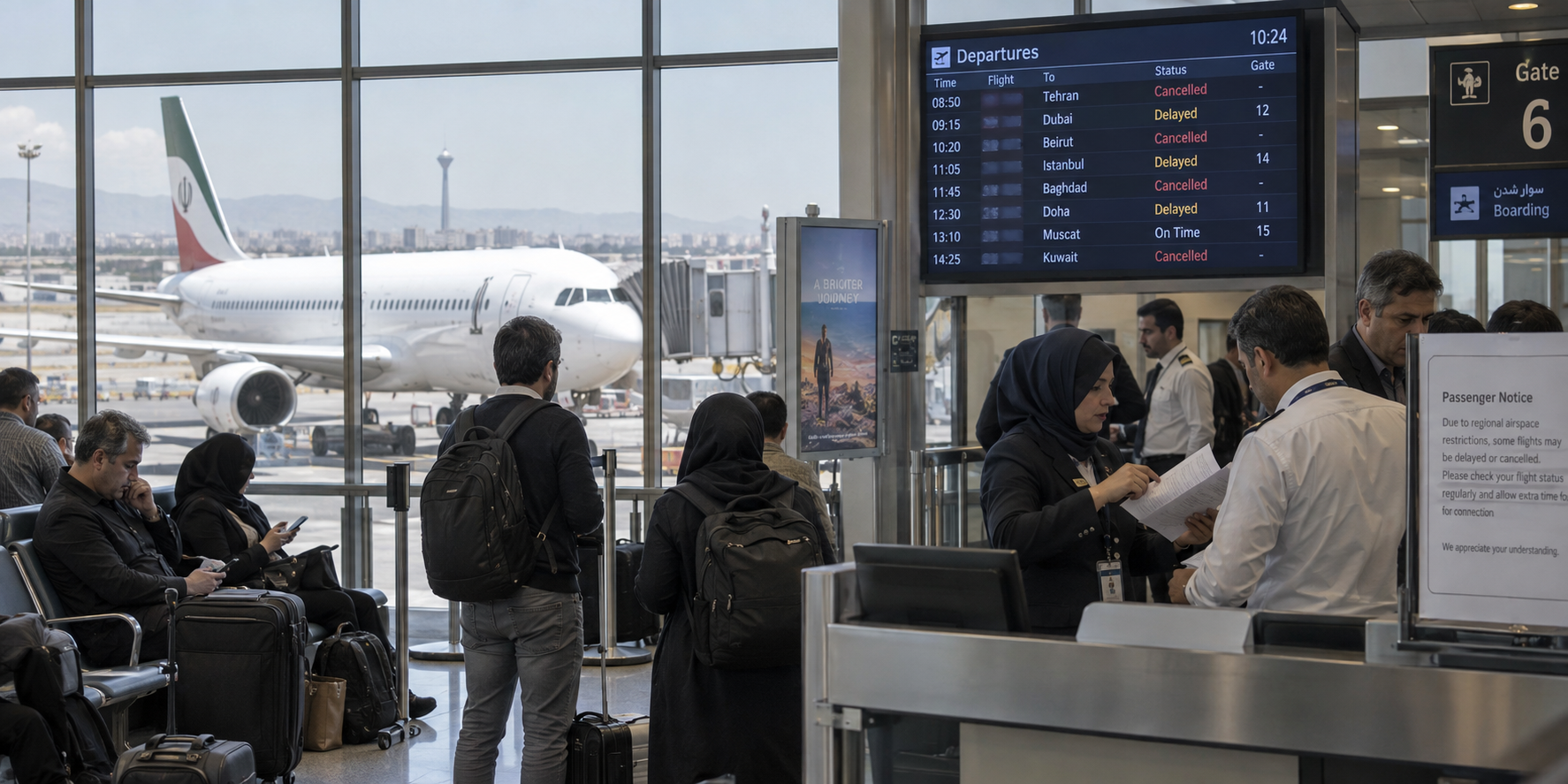
Iran has cancelled flights from Tehran to Baghdad and Muscat as US sanctions targeting Iranian airlines are set to take effect on Wednesday. Majid Akhavan, a spokesman for Iran’s Civil Aviation Organization, said the airports in Baghdad and Muscat would stop accepting Iranian flights from midnight local time. Iran is coordinating to redirect Baghdad-bound flights to Najaf, while talks with Oman are ongoing. The country’s remaining international flights, including those to Istanbul, are expected to operate as scheduled. Iraqi and Omani authorities had not immediately commented.
The sanctions, announced by US Treasury Secretary Scott Bessent, threaten secondary penalties against companies that provide Iranian airlines with services such as fuel, landing support or ticket sales. Bessent said firms assisting the carriers risk being excluded from the US dollar system. Although the United States cannot close foreign airspace, aviation analysts told Al Jazeera that restricting access to refuelling and ground-handling services could achieve a similar practical effect by depriving airlines of essential operational support.
The measures form part of Washington’s broader sanctions campaign against Tehran. Earlier in September, the Treasury Department’s Office of Foreign Assets Control imposed tighter restrictions involving trade, energy and financial institutions. The Trump administration had also expanded secondary sanctions in August, warning foreign firms involved in Iranian shipping, technology, gold and digital-asset sectors that they could face penalties.
The article places the flight disruptions amid an ongoing US-Israeli war on Iran and heightened tensions between Tehran and Washington. Iran has nonetheless signalled openness to Qatar-mediated talks aimed at a long-term resolution. At the same time, security chief Mohsen Rezaei rejected the effect of US threats and said Iran was prepared for war.
Entities: Iran, Baghdad, Muscat, Najaf, Majid Akhavan • Tone: analytical • Sentiment: neutral • Intent: inform
23-09-2026
The available page capture identifies a live-news article titled “Iran war latest: UAE Central Bank bars Bank Melli Iran from conducting transactions,” updated on September 23, 2026, at 1:50 PM. Its central reported development is that the UAE Central Bank has barred Bank Melli Iran from conducting transactions. However, the captured material does not include the article’s explanatory text: it gives no details about the basis, scope, timing, or practical consequences of the restriction, nor does it include a response from the bank or Iranian authorities. Those details cannot be reliably inferred from the headline alone.
The page also displays a list of other Iran-war updates and related video headlines. These refer to oil prices and Saudi supply recovery, an incident involving a cargo vessel in the Strait of Hormuz, diplomatic activity around the United Nations General Assembly, flights to China and Thailand despite US sanctions, and reported contact between Iran and the United States through Qatar. Other displayed headlines mention statements by Donald Trump, Antonio Guterres and UAE official Anwar Gargash, as well as the Houthi conflict. These are surrounding live-news items, not substantiated details about the Bank Melli restriction itself.
Accordingly, the capture supports only a limited account of the article: it reports a UAE regulatory action affecting an Iranian bank within the broader context of the Iran war. The summary is necessarily cautious because the page text supplied here contains the headline and surrounding site material but no full story body.
Entities: UAE Central Bank, Bank Melli Iran, United Arab Emirates, Iran, Iran war • Tone: neutral • Sentiment: neutral • Intent: inform
23-09-2026
The UAE Central Bank has prohibited all UAE branches of Bank Melli Iran from carrying out financial transactions to and from Iran, including trade finance and fund transfers. The decision followed regulatory examinations that found the Tehran-based bank had failed to comply with UAE rules and supervisory decisions concerning anti-money laundering, counter-terrorism financing and proliferation financing. Bank Melli Iran is Iran’s largest lender and has eight branches in the UAE, including a regional office.
The measure is part of what the Central Bank describes as strict enforcement of the country’s financial regulations. It follows a wider UAE announcement the previous month suspending trade, commercial exchange and financial transactions with Iran, citing regional security threats after attacks on UAE-owned tankers and Tehran’s rejection of talks with the United States. The two countries have maintained substantial commercial links despite political tensions, and the UAE has been an important trading partner for Iran. Iranian customs data indicate that bilateral non-oil trade has reached tens of billions of dollars in recent years.
The article places the bank prohibition within the UAE’s broader effort to counter illicit finance. The country’s 2024–2027 national strategy sets out measures to combat money laundering, terrorism financing and proliferation financing. The government has also amended relevant laws, established a national committee on financial crimes, and issued anti-money laundering and counter-terrorist financing guidelines for licensed financial institutions. Those guidelines include using digital identification systems to meet customer due-diligence requirements.
The Central Bank has taken other enforcement and oversight actions. It recently ordered a special examination of Egypt’s Banque Misr after US concerns about money laundering. In June, a UAE branch of a foreign bank received a Dh20 million fine for significant and repeated failures under anti-money-laundering, counter-terrorist-financing and sanctions rules. Together, the actions indicate heightened regulatory scrutiny of financial institutions operating in the UAE.
Entities: UAE Central Bank, Bank Melli Iran, United Arab Emirates, Iran, Banque Misr • Tone: analytical • Sentiment: neutral • Intent: inform
23-09-2026
Iraq has ordered the suspension of Iranian flights to Baghdad airport from midnight on Wednesday, according to sources cited by Reuters. The decision follows a US threat to impose secondary sanctions on airports and service providers that continue to assist Iranian airlines. Iraqi officials are also discussing diverting Iranian Airways flights from Baghdad to Najaf.
US Treasury Secretary Scott Bessent said the United States intended to shut down Iranian airlines from September 23 by targeting the companies and airports that support them. He warned that providers could lose access to the US dollar system if they supplied services such as fuel, landing support, or ticket sales to Iranian carriers. The report also says Iranian aviation authorities announced cancellations of flights from Tehran to Baghdad and Muscat, while other international routes, including Istanbul, were expected to continue. Iran’s Civil Aviation Organization said Iranian travelers were not being admitted at an airport in Oman, and that consultations with Oman were underway.
The restrictions form part of Washington’s broader campaign of sanctions against Iran’s trade, energy, and financial sectors, including penalties for foreign companies doing business with Tehran. Despite the pressure, Iran has indicated that it is open to Qatar-mediated talks aimed at a long-term resolution to the conflict. Iranian security chief Mohsen Rezaei told Al Jazeera that Washington should accept Iran’s conditions, while warning that the country was prepared for war. The article concludes that the flight restrictions add to the pressure on Iran’s international air links as the United States seeks to isolate its airlines.
Entities: Iraq, Iran, Baghdad airport, Najaf airport, United States • Tone: analytical • Sentiment: neutral • Intent: inform